
Securing the AI Supply Chain with Blockchain: From Dataset Collection to Deployment
 Suyash Raizada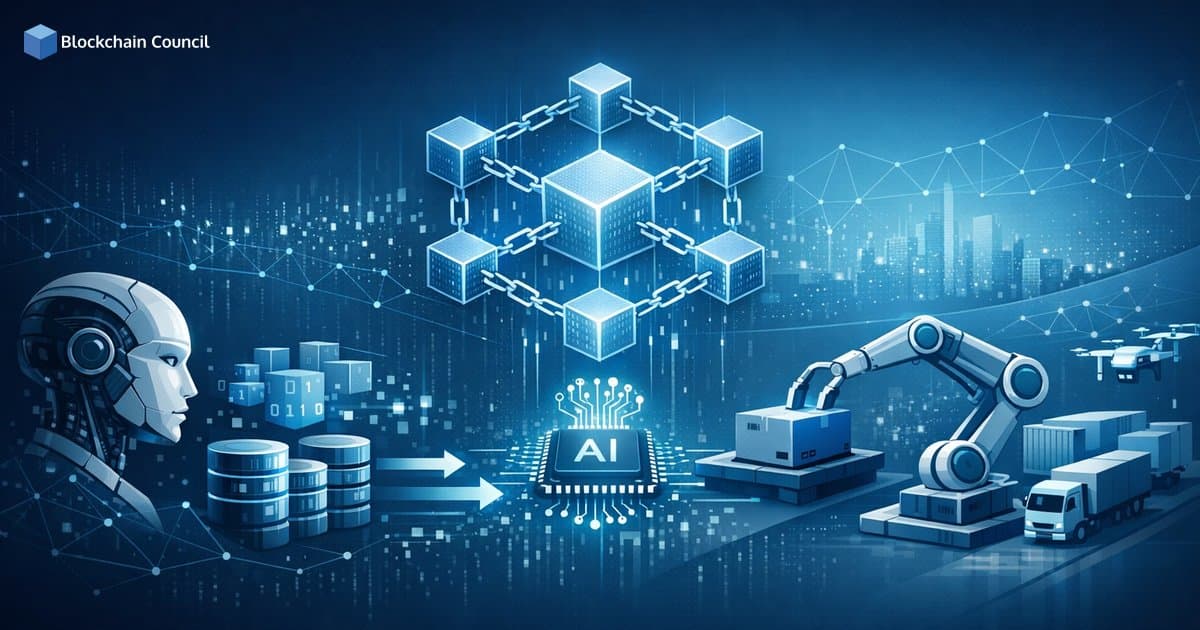
Securing the AI supply chain with blockchain is becoming a practical response to a growing problem: AI systems are only as trustworthy as the data, models, and infrastructure they depend on. From dataset collection and labeling to model training, validation, packaging, and deployment, every handoff creates an opportunity for tampering, hidden provenance gaps, or supply chain attacks. Blockchain adds an immutable, time-stamped audit trail across these stages, while smart contracts and oracles automate verification and connect real-world events to on-chain records.
Organizations increasingly view this as a path to Provenanced AI, where each dataset, training run, model artifact, and even model output can be traced back to verified sources and controlled processes. This article explains how blockchain can secure the AI supply chain end to end, what technologies matter most - permissioned networks, oracles, federated learning, digital twins, and zero-knowledge proofs - and how to implement it with realistic timelines.

Securing AI pipelines requires verifiable data provenance, model lineage, and immutable audit logs-build expertise with a Certified Blockchain Expert, implement tracking systems using a Python Course, and align security with real-world deployment through an AI powered marketing course.
Why the AI Supply Chain Needs Stronger Security Controls
AI supply chains are more complex than traditional software supply chains because they combine data pipelines, ML experimentation, model registries, deployment platforms, and often physical infrastructure such as GPUs, edge devices, sensors, and specialized AI chips. Common vulnerabilities include:
Data tampering and poisoning: subtle changes to training data can bias or backdoor a model.
Provenance uncertainty: teams cannot always prove where data came from, how it was transformed, or whether consent and licensing requirements were met.
Model and artifact integrity risks: weights, configuration files, or containers can be swapped between training and deployment.
Multi-party trust gaps: suppliers, labeling vendors, cloud providers, and integrators each maintain separate logs that can be incomplete or altered.
Operational supply chain attacks: compromised components such as firmware, drivers, or edge devices can corrupt AI inputs and outputs.
The objective of securing the AI supply chain with blockchain is not to replace existing security controls, but to add a tamper-evident trust layer that improves auditability, speeds investigations, and supports compliance and risk management.
How Blockchain Secures the AI Supply Chain
Blockchain provides a shared ledger where participants can write verifiable records of events and artifacts. Its security value comes from three core mechanisms:
Immutability with hashing and timestamping: when records are chained via hashes, altering one record changes subsequent hashes, making tampering evident.
Smart contracts: programmable rules automate verifications, approvals, and conditional actions such as payments or deployment gates.
Oracles: middleware that securely brings off-chain signals - IoT data, registry events, validation results - onto the blockchain for policy enforcement.
Permissioned Blockchains for Enterprise AI Supply Chains
For most enterprises, permissioned blockchains are the preferred choice for supply chain security because they restrict who can validate and write records, while still enabling shared auditability across partners. They also support role-based access so different stakeholders can view only what they are authorized to see, a common requirement when datasets and model details are sensitive.
Oracles as the Bridge Between Isolated Systems
AI supply chains span data lakes, feature stores, labeling platforms, MLOps pipelines, CI/CD systems, and edge devices. Oracles serve as essential middleware for connecting these systems to smart contracts. Oracle networks can relay real-world inputs - for example, IoT sensor readings, model validation metrics, or registry attestations - into on-chain logic in a tamper-resistant way, enabling automated policy enforcement across distributed environments.
End-to-End: Securing the AI Supply Chain from Dataset to Deployment
Below is a practical mapping of where blockchain fits across the AI lifecycle and what to anchor on-chain.
1) Dataset Collection and Provenance
Dataset collection is often the highest-risk stage because it determines the model's ground truth. Blockchain can record dataset provenance with immutable logs that include:
Source identifiers: sensor IDs, system IDs, or vendor identifiers.
Consent and licensing metadata: policy references, data use scope, retention rules.
Transformations: hashing of raw files and hashes of processed datasets to prove integrity across ETL steps.
Quality checks: automated validations triggered by smart contracts before data is accepted downstream.
When privacy is a concern, teams can combine blockchain logging with zero-knowledge proofs to demonstrate that data meets certain requirements - for example, passed validation thresholds or originated from approved sources - without exposing the underlying sensitive data.
2) Data Labeling and Enrichment
Labeling workflows often involve external vendors or distributed teams. Blockchain records can strengthen accountability by capturing:
Labeling task assignments and completion timestamps
Annotator role attestations and tool versions
Inter-annotator agreement metrics or sampled QA outcomes
Smart contracts can enforce that only datasets meeting defined QA thresholds proceed to training, and can also automate vendor payments when predefined acceptance conditions are met.
3) Model Training with Federated Learning on Blockchain
Federated learning is increasingly paired with blockchain in multi-site environments such as warehouses, factories, or hospital networks. Instead of moving raw data to a central location, local nodes train on their own datasets and share model updates - gradients or parameters. Blockchain can then immutably record:
Which nodes contributed updates and when
Hashes of update packages and aggregation steps
Policy compliance checks, for example ensuring only authorized nodes can contribute
This approach reduces exposure of raw data while maintaining a verifiable training trail. It also improves traceability when investigating performance regressions or suspected poisoning attempts.
4) Validation, Evaluation, and Release Gating
Validation is where organizations decide whether a model is ready to ship. By writing evaluation artifacts and attestations on-chain, teams can create a tamper-evident record of:
Benchmark datasets used and their hashes
Evaluation results and threshold checks
Sign-offs from responsible roles such as ML lead, security, and compliance
Smart contracts can act as release gates: deployment is allowed only if required attestations exist and defined metrics meet policy thresholds.
5) Deployment, Monitoring, and Incident Response
During deployment, the goal shifts to ensuring that the model running in production matches the approved artifact and that changes are traceable. Blockchain can log:
Hashes of model binaries, containers, and configuration
Environment details such as hardware class, driver versions, and dependencies
Deployment approvals and rollback history
When integrated with monitoring tools, model events can be anchored to the ledger, enabling faster root-cause analysis. A key benefit of Provenanced AI is that model outputs can be linked back to verified inputs, approved model versions, and validated pipelines, supporting audits and regulated reporting.
Digital Twins and IoT Anchoring for AI Infrastructure
Securing the AI supply chain is not only about data and models. Physical assets matter too, especially where edge AI, specialized chips, or distributed servers are involved. A practical pattern is creating blockchain-secured digital twins of critical assets such as GPUs, AI chips, edge gateways, or sensor clusters, updated via RFID, GPS, and telemetry sensors.
This supports real-time traceability and helps detect substitution, theft, or unauthorized maintenance events. Similar to cold-chain monitoring in pharmaceuticals, IoT-anchored logs can reveal conditions that compromise the integrity of AI inputs - such as sensor drift, hardware reliability issues, or unexpected location changes.
Agentic AI, Smart Contracts, and Autonomous Execution
The next stage involves autonomous coordination. Industry analysis suggests a growing share of supply chain solutions will rely on intelligent agents for autonomous execution in coming years. In AI supply chains, agentic AI can:
Detect anomalies in data provenance or model behavior
Propose remediation actions such as retraining, rollback, or re-validation
Trigger smart contracts to enforce policy by pausing deployments or requiring approvals
This moves supply chains toward a model where disruptions are predicted and issues resolved automatically, while the blockchain ledger provides the trust foundation recording what happened, when, and under which authorization.
Measurable Impact and Implementation Timelines
Organizations adopting AI-blockchain integration in supply chain operations report measurable outcomes including significant cost reductions and near-real-time traceability for certain workflows, reflecting the value of automated verification and shared auditability.
Implementation typically follows a staged approach:
Pilot (3-6 months): define the minimal set of assets to anchor - datasets, model versions, key approvals - integrate one oracle path, and validate governance.
Production (6-12 months): expand partner participation, implement role-based access, strengthen key management, and integrate MLOps and monitoring.
Maturity (18-24 months): scale to multi-tier ecosystems, add digital twins, federated learning, and privacy tooling such as zero-knowledge proofs.
Architecture Checklist: Building a Secure, Auditable AI Supply Chain
Define what goes on-chain: store hashes and attestations on-chain, keep large datasets off-chain in secure storage.
Choose network type: permissioned blockchain for enterprise collaboration, with clear validator governance.
Harden oracle security: treat oracles as critical infrastructure, with redundancy and monitoring.
Use strong identity and key management: map roles to cryptographic identities and enforce least privilege.
Implement smart contract policy gates: automate dataset acceptance, training eligibility, and deployment approvals.
Plan for privacy: federated learning combined with zero-knowledge proofs where sensitive data cannot be revealed.
AI supply chain security depends on integrating blockchain with ML pipelines for transparency and verification-develop these capabilities with a Blockchain Course, strengthen ML systems via a machine learning course, and connect trust systems to enterprise adoption through a Digital marketing course.
Conclusion: Toward Provenanced AI You Can Audit and Trust
Securing the AI supply chain with blockchain helps organizations move from fragmented logs and unverifiable handoffs to an auditable chain of custody for datasets, model artifacts, validations, and deployments. With permissioned networks for controlled participation, oracles for trusted data bridging, smart contracts for automated enforcement, and privacy-enhancing methods such as federated learning and zero-knowledge proofs, teams can build Provenanced AI systems that withstand tampering and reduce operational risk.
As agentic AI adoption grows and AI supply chains become more autonomous, blockchain-based trust layers will serve as a practical foundation for governance, compliance, and resilient global deployment.
Related Articles
View All
Blockchain
How Blockchain Supply Chain Systems Are Transforming Supply Chain Management in 2026
In 2026, blockchain supply chain systems boost transparency, traceability, and automation with DLT, smart contracts, and real-time data sharing across partners.
Blockchain
What is MEV Supply Chain

Blockchain
On-Chain vs Off-Chain AI: Architecture Patterns for Scalable Blockchain + AI Systems
Learn on-chain vs off-chain AI trade-offs and hybrid architecture patterns for scalable blockchain + AI systems, including rollups, AVS inference, and provenance design.
Trending Articles
The Role of Blockchain in Ethical AI Development
How blockchain technology is being used to promote transparency and accountability in artificial intelligence systems.

AWS Career Roadmap
A step-by-step guide to building a successful career in Amazon Web Services cloud computing.
Top 5 DeFi Platforms
Explore the leading decentralized finance platforms and what makes each one unique in the evolving DeFi landscape.