

Decentralized Identity for AI: Using Blockchain to Authenticate Agents, Devices, and Users
 Suyash Raizada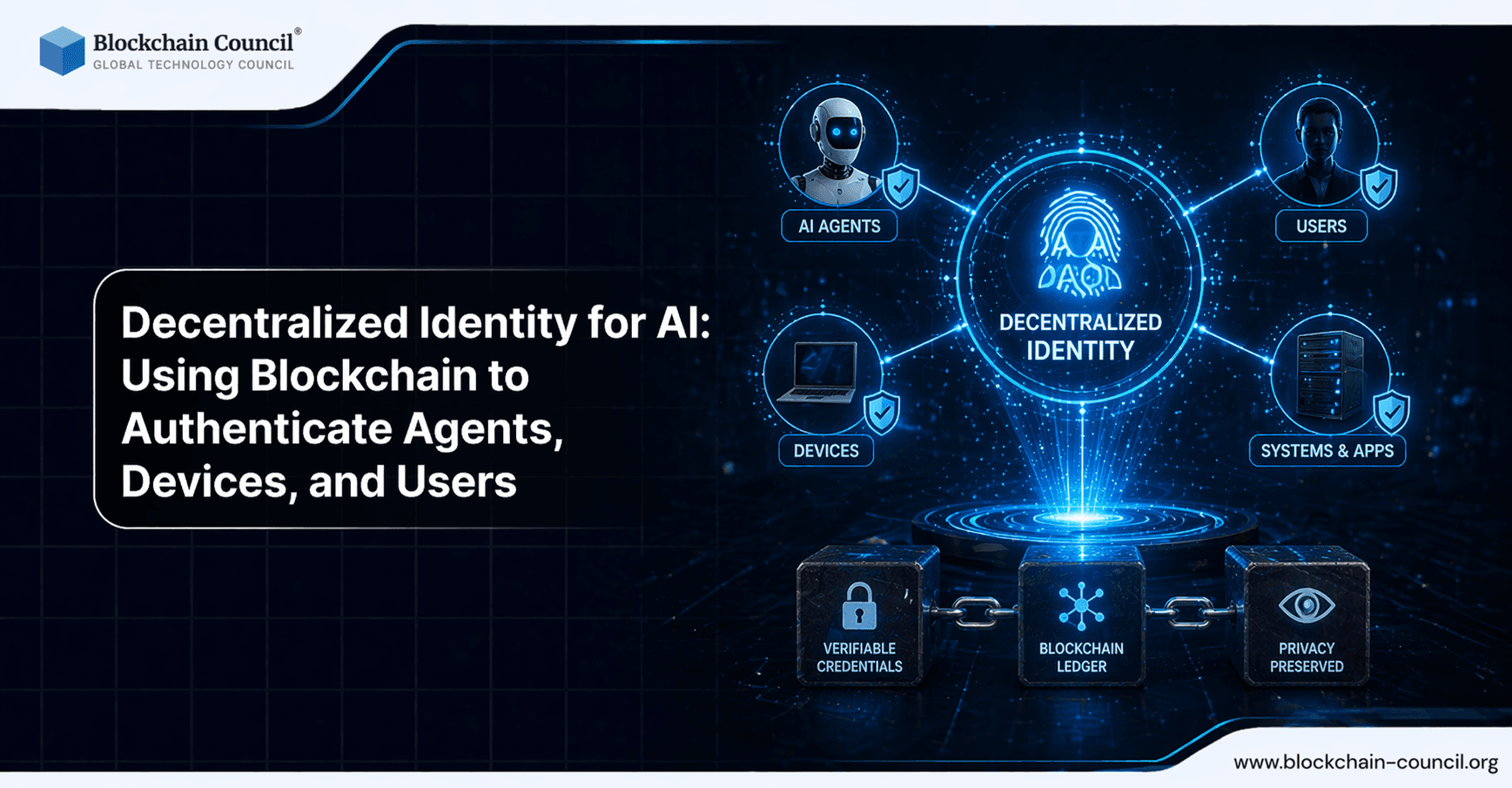
Decentralized identity for AI is becoming a foundational layer for trustworthy digital interactions, particularly as AI agents, devices, and users operate across platforms, organizations, and jurisdictions. By combining blockchain-backed decentralized identifiers (DIDs) with verifiable credentials (VCs), these systems enable tamper-evident authentication and authorization without relying on a single central authority or database.
This shift carries significant weight in 2026 because identity is no longer exclusively about people. Enterprises are managing rapid growth in non-human identities, including bots, devices, and AI agents, with reported year-over-year growth of 44% and machine-to-human ratios reaching as high as 144:1 in some environments. At the same time, regulators are formalizing digital identity infrastructure, including eIDAS 2.0 requirements that every EU member state deploy a digital identity wallet by the end of 2026. These developments intersect directly with AI security, fraud prevention, and regulatory compliance. Implement decentralized identity systems for AI agents, devices, and users using blockchain-based authentication and verifiable credentials by mastering security frameworks through an AI Security Certification, building identity solutions using a Python certification, and scaling adoption with a Digital marketing course.

What Is Decentralized Identity for AI?
Decentralized identity for AI applies DID and VC standards to authenticate and manage identities across three major categories:
Users: individuals who require secure login, access control, and consent-driven data sharing.
Devices: endpoints such as IoT sensors, industrial controllers, mobile devices, and edge nodes.
AI agents: autonomous or semi-autonomous systems that call APIs, execute transactions, negotiate, or act on behalf of users and organizations.
Rather than storing sensitive identity records in centralized databases, decentralized identity architectures anchor only non-sensitive public information on-chain, such as:
Public DIDs and associated public keys
Issuer registries
Credential status and revocation lists
Proofs that support long-term verification, including timestamps and integrity checks
Personal data and private attributes remain off-chain, stored in an identity wallet controlled by the user or organization, and shared selectively through cryptographic proofs.
Core Building Blocks: DIDs, Verifiable Credentials, and Identity Wallets
Decentralized Identifiers (DIDs)
A DID is a globally resolvable identifier that points to public key material and service endpoints required for verification. In decentralized identity architectures, blockchain typically acts as the trust anchor for publishing and resolving DID-related data, reducing reliance on centralized identity providers.
Verifiable Credentials (VCs)
VCs are cryptographically signed claims about an entity. In AI and enterprise environments, a VC can represent:
An employee role or clearance level
A device identity and firmware attestation
An AI agent registration, its permissions, and operational constraints
A license, certification, or academic credential
Because VCs are digitally signed by issuers and can be checked against on-chain registries and revocation mechanisms, they support tamper-evident, portable verification across systems and organizational boundaries.
Identity Wallets and Selective Disclosure
Identity wallets store credentials and enable controlled sharing. Rather than transmitting full identity records, holders can present only the minimum necessary attributes, for example, confirming they are "over 18" or "authorized for environment X," while withholding unrelated personal data. This design limits data exposure, which is especially relevant for AI-driven interactions where data can be copied and reused at scale.
Why Blockchain Matters for Authenticating AI Agents, Devices, and Users
Centralized identity systems are vulnerable to breaches, outages, insider risk, and vendor lock-in. For AI ecosystems spanning multiple clouds, vendors, and autonomous components, those weaknesses are compounded.
Blockchain contributes to decentralized identity for AI in several practical ways:
No single point of failure: verification does not depend on one database or provider.
Long-term verifiability: credentials can be validated years later by checking issuer keys, registries, and revocation status anchored to immutable records.
Interoperability: standards-based DID and VC approaches support cross-domain verification, which is increasingly required for AI agents and supply chain scenarios.
Auditability: on-chain registries and status lists enable consistent governance and monitoring without publishing sensitive identity data.
This model aligns with growing industry emphasis on blockchain-backed identity resilience, particularly as deepfake-driven fraud scales and organizations demand stronger verification guarantees.
2026 Developments Shaping Decentralized Identity for AI
Several market and regulatory signals are accelerating adoption:
Market growth: the decentralized identity market is projected to reach $7.4 billion in 2026, reflecting increasing enterprise and public sector investment.
EU digital identity wallets: eIDAS 2.0 requires EU member states to deploy digital identity wallets by the end of 2026, strengthening demand for interoperable, standards-aligned systems.
Non-human identity management: enterprises are formalizing identity lifecycle management for machines and AI agents to reduce fraud and operational risk.
Continuous authentication: identity checks are shifting from one-time onboarding to continuous, context-aware validation across devices and sessions.
Post-quantum planning: crypto-agile identity foundations are becoming a core requirement for systems expected to remain operational for decades.
Key Use Cases: Where Decentralized Identity for AI Delivers Value
1) Enterprise IAM with Reusable Verifiable Credentials
Traditional identity and access management (IAM) often creates silos across departments, subsidiaries, and partners. With decentralized identity, an organization can issue one VC or a set of credentials and enable access across multiple systems by verifying attributes such as role, business unit, or clearance level.
Benefit: reduced onboarding friction and fewer repeated verification steps, while maintaining cryptographic assurance and revocation controls.
2) Authenticating AI Agents as First-Class Identity Actors
As AI agents handle tasks such as workflow automation, customer support, procurement, and system administration, they must be authenticated, authorized, and monitored. Industry frameworks increasingly treat AI agents as formal identity participants requiring full lifecycle management, including registration, permission scoping, and continuous oversight.
Example: an enterprise registers an AI agent with a DID, issues a VC defining its allowed actions (for example, "read-only access to the billing API"), and enforces policy checks before the agent can execute calls.
3) Device Identity and Secure Machine-to-Machine Trust
IoT and edge environments depend on device authenticity. A DID-based approach can bind devices to cryptographic keys and support attestations covering manufacturing provenance, firmware version, or compliance status. This becomes increasingly important as machine identity volumes outpace human identities.
Benefit: stronger protections against spoofed devices, rogue endpoints, and unauthorized network access.
4) Regulatory Compliance and Cross-Border Verification
eIDAS 2.0 and the EU Digital Identity Wallet ecosystem push identity toward interoperable, verifiable credentials. Blockchain can support qualified seals and timestamps that are globally verifiable without relying on intermediaries, which is critical for credentials that must remain valid over extended periods.
Benefit: organizations improve audit readiness and reduce dependency on bespoke verification integrations.
5) Fraud-Resistant Verification in High-Stakes Sectors
Licensing bodies, universities, and professional credential issuers can publish their issuer DIDs and verification material in tamper-evident registries. This enables relying parties to confirm that a credential was issued by the correct entity and has not been revoked, supporting anti-fraud initiatives in sectors where forged documents are a persistent risk.
Implementation Considerations for Teams Building Decentralized Identity for AI
Decentralized identity is not purely a technology decision. It requires governance, standards alignment, and security engineering. Key considerations include:
Interoperability and Standards
Adopt W3C Verifiable Credentials and Decentralized Identifiers to improve cross-platform compatibility.
Plan for jurisdictional requirements, including eIDAS 2.0 alignment where applicable.
Privacy and Data Minimization
Keep sensitive attributes off-chain and use wallets for selective disclosure.
Apply least-privilege credential design, asserting only what a verifier requires.
Credential Lifecycle Management
Define issuance, rotation, expiration, and revocation processes before deployment.
Maintain revocation and status mechanisms that verifiers can reliably query.
AI Agent Governance
Register agents with DIDs and bind them to cryptographic keys and operational policies.
Log agent actions and enforce monitoring to detect abnormal behavior.
Support continuous authentication where risk levels warrant it, particularly for privileged agents.
Crypto Agility and Post-Quantum Readiness
Identity infrastructure often needs to remain verifiable for decades. Teams should audit cryptographic dependencies, including signature schemes, key types, and hash functions, and design clear upgrade paths. This supports future transitions as post-quantum cryptography standards mature and adoption accelerates.
Skills and Training to Build Decentralized Identity Systems
Decentralized identity for AI sits at the intersection of blockchain architecture, cryptography, IAM, and secure AI operations. Teams frequently benefit from structured training in:
Blockchain fundamentals and enterprise architecture to understand trust anchors, consensus mechanisms, and on-chain registry design.
Smart contract and Web3 development for building registry and policy enforcement components.
AI security and governance, particularly for designing and auditing agentic systems.
Cybersecurity and risk management covering identity lifecycle processes and cryptographic key management.
Build secure, trustless identity verification systems for AI ecosystems by gaining expertise through an AI Security Certification, developing decentralized applications via a Node JS Course, and promoting Web3 identity solutions using an AI powered marketing course.
Conclusion: Decentralized Identity Is Becoming Essential for Trustworthy AI
Decentralized identity for AI addresses a concrete operational challenge: the digital world now includes large numbers of autonomous agents and connected devices that must be authenticated and governed with the same rigor applied to human users. By using blockchain as a trust anchor for DIDs, public keys, and revocation infrastructure, and by issuing verifiable credentials that prove attributes without exposing unnecessary data, organizations can reduce onboarding friction, limit breach impact, and strengthen fraud defenses.
With EU-wide digital identity wallet mandates arriving by end of 2026, a growing decentralized identity market, and continued expansion of non-human identities, DID and VC architectures are moving from experimental to operational. Organizations that prioritize interoperability, privacy-preserving design, and crypto-agile identity foundations will be better positioned to deploy AI systems that are not only capable, but also verifiable, compliant, and trustworthy.
FAQs
1. What is decentralized identity in AI?
Decentralized identity (DID) in AI refers to a system where identities are managed without a central authority. It uses blockchain to verify users, devices, and AI agents. This improves security, privacy, and control over identity data.
2. How does blockchain support decentralized identity for AI?
Blockchain provides a secure and tamper-resistant ledger for storing identity credentials. It enables verification without relying on centralized systems. This ensures trust and transparency in identity management.
3. Why is decentralized identity important for AI systems?
AI systems interact with multiple users, devices, and agents. Decentralized identity ensures secure authentication and reduces risks of impersonation. It also enhances trust in AI-driven interactions.
4. What are decentralized identifiers (DIDs)?
DIDs are unique identifiers stored on a blockchain that represent users, devices, or entities. They do not rely on centralized registries. DIDs enable secure and verifiable digital identities.
5. How are AI agents authenticated using decentralized identity?
AI agents use cryptographic keys linked to decentralized identifiers. These keys verify their identity during interactions. This prevents unauthorized or malicious agents from participating.
6. What are verifiable credentials in decentralized identity?
Verifiable credentials are digital certificates issued and signed by trusted entities. They can be securely shared and verified without revealing unnecessary data. This supports privacy-preserving authentication.
7. How does decentralized identity improve data privacy?
Users control their identity data and decide what to share. Sensitive information is not stored in centralized databases. This reduces the risk of data breaches and misuse.
8. Can decentralized identity be used for IoT devices?
Yes, IoT devices can use decentralized identity for secure authentication. Each device can have a unique DID. This prevents unauthorized access and improves device security.
9. What role does cryptography play in decentralized identity?
Cryptography secures identity data and ensures only authorized parties can access it. It enables digital signatures and secure key management. This is essential for trust in decentralized systems.
10. How does decentralized identity differ from traditional identity systems?
Traditional systems rely on centralized authorities like databases or identity providers. Decentralized identity removes this dependency. It gives users more control and reduces single points of failure.
11. What are the benefits of decentralized identity for AI applications?
Benefits include enhanced security, privacy, and user control. It also enables trustless verification between parties. This is critical for scalable and autonomous AI systems.
12. What challenges exist in implementing decentralized identity?
Challenges include technical complexity, interoperability, and regulatory uncertainty. Adoption may require new standards and infrastructure. Usability is also a key concern.
13. How can decentralized identity prevent AI misuse?
By verifying identities, it reduces the risk of malicious actors using AI systems. Only authenticated entities can access or deploy AI agents. This improves accountability and trust.
14. What is self-sovereign identity in AI?
Self-sovereign identity allows individuals to own and control their digital identities. They manage credentials without relying on centralized providers. This aligns well with decentralized AI ecosystems.
15. Can decentralized identity scale for large AI systems?
Yes, but scalability depends on blockchain infrastructure and design. Layer 2 solutions and off-chain methods can improve performance. Efficient systems are needed for widespread adoption.
16. How do smart contracts support decentralized identity?
Smart contracts automate identity verification and access control. They enforce rules without manual intervention. This ensures consistency and transparency in identity management.
17. What industries benefit from decentralized identity in AI?
Industries like finance, healthcare, and IoT benefit significantly. They require secure and verifiable identity systems. Decentralized identity enhances trust and compliance in these sectors.
18. How does decentralized identity enable trusted AI interactions?
It ensures all participants are authenticated and verified. This reduces fraud and increases confidence in AI systems. Trust is essential for collaboration and automation.
19. Are there standards for decentralized identity in AI?
Yes, standards like W3C DID and verifiable credentials frameworks exist. These ensure interoperability across platforms. Standards are critical for adoption and scalability.
20. What is the future of decentralized identity in AI?
Decentralized identity is expected to play a key role in secure AI ecosystems. It will support autonomous systems and digital trust frameworks. Adoption will grow as technology and standards mature.
Related Articles
View All
Blockchain
Blockchain vs IoT: How Decentralized Networks and Connected Devices Work Together
Blockchain vs IoT explained: how connected devices, smart contracts, device identity, and decentralized ledgers work together in real systems.

Blockchain
Agile for Blockchain Teams: Managing Sprints, Smart Contracts, and Decentralized Roadmaps
Learn how agile for blockchain teams works when sprints, smart contracts, audits, governance, and decentralized roadmaps are planned around risk.

Blockchain
Blockchain Digital Identity Management Patents: Key Innovations and Market Trends
A practitioner-focused look at blockchain digital identity management patents, from biometric wallets and DIDs to KYC, EU wallets, IoT, and market growth.
Trending Articles
AWS Career Roadmap
A step-by-step guide to building a successful career in Amazon Web Services cloud computing.
How Blockchain Secures AI Data
Understand how blockchain technology is being applied to protect the integrity and security of AI training data.
How to Install Claude Code
Learn how to install Claude Code on macOS, Linux, and Windows using the native installer, plus verification, authentication, and troubleshooting tips.