

Oracles for Smart Contracts: Secure Data Feeds, Common Attack Vectors, and Mitigation Strategies

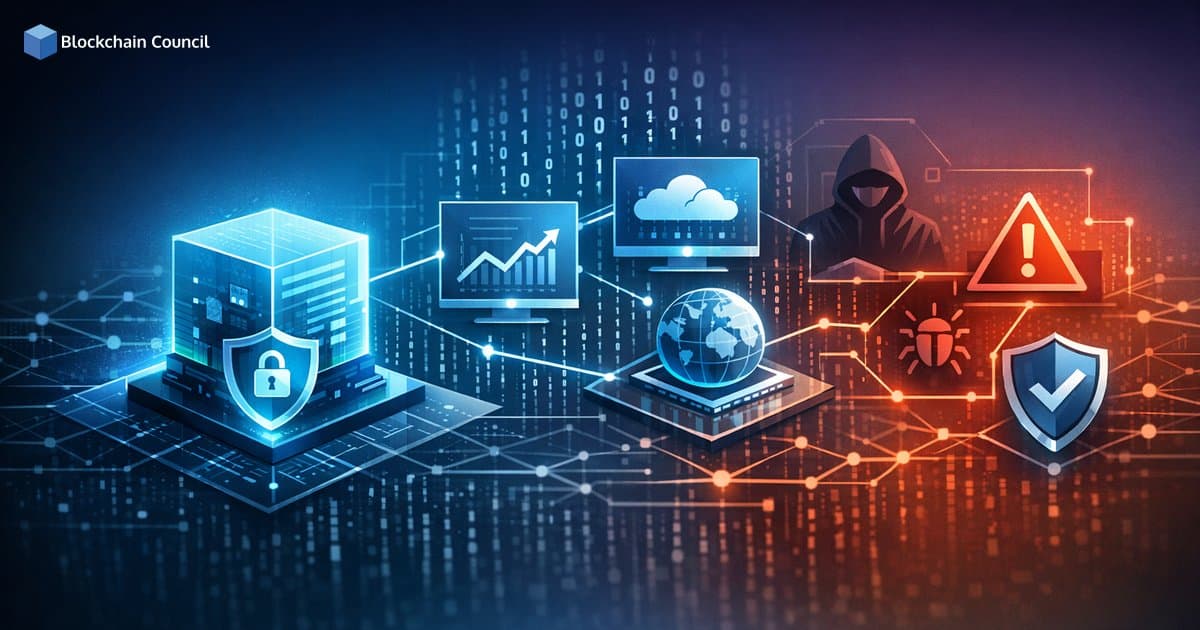
Oracles for smart contracts have become a core security boundary in modern blockchain systems. As DeFi protocols, stablecoins, and real-world asset (RWA) tokenization mature, the integrity of off-chain data - prices, rates, identity signals, and events - increasingly determines whether on-chain logic remains solvent and trustworthy. If a smart contract is correct but its oracle input is wrong, the system can still fail.
This article explains what blockchain oracles do, why they matter, where they are attacked, and how teams can reduce oracle risk using defense-in-depth design patterns.

What Are Blockchain Oracles and Why Do They Matter?
A blockchain oracle is middleware that fetches, verifies, and delivers off-chain data to on-chain smart contracts in a blockchain-readable format. This includes price data for DeFi, interest rates for RWAs, weather data for parametric insurance, IoT sensor readings for supply chain, and compliance signals such as KYC or sanctions checks.
Blockchains are intentionally closed systems. They cannot directly call external APIs or query traditional databases. Oracles bridge that gap without undermining security guarantees.
Typical Oracle Workflow
- Fetch data from exchanges, data vendors, enterprise systems, sensors, or web services.
- Validate and aggregate using cryptographic proofs, multi-source consensus, or reputation-based mechanisms.
- Deliver on-chain through oracle contracts that smart contracts read from.
- Optionally trigger execution when conditions are met, such as settling a derivative if a threshold is crossed.
Common Oracle Categories
- Price feeds for lending, derivatives, stablecoins, and AMM risk controls.
- Event feeds such as sports results, flight status, or shipping milestones.
- IoT and machine data for telemetry, logistics, and energy tracking.
- Compliance and identity such as KYC/AML, sanctions screening, and proof-of-reserves attestations.
- Cross-chain oracles enabling messaging or state proofs between chains and rollups.
Without oracles, most real-world smart contract use cases would not function. DeFi would lack reliable collateral valuation, insurance would have no objective settlement triggers, and RWA tokenization could not synchronize legal and financial states with on-chain logic.
Current Oracle Architectures and Why Decentralization Is the Default
Most production deployments now prefer decentralized oracle networks (DONs) over single-oracle designs to eliminate single points of failure. Ethereum developer guidance explicitly warns that relying on a single oracle is a common vulnerability and recommends decentralized approaches. Industry guidance also identifies single-source DEX pricing as a frequent root cause in flash loan exploits.
Dominant Design Patterns
- Multi-node networks where independent nodes fetch and report data.
- Multi-source inputs where each node reads from several providers, including multiple exchanges, market data vendors, or institutional feeds.
- On-chain aggregation contracts computing medians or trimmed means to reduce outlier impact.
Oracles in DeFi and RWAs
DeFi lending and derivatives rely on oracles for collateral valuation, liquidations, settlement, and funding rates. RWAs depend on oracles to map off-chain valuations and interest accrual to on-chain representations. BlackRock's BUIDL tokenized U.S. Treasury fund on Ethereum surpassed USD 400 million in assets under management within months of its 2024 launch, illustrating that oracle-secured tokenized finance is already operating at institutional scale.
Oracle Threat Model: The Four Layers Attackers Target
Oracle risk is not confined to the oracle contract alone. Attackers can target any layer in the data path:
- Data source layer - APIs, exchanges, sensors, providers
- Oracle node and network layer - operators, keys, software
- On-chain aggregation layer - oracle contracts, governance, upgradeability
- Consuming protocol layer - how smart contracts use oracle values
Common Oracle Attack Vectors
1. Data Source Manipulation and Low-Liquidity Markets
If an oracle depends on a single venue or an illiquid market, attackers can manipulate the price briefly - often using flash loans - and force the protocol to act on a false input. This can trigger mispriced liquidations, bad debt, or exploitable arbitrage.
Typical pattern: Borrow capital via flash loan, push the price on a thin DEX pool, wait for the oracle to read the manipulated price, allow the protocol to execute (borrow more, avoid liquidation, drain reserves), then unwind the position and repay.
2. API Compromise or Downtime
Centralized APIs introduce familiar Web2 failure modes: credential theft, DNS hijacking, BGP hijacking, or infrastructure compromise. Even without malicious activity, outages can produce stale data, which is equally dangerous if protocols do not handle staleness explicitly.
3. Centralized Oracle Operator Risk
A single node or single operator is a single point of failure. If compromised, coerced, or malicious, the operator can post arbitrary values and cause direct losses in protocols that treat oracle data as authoritative.
4. Key Compromise and Censorship
If oracle signing keys are stolen, an attacker can publish falsified data that still passes signature checks. If attackers can censor updates, they can force prices to become stale and trigger liquidation errors or denial-of-service conditions.
5. Sybil or Cartel Control in Weakly Designed DONs
Decentralization only helps if it is genuine. If a network lacks strong Sybil resistance and robust incentives, a cartel of nodes can dominate reporting and manipulate outcomes when the attack payoff exceeds the cost of misbehavior.
6. Aggregation and Governance Failures On-Chain
- Faulty aggregation - such as simple averages with no outlier filtering - can be skewed by a minority of manipulated values.
- Upgradeable oracle contracts with weak governance concentrate power in admin keys.
- No rate limits or circuit breakers allows extreme updates to drain protocols faster than teams can respond.
7. Consuming-Protocol Design Flaws
Some of the most damaging outcomes stem from how protocols use oracle values:
- Single-DEX oracle dependence combined with flash loans and same-transaction borrowing and liquidation paths.
- Under-specified invariants, such as no bounds on per-block price change or no requirement for time-weighted prices.
- No separation of safety-critical and non-critical feeds, which increases blast radius when a feed fails.
Mitigation Strategies: Defense-in-Depth for Secure Oracle Design
Effective mitigation requires layered controls across sourcing, network design, on-chain contracts, and consuming protocol logic.
Data-Layer Controls
- Multi-source aggregation using independent providers and robust statistics such as median or trimmed mean.
- Liquidity filters to exclude low-depth markets and isolated pairs from calculations.
- Provider vetting and SLAs covering uptime, security posture, and incident response.
- Authenticated data feeds using signed data directly from data owners to reduce transport tampering risk.
Oracle Network Controls (DON Design)
- Node diversity across organizations, infrastructure providers, and geographies.
- Quorum-based reporting with configurable thresholds and robust on-chain aggregation.
- Cryptoeconomic incentives such as staking and slashing, calibrated so the cost of attack exceeds expected profit.
- Key management using hardware security modules (HSMs) or trusted execution environments (TEEs) to reduce theft and tampering risk.
- Monitoring and reputation systems to detect deviating nodes, rotate keys, and remove unreliable operators.
- Secure node operations including hardening, patching, dependency scanning, and least-privilege deployments.
On-Chain Oracle Contract Protections
- Robust aggregation with outlier rejection and bounded deviation thresholds.
- Time-weighted average prices (TWAP) where appropriate to reduce sensitivity to short-lived price manipulation.
- Rate limits and circuit breakers to cap sudden changes and freeze critical actions on abnormal deviations.
- Governance hardening for upgradeable components with timelocks, audits, and transparent change processes.
- Transparency and auditability via events, historical data access, and verifiable update provenance.
- Cryptographic proofs including provider signatures and, where needed, zero-knowledge proofs for privacy-preserving verification.
Protocol-Level Risk Management for Oracle Consumers
- Redundancy by combining independent oracle networks with on-chain sanity checks.
- Feed separation so liquidations and settlement depend on conservative, highly reliable inputs.
- Economic plausibility checks such as maximum per-block price change limits and bounds relative to moving averages.
- Simulation and stress testing for oracle failure, divergence, and extreme market scenarios.
- Incident response plans including pause mechanisms, fallback feeds, and clear governance procedures.
For teams building and auditing these systems, structured training can help standardize secure design reviews. Blockchain Council offers relevant professional certifications including the Certified Blockchain Developer, Certified Smart Contract Developer, Certified DeFi Expert, and Certified Blockchain Security Expert programmes.
Real-World Use Cases Where Oracle Security Directly Impacts Outcomes
- DeFi lending and derivatives: collateral valuation, borrowing power, liquidation triggers, and settlement depend on correct price feeds.
- Stablecoins: pegs depend on reliable fiat and commodity reference rates for minting, redemption, and rebalancing logic.
- Parametric insurance: weather and event data determines whether payouts execute automatically.
- Supply chain and IoT: sensor readings can trigger payments or compliance checks based on location and condition data.
- RWA tokenization: net asset value, interest rates, and compliance controls must be synchronized with off-chain financial reality.
- Cross-chain systems: oracle-based messaging expands blast radius, since compromised messages can affect multiple chains simultaneously.
Conclusion: Treat Oracles as a Security Primitive
Oracles for smart contracts deserve the same rigorous evaluation applied to smart contract code, bridge security, and consensus assumptions. They are not integration plumbing. They are the boundary where off-chain trust enters on-chain execution.
To reduce risk, teams should prioritize decentralized, multi-source data feeds; strong cryptoeconomic incentives; hardened key management; robust on-chain aggregation; and protocol-level circuit breakers and sanity checks. As DeFi and RWAs scale, the ecosystem is moving toward stronger guarantees through signed data, TEEs, and privacy-preserving proofs.
When built with defense-in-depth, oracle systems can evolve from a frequent weak point into an auditable, composable data layer that supports high-value, real-world smart contract applications.
Related Articles
View All
Blockchain
Agile for Blockchain Teams: Managing Sprints, Smart Contracts, and Decentralized Roadmaps
Learn how agile for blockchain teams works when sprints, smart contracts, audits, governance, and decentralized roadmaps are planned around risk.

Blockchain
Blockchain vs Smart Contracts: Key Differences, Benefits, and Real-World Applications
Blockchain vs smart contracts explained: learn how distributed ledgers and self-executing code differ, work together, and power DeFi, NFTs, DAOs, and enterprise workflows.

Blockchain
Blockchain in Detail: Blocks, Nodes, Consensus, Smart Contracts, and Decentralization
A practical guide to blockchain in detail, covering blocks, nodes, consensus, smart contracts, decentralization, use cases, and learning paths.
Trending Articles

Top 5 DeFi Platforms
Explore the leading decentralized finance platforms and what makes each one unique in the evolving DeFi landscape.
How Blockchain Secures AI Data
Understand how blockchain technology is being applied to protect the integrity and security of AI training data.
Claude AI Tools for Productivity
Discover Claude AI tools for productivity to streamline tasks, manage workflows, and improve efficiency.