

Blockchain vs Web2: Understanding the Shift to Web3
 Suyash Raizada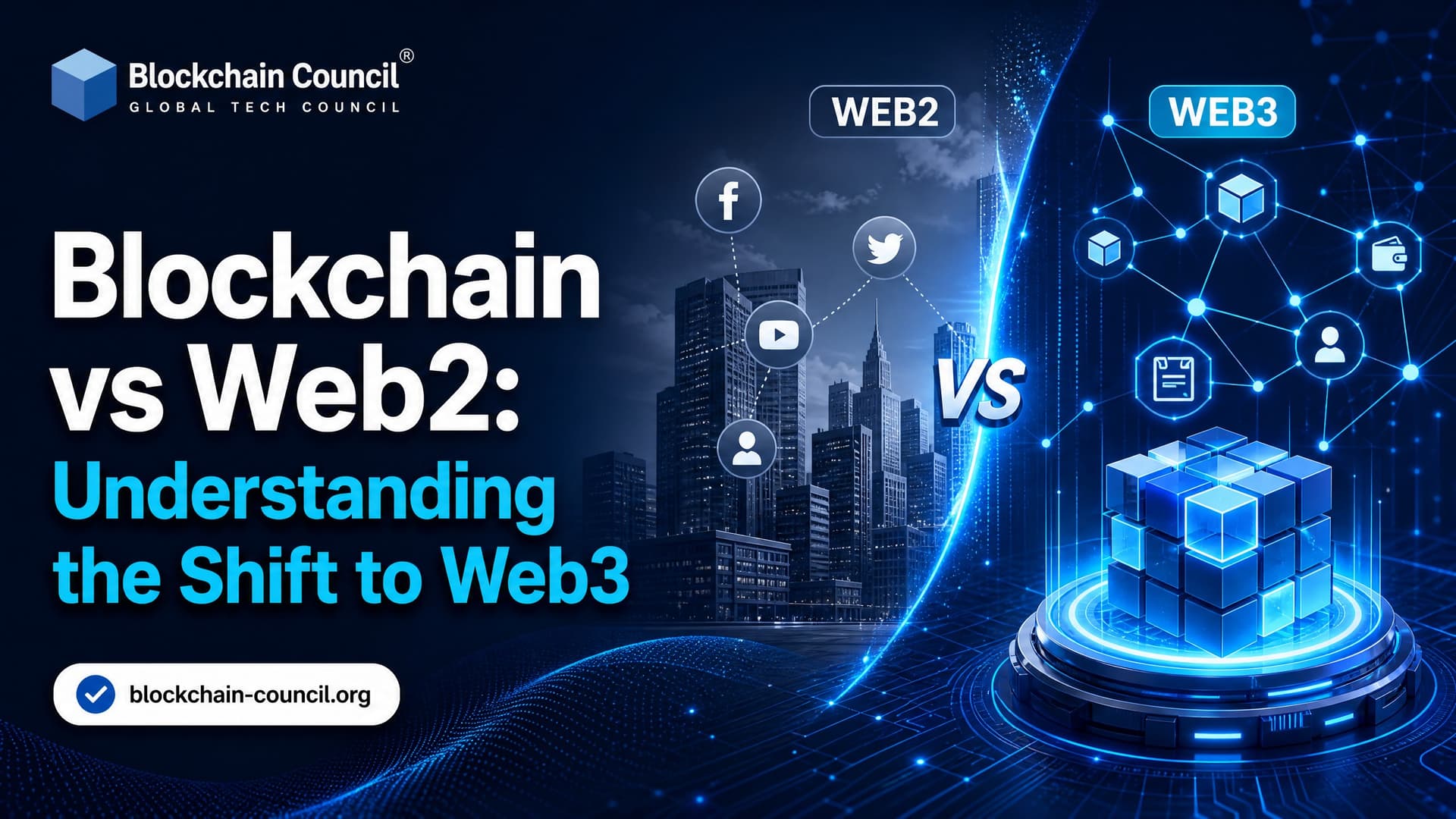
Blockchain vs Web2 is really a question about control. Web2 gave users publishing, social media, cloud apps, and easy payments, but most of that activity sits inside company-owned databases. Web3 uses blockchain networks to move parts of identity, ownership, payments, and governance onto shared infrastructure that users and communities can verify directly.
That does not mean every app should be decentralized. To be blunt, a blockchain is a poor choice for many high-speed consumer products. But when the use case involves digital ownership, settlement, auditability, or reducing dependence on one platform operator, Web3 changes the architecture in a serious way.

For professionals exploring decentralized technologies, becoming a Blockchain Expert provides a solid foundation for understanding distributed ledgers, consensus mechanisms, tokenization, and enterprise blockchain applications that are reshaping digital business models.
Web2 vs Web3: The Core Difference
Web2 is the read-write internet. You can create content, rate products, upload videos, join groups, and run a business through online platforms. The catch is that identity, data, monetization, and moderation are usually controlled by the platform.
Google, Meta, Amazon, Apple, and other large platforms provide useful services, often at low direct cost. In return, they gather behavioral data, sell advertising, set API rules, and decide how visibility works. If an account is removed, an API is restricted, or a policy changes, users have limited recourse.
Web3 is often called the read-write-own internet. In blockchain-based Web3, applications run on public or permissioned ledgers such as Ethereum, BNB Chain, Algorand, and Avalanche. Smart contracts define the rules. Wallets hold the assets. Tokens can represent money, voting power, collectibles, credentials, or claims on real-world assets.
Developing as a Web3 Expert also helps professionals understand smart contracts, decentralized applications, digital identity, token economies, and blockchain governance, making it easier to evaluate when Web3 creates genuine business value rather than unnecessary technical complexity.
How Control Changes
Web2 control: Companies manage accounts, databases, monetization, identity, and content rules.
Web3 control: Protocols, smart contracts, wallets, and community governance distribute some of that control.
Web2 data: User data sits in platform silos and is governed by terms of service.
Web3 data: Asset ownership and transaction history can be verified on-chain.
Web2 identity: Login is tied to email, phone numbers, OAuth, or social accounts.
Web3 identity: Wallets, decentralized identifiers, and verifiable credentials can make identity more portable.
The Ethereum Foundation describes Web3 as a model where anyone can participate without personal data becoming the product. PwC frames it as a shift in ownership and incentives, not just another crypto trend. McKinsey takes a balanced view: many Web3 components already exist, but Web3 has not replaced Web2.
How Blockchain Enables Web3
Blockchain changes the trust model. In Web2, you trust a platform to update records correctly. In Web3, you can verify state through consensus and cryptographic signatures. The phrase "don't trust, verify" is overused, but it captures the point.
Distributed Ledgers and Consensus
A blockchain stores transactions across many nodes. Ethereum, for example, uses Proof of Stake after its 2022 Merge. The Ethereum mainnet chain ID is 1, a small detail that matters when signing transactions or configuring wallets. If you have ever pointed MetaMask at the wrong network during testing, you know how quickly theory becomes debugging.
Consensus makes it difficult for one party to rewrite history. That is useful for payments, registries, tokenized assets, and audit trails. It is less useful for a photo feed where users expect instant updates and cheap storage.
Smart Contracts and Programmable Ownership
Smart contracts are programs deployed to a blockchain. On Ethereum, developers commonly write them in Solidity 0.8.x. One practical detail: arithmetic overflow reverts by default in Solidity 0.8 and later, while older versions often required the SafeMath library. Certification candidates and new developers still get tripped up by this version difference.
Smart contracts enable:
Automated token swaps on decentralized exchanges such as Uniswap.
ERC-20 tokens for fungible assets.
ERC-721 tokens for unique NFTs.
DAO voting and treasury rules.
Programmatic settlement for tokenized funds or deposits.
Developers working with Hardhat or Foundry learn the less glamorous parts fast. A failed deployment with "insufficient funds for intrinsic transaction cost" usually means the wallet lacks native gas tokens, not that the contract code is broken. These small frictions are part of why Web3 onboarding still feels harder than Web2.
Real-World Examples of the Shift
Finance: DeFi and Tokenization
Finance is where Web3 has the clearest product-market fit. Decentralized exchanges let users trade tokens through smart contracts rather than a centralized order book. Uniswap is the standard example: liquidity pools, automated market makers, and on-chain settlement replace the traditional exchange operator for certain trades.
Institutional use is growing too. McKinsey has highlighted JPMorgan Chase's first cross-border blockchain transaction under Project Guardian in November 2022, involving tokenized Singapore dollar and Japanese yen deposits with DBS Bank. KKR also partnered with Securitize to make a tokenized private fund available on Avalanche. These are not meme coin experiments. They are signs that shared ledgers are being tested for capital markets and settlement.
Digital Ownership: NFTs and Brand Platforms
In Web2, digital goods often live inside one company's database. A game skin, subscription badge, or platform collectible may have value, but its transferability depends on the platform's rules.
In Web3, NFTs can make ownership verifiable outside the original application. Nike's .Swoosh platform, launched after Nike acquired RTFKT in 2021, is one example of a major brand testing blockchain-based digital collectibles. McKinsey has also cited consumer campaigns where more than 300,000 people redeemed NFTs, which shows that users will interact with Web3 assets when the experience is simple enough.
Creators and Communities
Creator platforms are another test case. Academic work published by SAGE has examined blockchain-based video platforms such as Theta.tv and Odysee, comparing creator expectations around ownership, monetization, and control with Web2 platforms like YouTube and Twitch.
The promise is direct compensation, portable audiences, and governance participation. The problem is scale. Web2 creator platforms still win on discovery, reliability, audience size, and payment simplicity. Web3 creator tools need better UX before they become a daily default for most creators.
Why Web2 Still Wins in Many Cases
Blockchain vs Web2 should not be framed as a simple replacement story. Web2 remains faster, cheaper, and easier for many applications.
Performance: Centralized databases can process updates with low latency. Blockchains must propagate and validate transactions across a network.
User experience: Password reset is familiar. Seed phrase recovery is not. Lost keys can mean lost assets.
Cost: On-chain transactions may require gas fees. EIP-1559 changed Ethereum's fee market, but it did not make blockspace free.
Compliance: Tokenized funds, DeFi, and cross-border payments must address KYC, AML, securities law, and jurisdiction-specific rules.
Moderation: Censorship resistance is valuable, but consumer platforms still need safety tools, spam control, and legal compliance.
This is why many products are becoming Web2.5. The user sees a normal website or app. The blockchain runs in the background for settlement, ownership, or audit trails. For enterprise adoption, this hybrid model is often the practical path.
A Tech Certification can further strengthen these capabilities by providing structured knowledge of blockchain, cloud computing, cybersecurity, artificial intelligence, and other emerging technologies that increasingly intersect with modern enterprise architecture and digital transformation.
What Professionals Should Learn Next
If you work in product, compliance, software, finance, or enterprise architecture, the practical question is not "Will Web3 replace Web2?" A better question: "Which parts of my workflow need shared trust, programmable assets, or user-owned identity?"
Developers should start with wallet flows, smart contract basics, ERC standards, gas mechanics, and security testing. Product leaders should understand token incentives, custody models, governance design, and when decentralization adds unnecessary complexity. Compliance teams should study how tokenization, DeFi, and identity systems interact with existing law.
For structured learning, consider Blockchain Council programs such as Certified Blockchain Expert™, Certified Blockchain Developer™, Certified Smart Contract Developer™, and Certified Web3 Expert™. Pair the coursework with a small build: deploy an ERC-20 token on a testnet, connect it to a wallet, write one unit test, and document the failure cases. You will learn more from that than from reading another abstract Web3 thread.
The Practical Future: Coexistence, Not Replacement
The most credible future is coexistence. Web2 will keep powering high-performance apps, search, streaming, social feeds, and enterprise SaaS. Web3 will grow where ownership, settlement, transparency, and shared governance matter enough to justify the added complexity.
Start with one concrete skill. If you are technical, learn Solidity 0.8.x with Hardhat or Foundry and study common smart contract vulnerabilities. If you are non-technical, map a Web2 process in your organization that depends on reconciliation between multiple parties. That is where the blockchain vs Web2 discussion becomes useful, specific, and worth your time.
As blockchain-powered products continue to enter mainstream markets, a Marketing Certification can help professionals understand product positioning, customer education, digital marketing strategies, and go-to-market planning for Web3 products and emerging technology solutions.
FAQs
1. What Is Web2?
Web2 is the current generation of the internet, characterized by interactive websites, social media platforms, cloud computing, and centralized services where companies control user data, applications, and digital infrastructure.
2. What Is Blockchain?
Blockchain is a decentralized digital ledger that records transactions across a distributed network of computers. It enables secure, transparent, and tamper-resistant data storage without relying on a central authority.
3. What Is Web3?
Web3 is an evolving vision of the internet built on blockchain technology, decentralized applications (dApps), smart contracts, and digital assets. It aims to give users greater control over their identities, data, and online interactions.
4. How Does Web2 Differ from Blockchain-Based Web3?
In Web2, applications and data are typically managed by centralized organizations. In Web3, many applications use decentralized networks where governance, ownership, and data management can be distributed among participants.
5. Who Controls Data in Web2 and Web3?
In Web2, companies usually control user data stored on centralized servers. In Web3, users may have greater control over their digital identities and assets, depending on the design of the blockchain application.
6. What Role Does Blockchain Play in Web3?
Blockchain serves as the foundational infrastructure for many Web3 applications by enabling decentralized record-keeping, smart contracts, digital asset ownership, and transparent transactions.
7. What Are Smart Contracts?
Smart contracts are self-executing programs stored on a blockchain that automatically perform predefined actions when specified conditions are met, reducing the need for intermediaries.
8. What Are Decentralized Applications (dApps)?
dApps are applications that operate on decentralized blockchain networks instead of centralized servers. They often use smart contracts to provide transparent and automated functionality.
9. What Are the Benefits of Web3?
Potential benefits include:
Greater user control over digital assets and identity
Increased transparency
Reduced reliance on intermediaries
Improved interoperability between decentralized services
New models for digital ownership and governance
10. What Are the Advantages of Blockchain?
Blockchain offers several advantages, including:
Transparency
Data integrity
Security through cryptographic mechanisms
Traceability
Decentralization
Automation through smart contracts
11. What Are the Limitations of Web2?
Common limitations include centralized control of user data, platform dependency, privacy concerns, potential single points of failure, and limited user ownership of digital assets.
12. What Challenges Does Web3 Face?
Web3 faces challenges such as scalability, user experience, regulatory uncertainty, security risks, interoperability, transaction costs on some networks, and varying levels of decentralization across projects.
13. Which Industries Are Adopting Web3?
Industries exploring Web3 include finance, supply chain, healthcare, gaming, digital identity, entertainment, real estate, education, logistics, and government services.
14. How Is Digital Ownership Different in Web3?
Web3 introduces blockchain-based ownership models where users can hold and transfer digital assets, such as cryptocurrencies, NFTs, or tokenized assets, using cryptographic wallets rather than relying solely on centralized platforms.
15. How Does Blockchain Improve Security?
Blockchain uses cryptographic techniques, distributed consensus, and immutable transaction records to help protect data integrity. However, applications built on blockchain can still have vulnerabilities, and security depends on their implementation.
16. Can Web2 and Web3 Coexist?
Yes. Many organizations are adopting hybrid approaches that combine traditional Web2 infrastructure with blockchain-based services. Businesses often integrate Web3 capabilities gradually instead of replacing existing systems entirely.
17. What Skills Are Needed for Web3 Development?
Professionals interested in Web3 benefit from learning blockchain fundamentals, smart contract development, Solidity or other blockchain programming languages, cryptography, decentralized finance (DeFi), tokenomics, and cybersecurity.
18. What Are Common Misconceptions About Web3?
Some common misconceptions include:
That Web3 completely replaces Web2 rather than complementing parts of it.
That blockchain automatically guarantees privacy or anonymity.
That every decentralized application is fully decentralized.
That blockchain is suitable for every business problem.
19. How Can Businesses Prepare for the Shift to Web3?
Organizations should evaluate practical use cases, understand regulatory requirements, educate employees, experiment with pilot projects, assess security risks, and focus on solving real business problems rather than adopting blockchain simply because it is fashionable. Technology trends have a remarkable ability to attract hype first and practical implementation second.
20. What Is the Future of the Transition from Web2 to Web3?
The transition from Web2 to Web3 is expected to be gradual rather than immediate. Many future digital ecosystems will likely combine centralized and decentralized technologies, allowing organizations to balance performance, compliance, user experience, and digital ownership. Businesses that understand both Web2 and Web3 architectures will be better positioned to adopt blockchain where it creates measurable value while continuing to leverage proven centralized systems where they remain the better fit.
Related Articles
View All
Blockchain
Product Discovery for Blockchain Products: A Step-by-Step Guide for Web3 Product Managers
A practical Web3 product discovery guide covering wallet behavior, token validation, governance, security, metrics, and testnet pilots.

Blockchain
Go-to-Market Strategy for Blockchain Products in Competitive Web3 Markets
Learn how to build a go-to-market strategy for blockchain products with value-first positioning, token design, community, security, and Web3 metrics.

Blockchain
User Experience in Blockchain Products: How to Make Web3 Apps Easier to Use
Learn how to improve user experience in blockchain products with simpler onboarding, clearer transaction flows, safer wallet UX, and better Web3 metrics.
Trending Articles
AWS Career Roadmap
A step-by-step guide to building a successful career in Amazon Web Services cloud computing.

Top 5 DeFi Platforms
Explore the leading decentralized finance platforms and what makes each one unique in the evolving DeFi landscape.
Claude AI Tools for Productivity
Discover Claude AI tools for productivity to streamline tasks, manage workflows, and improve efficiency.