
Blockchain vs Traditional Databases in AI Systems
 Michael Willson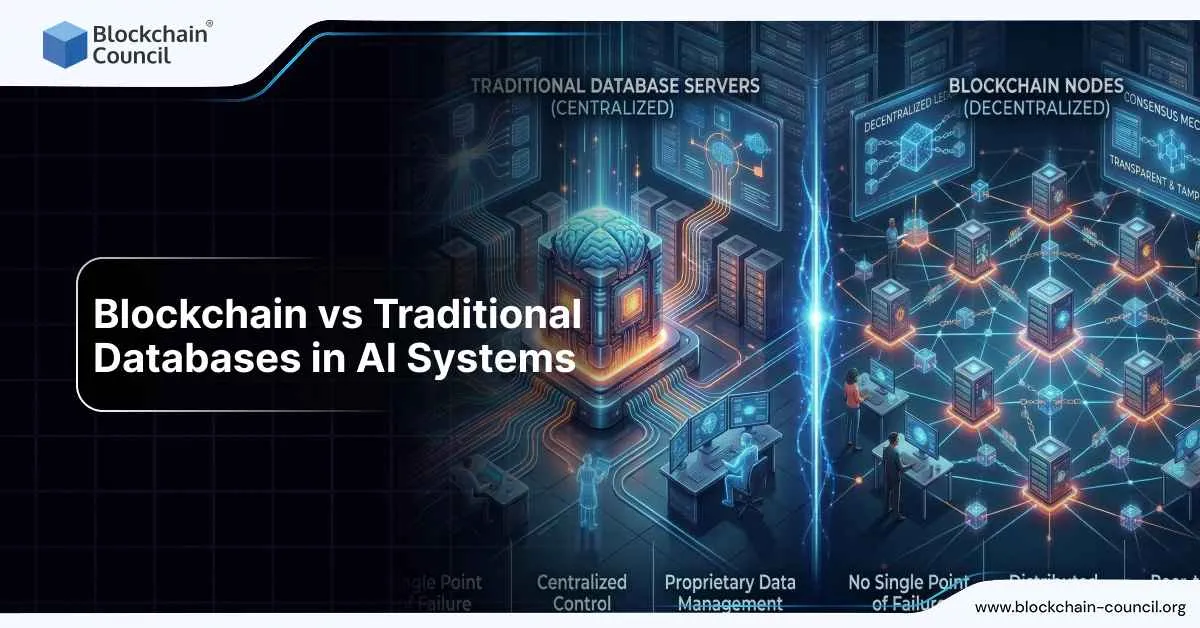
Introduction
Artificial Intelligence (AI) systems depend heavily on data. The performance, accuracy, and reliability of AI models are directly influenced by how data is stored, processed, and managed. Traditionally, AI systems rely on centralized databases such as SQL, NoSQL, and cloud-based storage systems. These traditional databases are optimized for speed, scalability, and efficient data management.
However, as AI continues to expand into critical industries like healthcare, finance, cybersecurity, and autonomous technologies, new challenges are emerging. Concerns around data security, transparency, trust, and data ownership have pushed organizations to explore alternative data infrastructures.
Blockchain technology has emerged as one of the most promising solutions for addressing these challenges. Unlike traditional databases, blockchain offers a decentralized, transparent, and tamper-proof system for storing and verifying data. When integrated with AI systems, blockchain can provide stronger guarantees around data integrity, traceability, and accountability.
As the technology ecosystem evolves, professionals who understand both blockchain and AI infrastructure are becoming increasingly valuable. Certifications such as the Blockchain Expert certification from Blockchain Council and the Agentic AI Expert program from Blockchain Council are helping individuals develop the expertise required to build modern AI systems powered by decentralized technologies.
In this article, we will compare blockchain and traditional databases in AI systems, explore their advantages and limitations, and understand how these technologies shape the future of intelligent data management.
Understanding Traditional Databases in AI Systems
Traditional databases have been the backbone of data management for decades. Most AI applications today rely on centralized database systems to store training datasets, application data, and model outputs.
Common types of traditional databases include:
- Relational databases (SQL)
- NoSQL databases
- Cloud storage systems
- Distributed databases
These databases are designed to handle large volumes of data efficiently and support high-speed transactions.
Key Features of Traditional Databases
Traditional databases provide several benefits that make them widely used in AI systems.
High Performance
Traditional databases are optimized for fast data retrieval and processing, which is essential for AI applications that require real-time data access.
Centralized Control
Database administrators manage and control data access within centralized systems.
Flexible Data Management
Developers can easily modify, update, or delete records within traditional databases.
Mature Technology Ecosystem
Traditional databases have decades of development behind them, with extensive documentation, tools, and developer support.
Because of these advantages, traditional databases remain a critical component of modern AI infrastructure.
However, centralized systems also introduce several limitations.
Limitations of Traditional Databases for AI Systems
As AI applications become more complex and widely distributed, traditional databases face several challenges.
1. Data Integrity Issues
In centralized systems, administrators can modify or delete records. While this flexibility is useful, it also creates risks related to data manipulation.
If AI training data is altered intentionally or accidentally, the performance of AI models may be affected.
2. Lack of Transparency
Traditional databases often lack transparent audit trails. This makes it difficult to verify how datasets were collected or modified.
This issue contributes to the AI black box problem, where users cannot easily trace how AI systems arrive at decisions.
3. Security Risks
Centralized databases can become attractive targets for cyberattacks. A single breach can expose large volumes of sensitive data.
AI systems often rely on personal or confidential data, making security a major concern.
4. Data Ownership Challenges
In centralized infrastructures, organizations that control the database also control the data. This creates challenges around data ownership and sharing.
These limitations have encouraged organizations to explore alternative technologies like blockchain.
Understanding Blockchain Technology
Blockchain is a decentralized digital ledger that records transactions across multiple computers. Instead of relying on a central authority, blockchain networks distribute data across nodes in a peer-to-peer system.
Each block in a blockchain contains:
- Transaction data
- Timestamp
- Cryptographic hash of the previous block
This structure ensures that once data is recorded, it becomes extremely difficult to modify.
Key Features of Blockchain
Blockchain technology introduces several capabilities that make it attractive for AI systems.
Immutability
Once data is stored on a blockchain, it cannot easily be changed or deleted.
Decentralization
Blockchain networks distribute data across multiple nodes, reducing reliance on a single centralized authority.
Transparency
Transactions recorded on blockchain networks are visible and traceable.
Security
Cryptographic techniques protect blockchain data from unauthorized modifications.
These features make blockchain an ideal system for ensuring data integrity and transparency in AI environments.
Blockchain vs Traditional Databases: Key Differences
When comparing blockchain with traditional databases in AI systems, several important differences emerge.
Data Control
Traditional databases are centrally controlled by administrators or organizations. Blockchain systems distribute control across multiple participants in a network.
Data Modification
Traditional databases allow records to be modified or deleted easily. Blockchain systems create immutable records that cannot be altered without consensus from the network.
Transparency
Blockchain provides transparent transaction histories, while traditional databases often rely on internal access controls.
Security Model
Traditional databases depend on perimeter security and access controls. Blockchain relies on cryptographic validation and distributed verification.
Performance
Traditional databases typically offer faster transaction processing. Blockchain networks may have slower performance due to consensus mechanisms.
Because of these differences, each system has its own strengths and ideal use cases.
When Traditional Databases Are Better for AI
Despite the advantages of blockchain, traditional databases remain essential for many AI applications.
Traditional databases are more suitable when:
- Real-time performance is critical
- Data needs frequent updates
- Systems require high transaction throughput
- centralized control is acceptable
For example, AI applications such as recommendation engines, chatbots, and real-time analytics systems rely heavily on fast database operations.
In these cases, traditional databases provide the performance needed to support large-scale AI operations.
When Blockchain Is Better for AI
Blockchain becomes valuable in AI systems where trust, transparency, and security are essential.
Some scenarios where blockchain is particularly useful include:
Data Provenance
Blockchain can record the origin and history of datasets used in AI training.
Secure Data Sharing
Organizations can share datasets securely without losing control of their data.
Auditable AI Systems
Blockchain records AI decisions and model updates, creating transparent audit trails.
Decentralized AI Networks
Blockchain enables collaborative AI development across multiple participants.
These capabilities make blockchain particularly useful in industries that require strong accountability.
The Rise of Agentic AI and Blockchain Integration
A major trend in artificial intelligence is the emergence of Agentic AI—autonomous AI agents capable of planning tasks, making decisions, and executing complex workflows.
Agentic AI systems may operate independently across digital ecosystems. However, ensuring transparency and trust in autonomous systems is crucial.
Blockchain technology can support Agentic AI by:
- recording AI agent activities
- tracking decision processes
- securing autonomous transactions
- maintaining transparent logs of AI actions
Professionals interested in working with these advanced technologies can explore the Agentic AI Expert certification from Blockchain Council, which focuses on designing intelligent autonomous systems.
Infrastructure Technologies Supporting AI Systems
Building AI platforms powered by blockchain or traditional databases requires strong backend infrastructure. Technologies such as Node.js and Python play a critical role in this ecosystem.
Node.js for AI Applications
Node.js is widely used to build backend systems and APIs that support AI platforms.
Developers use Node.js to:
- integrate machine learning models
- build scalable APIs
- process real-time data streams
- manage server-side operations
The Node.js certification from Global Tech Council helps developers gain expertise in building scalable applications that support modern AI systems.
Python for AI Deployment
AI models require continuous updates, testing, and deployment. Python helps organizations support these processes through automation, scripting, and integration, while improving overall system efficiency.
Python professionals work with:
- automation scripts
- data processing
- model integration
- testing and performance optimization
The Python certification from Global Tech Council equips professionals with the skills required to build, support, and manage AI applications effectively.
Digital Marketing for AI and Blockchain Products
As AI and blockchain technologies evolve, companies must effectively communicate their benefits to users and businesses.
Digital marketing plays a key role in promoting technology products and educating audiences about emerging innovations.
Marketing strategies often include:
- SEO-driven content
- educational articles and whitepapers
- product marketing campaigns
- social media promotion
Professionals with expertise in Digital Marketing can help organizations explain complex technologies and reach their target audiences.
A Digital Marketing Expert certification provides the knowledge required to promote AI and blockchain products successfully in competitive digital markets.
The Future of AI Data Infrastructure
The future of AI systems will likely involve a hybrid approach that combines the strengths of both blockchain and traditional databases.
Traditional databases will continue to handle:
- high-speed data processing
- real-time analytics
- large-scale AI training workloads
Meanwhile, blockchain systems will provide:
- data verification
- transparency
- decentralized governance
- trusted data sharing
This hybrid architecture will allow organizations to build AI systems that are both efficient and trustworthy.
As the AI ecosystem continues to evolve, professionals who understand both database technologies and blockchain systems will be highly sought after in the global technology workforce.
Conclusion
Artificial intelligence relies heavily on data infrastructure, and the choice between blockchain and traditional databases plays a significant role in how AI systems operate.
Traditional databases offer high performance, flexibility, and efficient data management, making them essential for many real-time AI applications.
Blockchain, on the other hand, provides transparency, immutability, and decentralized governance, making it ideal for systems where trust and accountability are critical.
Rather than replacing traditional databases, blockchain complements them by adding a layer of security and transparency to AI ecosystems.
As organizations increasingly adopt hybrid architectures that combine these technologies, professionals with expertise in blockchain, AI infrastructure, Python, and digital marketing will play a key role in shaping the future of intelligent systems.
Certifications such as the Blockchain Expert and Agentic AI Expert program from Blockchain Council, along with Node.js and Python certification from Global Tech Council, help professionals gain the knowledge required to succeed in this evolving technology landscape.
FAQs
1. What is the difference between blockchain and traditional databases?
Traditional databases are centrally controlled systems that allow data modification, while blockchain is a decentralized ledger that records immutable transactions.
2. Why do AI systems use databases?
AI systems require databases to store training datasets, application data, and model outputs.
3. Can blockchain replace traditional databases in AI systems?
In most cases, blockchain complements rather than replaces traditional databases, creating hybrid AI infrastructures.
4. What are the advantages of blockchain for AI systems?
Blockchain provides transparency, data integrity, secure data sharing, and decentralized governance.
5. What are the disadvantages of blockchain compared to traditional databases?
Blockchain may have slower transaction speeds and limited scalability compared to traditional database systems.
6. Why is data integrity important for AI models?
AI models rely on accurate data to produce reliable predictions and insights.
7. How does blockchain improve AI data transparency?
Blockchain records the origin and history of datasets, allowing organizations to verify the authenticity of training data.
8. What industries benefit from blockchain-based AI systems?
Industries such as healthcare, finance, logistics, cybersecurity, and government services benefit from blockchain-powered AI.
9. What is Agentic AI?
Agentic AI refers to autonomous AI systems that can perform tasks and make decisions independently.
10. How does blockchain support autonomous AI agents?
Blockchain can record decisions and activities of AI agents, ensuring transparency and accountability.
11. What is Node.js used for in AI applications?
Node.js is used to build backend systems, APIs, and real-time data processing infrastructure for AI platforms.
12. What role does Python play in AI systems?
13. Why is decentralized data important for AI?
Decentralized data systems reduce the risk of manipulation and allow collaborative data sharing.
14. What career opportunities exist in blockchain and AI infrastructure?
Roles include blockchain developer, AI engineer, DevOps engineer, data engineer, and backend developer.
15. How can professionals learn blockchain and AI technologies?
Professionals can gain expertise through specialized certifications, training programs, and hands-on projects.