

Blockchain Product Lifecycle: From Ideation to Mainnet Launch

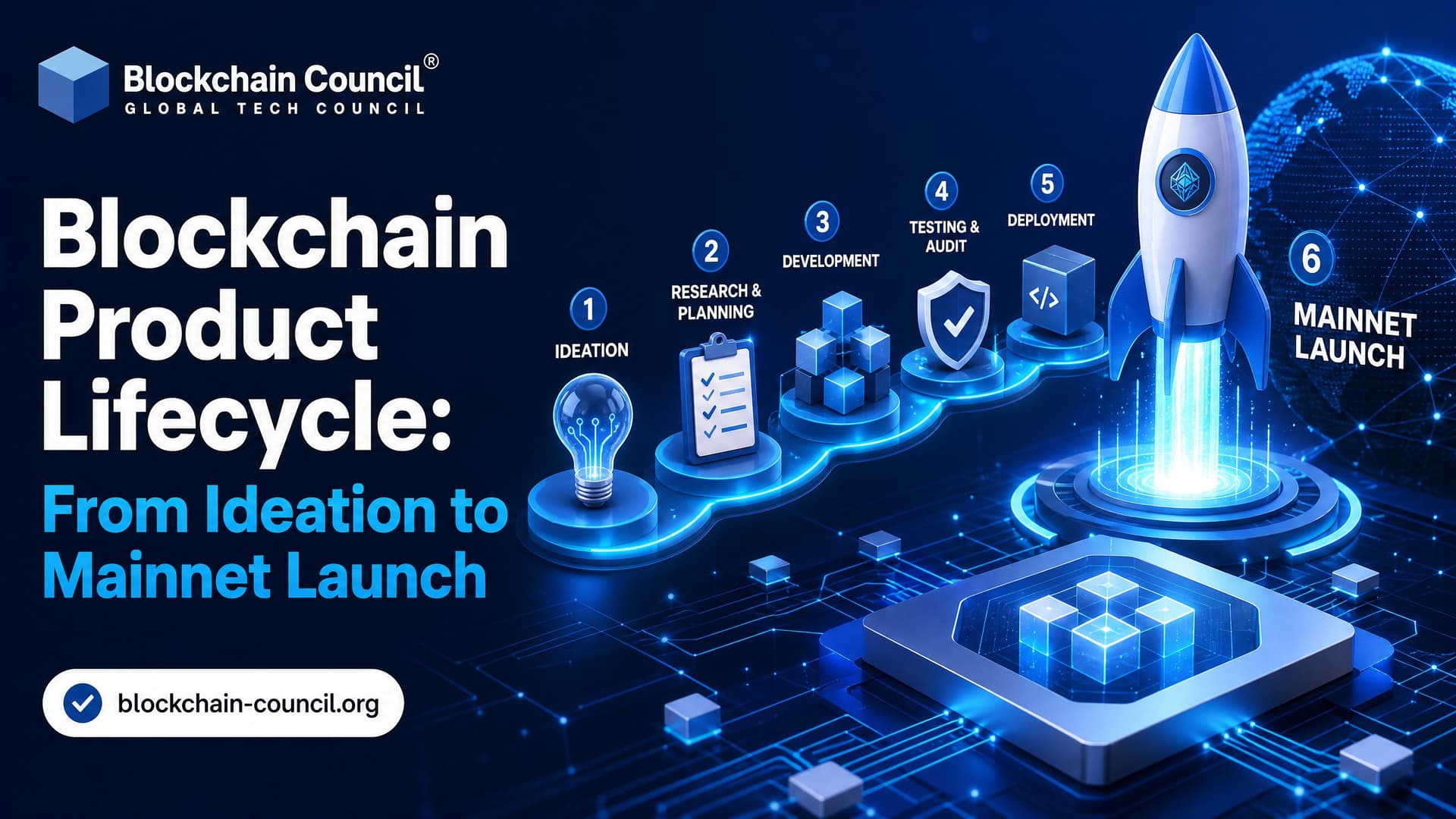
The blockchain product lifecycle is not a straight sprint from whitepaper to mainnet. It is a staged process. You test the problem, design the system, build the smallest useful version, expose it to testnet pressure, harden security, and only then move real value on-chain.
That sounds obvious. Many teams still get it wrong. They treat mainnet as a launch party instead of a production incident waiting to happen when requirements, audits, infrastructure, tokenomics, and governance are not ready.

What Is the Blockchain Product Lifecycle?
The blockchain product lifecycle is the end-to-end path a Web3 product follows from idea to live network operations. It usually includes:
- Ideation and problem definition
- Feasibility and requirements planning
- Architecture and system design
- MVP development
- Testnet deployment and validation
- Security audits and bug bounties
- Tokenomics, funding, and community readiness
- Mainnet launch
- Post-launch monitoring and upgrades
This maps loosely to traditional project phases such as initiation, planning, execution, and closure. The blockchain version is tougher. Smart contracts are public, transactions may be irreversible, incentives can be attacked, and governance often involves more than one company.
Stage 1: Ideation and Problem Definition
Start with a blunt question: does this need a blockchain?
If the product only needs a shared database controlled by one company, blockchain is probably the wrong tool. A blockchain makes sense when you need one or more of these:
- Shared state across parties that do not fully trust each other
- Transparent audit trails
- Programmable digital assets
- Decentralized governance or validation
- Tokenized ownership, access, or incentives
Good ideation defines the user, the pain point, the business case, and the failure mode. Take a real estate tokenization product. It should not start with ERC-1400 or ERC-3643 selection. It should start with investor onboarding, transfer restrictions, custody, disclosure rules, and who can legally hold the token.
If you are building the skills to weigh these decisions, Blockchain Council programs such as the Certified Blockchain Expert™ and Certified Blockchain Architect™ connect directly to this work.
Stage 2: Feasibility and Requirements
Once the idea survives the first filter, capture functional and non-functional requirements.
Functional requirements
- What transactions can users perform?
- Who can mint, burn, pause, vote, validate, or upgrade?
- Which assets are represented on-chain?
- What must remain off-chain?
Non-functional requirements
- Throughput and latency targets
- Security and privacy constraints
- Compliance obligations
- Upgrade policy
- Node, wallet, and infrastructure requirements
Here is a trade-off that matters. Public chains such as Ethereum offer open composability and strong ecosystem support, but gas costs and public data visibility shape your product design. Permissioned networks give more control over validators and privacy, yet they cut open participation. Hybrid architectures are common in enterprise projects because not every record belongs on-chain.
Stage 3: Architecture and System Design
Architecture decides what you can safely launch later. Do not rush it.
A typical blockchain architecture covers:
- Base network: Ethereum, Polygon, Solana, Hyperledger Besu, Quorum-based infrastructure, or another stack
- Consensus model: Proof of Stake, a permissioned validator set, or another mechanism
- Smart contract design: token standards, access control, upgradeability, storage layout
- Off-chain services: APIs, indexers, relayers, KYC systems, data pipelines
- User layer: wallet flows, transaction signing, recovery, notifications
- Monitoring: node health, contract events, failed transactions, RPC performance
One practitioner detail: Solidity 0.8.x automatically reverts on arithmetic overflow and underflow with panic code 0x11. Developers coming from older Solidity versions sometimes still add SafeMath everywhere, which is usually unnecessary in 0.8.x unless you have a specific reason. Small version details like this affect gas, audits, and code clarity.
For developers, the Certified Blockchain Developer™ and Certified Smart Contract Developer™ programs map closely to this stage.
Stage 4: MVP Development
An MVP in blockchain should prove the riskiest assumption, not impress investors with a stack of screens.
For a DeFi lending product, the MVP might test collateral deposits, price feed handling, liquidation logic, and withdrawal paths. For a supply chain network, it may test asset registration, custody transfer, and audit visibility between two participants.
Measure what matters:
- Transaction success rate
- Wallet connection drop-off
- Gas cost per key action
- Time to finality
- Number of failed contract calls
- User feedback from real workflows
Build-measure-learn applies strongly in Web3. Ship small. Watch real behavior. Then cut features that add attack surface without improving adoption.
Stage 5: Testnet Deployment and Iteration
Testnets are where your assumptions meet messy reality. Ethereum historically used testnets such as Ropsten and Goerli for protocol and application testing. Both are now deprecated, and Sepolia is the standard environment for Ethereum application developers today.
Testnet work should include:
- Contract deployment rehearsal
- Frontend wallet integration
- RPC failover testing
- Indexer and event processing checks
- Load testing under realistic user actions
- Validator or node setup drills, where relevant
Beginners often discover deployment issues here. A common one is the RPC error replacement transaction underpriced, usually caused by trying to replace a pending transaction without raising the gas fee enough. Another classic is nonce too low, which often appears when a deployer account has pending transactions or when several scripts share the same key. Fix these on testnet, not while your community waits on launch day.
Stage 6: Security Audits and Bug Bounties
Security is not a checkbox. It is a phase, and then it becomes a habit.
Before mainnet, teams should run internal reviews, automated checks, static analysis, fuzz testing, and independent audits. Auditors look for access control bugs, reentrancy, faulty upgrade patterns, oracle manipulation, bad assumptions in tokenomics, and logic errors that unit tests missed.
Bug bounties are also standard for serious projects. The reason is simple. After mainnet, a critical smart contract bug can move from theoretical risk to permanent financial loss in minutes.
To be blunt, launching unaudited contracts that hold user funds is irresponsible. Testnet excitement does not replace a security review.
Stage 7: Tokenomics, Funding, and Community Readiness
If the project has a token, design the tokenomics before launch pressure distorts decisions. Define supply, emissions, vesting, staking rewards, governance rights, treasury controls, and utility.
Tokenomics is not just math. It is behavior design. If incentives reward short-term extraction, users will act accordingly. If governance power concentrates too heavily, the market will notice.
This stage often includes:
- Whitepaper or technical paper finalization
- Validator, node operator, or ecosystem partner onboarding
- Community education
- Liquidity planning, if a public token is involved
- Exchange, custodian, or institutional coordination
- Legal and compliance review
The World Economic Forum has projected large-scale financial asset tokenization opportunities running into the trillions of dollars. That explains why asset tokenization teams feel pressure to move fast. Even so, regulated assets need slower, cleaner lifecycle management than a simple NFT experiment.
Stage 8: Mainnet Launch
Mainnet launch is the move from simulation to production. Real assets move. Real validators secure the network. Real users can lose money if something fails.
A practical mainnet checklist includes:
- Final audited contract addresses verified on block explorers
- Deployment scripts tested with the exact compiler and network settings
- Multisig owners confirmed, ideally through a tool such as Safe
- RPC, indexer, and monitoring alerts configured
- Pause or emergency controls documented
- Token migration or activation process tested
- Public communication prepared for delays and incidents
For Ethereum mainnet, remember the chain ID is 1. That tiny value matters in deployment scripts, wallet configuration, and transaction signing. Wrong-network mistakes are embarrassing at best and costly at worst.
Stage 9: Post-Launch Operations and Upgrades
Mainnet is not the finish line. It is the start of operational accountability.
Solana is a useful case study. It launched mainnet beta in March 2020 after earlier protocol and testnet phases, then grew quickly as a high-throughput network. It also went through significant outages under demand stress, a reminder that production load can expose issues testnets never fully reveal.
LACChain offers another angle. The permissioned public blockchain ecosystem for Latin America and the Caribbean started with early testnet work in 2019 and grew into longer-term infrastructure coordinated beyond the initial IDB Lab project phase. That is what mature lifecycle thinking looks like: governance, sustainability, and operations planned from the start.
After launch, track:
- Network uptime
- Transaction throughput
- Gas or fee trends
- Failed transaction patterns
- Validator or node performance
- User retention
- Governance participation
- Security alerts and exploit attempts
Upgrades should pass through the lifecycle again: requirements, design, testnet, audit, governance approval, and mainnet deployment. Shortcuts compound risk.
Best Practices for Managing the Blockchain Product Lifecycle
- Prove the blockchain need early: Do not add decentralization where a database would solve the problem.
- Design for upgrades carefully: Proxy patterns help, but storage layout mistakes can break live contracts.
- Use multiple test environments: Local fork tests, public testnets, staging services, and controlled pilots catch different failures.
- Budget for audits: Security costs less before mainnet than after an exploit.
- Document governance: Users should know who can upgrade, pause, mint, or change parameters.
- Monitor from block one: Launching without observability is flying blind.
Build Your Mainnet Readiness Plan
If you are preparing for a blockchain launch, write a one-page lifecycle map this week. List your current stage, top three risks, testnet plan, audit status, governance model, and mainnet readiness gaps.
Then strengthen the weakest area. Product leaders should study blockchain strategy and architecture. Developers should practice contract deployment, testing, and security review. Blockchain Council certifications such as the Certified Blockchain Expert™, Certified Blockchain Developer™, Certified Smart Contract Developer™, and Certified Blockchain Architect™ are practical next steps depending on your role.
Mainnet rewards disciplined teams. Start with the lifecycle, not the launch date.
Related Articles
View All
Blockchain
Best Blockchain Product Management Tools to Plan, Launch, and Scale Products
A practical guide to blockchain product management tools for planning roadmaps, launching safely, tracking on-chain metrics, and scaling Web3 products.

Blockchain
Tokenomics for Product Managers: Designing Sustainable Blockchain Products
A practical guide to tokenomics for product managers, covering utility, supply, incentives, governance, compliance, and sustainable Web3 product design.

Blockchain
How to Write Product Requirements Documents for Blockchain Products
Learn how to write PRDs for blockchain products with sections for smart contracts, tokenomics, security, compliance, metrics, and launch readiness.
Trending Articles
AWS Career Roadmap
A step-by-step guide to building a successful career in Amazon Web Services cloud computing.
What is AWS? A Beginner's Guide to Cloud Computing
Everything you need to know about Amazon Web Services, cloud computing fundamentals, and career opportunities.

Can DeFi 2.0 Bridge the Gap Between Traditional and Decentralized Finance?
The next generation of DeFi protocols aims to connect traditional banking with decentralized finance ecosystems.