

Blockchain in Food Safety: Building Consumer Trust Through Traceability

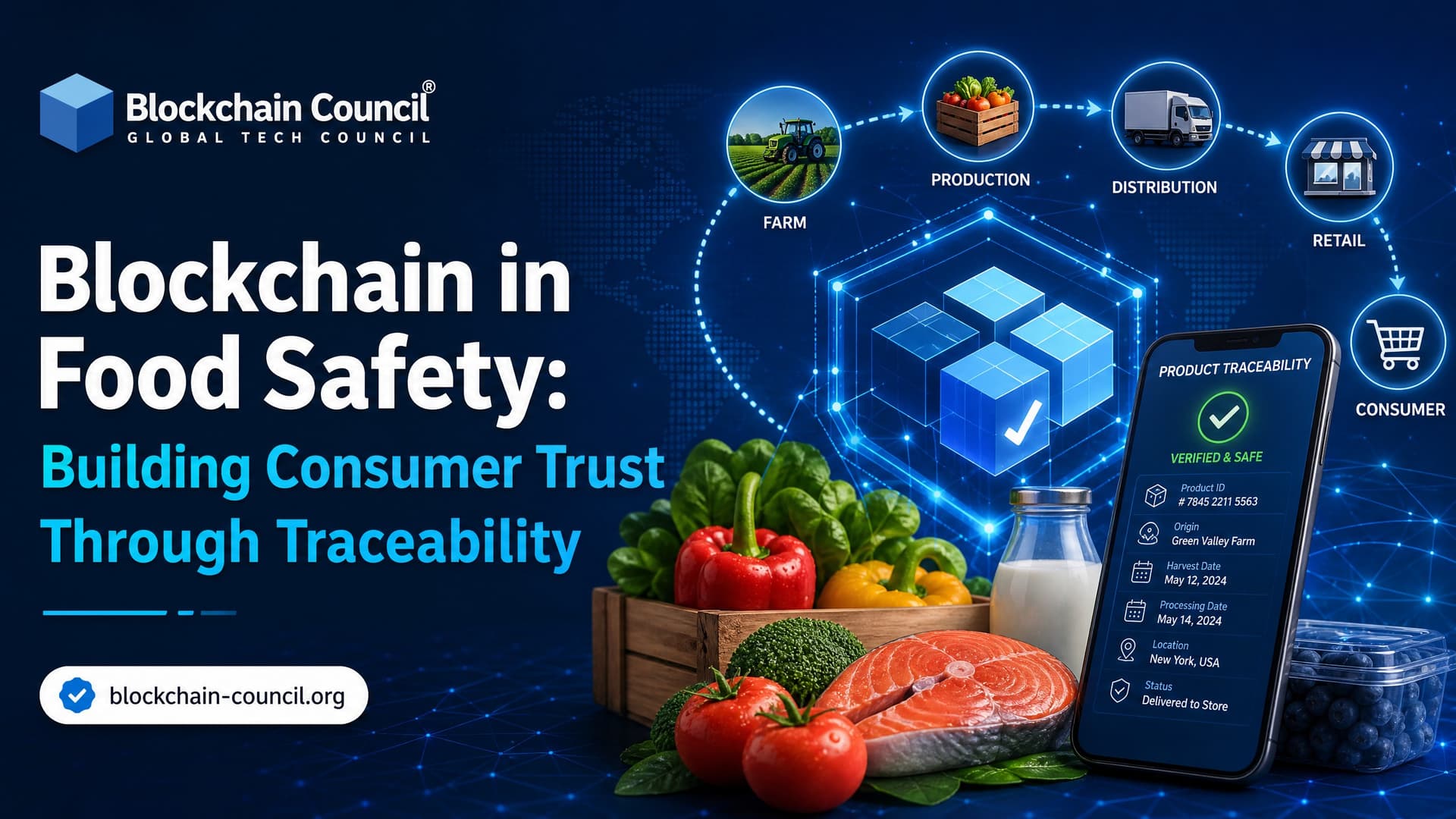
Blockchain in food safety is becoming a practical response to one of the food industry's most urgent challenges: proving where food comes from, how it was handled, and whether it is safe to eat. As supply chains stretch across farms, processors, distributors, retailers, and multiple countries, consumers and regulators are demanding faster and more reliable traceability.
Food safety incidents, mislabeling, fraud, and opaque sourcing have created a trust gap. A Food Marketing Institute survey found that a majority of consumers want to know where their food comes from before buying it. Blockchain offers a way to make that information more verifiable, more accessible, and harder to manipulate.

Why Consumer Trust in Food Supply Chains Is Under Pressure
Foodborne illness affects millions of people worldwide each year. When contamination occurs, companies must identify the source quickly, remove affected products, and reassure consumers. Traditional paper-based systems often make this process slow because records are fragmented across suppliers, logistics providers, warehouses, and stores.
Trust is also shaped by food fraud and misleading claims. Consumers increasingly expect proof of origin, certifications, ethical sourcing, and proper handling. Academic reviews of food trust show that consumers respond positively to credible assurances such as traceability data, certifications, and origin claims. Blockchain aligns with these mechanisms because it can make assurance data easier to verify.
What Blockchain Does in Food Safety
In food safety, blockchain acts as a shared digital ledger that records key events in a product's journey from farm to fork. Each participant can add verified information, and authorized parties can view the record. Once data is written to the ledger, it becomes difficult to alter without detection.
Core Features That Matter
- Transparency: Events such as harvesting, processing, packaging, shipping, storage, and retail receiving can be recorded across the supply chain.
- Immutability: Records become tamper-resistant, making it harder to change origin or safety information after the fact.
- Traceability: Batch numbers, farm origin, expiration dates, shipping details, and storage conditions can be connected in one digital chain.
- Efficiency: Shared ledgers reduce dependence on disconnected spreadsheets, PDFs, and paper records.
These systems often connect blockchain records with QR codes, text codes, or mobile interfaces. This allows retailers, regulators, and in some cases consumers to check product origin, handling data, and supporting certifications.
Real-World Examples of Blockchain in Food Safety
Walmart and IBM Food Trust
Walmart has been one of the most visible adopters of blockchain for food traceability. In China, it piloted blockchain tracking for pork products, recording farm origin, batch numbers, and storage temperatures. In another widely discussed pilot with IBM, Dole, and Driscoll's, Walmart tested blockchain tracing for sliced mangoes.
The results were significant. Traditional traceback could take days or even weeks, while the blockchain-enabled process traced product origin in seconds. This difference matters during contamination events because faster identification can limit consumer exposure, reduce unnecessary recalls, and lower food waste.
Walmart later required leafy greens suppliers to use a blockchain-based tracking system from farm to store. The decision followed recurring outbreaks linked to leafy greens and the need to isolate affected lots more precisely.
IBM Food Trust and Industry Collaboration
IBM Food Trust was launched to connect farmers, processors, distributors, retailers, and food brands through a common traceability network. IBM has worked with companies such as Walmart, Nestle, Tyson, Unilever, and McCormick to improve transparency, fraud detection, and contamination tracking.
The Blockchain Food Safety Alliance, formed by Walmart with IBM, JD.com, and Tsinghua University's National Engineering Laboratory for E-Commerce, highlights the importance of standards. Food safety traceability works best when companies collect and share data in consistent formats.
Cargill and Consumer-Facing Transparency
Cargill has used blockchain to support traceability for Honeysuckle White turkeys in select markets. Consumers could text or enter an on-package code to view farm location, farmer stories, photos, and other product information. Cargill has also worked on beef transparency initiatives to provide similar visibility for beef products.
These examples show that blockchain is not only a back-office safety tool. It can also help consumers connect product claims with verifiable information.
How Blockchain Builds Consumer Trust
Building consumer trust in food safety depends on more than technology. It depends on whether the information is credible, understandable, and useful. Blockchain can support trust in several ways.
Faster Recall Response
During a food safety crisis, speed is critical. Blockchain can help companies identify affected batches, suppliers, and locations quickly. Instead of recalling an entire product category, companies may be able to remove only the affected lots. This protects consumers while reducing waste and business disruption.
Verifiable Origin and Handling Data
Consumers often want to know where food was grown, processed, and shipped. Blockchain can record these details across the product lifecycle. When linked to QR codes or retailer apps, the information becomes more accessible at the point of purchase.
Stronger Protection Against Fraud
Food fraud can include ingredient substitution, false origin claims, and counterfeit certifications. Blockchain does not eliminate fraud by itself, but immutable records make inconsistencies easier to detect. When combined with audits, digital identity, and secure data capture, it can strengthen authenticity controls.
Better Use of Certification and Audit Data
Blockchain can make certification and audit results more useful by turning them into structured data. Instead of static PDFs that are difficult to compare, verified records can be shared across supply chain partners. This matters for retailers, regulators, and enterprise risk teams.
Regulatory Drivers: FSMA 204 and Digital Traceability
Regulation is accelerating adoption. In the United States, the FDA's FSMA Final Rule on Requirements for Additional Traceability Records for Certain Foods, often called FSMA 204, requires companies to maintain records of Key Data Elements linked to Critical Tracking Events.
Blockchain can help organizations maintain these records in a structured, time-stamped, and shareable format. While blockchain is not the only compliance tool, it is well suited to traceability requirements because it connects data across multiple participants without relying on a single company's database.
Benefits for Enterprises and Consumers
- Improved food safety: Faster tracebacks help identify contamination sources and remove unsafe products.
- Reduced food waste: More precise recalls prevent unnecessary destruction of unaffected inventory.
- Greater supply chain visibility: Stakeholders can access consistent records across the product journey.
- Stronger consumer confidence: Verifiable origin and handling data support informed purchasing decisions.
- Better market access: Companies with transparent records may meet retailer and regulatory requirements more easily.
- Fraud reduction: Immutable records help deter mislabeling and false sourcing claims.
Limitations and Implementation Challenges
Blockchain is not a complete solution on its own. Its value depends on the accuracy of the data entered. If incorrect information is recorded at the start, the ledger preserves the error. This is often described as the garbage in, garbage out problem.
Other challenges include implementation cost, integration with legacy systems, platform interoperability, and training. Small producers may also face barriers if they lack digital infrastructure or technical support. For blockchain food safety systems to scale, industry standards and user-friendly tools will be essential.
The Role of IoT, AI, and Professional Skills
The future of blockchain in food safety is likely to involve integration with the Internet of Things (IoT) and artificial intelligence (AI). IoT sensors can record temperature, humidity, location, and storage conditions automatically. AI can analyze traceability data to identify risk patterns, optimize logistics, and support faster recall decisions.
For professionals working in supply chain, compliance, food technology, or enterprise IT, understanding these systems is increasingly valuable. Relevant Blockchain Council learning paths include the Certified Blockchain Expert and Certified Blockchain Developer programs, along with AI-focused certifications for those exploring analytics and automation in food safety systems.
Future Outlook
Adoption is moving from pilots toward operational deployment among large retailers and food manufacturers. Industry analysts expect a significant share of top global grocers to use blockchain solutions for food safety and product tracking. Regulatory pressure, consumer expectations, and cross-company alliances are likely to increase this momentum.
Future traceability platforms may combine safety, sustainability, ethical sourcing, carbon data, and certification status in a single verifiable product record. As consumers become more familiar with digital labels and QR-based transparency, blockchain-backed information may become a standard trust signal in food retail.
Conclusion
Blockchain in food safety is more than a technology trend. It addresses a real need for faster recalls, stronger traceability, better fraud prevention, and clearer communication with consumers. Companies such as Walmart, IBM, Cargill, Nestle, and Unilever have already demonstrated practical applications across food supply chains.
Successful adoption still requires reliable data capture, interoperability, stakeholder training, and alignment with regulatory requirements. When implemented carefully, blockchain can help transform food safety from a reactive process into a transparent, data-driven trust system that benefits consumers, enterprises, and regulators alike.
Related Articles
View All
Blockchain
Why Blockchain Is the Future of Digital Trust, Finance, and Data Security
Blockchain is becoming core infrastructure for digital trust, finance, and data security through shared ledgers, stablecoins, smart contracts, and verifiable records.

Blockchain
Blockchain Shared Security Protocols: How Shared Trust Secures Modular Chains
Blockchain Shared Security Protocols let chains, rollups, and services share validators, stake, or proofs instead of building security alone.

Blockchain
Blockchain and Big Data: Building Trusted Analytics for the Data Economy
Explore how Blockchain and Big Data work together to improve data integrity, provenance, analytics, and enterprise decision-making across industries.
Trending Articles
The Role of Blockchain in Ethical AI Development
How blockchain technology is being used to promote transparency and accountability in artificial intelligence systems.
How Blockchain Secures AI Data
Understand how blockchain technology is being applied to protect the integrity and security of AI training data.
Blockchain in Supply Chain Provenance Tracking
Supply chains are under pressure to prove not just efficiency, but also authenticity, sustainability, and fairness. Customers want to know if their coffee really is fair trade, if the diamonds are con