

Blockchain-Based AI Model Provenance
 Suyash Raizada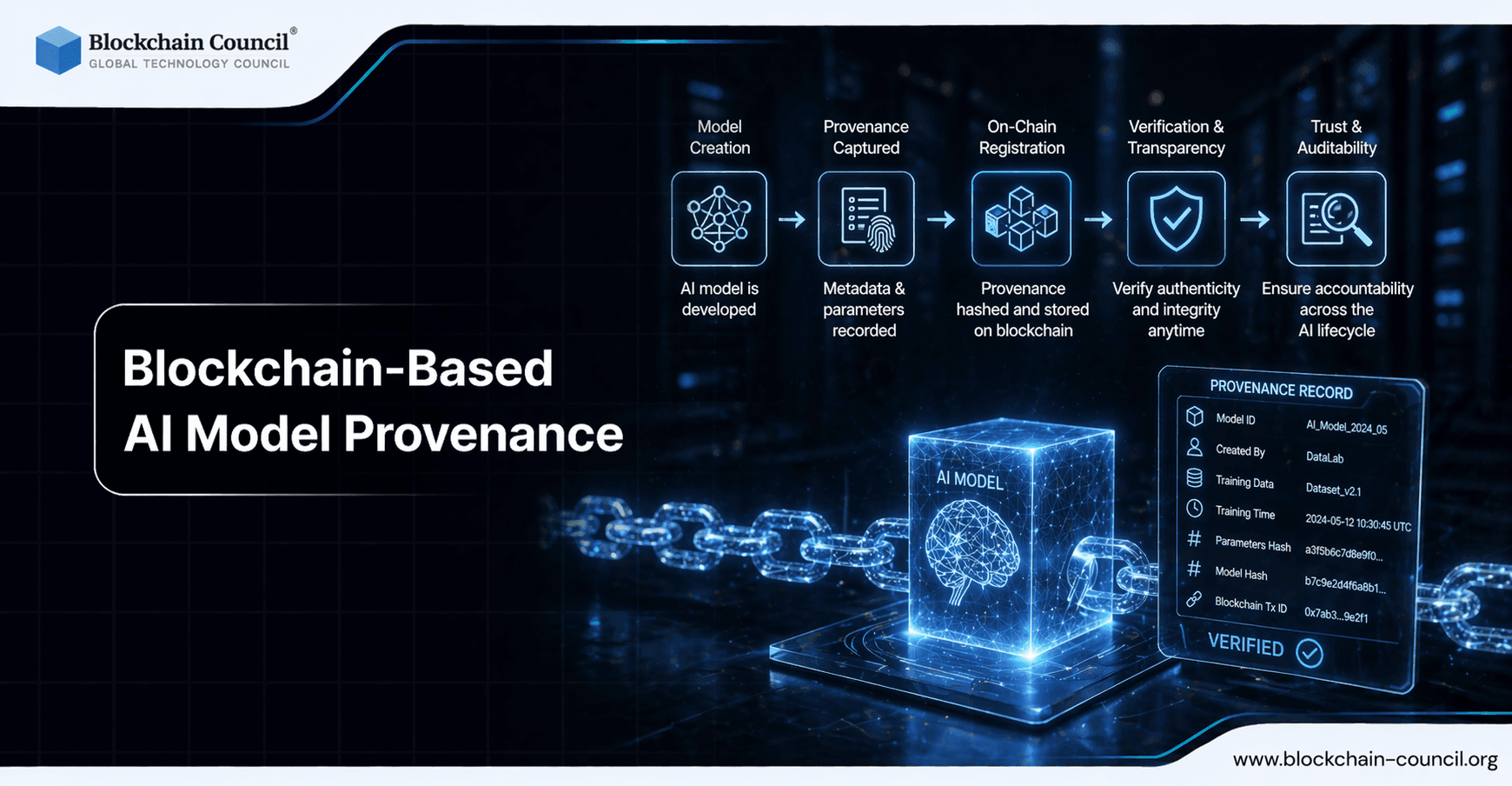
Blockchain-based AI model provenance is becoming a practical requirement, not just a technical upgrade. As AI models move into regulated environments like finance, healthcare, and public sector workflows, organizations must prove where training data came from, how model weights changed over time, and which version produced a given decision. Blockchain addresses this by providing immutable audit trails, timestamped attestations, and verifiable records that strengthen accountability and support compliance-driven traceability.
Track and verify AI model origins using blockchain by learning distributed systems through a Blockchain Course, enhancing AI workflows via an AI Course, and scaling products using a Digital marketing course.

What is blockchain-based AI model provenance?
AI model provenance is the ability to track and verify the history of an AI model across its lifecycle, including:
Training data lineage: which datasets were used, under what license, and with what preprocessing steps.
Model artifacts: model weights, architecture configuration, evaluation reports, and prompts (for LLM systems).
Version history: which model version was deployed, when it changed, and why.
Operational evidence: inference logs, policy checks, and approvals tied to releases.
Blockchain-based AI model provenance adds a tamper-resistant layer to this process by anchoring proofs (hashes), attestations, and approvals on a blockchain. Rather than storing large files on-chain, most architectures store artifacts off-chain (for example, in object storage or decentralized storage) and write cryptographic commitments on-chain to prove integrity and timing.
Why provenance is rising now: regulation and synthetic data risk
Regulatory pressure is pushing organizations toward stronger traceability. The EU AI Act, adopted in 2024, elevates expectations around documentation and traceability for AI systems and their data sources. Similar governance expectations are emerging across the US and Asia. In parallel, the growth of synthetic content and synthetic training data increases the need for verifiable authenticity and chain-of-custody, especially when models are fine-tuned repeatedly across teams and vendors.
Industry initiatives such as C2PA content credentials, supported by major technology providers, reflect the broader movement toward standardized provenance for digital media and AI-generated content. For enterprises, the same principle applies to models: organizations need a defensible way to prove what happened, when it happened, and who authorized it.
How blockchain enables traceability for training data, weights, and versions
At a high level, blockchain provides immutable logs while AI systems supply context and compute. Combining the two supports what many institutions describe as a trust layer for AI, where evidence can be verified independently.
1) Tracking training data provenance
Training data provenance is often the hardest part because data can be:
Aggregated from multiple sources
Updated over time
Subject to licensing and cross-border constraints
Processed through complex pipelines
A blockchain-based approach can record:
Dataset fingerprints: hashes of raw datasets and post-processed versions
Access and consent attestations: who approved usage and under what policy
Pipeline metadata: transformation steps, feature extraction versions, and quality checks
This is particularly valuable when an organization must demonstrate that a model was not trained on prohibited data, or that specific data was excluded from training.
2) Tracking model weights and artifacts
Model weights can be treated as controlled artifacts. Instead of placing large weight files on-chain, teams can store:
Weight file hashes and signing keys to prove the artifact was not altered
Evaluation summaries (for example, safety tests, bias checks, and red-team reports) as attestations
Secure approvals indicating that a specific weight set passed required gates
This matters for high-stakes deployments, where organizations must demonstrate that the deployed model matches the tested model and that the testing evidence is intact.
3) Tracking version history and release governance
Modern AI systems change frequently through fine-tuning, retrieval updates, prompt updates, or policy updates. A provenance ledger can link:
Model version identifiers to training runs
Deployment timestamps and rollback events
Responsible parties and sign-offs
In regulated settings, this improves audit readiness. It also helps internally during incident response, when teams need to answer: which version produced this outcome, and what changed since the previous release?
Architecture patterns that work in practice
Implementations vary, but most enterprise-ready designs follow a few common patterns:
Off-chain storage with on-chain commitments: store datasets and weights in secured repositories, then write hashes and attestations to a blockchain for immutability.
Permissioned access with public verifiability: keep sensitive details private while allowing auditors to verify proofs independently.
Decentralized indexing for discoverability: index provenance events so AI and compliance tools can query them efficiently.
As blockchain data volumes grow, decentralized indexing becomes increasingly important. Protocols such as The Graph are widely recognized for providing decentralized indexing capabilities that support complex queries across blockchain records - a key requirement when provenance records must be retrieved quickly for audits or investigations.
Privacy-preserving provenance: proving without exposing
One of the biggest constraints in model provenance is privacy. Organizations may need to prove a model was trained correctly without exposing:
Personal data
Medical information
Proprietary datasets
Trade-secret model details
Privacy technologies increasingly combine blockchain with cryptographic proofs to add verifiable seals while keeping data local or encrypted. Zero-knowledge-based systems deployed on modern chains enable on-device processing for scenarios like diagnostics without exposing raw data. This direction is critical for edge AI and, longer term, for robotics and distributed AI systems.
Real-world use cases for blockchain-based AI model provenance
Compliance logging and anomaly detection (AML and fraud)
In financial compliance, AI can flag suspicious patterns in real time. Blockchain can immutably record alerts, rule triggers, model versions, and analyst actions. This supports regulator-facing evidence trails and reduces disputes about whether logs were modified after the fact.
Data governance across borders
Global enterprises face differing data regulations across jurisdictions. Provenance records can help demonstrate which datasets were used in which region, which data handling policies applied, and which model outputs were generated under which governance conditions.
DeFAI automation and agent-based execution
Decentralized finance is increasingly experimenting with AI agents that can translate natural language intent into transactions and portfolio actions. This raises the importance of verifiable interactions: which agent acted, under what policy, and based on which model version. Ecosystems such as Fetch.ai focus on enabling autonomous agents with verifiable interactions, aligning well with provenance requirements.
Decentralized infrastructure for training and inference
Compute and data availability are strategic constraints for AI. Decentralized GPU networks such as Render aim to broaden access to compute resources. Combined with provenance, tokenized compute and artifact tracking can reduce reliance on centralized clouds and improve accountability for who trained what, where, and when.
Market signals: why momentum is building into 2026
Venture activity indicates sustained interest in the crypto-AI intersection, with hundreds of funded projects reported in 2025. The underlying driver is practical: organizations need scalable ways to prove integrity, ownership, and compliance for AI artifacts. This also supports emerging models of custody for AI assets - including tokenized models, datasets, and compute rights - where secure storage and verified artifact management could become standard in sectors such as finance, legal services, and healthcare.
Implementation checklist: adopting provenance without overengineering
When building a provenance layer, focus on the minimum verifiable set first:
Define provenance events: dataset creation, preprocessing, training run, evaluation gate, deployment, rollback.
Choose identifiers: consistent model and dataset IDs, plus hashes for artifacts.
Use signing and roles: ensure attestations are tied to accountable identities and approval workflows.
Decide storage boundaries: what stays off-chain, what is hashed on-chain, and what is encrypted.
Index for audit queries: ensure you can answer who, what, when, and which version quickly.
Strengthen AI transparency and auditability by combining knowledge from a Certified Blockchain Expert, securing pipelines with Cyber security certifications, and promoting solutions via an AI powered marketing course.
Conclusion: provenance is becoming AI infrastructure
Blockchain-based AI model provenance is moving from an experimental concept to an operational necessity. Regulation is increasing expectations for traceability, synthetic data is complicating trust, and enterprises need defensible evidence trails for training data, weights, and version history. Blockchain provides immutable records and auditability, while AI systems supply the context that makes those records meaningful.
By 2026, the convergence is expected to deepen, with more tokenized AI artifacts, custody of verified model assets, and agent-driven workflows that require strong accountability. Teams that implement provenance now will be better positioned to meet compliance demands, reduce operational risk, and deploy AI systems that can be independently verified.
FAQs
1. What is blockchain-based AI model provenance?
Blockchain-based AI model provenance tracks the origin, history, and changes of AI models using a distributed ledger. It records data sources, training steps, and updates. This ensures transparency and traceability.
2. Why is model provenance important in AI?
Model provenance helps verify how an AI system was built and trained. It supports accountability and trust. This is critical for regulated and high-risk applications.
3. How does blockchain improve AI model provenance?
Blockchain provides immutable records that cannot be altered. It logs model training, updates, and usage securely. This ensures reliable tracking over time.
4. What information is stored in AI model provenance records?
Records may include training data sources, model versions, parameters, and performance metrics. It can also track contributors and updates. This creates a complete audit trail.
5. How does provenance help with AI transparency?
Provenance allows users to understand how a model was developed and modified. It reveals data sources and decision processes. This improves trust and explainability.
6. What role does immutability play in model provenance?
Immutability ensures that once data is recorded, it cannot be changed. This prevents tampering with model history. It guarantees integrity of records.
7. How does blockchain-based provenance support compliance?
It provides verifiable audit trails required by regulations. Organizations can demonstrate how models were built and used. This simplifies compliance with AI governance rules.
8. Can blockchain track model updates and versions?
Yes, each update or version can be recorded on the blockchain. This creates a clear version history. It helps manage model lifecycle effectively.
9. What industries benefit from AI model provenance?
Industries like healthcare, finance, and government benefit from transparent AI systems. These sectors require strict accountability. Provenance supports trust and regulation.
10. How does provenance help detect model bias?
By tracking training data and updates, provenance reveals potential sources of bias. This allows organizations to identify and address issues. It improves fairness in AI systems.
11. What are smart contracts in AI provenance systems?
Smart contracts automate processes like validation and access control. They enforce rules for updating and using models. This reduces manual oversight.
12. How does blockchain-based provenance improve security?
It protects model history from unauthorized changes. Access controls and encryption enhance security. This reduces risks of tampering and misuse.
13. What challenges exist in implementing model provenance?
Challenges include scalability, storage requirements, and integration complexity. Blockchain systems can be resource-intensive. Efficient design is necessary.
14. How does provenance support collaboration in AI development?
Provenance records contributions from multiple participants. It ensures transparency in collaborative projects. This builds trust among stakeholders.
15. Can blockchain-based provenance track data usage in AI?
Yes, it can record how data is used in training and inference. This ensures accountability. It also helps manage data ownership and rights.
16. What is the role of encryption in AI provenance systems?
Encryption protects sensitive data linked to provenance records. It ensures confidentiality while maintaining traceability. Secure key management is important.
17. How does provenance improve AI lifecycle management?
It tracks every stage from data collection to deployment. This provides visibility into the entire lifecycle. It supports better management and updates.
18. What is the difference between centralized and blockchain-based provenance?
Centralized systems rely on a single authority to manage records. Blockchain-based systems distribute records across participants. This improves transparency and trust.
19. How scalable is blockchain for AI provenance tracking?
Scalability can be a challenge due to large data volumes. Solutions include off-chain storage and hybrid architectures. These improve performance.
20. What is the future of blockchain-based AI model provenance?
It will play a key role in AI governance and accountability. More standardized solutions will emerge. Adoption will grow as regulations increase.
Related Articles
View All
Blockchain
Zero-Knowledge Proofs for Tax Compliance: Verifying Taxpayer Information Without Exposing Sensitive Data
Zero-Knowledge Proofs (ZKPs) could make tax compliance more privacy-preserving by allowing taxpayers to prove specific claims, such as income falling within a required range or eligibility for a deduction, without exposing an entire tax return. MIT’s zkTax prototype demonstrates this approach using digitally signed tax records, selective disclosure, and independently verifiable proofs. Such systems could reduce unnecessary exposure of sensitive financial and personal information while preserving auditability and verification.

Blockchain
Blockchain Certification Programs You Can Join Online
Discover the best blockchain certification programs you can join online. Learn blockchain fundamentals, smart contracts, enterprise blockchain, and career opportunities with globally recognized certifications.

Blockchain
Agile for Blockchain Teams: Managing Sprints, Smart Contracts, and Decentralized Roadmaps
Learn how agile for blockchain teams works when sprints, smart contracts, audits, governance, and decentralized roadmaps are planned around risk.
Trending Articles
AWS Career Roadmap
A step-by-step guide to building a successful career in Amazon Web Services cloud computing.
What is AWS? A Beginner's Guide to Cloud Computing
Everything you need to know about Amazon Web Services, cloud computing fundamentals, and career opportunities.
Claude AI Tools for Productivity
Discover Claude AI tools for productivity to streamline tasks, manage workflows, and improve efficiency.