

AI + Blockchain: The Next Trillion-Dollar Opportunity

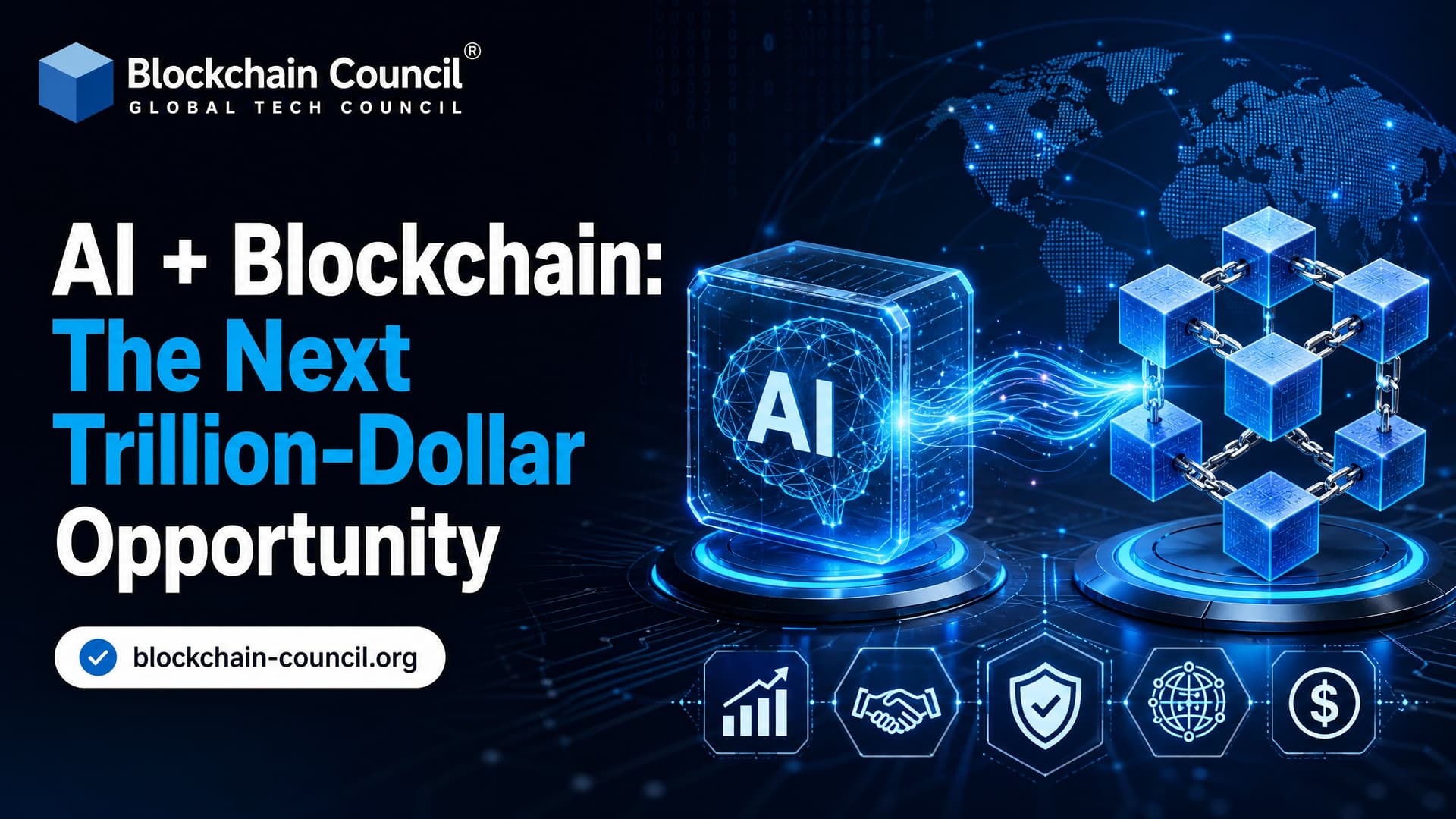
AI + Blockchain: The Next Trillion-Dollar Opportunity is more than a market slogan. It describes the convergence of two foundational technologies at a time when artificial intelligence is driving record infrastructure spending, while blockchain is maturing into a trusted layer for data, identity, payments, and programmable coordination.
Analysts and investors increasingly view this convergence as a strategic frontier because AI is becoming a multi-trillion-dollar sector. Financial media and market commentary have cited projections that the AI market could reach 7 to 10 trillion USD by 2030. Investor analysis using Goldman Sachs data also points to more than 8 trillion USD in AI-related capital expenditure over roughly six years. These figures relate to AI broadly, but they help explain why the supporting infrastructure, including decentralized data, compute, governance, and settlement rails, could become a major opportunity for blockchain.

Why AI and Blockchain Are Converging
AI systems need enormous amounts of data, compute, and coordination. Blockchain networks are designed to coordinate assets, permissions, incentives, and records across parties that do not fully trust one another. This makes the combination especially relevant for industries that require transparency, accountability, and automation.
The core value of blockchain in AI is not simply storing data on-chain. In most cases, large datasets and models remain off-chain. Blockchain is more useful as a verification and coordination layer that records proofs, permissions, payments, ownership, and governance decisions.
Key Areas Where the Technologies Complement Each Other
- Data provenance: Blockchain can record hashes, timestamps, and permissions linked to training datasets.
- Model auditability: Immutable logs can track model versions, retraining events, and deployment changes.
- Compute markets: Tokenized compute credits can support transparent pricing and settlement.
- AI agent payments: Autonomous agents can use digital assets and smart contracts for machine-to-machine transactions.
- Governance: On-chain voting and policy rules can support multi-stakeholder oversight of AI systems.
The Trillion-Dollar Context: AI Infrastructure Is Expanding Fast
The idea of AI + Blockchain: The Next Trillion-Dollar Opportunity is rooted in the scale of AI infrastructure spending. The first wave of AI growth focused heavily on models, chips, and cloud platforms. The next wave is shifting toward energy, cooling, networking, storage, and specialized data center capacity.
Industry analysis describes this as a move from big tech AI build-outs toward sovereign AI, where countries develop their own AI infrastructure using local data, local compute, and local governance. The same analysis notes that US big tech firms are expected to spend more than 300 billion USD in a single year on AI data centers, while future government spending on AI infrastructure may eventually exceed private technology spending.
This matters for blockchain because AI infrastructure will require trusted coordination across many participants, including cloud providers, governments, data owners, model developers, energy producers, regulators, and end users. Blockchain can provide neutral rails for verification, settlement, and compliance across these networks.
Compute as a Commodity and Financial Asset
As AI adoption grows, compute is increasingly discussed as a commodity, similar to electricity or oil in industrial economies. If AI becomes a 7 to 10 trillion USD market, then GPU time, inference capacity, storage, and bandwidth may require mature markets for pricing, allocation, and risk management.
Blockchain can support this shift through programmable resource markets. For example, platforms can tokenize access to compute resources, allowing buyers and sellers to trade capacity with transparent rules. Smart contracts can automate settlement, while tokenized futures or options could help enterprises hedge compute costs.
This is especially relevant for developers, startups, and research institutions that cannot always access hyperscale cloud infrastructure at predictable prices. Decentralized compute networks could make capacity more accessible, although challenges remain around performance, reliability, security, and regulatory compliance.
Data Provenance: A Critical Layer for Responsible AI
AI systems are only as reliable as the data used to train and evaluate them. Concerns around copyright, bias, privacy, and data quality are increasing. Enterprises and regulators need better ways to prove where data came from, whether it was licensed, and how it was used.
Blockchain-based provenance systems can help by recording:
- Dataset fingerprints and metadata
- Consent and licensing terms
- Access permissions and revocations
- Training and fine-tuning events
- Model update histories
These records do not need to expose sensitive data. Instead, cryptographic proofs can confirm that data or model events occurred without revealing confidential information. This approach is highly relevant for healthcare, finance, insurance, government, and other regulated sectors.
AI Agents Need Economic Rails
One of the most important emerging themes is the rise of autonomous AI agents. These systems may soon book services, purchase data, call APIs, negotiate with other agents, and manage digital workflows with minimal human intervention.
For this to work at scale, AI agents need reliable economic infrastructure. Traditional banking and payment rails were not designed for high-frequency, low-value, programmable machine transactions. Blockchain networks, digital assets, and smart contracts can provide always-on settlement, programmable escrow, and transparent transaction histories.
Examples include:
- An AI agent paying for a data feed in real time
- A software agent purchasing inference from a decentralized GPU marketplace
- IoT devices settling microtransactions for energy or connectivity
- Autonomous research agents rewarding human reviewers or data contributors
This is where AI and blockchain move beyond infrastructure into machine economies. If billions of agents interact economically, blockchain may become one of the most practical settlement layers.
Governance and Compliance in AI + Blockchain Systems
Academic governance research highlights that combining AI and blockchain creates both opportunities and risks. Blockchain can improve auditability, accountability, and multi-party control. It can also introduce challenges related to privacy, immutability, scalability, and legal responsibility.
For enterprises, governance should be designed from the start. Important questions include:
- Who can update or fine-tune an AI model?
- How are training datasets approved and audited?
- What information is recorded on-chain and what remains private?
- How are disputes resolved when an autonomous agent causes harm?
- Which regulators have oversight across jurisdictions?
These questions are particularly important for sovereign AI systems, where national security, data localization, and cross-border interoperability are central concerns. Blockchain can provide shared verification standards, but legal and technical design must be carefully aligned.
Enterprise Use Cases Taking Shape
The combined AI and blockchain market is still early, but several practical use cases are already emerging.
1. Decentralized Data Marketplaces
Data providers can tokenize access rights and use smart contracts to define licensing terms. AI developers can purchase verified datasets while maintaining a clear audit trail.
2. Model and Inference Marketplaces
Model owners can offer inference services and receive automated payments per query, per result, or based on performance metrics.
3. Tokenized Compute and Storage
Organizations can buy, sell, or reserve GPU capacity, storage, and bandwidth through decentralized marketplaces with transparent settlement.
4. AI Identity and Access Control
Blockchain-based credentials can verify whether a user, system, or AI agent is authorized to access a model, dataset, or API.
5. Regulatory Audit Trails
Enterprises can log critical AI lifecycle events to support compliance, incident investigation, and independent verification.
Skills Professionals Need for This Opportunity
Professionals who want to participate in this convergence need cross-disciplinary knowledge. Technical teams must understand smart contracts, AI model lifecycle management, data governance, token economics, and cybersecurity. Business leaders need to assess where decentralization adds real value and where traditional architecture is more appropriate.
Relevant learning paths include Blockchain Council programs such as the Certified Blockchain Expert, Certified Smart Contract Developer, Certified Artificial Intelligence Expert, and specialized Web3 or crypto certifications. These provide structured training in blockchain, AI, and decentralized application design.
Risks and Limitations to Consider
The opportunity is significant, but it should not be treated as risk-free. Common challenges include:
- Scalability: Public blockchains may not handle high-volume AI events without layer 2 systems or off-chain computation.
- Privacy: Sensitive data must not be exposed through poorly designed on-chain records.
- Regulation: AI and digital asset rules are evolving quickly across jurisdictions.
- Security: Smart contract vulnerabilities can create financial and operational risks.
- Economic design: Token incentives can fail if they reward low-quality data, compute, or model outputs.
Successful projects will focus on clear problems, strong governance, and measurable efficiency gains rather than using blockchain where a conventional database would suffice.
Conclusion
The convergence of AI and blockchain reflects a broader shift in how digital infrastructure is built and governed. AI is driving unprecedented demand for data, compute, energy, and automation. Blockchain offers tools for provenance, programmable incentives, tokenized markets, identity, and decentralized governance.
The most valuable opportunities will likely emerge where these technologies solve real coordination problems: verifying AI data, pricing compute, enabling autonomous agent payments, and creating auditable governance for high-stakes systems. For enterprises and professionals, the message is clear. The future of AI will not be shaped by models alone. It will also depend on the trusted infrastructure that allows those models, agents, and markets to operate at global scale.
Related Articles
View All
Blockchain
Truth About Blockchain: What Works, What Is Hype, and What Comes Next
Learn the truth about blockchain: where it works today (DeFi, identity, government, supply chain), where it falls short, and what trends will shape adoption next.

Blockchain
How Banking Is Adapting Blockchain Technology: Key Use Cases, Benefits, and What Comes Next
Banks are adopting blockchain for faster settlement, shared KYC, trade finance automation, and asset tokenization using hybrid, interoperable models aligned with regulation.

Blockchain
How Blockchain Creates Transparency in Business
Learn how blockchain creates transparency in business through shared ledgers, immutability, traceability, smart contracts, and verifiable audit trails.
Trending Articles
The Role of Blockchain in Ethical AI Development
How blockchain technology is being used to promote transparency and accountability in artificial intelligence systems.

How Blockchain Secures AI Data
Understand how blockchain technology is being applied to protect the integrity and security of AI training data.

Can DeFi 2.0 Bridge the Gap Between Traditional and Decentralized Finance?
The next generation of DeFi protocols aims to connect traditional banking with decentralized finance ecosystems.