

How Blockchain Prevents Counterfeit Products in Global Supply Chains

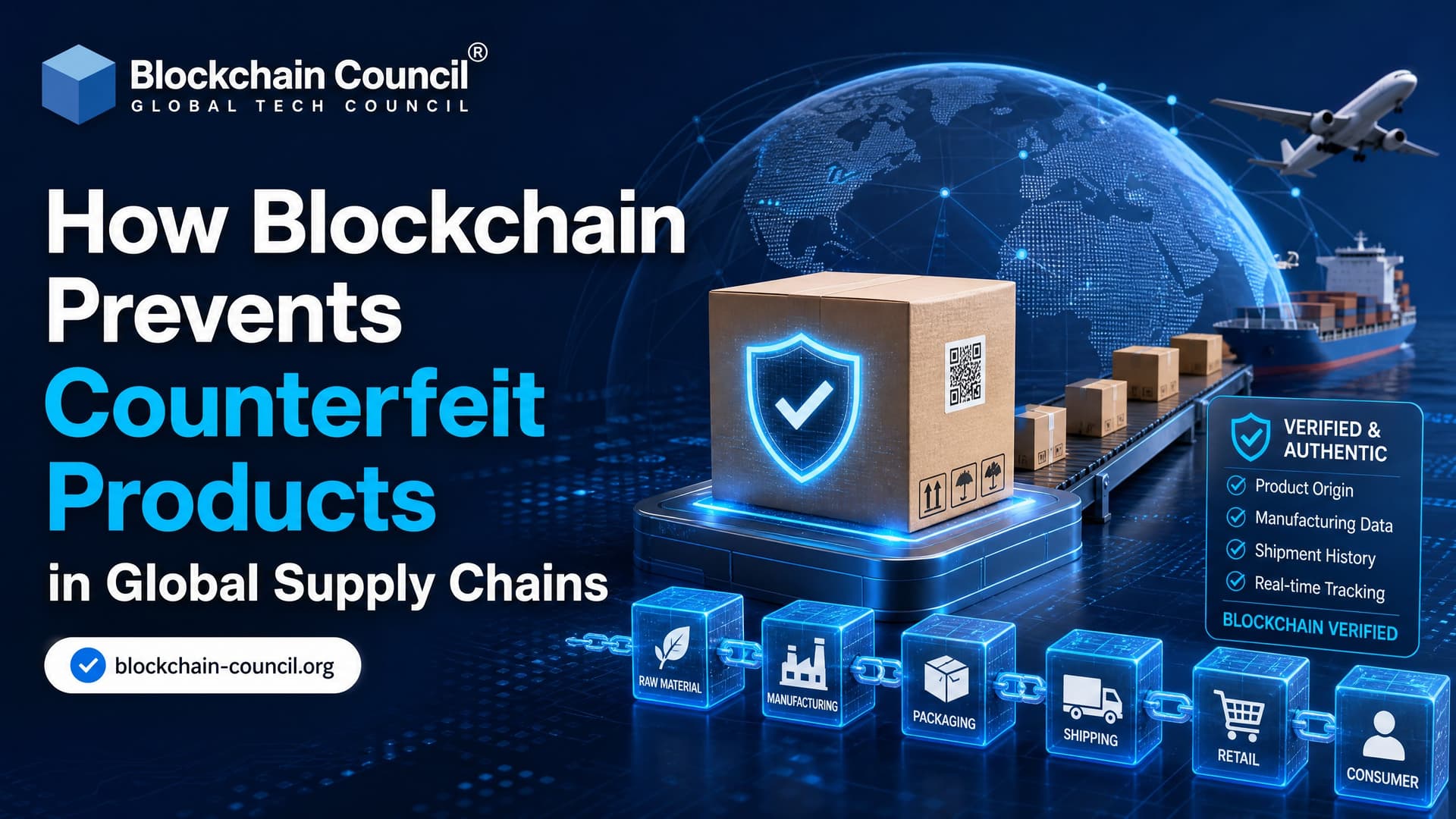
How Blockchain Prevents Counterfeit Products is becoming an important question for brands, regulators, logistics providers, and consumers. Counterfeit goods represent more than 500 billion USD in global trade, according to industry and policy analyses, and the problem affects sectors ranging from luxury fashion and electronics to pharmaceuticals and food. Traditional supply chains often rely on fragmented databases, paper records, and limited visibility between trading partners. This makes it difficult to prove where a product came from, who handled it, and whether it is genuine.
Blockchain addresses this challenge by creating a shared, tamper-resistant record of product provenance. When combined with smart tags, digital identities, IoT sensors, and smart contracts, blockchain can make product authentication faster, more transparent, and harder to manipulate.

Why Counterfeiting Is Difficult to Stop
Counterfeiters exploit gaps in global supply chains. Products may pass through manufacturers, suppliers, freight forwarders, warehouses, customs agencies, distributors, retailers, and online marketplaces before reaching buyers. Each handoff creates an opportunity for fake goods to enter the network.
Common weaknesses include:
- Limited supply chain visibility: Companies may only see their direct suppliers or immediate logistics partners.
- Siloed data: Records are often stored in separate systems that do not communicate well with each other.
- Manual verification: Paper documents, certificates, and labels can be forged or altered.
- Delayed investigations: Identifying where counterfeit products entered the chain can take weeks or months.
Blockchain is not a standalone cure for counterfeiting, but it provides a stronger foundation for traceability, verification, and accountability across multiple organizations.
How Blockchain Prevents Counterfeit Products
1. Immutable Provenance Records
At the center of blockchain-based anti-counterfeit systems is an immutable ledger. Every important event in a product's life cycle can be recorded as a transaction, such as manufacturing, packaging, inspection, shipment, customs clearance, warehousing, retail receipt, or resale.
Each event is time-stamped and cryptographically secured. Once recorded, it cannot be secretly altered or deleted without detection. This creates an auditable provenance trail from origin to end user.
For example, a luxury watch can have records showing its manufacturer, production batch, authorized distributor, shipping route, retail location, and ownership history. If a product has no valid record, or if its history is incomplete, duplicated, or inconsistent, it can be flagged for further inspection.
2. Unique Digital Identities for Physical Products
Blockchain prevents counterfeit products more effectively when every genuine item has a unique digital identity. This identity may be linked to a QR code, NFC chip, RFID tag, barcode, or secure label attached to the product or its packaging.
The blockchain record can include:
- Manufacturer details
- Batch or serial number
- Production date and location
- Quality inspection status
- Transfer of ownership
- Shipping and storage events
- Warranty or certification data
If counterfeiters copy the same QR code onto many fake products, the system can detect suspicious activity. Multiple scans from different locations, repeated use of one identifier, or conflicts in ownership history can indicate fraud.
3. Smart Tags and IoT Data Capture
The physical-digital link is critical. Smart tags connect a real-world item to its blockchain identity. When a product is scanned at each supply chain checkpoint, the event is sent to the ledger with a timestamp and participant identity.
IoT sensors can add another layer of protection. In pharmaceuticals and food, sensors can track temperature, humidity, storage conditions, and route deviations. If a medicine requires cold-chain handling, sensor data can show whether it remained within safe limits during transport.
This is especially valuable for products where counterfeiting is not the only concern. Tampering, diversion, expired inventory, and incorrect storage can also create safety and compliance risks.
4. Smart Contracts for Automated Verification
Smart contracts are programs that run on a blockchain and execute predefined rules. In anti-counterfeit systems, they can automate checks that would otherwise require manual review.
Smart contracts can be used to:
- Validate whether a product identifier exists on the blockchain
- Confirm that the current seller is an authorized participant
- Record transfer of custody between approved parties
- Trigger alerts when duplicate identifiers appear
- Block transactions if required quality checks are missing
Automation helps reduce human error, speeds up investigations, and supports trust between organizations that may not fully trust each other's internal systems.
5. Consumer-Facing Authentication
One of the most practical benefits of blockchain is that authentication can reach the end customer. A consumer can scan a QR code or NFC tag using a smartphone and view key product information, such as origin, production date, certification status, and supply chain history.
This reduces information asymmetry at the point of purchase. Buyers no longer need to rely only on packaging, seller claims, or visual inspection. For high-value goods, medicines, organic foods, or electronics, instant verification can improve confidence and help consumers avoid unsafe or fake products.
Real-World Use Cases
Luxury Goods
Luxury brands use blockchain to issue digital certificates of authenticity for handbags, watches, jewelry, and collectibles. Some systems also connect physical goods to NFTs or tokenized certificates, making ownership and resale histories easier to verify. This is particularly useful in secondary markets, where counterfeit risk is high.
Pharmaceuticals
In healthcare, counterfeit medicines can be dangerous or fatal. Blockchain can track medication batches from manufacturer to wholesaler, pharmacy, hospital, and patient. Each handover can be recorded, helping detect fake, expired, diverted, or tampered drugs.
Food and Agriculture
Blockchain supports farm-to-table traceability for premium, organic, certified, or origin-protected products. It can help verify farming practices, processing locations, shipping conditions, and retailer records. When contamination or mislabeling occurs, traceability can also speed up recalls.
Electronics and Components
Electronics supply chains are complex and global. Blockchain can help verify the origin of microchips, batteries, components, and assemblies. This supports warranty management, recall processes, and risk reduction for industries that depend on reliable parts.
E-Commerce Platforms
Online marketplaces face major counterfeit challenges because buyers may never interact directly with the brand. Blockchain-enabled product records can give platforms a stronger technical basis for verifying listings, removing suspicious goods, and building consumer trust.
Benefits for Enterprises and Regulators
For enterprises, blockchain-based anti-counterfeit systems can provide:
- Stronger brand protection: Authenticity records make it harder for fake products to pass as genuine.
- Faster investigations: Shared records help identify where suspicious goods entered the supply chain.
- Improved compliance: Time-stamped records support audits, recalls, and regulatory reporting.
- Better customer trust: Consumers can verify product history directly.
- Reduced manual work: Smart contracts and digital records can reduce dependence on paper-based checks.
For regulators, blockchain can support origin verification, customs enforcement, product safety oversight, and public-private collaboration against counterfeiting.
Challenges and Limitations
Blockchain improves data integrity after information is recorded, but it does not automatically guarantee that the original data is correct. If a fake product receives a tag at the start, the blockchain may preserve inaccurate data. This is known as the physical-digital gap.
Other challenges include:
- Integration complexity: Blockchain systems must connect with ERP, warehouse, logistics, and retail platforms.
- Cost: Tags, sensors, software integration, governance, and staff training require investment.
- Interoperability: Different companies may use different standards and networks.
- Scalability: High-volume product events may require permissioned or hybrid blockchain architectures.
- Data privacy: Businesses need to balance transparency with protection of sensitive commercial information.
Successful implementations usually combine technology with governance, inspection procedures, partner onboarding, and clear accountability rules.
Skills Professionals Need
Professionals working on blockchain anti-counterfeit systems need knowledge across distributed ledgers, supply chain operations, cybersecurity, data governance, and smart contract design. Developers must understand how to build secure identity, tagging, and verification workflows. Business leaders need to evaluate cost, compliance, and ecosystem readiness.
For deeper learning, Blockchain Council resources such as the Certified Blockchain Expert, Certified Blockchain Developer, and Certified Smart Contract Developer programs can serve as useful learning pathways. Professionals focused on enterprise transformation may also explore blockchain strategy and supply chain-oriented courses.
The Future of Blockchain in Anti-Counterfeiting
The next stage will likely involve greater standardization, stronger interoperability, and closer integration with digital identity and verifiable credentials. Product identities may be combined with verified organizational credentials, allowing systems to check not only whether a product is genuine but also whether the manufacturer, logistics provider, or seller is authorized.
As adoption expands, blockchain may become a common trust layer for high-risk sectors such as pharmaceuticals, luxury goods, electronics, and food. Progress will depend on collaboration between brands, technology providers, regulators, logistics firms, marketplaces, and consumers.
Conclusion
How Blockchain Prevents Counterfeit Products comes down to one core idea: it makes authenticity visible, verifiable, and difficult to falsify. By linking physical products to immutable provenance records, unique digital identities, smart tags, IoT data, and smart contracts, blockchain creates a stronger defense against counterfeit goods.
It does not eliminate the need for inspections, governance, or trusted onboarding, but it greatly improves traceability and accountability. For professionals and enterprises, understanding blockchain-based anti-counterfeit systems is becoming increasingly relevant as supply chains grow more digital, regulated, and consumer-driven.
Related Articles
View All
Blockchain
How to Write a PRD for Blockchain Products: Key Sections, Examples, and Best Practices
Learn how to write a PRD for blockchain products with key sections, practical examples, tokenomics, security, governance, and success metrics.

Blockchain
Product Discovery for Blockchain Products: A Step-by-Step Guide for Web3 Product Managers
A practical Web3 product discovery guide covering wallet behavior, token validation, governance, security, metrics, and testnet pilots.

Blockchain
Go-to-Market Strategy for Blockchain Products in Competitive Web3 Markets
Learn how to build a go-to-market strategy for blockchain products with value-first positioning, token design, community, security, and Web3 metrics.
Trending Articles
AWS Career Roadmap
A step-by-step guide to building a successful career in Amazon Web Services cloud computing.

Can DeFi 2.0 Bridge the Gap Between Traditional and Decentralized Finance?
The next generation of DeFi protocols aims to connect traditional banking with decentralized finance ecosystems.
Claude AI Tools for Productivity
Discover Claude AI tools for productivity to streamline tasks, manage workflows, and improve efficiency.