

Blockchain Product Roadmap: Complete Guide for Product Managers

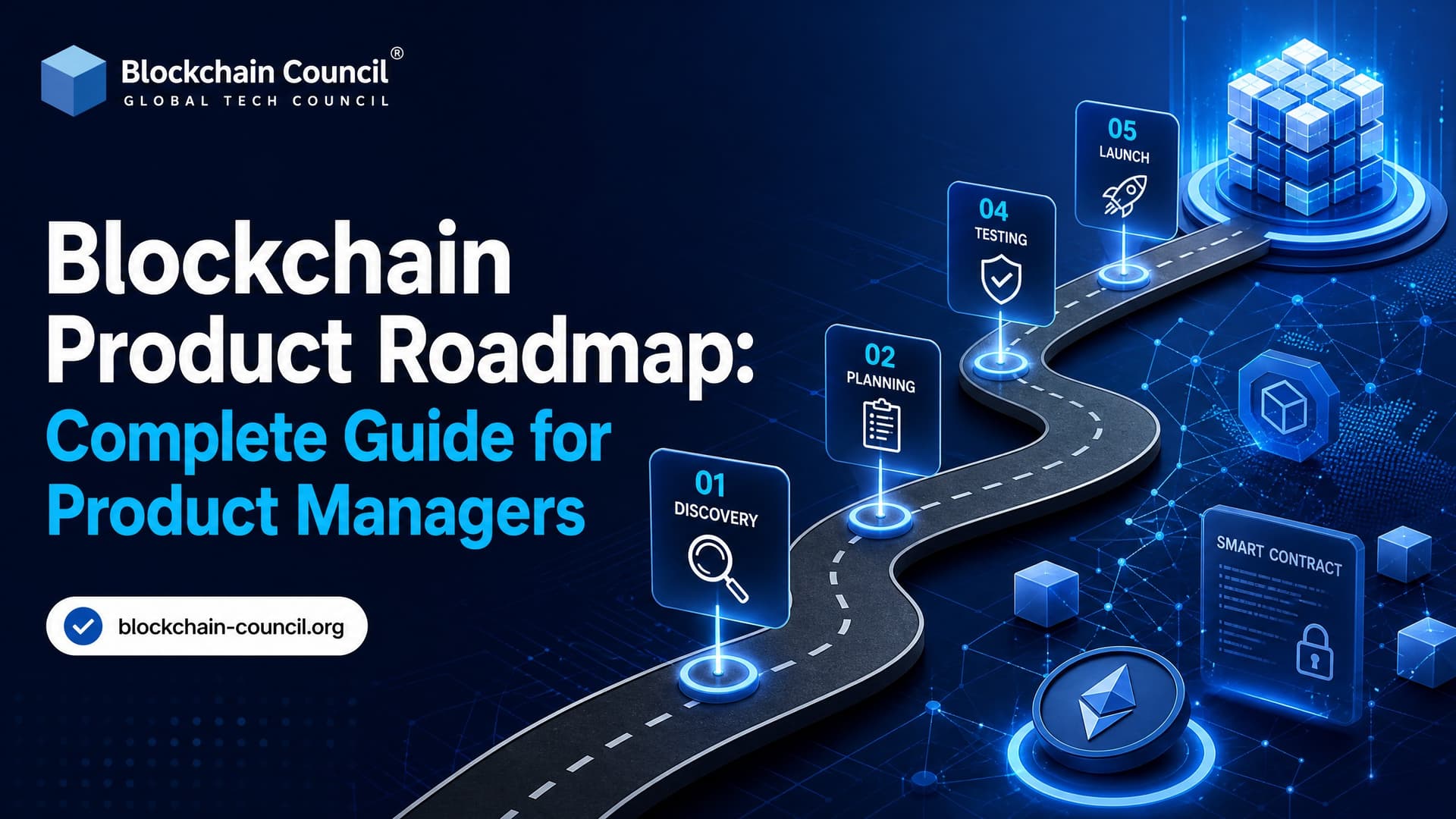
A blockchain product roadmap is not a feature calendar with token dates added to it. It is a living plan that connects product vision, user value, smart contract delivery, security, compliance, token design, and community governance. If you manage blockchain products, your roadmap has to survive shifting gas fees, audit findings, market cycles, and regulatory reviews. That changes the job.
Traditional product management still matters. You still define the customer, prioritize work, write requirements, and align teams. The difference is that your decisions may affect deployed contracts, treasury funds, governance voters, liquidity providers, validators, or enterprise partners. A missed dependency can be expensive. A rushed launch can be worse.

What Is a Blockchain Product Roadmap?
A product roadmap is a strategic plan that explains the vision, direction, priorities, and progress of a product over time. Atlassian describes roadmaps as shared communication tools that balance short-term work with long-term goals and must be updated as plans change. That guidance applies well to blockchain, but the scope is wider.
A blockchain product roadmap usually covers:
- User and business goals: For example, lower settlement time, improve liquidity, prove provenance, or reduce reconciliation costs.
- Architecture decisions: Chain selection, layer 2 plans, bridge strategy, indexing, wallet support, and node infrastructure.
- Smart contract delivery: Testnet, mainnet, upgrade patterns, audits, and bug bounties.
- Tokenomics: Token utility, distribution, emissions, staking, fee capture, and vesting.
- Governance: Forum processes, Snapshot voting, on-chain proposals, DAO treasury controls, and delegation.
- Compliance: KYC, AML, sanctions screening, data protection, securities analysis, licensing, and regional rollout.
- Community growth: Developer docs, SDKs, grants, partnerships, and governance education.
Good roadmaps are understandable. Great blockchain roadmaps are understandable and honest about risk.
Why Blockchain Roadmaps Are Different
Blockchain product managers work with the same basic product questions as any PM: who is the user, what problem hurts enough, what should ship first, and how will success be measured? But decentralized systems add constraints that do not exist in most Web2 products.
Smart contracts are hard to fix after launch
In a SaaS product, you can patch a backend service quickly. On-chain contracts are different. If you deploy immutable Solidity 0.8.x contracts with a flawed access-control function, you may need a migration, a pause plan, or a governance vote. If user funds are involved, the roadmap must include audit time before launch, not after the marketing date is set.
A small deployment detail can also block a release. Anyone who has shipped on Sepolia has probably seen errors like ProviderError: max fee per gas less than block base fee. That is not a strategy problem, but it can ruin a release window if your team has not planned gas settings, relayer funding, and deployment rehearsals. Roadmaps need room for these operational checks.
Governance changes who controls priorities
Many blockchain teams start centralized and move toward community governance. That path is often called progressive decentralization. It sounds clean on a slide. In practice, you need milestones for governance forums, proposal templates, voter education, quorum thresholds, delegated voting, and emergency controls.
Do not hand over admin keys before your community understands the system. To be blunt, a DAO without informed participation is not decentralization. It is unmanaged risk.
Tokens can distort product signals
Token incentives can create growth, but they can also hide weak retention. Liquidity mining may raise total value locked for a short period while real usage remains flat. Your roadmap should separate product-market fit milestones from incentive-driven activity. Measure both.
Core Components of a Blockchain Product Roadmap
1. Vision and problem definition
Start with the reason blockchain is needed. If a normal database solves the problem better, say so. Blockchain is strongest when you need shared state across parties, verifiable ownership, programmable assets, censorship resistance, or settlement without a central operator.
Write the problem in plain language. For example: Importers, banks, and logistics firms need a shared record of shipment documents because email-based reconciliation causes delays and disputes. That is clearer than build a decentralized supply chain ecosystem.
2. Market and user segmentation
Define your primary users. A DeFi lending protocol may serve depositors, borrowers, liquidators, risk managers, and governance delegates. An enterprise blockchain product may serve operations teams, auditors, suppliers, and regulators. Each group has different risk tolerance.
Use interviews, support tickets, on-chain behavior, competitor analysis, and analytics. Product managers in blockchain cannot rely only on Discord sentiment. It is noisy.
3. Architecture and chain selection
Your roadmap should show why you selected a chain or network. Ethereum mainnet, chain ID 1, offers deep liquidity and composability, but gas costs can be high. Layer 2 rollups can reduce transaction costs, but they add bridge and withdrawal considerations. Alternative chains may offer faster confirmation and lower fees, but liquidity, tooling, and security assumptions vary.
Include milestones for:
- Proof of concept and architecture review
- Testnet deployment on networks such as Sepolia or a relevant L2 testnet
- Mainnet deployment
- Indexer setup using tools such as The Graph or custom event pipelines
- Wallet integrations, including MetaMask and WalletConnect
- Cross-chain or multi-chain expansion, if it is truly needed
4. Smart contract development and security
Security should be a roadmap theme, not a checklist item. Include internal reviews, unit tests, fuzz testing, static analysis, audit remediation, and bug bounty launch. Tools such as Foundry, Hardhat, Slither, Echidna, and OpenZeppelin Contracts are common in serious smart contract workflows.
Also decide your upgrade model early. Proxy contracts give flexibility, but they add admin-key risk. Immutable contracts reduce governance risk, but bugs become harder to fix. There is no universal answer. For DeFi holding user funds, I prefer conservative upgradeability with a timelock and a clear emergency pause process during early stages. Later, governance can reduce team control.
5. Tokenomics and governance
A token should have a job. If the token only exists because competitors have one, delay it. Your roadmap should define whether the token is needed for governance, staking, payments, rewards, access, or protocol security.
Plan token milestones carefully:
- Token utility and legal analysis
- Supply, allocation, emissions, and vesting schedules
- Liquidity planning and market-risk controls
- Governance forum launch
- Off-chain voting, then on-chain execution if appropriate
- Treasury management policies
Regulatory review belongs here. Securities and financial conduct rules differ by jurisdiction, and roadmaps often need phased market entry rather than one global launch.
6. UX and onboarding
Users should not need to understand every blockchain detail to complete a task. Roadmap UX work should include wallet connection, transaction status, gas explanation, fiat on-ramp options, account recovery, error handling, and education around irreversible transactions.
Account abstraction, gas sponsorship, MPC wallets, and social recovery can reduce friction. Use them where they fit. Do not add them only because they sound modern. If your product serves advanced DeFi traders, power-user controls may matter more than hiding every detail.
Common Roadmap Formats for Blockchain Products
Time-based roadmap
A quarterly roadmap works well for executives, investors, and public community updates. Use it for broad milestones such as testnet, audit, mainnet, DAO launch, or L2 expansion. Add a clear note that timing may change due to audit findings, governance votes, or legal review.
Theme-based roadmap
This format groups work by outcomes. It is often better for product teams because it avoids fake certainty. Example themes include Security, Liquidity, Compliance, Developer Ecosystem, UX, and Governance.
A strong theme-based objective might be: Reduce failed deposit transactions by 30 percent through better wallet messaging, gas estimation, and relayer monitoring. That is more useful than Improve onboarding.
Layered roadmap
For complex products, split the roadmap into layers:
- Protocol layer: contracts, consensus dependencies, oracle design, risk parameters
- Application layer: front end, dashboards, notifications, analytics
- Governance layer: proposals, voting, delegation, treasury
- Compliance layer: policies, reviews, jurisdictional controls
- Community layer: documentation, grants, events, developer support
This format helps teams see dependencies. For example, you should not schedule a governance token vote before the forum process and delegation documentation are ready.
Lifecycle Phases for a Blockchain Product Roadmap
- Discovery and validation: Prove the problem, test whether blockchain is justified, study competitors, and involve legal early.
- MVP and testnet: Build core contracts and a minimal front end. Deploy to testnet. Watch failed transactions, user confusion, and contract event data.
- Mainnet launch: Launch with conservative limits. In DeFi, cap exposure first. Monitor contracts, oracles, relayers, bridges, and support channels.
- Growth and integrations: Add assets, partners, aggregators, enterprise systems, or SDKs based on actual traction.
- Progressive decentralization: Shift selected decisions from the core team to governance after the process is tested.
- Maintenance and evolution: Improve security, reduce costs, adapt to regulation, and retire features that do not perform.
Metrics That Should Drive Roadmap Decisions
Use data from three places: on-chain activity, product analytics, and community behavior.
- On-chain metrics: Active addresses, transaction volume, total value locked, liquidity depth, protocol fees, failed transaction rate, and contract interactions.
- Product metrics: Activation, retention, conversion rate, time to complete a swap or mint, support tickets, and funnel drop-off.
- Community metrics: Proposal participation, voter turnout, forum quality, developer pull requests, forks, SDK usage, and grant outcomes.
Be careful with vanity metrics. Wallet count can be gamed. TVL can leave when incentives end. A smaller user base that returns weekly may be healthier than a spike caused by rewards farming.
Example: DeFi Roadmap Snapshot
A lending protocol roadmap might look like this:
- Foundation: Core lending contracts, oracle integration, Sepolia testnet, internal security review, first audit, limited mainnet launch.
- Risk-controlled growth: Asset caps, liquidation monitoring, analytics dashboard, second audit, bug bounty, wallet and aggregator integrations.
- Governance: Governance forum, parameter proposal process, token legal review, delegation program, on-chain voting with timelock execution.
- Expansion: L2 deployment, new collateral types, institutional reporting, improved risk engine, cross-chain monitoring if needed.
Notice the order. Governance comes after the protocol proves it can operate safely. Cross-chain expansion comes after monitoring and risk processes exist. That sequencing is not glamorous, but it is how teams avoid avoidable failures.
Skills Product Managers Need
A blockchain PM does not need to be the best Solidity engineer in the room, but you must understand enough to ask hard questions. Learn ERC-20 and ERC-721 behavior, EIP-1559 gas mechanics, wallet signing flows, oracle risk, bridge assumptions, upgrade patterns, and basic threat modeling.
If you want structured learning, Blockchain Council programs such as Certified Blockchain Expert™, Certified Blockchain Developer™, Certified Blockchain Architect™, and Certified Smart Contract Developer™ help product leaders build technical and product depth. Those working on AI and blockchain intersections may also look at Certified Artificial Intelligence (AI) Expert™ as a related path.
Practical Checklist Before You Publish the Roadmap
- Does the roadmap explain why blockchain is required?
- Are audit, legal, and compliance milestones visible?
- Does it separate token incentives from real product adoption?
- Are governance steps realistic for the current community maturity?
- Have you planned testnet rehearsals, deployment scripts, monitoring, and incident response?
- Are metrics tied to outcomes rather than vanity numbers?
- Can non-technical stakeholders understand the trade-offs?
A blockchain product roadmap is part strategy document, part risk register, part coordination tool. Treat it that way. Your next step is simple: draft a one-page theme-based roadmap for your product, add security and compliance as their own tracks, then review it with engineering, legal, and at least five real users before you publish anything to the community.
Related Articles
View All
Blockchain
Product Discovery for Blockchain Products: A Step-by-Step Guide for Web3 Product Managers
A practical Web3 product discovery guide covering wallet behavior, token validation, governance, security, metrics, and testnet pilots.

Blockchain
Tokenomics for Product Managers: Designing Sustainable Blockchain Products
A practical guide to tokenomics for product managers, covering utility, supply, incentives, governance, compliance, and sustainable Web3 product design.

Blockchain
Managing Smart Contract Product Development: A Guide for Product Managers
A practical guide to smart contract product development for product managers, covering lifecycle planning, governance, testing, audits, and launch readiness.
Trending Articles
The Role of Blockchain in Ethical AI Development
How blockchain technology is being used to promote transparency and accountability in artificial intelligence systems.
How Blockchain Secures AI Data
Understand how blockchain technology is being applied to protect the integrity and security of AI training data.
How to Install Claude Code
Learn how to install Claude Code on macOS, Linux, and Windows using the native installer, plus verification, authentication, and troubleshooting tips.