

Stakeholder Management in Web3: Aligning DAOs, Developers, Token Holders, and Investors
 Suyash Raizada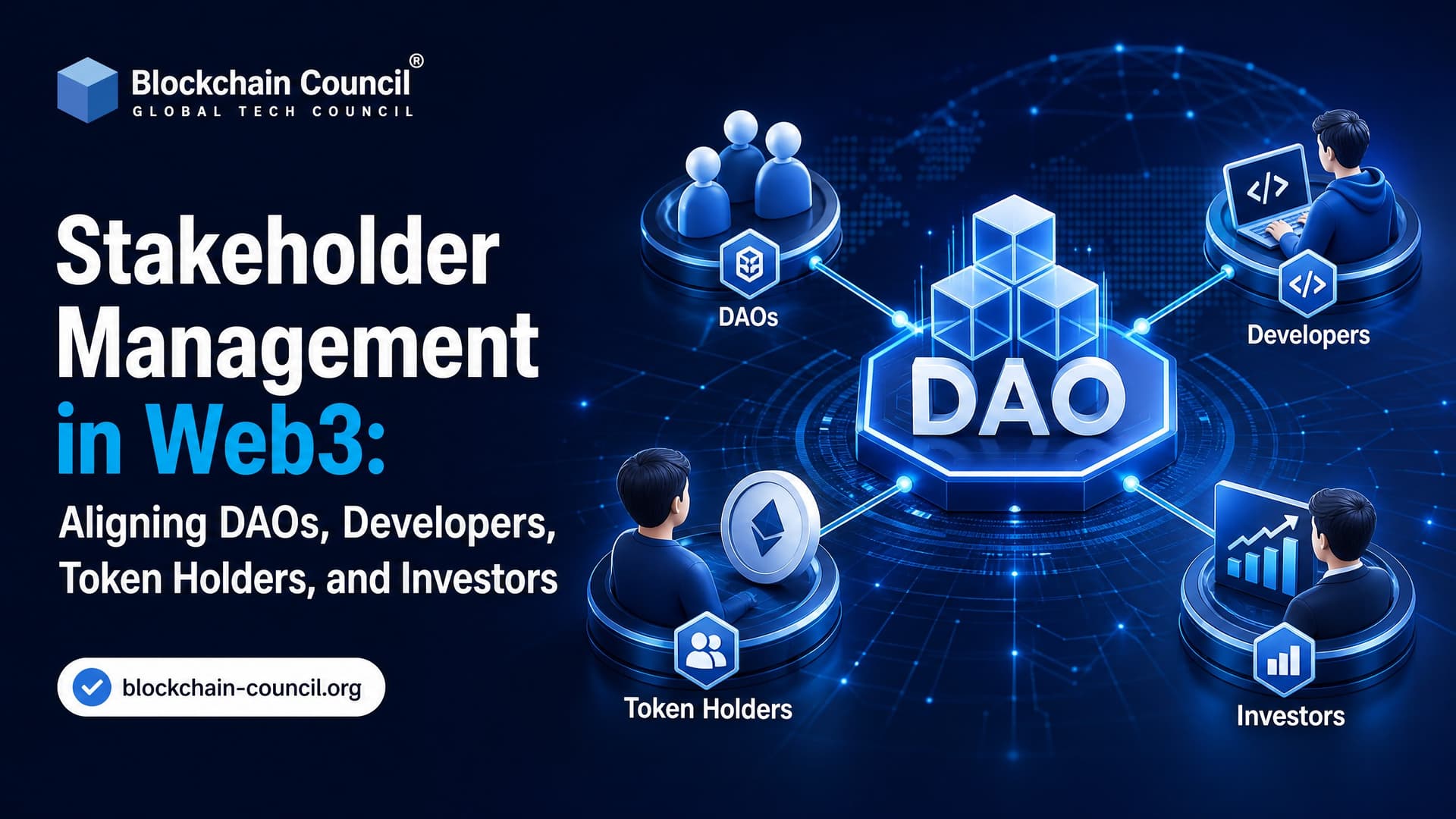
Stakeholder Management in Web3 is not just a community task. It is a governance, security, legal, and capital allocation problem. Developers want stable systems. Token holders want influence, yield, or price appreciation. DAOs need legitimacy. Investors want returns and risk control. If you do not design for these different motives early, your protocol governance can become noisy at best and captured at worst.
The hard truth: many Web3 governance systems look open, but practical control often sits with a small group of whales, delegates, foundations, and exchanges. Good stakeholder management turns that reality into a design constraint, not a surprise.

Who Are the Main Stakeholders in Web3?
A Web3 project usually has more stakeholder groups than a traditional software company. The network, token, smart contracts, treasury, users, and governance forum all create different kinds of power.
Developers
Developers build the protocol, write smart contracts, audit upgrades, maintain front ends, and respond when something breaks at 2 a.m. Their incentives are usually technical: security, uptime, clean architecture, and a roadmap that does not change every time the token price moves.
In practice, developers are constrained by treasury runway, governance approvals, grant cycles, and pressure from holders who may not understand why a security fix is more urgent than a new staking campaign.
Token Holders
Token holders include retail users, early contributors, whales, liquidity providers, exchanges, market makers, and protocol treasuries. In most DAOs, they formally control governance through token-weighted voting or delegated voting.
But formal power is not the same as active participation. Many holders buy tokens for speculation, liquidity mining, or exposure to a sector. They never read forum threads. Some do not even know where to vote.
DAOs and SubDAOs
DAOs manage treasury spending, protocol settings, ecosystem grants, working groups, and sometimes legal relationships. Large DAOs often split work into subDAOs or committees for grants, risk, development, operations, and marketing.
This helps. A risk committee can move faster than a full token vote on every parameter change. Still, you need clear limits. Which decisions can a working group make alone? Which ones require a DAO-wide vote? Write that down before the first serious conflict.
Investors
Investors range from short-term token buyers to strategic funds that help with governance design, exchange strategy, hiring, legal structure, and ecosystem partnerships. The difference matters.
An investor who wants a quick secondary-market exit may push for token liquidity before the protocol is ready. A long-term investor may support vesting, delegated governance, transparent token economics, and developer grants. Same capital category. Very different behavior.
The Current Problem: Governance Is Often Concentrated
Web3 governance has scale, but not always depth. DeepDAO and other governance dashboards have tracked thousands of active DAOs and millions of identified voters across major platforms. Yet many DAOs show little ongoing proposal activity.
Several studies point to the same pattern: voting power is highly concentrated. Reporting from Chainalysis has shown that in some major DAOs, a fraction of one percent of holders can control the bulk of voting power. Academic work on DAO governance across hundreds of organizations and thousands of proposals has found similarly low average voter participation, often in the single digits, with a small share of voters holding most of the voting power.
That is not a small flaw. It changes how you should design governance.
Low turnout means a small group can decide major protocol changes.
High concentration means whales or delegates can dominate outcomes.
Complex proposals discourage normal users from voting.
Speculative ownership weakens long-term stewardship.
To be blunt, token democracy often becomes minority rule unless the system includes delegation, reputation, contribution tracking, quorum design, and legal clarity.
Where Misalignment Happens
Developers vs Token Holders
Developers usually prefer cautious upgrades. Token holders may demand faster releases, higher incentives, or treasury actions that support short-term market sentiment.
A common example is protocol parameter changes in DeFi. A developer may want more testing before adjusting collateral factors or oracle logic. A large holder may want the change passed quickly because it improves yield or token demand. Both may be rational. The protocol still needs a process that protects users.
One detail from real governance engineering: if you test an OpenZeppelin Governor flow after upgrading from Contracts 4.x to 5.x, old string-revert tests can fail because many errors moved to custom errors such as GovernorInvalidProposalState. Small version changes like that can break governance test suites. Non-technical voters rarely see this work, but it affects whether a proposal is safe to execute.
DAOs vs Large Holders
A DAO may describe itself as community-owned, but if the top wallets or delegates can pass proposals alone, the community is mostly advisory. That damages legitimacy.
Decentraland is a useful case. Research has shown average participation per proposal well below 1 percent of eligible addresses, with median participation close to zero. In that environment, governance exists, but only a tiny active subset shapes outcomes.
Investors vs Protocol Health
Investor misalignment is one of the least discussed Web3 risks. Token-first funding can push teams toward listings, attention cycles, and liquidity before product-market fit. Some investors may also act as validators, sequencers, market makers, or delegates, creating overlapping incentives.
This does not mean venture capital is bad for Web3. It means the wrong capital structure can hurt a protocol. Long vesting, public governance participation, disclosure of conflicts, and clear delegate policies are not paperwork. They are stakeholder controls.
Better Stakeholder Management in Web3
1. Define Governance Rights Early
Do not wait until launch week to decide who governs. Specify:
Who receives governance rights: users, contributors, investors, validators, liquidity providers, or a foundation.
What voting power is based on: token holdings, staking, delegation, reputation, or contribution.
Which decisions are on-chain and which stay with elected teams or legal entities.
What quorum and approval thresholds apply to routine, financial, and constitutional decisions.
A simple token vote may work for a small experimental community. It is a poor default for a protocol holding a large treasury.
2. Use Delegation, but Make It Accountable
Delegation helps solve voter apathy. Most holders will not study every proposal. That is normal. Give them a clear way to delegate to people who publish voting rationales and disclose conflicts.
Good delegate systems include:
Delegate profiles with expertise areas.
Voting history and rationale archives.
Conflict-of-interest statements.
Easy redelegation when a delegate stops participating.
Periodic reviews or compensation tied to attendance and quality.
Delegation without transparency just replaces whale control with delegate control.
3. Add Reputation and Contribution Signals
Pure token voting rewards capital. It does not always reward work. Reputation-based systems try to fix that by giving more influence to active contributors, developers, auditors, moderators, researchers, and long-term community members.
These systems may use non-transferable badges, contribution scores, role-based voting, or committee membership. They are not perfect. Reputation can be gamed, and measuring contribution is hard. Still, for technical or domain-specific decisions, contribution-weighted input often beats a raw token vote.
4. Separate Routine Decisions From Critical Changes
Not every vote deserves the same burden. A small grant should not require the same quorum as a treasury merger or core protocol upgrade.
Use tiered governance:
Low-risk decisions: small grants, events, working group budgets.
Medium-risk decisions: treasury reallocations, incentive campaigns, parameter updates.
High-risk decisions: smart contract upgrades, token supply changes, legal restructuring, treasury custody changes.
High-risk decisions should include longer discussion periods, higher quorum, timelocks, security review, and clear execution steps.
5. Build Legal Structure Around Governance
Legal wrappers, foundations, limited liability entities, DAO constitutions, and governance charters help clarify responsibility. They also reduce ambiguity for contributors, investors, counterparties, and regulators.
A European Central Bank working paper on DeFi governance noted how difficult it can be to identify accountable actors when top voters are delegates, exchanges, or protocol-linked wallets. If your governance cannot explain who has authority and who carries responsibility, institutional partners will hesitate.
What Web3 Teams Should Track
If you manage a DAO or protocol, treat governance metrics like product metrics. Track them monthly.
Voter turnout by eligible supply and by address count.
Voting power held by the top 10, top 50, and top 100 wallets.
Delegate participation rates.
Proposal pass rates and execution success rates.
Treasury runway and concentration risk.
Developer activity, such as commits, audits, releases, and bug fixes.
Time from proposal discussion to execution.
Do not only measure Discord members or token price. Those numbers can look healthy while governance is failing.
Where Professionals Should Build Skills
Stakeholder management in Web3 sits between technical design and organizational leadership. If you are a developer, you need to understand governance attacks, treasury risk, smart contract upgrade patterns, and voter behavior. If you are a founder or investor, you need to understand tokenomics, legal wrappers, DAO operations, and incentive design.
For structured learning, Blockchain Council readers can connect this topic with learning paths such as Certified Blockchain Expert™, Certified Blockchain Developer™, Certified Smart Contract Developer™, and Certified Web3 Expert™. These are natural next steps if you want to move from reading governance proposals to designing credible Web3 systems.
Future of Stakeholder Management in Web3
The next stage of Web3 governance will not be pure token voting. That model has shown its limits.
Expect more contribution-based authority, better delegate dashboards, legal wrappers, on-chain execution safeguards, and investor models that reward long-term participation instead of quick liquidity. Protocols will also treat governance quality as an economic signal. Research on digital asset prices has already linked broad participation and stronger cybersecurity with better market outcomes.
The strongest Web3 ecosystems will be the ones that make power visible, constrain concentrated control, reward real contribution, and give developers enough stability to build safely.
If you are launching or joining a DAO, start with one practical step: map every stakeholder group, write down what each group wants, and identify where those incentives conflict. Then design governance around those conflicts. Not around slogans.
Related Articles
View All
Blockchain
Blockchain Product Management Frameworks for Web3 Startups
A practical guide to blockchain product management frameworks for Web3 startups, covering tokens, governance, security, chain selection, and metrics.

Blockchain
Crypto Wallet Product Management: Building Secure, User-Friendly Wallet Experiences
A practical guide to crypto wallet product management, covering custody models, secure UX, threat modeling, metrics, compliance, and wallet roadmap decisions.

Blockchain
Product Discovery for Blockchain Products: A Step-by-Step Guide for Web3 Product Managers
A practical Web3 product discovery guide covering wallet behavior, token validation, governance, security, metrics, and testnet pilots.
Trending Articles
How Blockchain Secures AI Data
Understand how blockchain technology is being applied to protect the integrity and security of AI training data.

Can DeFi 2.0 Bridge the Gap Between Traditional and Decentralized Finance?
The next generation of DeFi protocols aims to connect traditional banking with decentralized finance ecosystems.
Claude AI Tools for Productivity
Discover Claude AI tools for productivity to streamline tasks, manage workflows, and improve efficiency.