Can Agentic AI Improve LLM Transparency and Explainability?

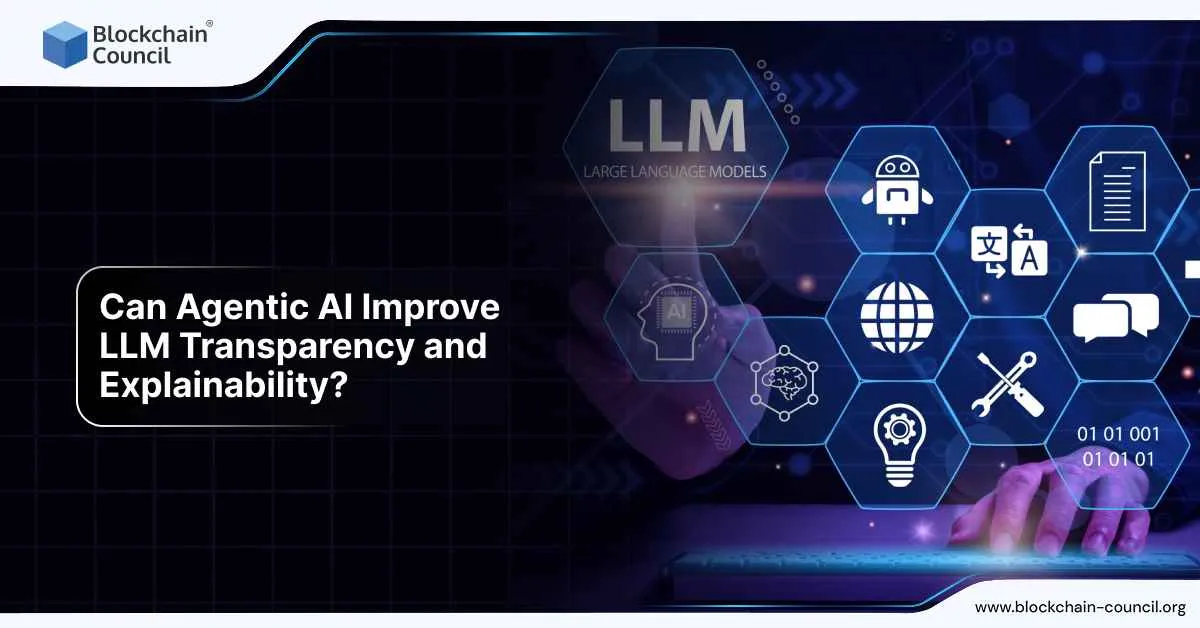
Large language models are powerful, but their inner workings often feel like a black box. Users see outputs without always knowing how those outputs were formed. As agentic AI—systems that plan, act, and reason autonomously—gains ground, this challenge becomes even more urgent. The question is whether agentic AI can actually help us understand complex models better. Early evidence shows that with the right design, agentic systems can make large language models more transparent and explainable. For professionals curious about these advances, an AI certification is a useful way to build knowledge in this area.
Why Transparency Matters in Agentic Systems
In simple applications, you can audit what goes into a model and what comes out. In agentic systems, multiple agents interact, tools are called, and memory is updated along the way. Without visibility, it’s impossible to track how a decision was made or who is accountable. Transparency is not just a technical concern—it’s a regulatory and ethical requirement, especially in industries like healthcare and finance where AI recommendations can have life-changing impacts.

How Agentic AI Enhances Explainability
Agentic AI introduces modular structures that can be logged and monitored. Instead of one long opaque reasoning process, the decision path is broken down into smaller steps. Each agent or tool documents its actions, creating a traceable “chain of custody.” This allows developers and auditors to review not just the final answer but the reasoning process behind it. To gain practical expertise in designing such frameworks, AI certs offer structured training in applied AI systems.
Recent Frameworks Pushing Transparency Forward
Researchers are actively developing models to make agentic systems more interpretable. The TAXAL framework, for example, combines cognitive, functional, and causal layers of explainability, helping end users not just see results but also understand why they are trustworthy. The TRiSM model embeds explainability into trust and security management, ensuring governance at every level of decision-making. In domains where data is central, earning a Data Science Certification can prepare professionals to apply these frameworks effectively.
Techniques That Improve LLM Transparency
| Technique | What It Adds |
| Prompt tracing | Clear trail from input to final output |
| Tool attribution | Identifies which external resource was used |
| Memory logs | Shows what data shaped the response |
| Auditor agents | Adds oversight to monitor decisions |
| Explainable frameworks | Structured reasoning with TAXAL and TRiSM |
| Least-privilege permissions | Prevents agents from overstepping roles |
| Observability stacks | Tracks anomalies, drift, and branching logic |
Industry Applications
In compliance systems, agentic AI has already been used to generate audit logs that regulators can review. In clinical decision support, transparency is critical, with doctors demanding justifications alongside recommendations. Even in customer-facing applications, companies are building observability layers to reassure users that AI actions are traceable and reliable. For leaders balancing technical and business priorities, a Marketing and Business Certification can provide strategies to implement transparent AI responsibly.
Remaining Challenges
Not every problem is solved. Emergent behavior in multi-agent systems can create outcomes no one anticipated. Some explanations generated by models can sound convincing but fail to reflect true reasoning. There’s also the constant tension between performance and transparency—detailed logging may slow systems down. These are challenges researchers and practitioners continue to refine. For those who want to specialize in governance and reliability, the agentic AI certification provides targeted skills for building trustworthy systems.
Looking Beyond Explainability
Explainability is just one part of trustworthy AI. The broader shift in technology emphasizes governance, accountability, and resilience across industries. Combining agentic AI with decentralized systems offers further safeguards, making blockchain technology courses a strong complement for professionals working on secure and transparent infrastructures.
Conclusion
Agentic AI has the potential not only to complicate AI systems but also to clarify them. By structuring decision-making into smaller, auditable steps, embedding observability, and applying frameworks like TAXAL and TRiSM, agentic AI can bring much-needed transparency to large language models. The work ahead lies in balancing performance with accountability and ensuring explanations remain faithful and useful. For professionals, building the right expertise today will help shape AI systems that are not only powerful but also trustworthy and explainable.