

Will AI Get Better at Helping With Music Creation?

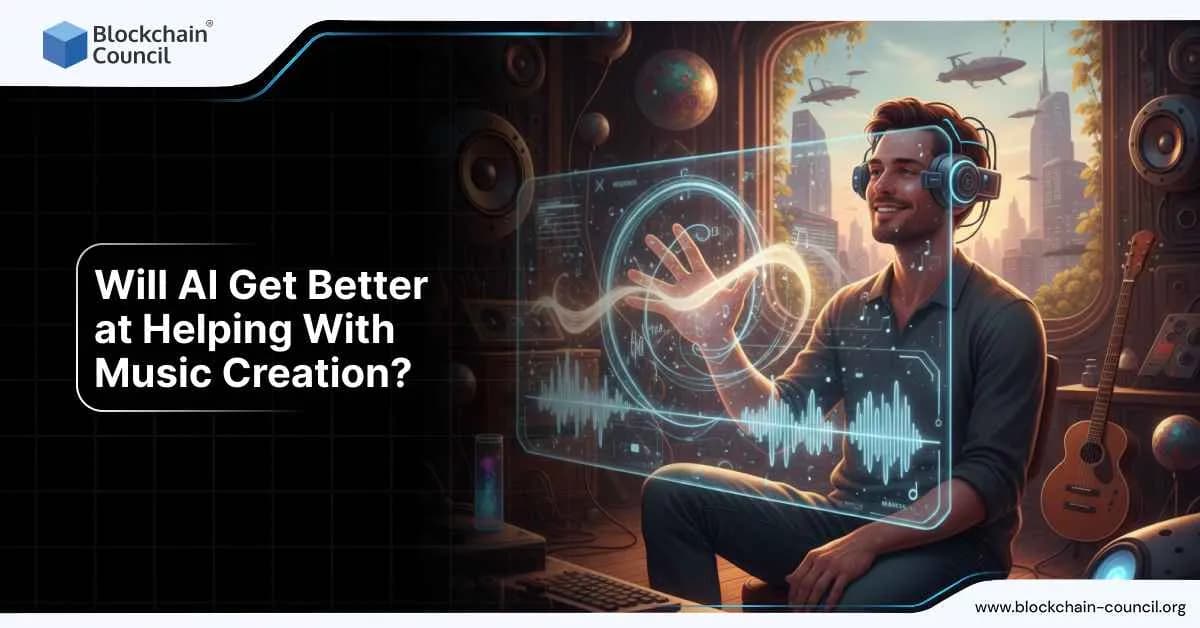
AI is already part of music creation for a lot of people. The real question is whether it will actually get better in ways that musicians, producers, and creators care about, or whether it will just keep generating more songs that all sound the same.
Right now, anyone who understands Artificial intelligence at even a basic level knows that music models are improving fast, but unevenly. That is why many creators who come from an AI Certification background tend to have more realistic expectations. They treat AI as a tool in a workflow, not a magic hit-song machine.

What does “better” actually mean for AI music?
When people talk about AI getting better at music creation, they are usually not asking for more songs. They want better control and fewer frustrations.
Better usually means:
- Cleaner audio with fewer artifacts and noise
- More control over vocals, style, tempo, and key
- Longer songs that stay coherent from start to finish
- The ability to edit parts instead of regenerating everything
- Clear rules around downloads, licensing, and reuse
If those do not improve, most creators do not care how advanced the model claims to be.
Is AI music quality already improving?
Yes, and users notice it, but it comes with tradeoffs.
Tools like Suno and Udio have clearly improved audio clarity and arrangement complexity compared to early versions. Some users say vocals sound more natural now, and genre matching is more accurate.
At the same time, many users complain that newer versions feel smoother but less emotional. The music can sound polished but bland. Noise artifacts, static, and compression issues still show up in real reviews.
So the quality curve is moving up, but not in a straight line.
Why does AI music still feel limited?
The biggest frustration is control.
Most AI music tools still work like a lottery. You prompt, you wait, you regenerate. If one bar is wrong, you regenerate the whole track. You cannot reliably lock a singer, reuse a melody, or fine-tune a section.
Length is another major issue. Short clips are fine for demos, but they break immersion for cinematic, regional, or story-driven music.
Until AI tools behave more like instruments and less like slot machines, this problem will stay.
What parts of AI music are improving fastest?
There are a few clear directions where progress is already visible.
Real-time generation is one of them. Google’s Lyria RealTime points toward music you can steer as it plays, instead of waiting for full renders. That matters because creators want interaction, not just output.
Audio-to-audio workflows are another. People prefer starting with a hum, riff, or sketch and transforming it, rather than generating from text alone.
Control layers are slowly expanding too. Prompt helpers, structure controls, and energy sliders are early steps toward predictable results.
These trends line up with how Artificial intelligence evolves in other creative fields, where controllability always matters more than raw output.
Will AI music tools integrate better with real workflows?
This is where tech matters more than creativity.
Most serious creators want:
- DAW integration
- Stem exports
- MIDI support
- Edit-in-place tools
Right now, many AI music platforms feel closed off. You generate inside their system and hope the export works.
As more developers with a Tech Certification background enter this space, the pressure to open these tools up will increase. Integration is not optional if AI wants to be taken seriously by professionals.
Will licensing and trust get better or worse?
This is the quiet deal-breaker.
Even if AI music quality improves, creators are becoming more cautious. Platform bans, changing policies, and unclear ownership rules make people nervous about building real projects on top of AI-generated music.
Some companies are starting to respond by emphasizing creator ownership and clearer licensing. That trend will likely accelerate, because trust is now a competitive feature.
From a business perspective, this mirrors what creators already see in other digital industries, which is why music tools increasingly overlap with ideas taught in a Marketing and Business Certification mindset. Distribution and rights matter as much as creation.
So will AI get better at helping with music creation?
Yes, but not in the way hype suggests.
AI will get better at:
- Assisting, not replacing
- Editing, not just generating
- Integrating into workflows, not locking creators in
The tools that win will be the ones that feel boringly reliable, not magically creative.
For most musicians, the future is not AI writing the song for them. It is AI helping them finish the song faster, cleaner, and with fewer compromises.
Related Articles
View All
AI & ML
Prompt Engineering to Context Engineering: How to Get Better Results From AI
Learn the journey from Prompt Engineering to Context Engineering. Understand prompts, few-shot and chain-of-thought techniques, context windows, memory, and RAG to get better results from AI.
AI & ML
Can an AI Model Create a Better AI Model Than Itself?
AI can already design architectures, optimizers, and training strategies that beat human baselines, but autonomous recursive self improvement remains unproven.
AI & ML
Google Launches Gemini 4 Argon: Features and Capabilities
Google has launched Gemini 4 Argon, its flagship AI model for coding, finance, law, cybersecurity and science. Learn its key features, availability, pricing and safety details.
Trending Articles
The Role of Blockchain in Ethical AI Development
How blockchain technology is being used to promote transparency and accountability in artificial intelligence systems.
How Blockchain Secures AI Data
Understand how blockchain technology is being applied to protect the integrity and security of AI training data.

Can DeFi 2.0 Bridge the Gap Between Traditional and Decentralized Finance?
The next generation of DeFi protocols aims to connect traditional banking with decentralized finance ecosystems.