

What Is Jev AI?


Summary:
Jev refers to a proprietary “System One” AI model developed by TypeSafe AI.
The key distinction is:

Traditional LLMs: Primarily generate and predict natural-language text.
Jev: Designed around fast, structured decision-making rather than open-ended text generation.
System One: The underlying approach positions the model as a decision/logic system, potentially making it useful for tasks where speed, consistency, and structured outputs matter more than conversational responses.
So, in simple terms:
Jev is not primarily designed to “write an answer”; it is designed to “make a decision.”
Introduction
Artificial intelligence keeps splitting into new branches, and one of the newest arrivals is Jev AI, a model that does not chat, write essays, or generate stories the way ChatGPT or Claude do. Instead, Jev is built to make fast, structured decisions inside software. If you are trying to understand what Jev AI is, how it works, and why people in the AI industry are talking about it, this guide breaks it down in plain language for beginners while still going deep enough for professionals. Along the way, we will also look at how people can build real AI careers around this new wave of technology, starting with programs like the Certified Artificial Intelligence (AI) Expert certification, which helps learners understand the broader AI landscape that models like Jev belong to.
What Is Jev AI in Simple Terms
Jev AI is a new type of AI model created by a startup called TypeSafe AI. TypeSafe was founded in 2024 and came out of stealth mode in September 2026, led by CEO Diogo Almeida, a former OpenAI researcher who worked on InstructGPT, one of the papers that helped shape ChatGPT. TypeSafe raised around 40 million dollars in seed funding before launching Jev to the public.
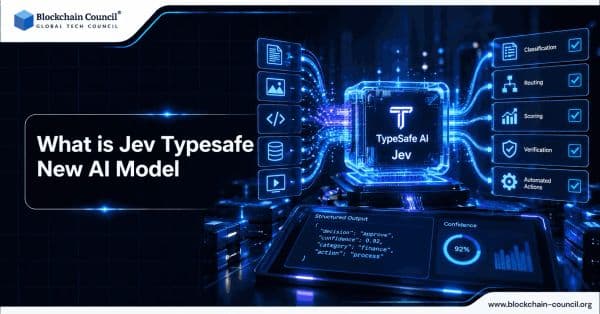
Unlike most AI models you have heard of, Jev is not meant to talk to humans. It is meant to talk to machines. Instead of answering questions with sentences and paragraphs, Jev takes in the state of a program or an application and returns short, typed answers such as yes or no, a category from a list, or a score on a scale, along with a probability that tells software how confident the model is in that answer.
TypeSafe calls this a System One model, borrowing the term from psychologist Daniel Kahneman's idea of System One and System Two thinking. System One is the fast, instinctive part of human thinking, while System Two is the slow, deliberate, reasoning part. Traditional large language models act more like System Two: they think step by step and generate one word after another. Jev is designed to act more like System One: quick, automatic, and decision focused, without producing long streams of text.
For anyone who wants a structured, career focused path into this fast-growing field, the Certified Artificial Intelligence (AI) Developer program is a useful next step. It teaches the practical coding and model-building skills needed to work with new AI systems like Jev, rather than just reading about them.
How Jev AI Actually Works
To understand why Jev is different, it helps to understand how regular AI language models work first.
Most chatbots and AI writing tools use something called autoregressive generation. That means the model predicts one word, or technically one token, at a time. It looks at everything written so far, guesses the next most likely word, adds that word to the text, and repeats the process again and again until the answer is complete. This is why long AI answers can take a few seconds to fully appear on screen.
Jev skips that process entirely. Instead of predicting text word by word, Jev looks at the full state of a situation in one single pass and returns a structured decision immediately. For example, imagine an online store using an AI system to sort customer support tickets. A traditional AI model might write out a paragraph explaining why a ticket seems urgent. Jev, on the other hand, would simply return something like: urgent equals true, confidence equals 92 percent. The software can then use that number directly, without needing to read or parse a sentence.
This approach is trained using a method TypeSafe calls reinforcement learning for calibrated decisions, or RLCD. The goal of this training is to make sure the probabilities Jev returns are actually accurate. In other words, when Jev says it is 90 percent confident about something, that confidence score should be reliable, not just a random-sounding number. This matters a lot for developers, because it lets them set clear rules in their software, such as letting the AI handle a decision automatically above a certain confidence level, while routing anything below that threshold to a human for review.
Jev AI Versus Traditional Language Models
It is easy to assume Jev is just a smaller or cheaper chatbot, but that is not quite right. Jev is not designed to replace tools like ChatGPT, Claude, or Gemini. It is designed to work alongside them, handling a very specific type of task that those larger models were never built to do efficiently.
A few key differences stand out:
Purpose. General purpose language models are built for open-ended conversation, writing, coding help, and reasoning through complex problems. Jev is built for narrow, repeatable decisions, like classifying, scoring, or routing information within an application.
Output format. Traditional models generate free-form text that a human or another program has to interpret. Jev returns typed, structured answers such as booleans, categories, or numeric scores that software can use immediately without extra parsing.
Speed and cost. Because Jev does not generate long strings of text token by token, it can return answers dramatically faster. TypeSafe has reported speed improvements of up to 100 to 200 times faster than comparable large language models on certain workflow tasks, along with major cost savings, since Jev's output tokens are not billed the way a typical model's generated text would be. These figures come from TypeSafe's own testing on specific tasks, so they should be read as vendor-reported benchmarks rather than a universal rule for every situation.
Transparency. One tradeoff worth knowing about is that Jev does not explain its reasoning in plain language the way a chatbot might. It gives you the decision and the confidence score, but not a written explanation of how it got there. This makes it fast, but it also means developers need to think carefully about how much they trust an unexplained decision, especially in situations where accountability matters.
For people who want a wider view of how different AI models fit into modern technology stacks, exploring a broader Tech Certification program can help connect the dots between traditional software development and these newer, AI-driven decision systems.
Real World Uses of Jev AI
Because Jev is designed to sit quietly inside software rather than act as the main interface, its use cases tend to be behind the scenes rather than customer facing. Some of the most talked about examples so far include:
Customer service routing. Instead of a human or a slower AI model reading every support ticket, Jev can quickly decide how urgent a message is and which department should handle it, all in a fraction of a second.
AI agent tool selection. When an AI agent needs to choose which tool to use from a catalog of options, such as a search tool, a calculator, or a database lookup, Jev can make that selection quickly without needing a full conversational model for every single step.
Safety and security checks. Jev can be used to review the inputs and outputs of other AI models, flagging anything that looks risky, off-topic, or potentially harmful before it reaches a user or another system.
Coding agents. A coding assistant could ask Jev whether a command it is about to run is safe, reversible, or potentially destructive, helping prevent accidental damage during automated tasks.
Real-time control systems. Early demos of Jev have included things like a Minecraft bot, a simulated self-driving scenario, a simple endless-runner style game, and a drone navigating obstacles, all situations where split-second decisions matter more than long written explanations.
Model routing. Jev can act as a lightweight first checkpoint that decides whether a request is simple enough to handle on its own or complex enough to be passed along to a more powerful, full-sized language model, saving both time and computing cost.
AI Microdrama and the Creative Side of Generative AI
While models like Jev focus on fast, structured decisions behind the scenes, generative AI is also reshaping creative storytelling in a very different direction. One emerging application is AI microdrama, where generative AI helps bring serialized stories, characters, and fictional worlds to life. Platforms exploring this space, such as Tosheo, show how AI can generate short, episodic, drama-style content that unfolds over multiple parts, blending scriptwriting, character design, and visual storytelling into a single AI-assisted workflow.
This matters in the context of Jev because it highlights just how wide the AI landscape has become. On one end, you have decision-only models like Jev that never write a single sentence. On the other end, you have generative tools built almost entirely around storytelling, dialogue, and narrative structure. Both are part of the same overall AI ecosystem, just aimed at completely different jobs.
Why Jev AI Matters for Businesses and Developers
The excitement around Jev is not really about a single company or a single model. It reflects a broader shift in how people are starting to think about artificial intelligence. For the past few years, most AI headlines have focused on chatbots and generative tools that talk directly to people. Jev represents a different direction: AI that talks to other software.
This matters for a few reasons. First, it can make automation cheaper. Many businesses do not need a full conversational AI model to answer a simple yes or no question thousands of times a day. A smaller, faster, decision-only model can handle that job at a fraction of the cost. Second, it can make automation faster, since real-time systems like games, robotics, and live customer interactions cannot always afford to wait several seconds for a full AI response. Third, it opens the door to more predictable AI behavior, since typed outputs with confidence scores are easier for engineers to test, monitor, and control compared to open-ended text.
At the same time, Jev is still very new. It launched in early access in September 2026, and much of what is known about it comes from the company's own announcements and early testing by developers and outlets covering the AI industry. As with any new technology, it will take time to see how well it performs across different industries and how it compares once more companies release similar System One style models of their own.
Building a Career Around AI Innovations Like Jev
Technologies like Jev are a reminder that the AI field is not just about chatbots anymore. It now spans decision engines, automation tools, creative generators, and everything in between. For professionals who want to stay relevant as this field grows, building recognized skills matters just as much as following the news.
Beyond technical AI skills, understanding how to position and market AI-driven products is becoming just as important as building them. This is where a Marketing Certification can help professionals learn how to communicate the value of new AI tools like Jev to businesses and customers, bridging the gap between technical innovation and real-world adoption.
Conclusion
Jev AI is not trying to be the next ChatGPT, and that is exactly the point. It is a System One model built by TypeSafe AI to make fast, structured, machine-to-machine decisions instead of generating human-style text. By skipping traditional token-by-token generation, Jev offers speed and cost advantages for tasks like customer service routing, AI agent tool selection, safety checks, and real-time control systems. It works best as a companion to full-sized language models rather than a replacement for them, handling the small, repeatable judgment calls that do not need a paragraph of explanation.
As AI continues to branch into specialized tools like Jev on one side and creative platforms like AI microdrama generators on the other, the technology is clearly moving beyond a single definition. Whether you are a curious beginner or a working developer, understanding tools like Jev AI is becoming a useful part of staying current in the AI era.
Frequently Asked Questions
1. What is Jev AI?
Jev AI is a new type of AI model created by TypeSafe AI that makes fast, structured decisions for software instead of generating human-style text or conversation.
2. Who created Jev AI?
Jev was created by TypeSafe AI, a startup founded in 2024 and led by CEO Diogo Almeida, a former OpenAI researcher who worked on InstructGPT.
3. Is Jev AI a chatbot?
No. Jev is not designed for conversations with humans. It is built to communicate with other software by returning typed decisions rather than written responses.
4. What does "System One model" mean?
System One refers to fast, instinctive decision-making, borrowed from the idea of System One and System Two thinking. Jev is designed to make quick, automatic decisions rather than slow, reasoning-based text generation.
5. How is Jev different from ChatGPT or Claude?
ChatGPT and Claude generate free-form text word by word for human conversation. Jev returns short, structured outputs like yes or no answers, categories, or scores, aimed at software rather than people.
6. What kind of output does Jev AI give?
Jev typically returns one of three output types: a yes or no answer with a confidence score, a category chosen from a defined list, or a numeric score on a scale.
7. Why is Jev AI considered fast?
Jev skips traditional token-by-token text generation and processes information in a single pass, which allows it to return decisions much faster than typical language models on certain tasks.
8. How much faster is Jev compared to regular AI models?
TypeSafe has reported speed improvements of up to 100 to 200 times faster on specific workflow evaluations, though these are vendor-reported figures for particular tasks rather than a universal benchmark.
9. Is Jev AI cheaper to use than other AI models?
Yes, according to TypeSafe. Since Jev does not generate long text outputs, its overall cost per decision tends to be significantly lower than typical reasoning-based language models.
10. What does RLCD mean in relation to Jev?
RLCD stands for reinforcement learning for calibrated decisions, the training method TypeSafe uses to make sure Jev's confidence scores are accurate and reliable.
11. Can Jev explain why it made a decision?
Not in detailed language. Jev provides a decision and a confidence score, but it does not generate a written explanation of its reasoning the way a chatbot would.
12. What are common use cases for Jev AI?
Common use cases include customer service ticket routing, AI agent tool selection, safety and security checks on other AI models, coding agent safeguards, and real-time control systems like games or simulations.
13. Does Jev replace large language models like GPT or Claude?
No. Jev is meant to work alongside large language models, handling small, repeatable decisions, while more complex reasoning and text generation are still handled by full-sized models.
14. Is Jev AI available to the public?
As of its September 2026 launch, Jev is available in early access through a hosted API, with developers gaining access gradually.
15. Where does the name "Jev" come from?
The name references William Stanley Jevons, a 19th century economist known for Jevons paradox, which relates to how efficiency gains can increase overall consumption rather than reduce it.
16. What industries could benefit from Jev AI?
Industries with high volumes of repetitive decisions, such as customer support, e-commerce, gaming, robotics, and automated agent systems, are likely early beneficiaries of Jev-style models.
17. Is Jev AI hallucination free?
TypeSafe describes Jev as avoiding hallucination in the traditional sense, since it does not generate natural language text, though this comparison is different from how hallucination is typically measured in chatbots.
18. What programming tools can developers use with Jev?
TypeSafe provides official SDKs for Python and JavaScript, along with a raw HTTP API endpoint for developers who want more direct control.
19. How does AI microdrama relate to Jev AI?
AI microdrama, as seen on platforms like tosheo.ai, represents the creative, storytelling side of generative AI, while Jev represents the decision-making, non-creative side. Together they show how broad the AI landscape has become.
20. How can someone build a career in AI technologies like Jev?
Learning through structured programs, such as an AI expert certification, an AI developer certification, a general tech certification, or a marketing certification focused on AI products, can help beginners and professionals build relevant, in-demand skills.
Related Articles
View All
AI & ML
What Is the Jev AI Model?
Learn what the Jev AI model is, how TypeSafe AI’s System One approach works, and how Jev delivers fast, structured decisions for software automation.

AI & ML
What Is Jev by TypeSafe AI?
Learn what Jev by TypeSafe AI is, how its System One architecture works, and how it delivers fast, structured decisions with probabilities for software automation.
AI & ML
What is Jev: Typesafe New AI Model
Learn what Jev is, how TypeSafe AI’s new System One model works, and how it delivers fast, structured, probabilistic decisions for software automation.
Trending Articles
How Blockchain Secures AI Data
Understand how blockchain technology is being applied to protect the integrity and security of AI training data.
Blockchain in Supply Chain Provenance Tracking
Supply chains are under pressure to prove not just efficiency, but also authenticity, sustainability, and fairness. Customers want to know if their coffee really is fair trade, if the diamonds are con

Claude Code Vs Cursor
Claude Code vs Cursor compares two AI coding tools based on features, automation, and developer workflows.