

Jev AI: the complete guide to TypeSafe's System One Model
 Suyash Raizada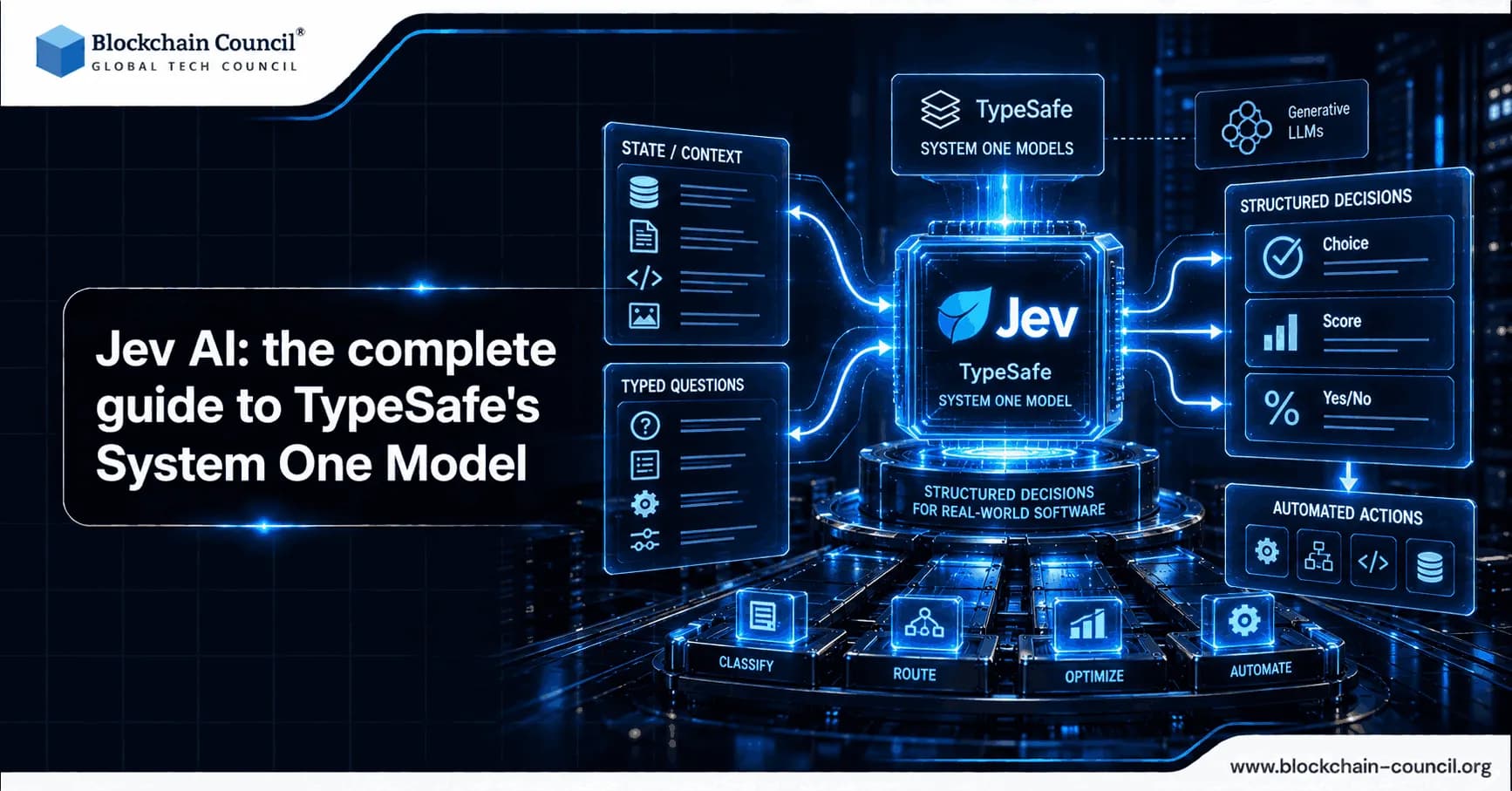
On September 15, 2026, a two-year-old San Francisco startup called TypeSafe AI walked out of stealth with $40 million in seed funding and a model that cannot write a single sentence. That's not a bug. It's the entire pitch. Within a week, Jev AI had become the fastest-adopted model in Vercel's AI Gateway history, landed inside LangChain's agent tooling, and sat at the top of Hacker News for most of launch day.
If you build software that has to make decisions rather than just answer questions, Jev AI is worth understanding properly. This guide covers what it is, how it works, what it costs, where it fits into agents and enterprise systems, and where the skepticism around it is fair.

What is Jev AI
Jev is TypeSafe's first "System One Model," a category the company invented to describe something that isn't a large language model in the way GPT-6, Claude, or Gemini are.
You don't chat with Jev. Instead:
You send it a block of state: a support ticket, a log line, a JSON object, a paragraph of text, anything.
You attach a set of typed questions about that state.
Jev answers every question in a single parallel pass.
The output isn't prose. It's structured: a chosen option, a score on a scale, or a probability between 0 and 1, each carrying its own confidence value.
Founder Diogo Almeida describes Jev as a frontier-intelligence function call. Unstructured state goes in, typed probabilistic decisions come out. No token-by-token text generation, no parsing a wall of text back into code afterward, no hoping the model didn't invent a field that isn't in your schema.
That last part is the whole point. Because the possible answers to a Jev question are defined by the developer in advance, the model cannot return something outside that set. TypeSafe calls this "impossible to hallucinate." Technically true, though the phrase needs a caveat we'll get to later in this guide.
Want to learn more? Read more here What Is Jev AI?
Quick facts about Jev
Developer: TypeSafe AI, founded in 2024, based in San Francisco.
Released: September 15, 2026, in early access.
Current stable version: jev-1.13.0.
License: proprietary, closed weights.
Context budget: roughly 32,000 tokens (about 150,000 characters of English text) shared between state and questions.
Response time: 70 to 500 milliseconds end to end.
Pricing: $0.042 per million input tokens, output tokens free.
What is a System One Model
TypeSafe borrowed the name from Daniel Kahneman's Thinking, Fast and Slow. System 1 is the fast, intuitive, automatic part of human cognition. System 2 is the slow, deliberate, reasoning part.
Large language models, in TypeSafe's framing, are built for something closer to System 2 work: writing, chatting, multi-step reasoning, generating code. A System One Model is built for the other half of cognition, the fast automatic judgment calls that don't need a paragraph of explanation, just a confident answer.
A few things define the category, at least as TypeSafe has built it so far:
It outputs typed values instead of text.
It evaluates multiple questions against one piece of state in parallel rather than sequentially.
It's trained to be calibrated, meaning its confidence scores should actually track real-world accuracy.
It's meant to be called by other software, not read by a person.
"System 1 thinking" has historically implied error-prone, fast, and a little sloppy. TypeSafe pushes back on that association and argues System One Models can be engineered to be more reliable than the alternative, not less, because the answer space is constrained from the start.
Want to learn more? Read more here What is a System One Model
Why Jev: the origin story
Almeida spent roughly four years at OpenAI, where he helped build reinforcement learning from human feedback and worked on InstructGPT, ChatGPT, and GPT-4. He left in 2024 with a specific frustration.
His argument, told to Forbes and TechCrunch around launch, goes something like this:
Chat models got extremely good at pleasing humans because RLHF optimizes for exactly that: text a human rater prefers.
Most of what software actually needs from AI isn't a human-pleasing sentence. It's a decision.
Route this ticket. Is this transaction fraud? Which tool should the agent call next? Should this go to a person or can it be auto-approved?
Businesses have been solving these problems by asking a chat model to output JSON and hoping it doesn't wander off-schema, invent a field, or hallucinate a value.
He called the result of four years of chat-model progress "lightning in a bottle," technology that was genuinely impressive and still not useful for automation. That gap, between what LLMs are good at and what software actually needs, is what TypeSafe spent two years in stealth trying to close.
Want to learn more? Read more here Why Was Jev Created?
The founding team
Diogo Almeida, CEO. Roughly four years at OpenAI on RLHF, InstructGPT, ChatGPT, and GPT-4. Previously at Google Brain.
Sasha Sheng, cofounder. Former research engineer at Meta and FAIR.
Erik Gafni, cofounder. Previously co-founded the DNA-sequencing AI company Ravel, and worked at Invitae and Freenome.
TypeSafe raised $40 million in seed funding led by DCVC, announced the same day as the Jev launch. Forbes reported the round valued the company at roughly $200 million, citing a person familiar with the deal. DCVC general partner James Hardiman described TypeSafe as tackling "one of the biggest remaining challenges in AI: turning increasingly capable models into technology that developers can reliably build into products at scale."
Why is it called Jev
The name isn't random. TypeSafe named the model after William Stanley Jevons, a 19th-century English economist best known for the Jevons paradox: the observation that making a resource more efficient to use doesn't reduce total consumption of it, it increases it. Cheaper coal, in Jevons's original example, didn't mean less coal burned. It meant coal got used everywhere.
Almeida has applied that logic directly to tokens. His bet is that making machine intelligence radically cheaper and faster won't shrink how much of it gets used; it'll multiply it, because entirely new categories of use become viable the moment the cost drops low enough. A decision that costs a fraction of a cent and takes 100 milliseconds can run on every single event flowing through a system. The same decision at LLM pricing and multi-second latency only runs where it's already been budgeted for.
It's a small naming choice, but it tells you how TypeSafe thinks about where this goes next: not as a niche tool for a handful of workflows, but as infrastructure cheap enough to sit underneath almost everything.
Jev architecture: what's known and what's guessed
This is the part where TypeSafe asks for trust it hasn't fully earned yet, and it's worth being honest about that rather than repeating the marketing uncritically.
Want to learn more? Read more here Jev Architecture Explained
What TypeSafe has confirmed
Jev is transformer-based.
It's trained exclusively on synthetic data.
The training method is Reinforcement Learning for Calibrated Decisions, or RLCD.
Under RLCD, probabilities are optimized against real outcomes, not against what a human rater prefers (RLHF) or a programmatically verifiable answer (RLVR).
Questions are evaluated in parallel against shared state, rather than generated one token at a time.
What TypeSafe has not published
An architecture paper.
Model weights.
Parameter count.
Independent, third-party benchmark verification of most of its headline numbers.
What outside researchers have guessed
One independent developer probed the API by watching how latency scaled with different context lengths and question orderings, then published a best-effort reconstruction. The theory: a causal transformer, likely using sparse mixture-of-experts, with shared-state encoding, isolated question branches, and probability readouts pulled directly from internal representations instead of generated as text.
That's an educated guess from outside the company, not a confirmed fact. A technical write-up summed up the state of play well: everything about how Jev achieves its speed is currently a black box, and the comparison Almeida draws (parallel evaluation replacing sequential generation the way transformers replaced recurrent networks) is an assertion, not something demonstrated with evidence anyone outside TypeSafe can check.
Until TypeSafe publishes something more concrete, that's where the architecture question sits.
Choice, Score and Noul: the three primitives
Jev only speaks in three formats. Understanding them is basically understanding the entire API surface.
Choice
Selects one option from a defined set you supply.
Returns the selected option, per-option probabilities, and an overall confidence score.
Supports cardinality up to 255 options in a single question.
Good for routing, categorization, and tool selection in an agent loop.
Score
Rates the state against ordered levels you define, like a rubric.
Returns the score, per-level probabilities, and a confidence value.
Good for urgency ratings, risk levels, quality grading, and sentiment scales.
Noul
Evaluates a yes/no statement against the state.
Returns a single probability between 0 and 1.
Also referred to in some integrations as a boolean primitive.
Good for guardrail checks: is this input safe, was a refund issued, should this escalate.
A worked example
Here's roughly how a support-ticket triage call looks, based on TypeSafe's own documentation and the Cloudflare Workers AI listing for the model:
state: "Help! I was charged twice for order A-104 and nobody has responded in three days."
questions:
is_urgent (noul): "Is this message urgent?"
department (choice): ["billing", "sales", "technical"]
frustration (score): 0 = calm, 1 = frustrated, 2 = very angry
The response comes back in one call, with every field typed and every value accompanied by a probability distribution, something like:
is_urgent: 0.95
department: billing, confidence 0.8, with billing at 87%, technical at 13%, sales at 0%
frustration: score 1.04, confidence 0.94, weighted mostly toward "frustrated"
Because the schema is fixed in advance, there's no JSON parsing, no retry logic for malformed output, and no possibility of the model inventing a department that doesn't exist in your system.
Jev vs other AI models
This is the comparison developers actually care about, so here it is straight.
Existing LLMs (GPT-6, Claude, Gemini) | Jev / System One Models | |
Optimized with | RLHF or RLVR | RLCD |
Optimizes for | Human preference or verifiable correctness | Calibrated probability of an outcome |
Input | Unstructured text, sequential messages | Unstructured text plus structured program state |
Output | Free-form strings, must be parsed | Typed values, guaranteed schema match |
Sampling | Sequential, one token at a time | Parallel, all answers in one pass |
Speed | 3 to 329 seconds end to end for frontier models | 70 to 500 milliseconds |
Input cost | $0.20 to $10 per million tokens | $0.042 per million tokens |
Output cost | Roughly 5x input cost | Free |
Confidence | Often overconfident, inconsistent | Reports calibrated probability on every answer |
Best for | Chat, coding, open-ended reasoning, demos | Routing, classification, scoring, guardrails |
A few things worth pulling out of that table:
Jev gives up general intelligence in exchange for speed, price, and type safety on narrow decisions.
LLMs remain the right tool anywhere the output genuinely needs to be a sentence, a paragraph, or working code.
The comparison only holds for what TypeSafe calls "System One shaped queries," meaning tasks that are already a decision, not a conversation.
One of the fairer critiques circulating after launch: calling Jev a "frontier model" borrows credibility it hasn't earned in the traditional sense, since it can't code, chat, or write a sentence at all. The more defensible claim, and the one the evidence actually supports, is that TypeSafe pushed the speed-and-cost frontier for structured decisions a long way out. That's a real achievement. It's a different achievement from building something that rivals a general-purpose frontier LLM.
Jev and AI agents
This is where Jev has found its clearest home so far. Watch a production AI agent run and most of its steps aren't writing at all; they're decisions:
Route this ticket.
Classify this document.
Is this input safe?
Which tool do I call next?
Should this go to a human?
Teams have been solving these steps with text-generation models, then acting surprised when the model hallucinates a tool that doesn't exist or returns malformed JSON mid-loop. Jev takes the opposite approach: it returns a typed decision with a confidence score instead of a sentence that has to be parsed and validated.
Want to learn more? Read more here Jev vs AI Agents
Where Jev fits in an agent architecture
Routing and triage between subagents or tools.
Classification of incoming requests, documents, or messages.
Scoring records against a rubric before an action is taken.
Validating which tool to call, and whether that tool call is well-formed.
Screening inputs and outputs for jailbreak attempts before they reach a downstream model.
Deciding whether to continue, retry, ask the user for clarification, or stop entirely.
Where Jev does not fit
It can't extract data from unstructured documents on its own, since that's a generative task.
It can't write the reply a customer reads.
It can't do open-ended multi-step reasoning.
It's a specialized decision layer, not a general-purpose model, so frontier LLMs still own the writing and reasoning steps in the loop.
A useful mental model: keep frontier models for the steps that genuinely require writing or multi-step reasoning, and hand the decision steps to Jev. It can still choose the wrong option, so it isn't "never wrong." What it can't do is hallucinate a tool that doesn't exist or break a downstream schema.
Jev and agentic AI
Agentic AI and "AI agents" get used interchangeably, but there's a useful distinction for this specific model. An AI agent is a single loop: perceive, decide, act. Agentic AI describes systems where multiple agents, tools, and decision points chain together with real autonomy, often without a human checking every step.
That autonomy is exactly where a decision layer without hallucination risk matters most, because errors compound across steps.
Why calibration matters more in agentic systems
A single wrong decision in a ten-step agentic pipeline can cascade into a completely wrong outcome by step ten.
Confidence scores let an orchestrator route uncertain cases to a human instead of letting the agent barrel forward on a guess.
Because Jev returns a full probability distribution rather than just a top pick, downstream logic can set its own thresholds for what counts as "confident enough to act automatically."
A practical pattern developers are using
Run Jev first at each decision point in the agent loop.
If confidence clears a threshold, let the agent proceed automatically.
If confidence falls below that threshold, route to a slower, more expensive frontier model, or to a human reviewer.
Use Jev again at the end of the loop to verify the agent's own output before it ships.
This "cheap gatekeeper, expensive fallback" pattern is showing up across the LangChain and Vercel integrations discussed further down, and it's arguably the single most common real-world use of Jev right now.
Jev use cases
TypeSafe and early adopters have converged on a fairly consistent list of where Jev earns its keep. Broadly, it fits anywhere a system already knows the possible answers and just needs something to choose well.
Customer support
Routing tickets to the right queue or department.
Scoring urgency and customer frustration before a human ever sees the ticket.
Deciding whether a refund request matches policy.
Flagging tickets that need escalation versus ones that can be auto-resolved.
Trust and safety
Content moderation and policy violation checks.
Screening prompts and outputs for jailbreak attempts.
Fraud and risk scoring on transactions in real time.
Verifying that an AI agent's tool call or output is safe before it executes.
Sales and growth
Lead scoring based on form submissions or enrichment data.
Classifying inbound contact-form messages as sales, support, or spam.
Candidate filtering in recruiting pipelines.
Data and content operations
Document classification at scale.
Map-reduce style processing over large datasets, turning raw records into structured features.
Quality grading of generated or user-submitted content.
Real-time and interactive systems
Game AI, since 100-millisecond response times are fast enough for interactive loops. TypeSafe's own Doom demo runs Jev queries around 10 times a second at roughly $7 an hour.
Any UX-critical application where a multi-second LLM call would be a visible lag.
Jev developer and API guide
Getting started with Jev looks less like prompting a chatbot and more like calling a typed function.
Requirements
Node.js 20 or newer if you're using the official SDK.
A TypeSafe API key, or access through a gateway provider like Vercel, Netlify, or Cloudflare that handles credentials for you.
State and questions that together fit within the roughly 32,000-token budget.
The basic request shape
A Jev request has two parts:
State: a string, JSON object, or array representing whatever the model needs to evaluate.
Questions: a map of named decisions, each typed as choice, score, or noul.
The model evaluates every question against the state in one parallel call and returns a structured object with the answer, probability distribution, and confidence score for each question, plus token usage.
Example through the Vercel AI SDK
import { experimental_evaluate as evaluate } from 'ai';
const result = await evaluate({
model: 'typesafe-ai/jev',
state: 'The support agent issued a full refund to the customer.',
questions: {
refunded: {
type: 'boolean',
instructions: 'Was a refund issued?',
},
},
providerOptions: {
gateway: { zeroDataRetention: true },
},
});
console.log(result.answers.refunded);
Access points currently available
Direct API through TypeSafe's own console and playground.
Vercel AI Gateway, through the experimental evaluate API in AI SDK 7.0.105 and later.
Netlify AI Gateway, with zero-configuration access through the @typesafe-ai/sdk package inside Netlify Functions.
Cloudflare Workers AI, listed as typesafe/jev, callable through env.AI.run().
LangChain, through a TypeSafeClassifier component exposed via .invoke().
Jev and programming
For engineers, the mental shift Jev asks for is small but real: stop treating AI calls as text generation to be parsed, and start treating them as typed function calls with a return type you already control.
What changes in your code
No more JSON.parse() wrapped in a try-catch hoping the model's output was valid.
No retry loops for malformed structured output.
No prompt engineering aimed at getting the model to "please only return JSON."
Decision logic becomes declarative: you define the schema, Jev fills it in.
Where Jev slots into a typical stack
As a pre-processing step before a request hits your main business logic, to route or classify it.
As a guardrail layer between a frontier model's output and whatever executes that output.
As a scoring function inside a larger pipeline, similar to how you might call a machine learning classifier today, except with natural-language state as input instead of engineered features.
As the decision node inside an agent's control loop, sitting alongside frontier models rather than replacing them.
Developers on Hacker News made a comparison worth repeating: Jev resembles the typed prediction modules in frameworks like DSPy, where an AI call is treated as a typed function rather than a chat turn, except TypeSafe built a model specifically for that job instead of squeezing a general LLM into the role.
Jev, LangChain, and the AI ecosystem
Distribution moved fast for Jev, and the specific integrations tell you a lot about where the industry expects this kind of model to live.
LangChain
LangChain integrated Jev into the control loops developers use to build AI agents within days of launch, exposing it through a TypeSafeClassifier component. Instead of asking a chat model to generate another response for a routing decision, an application submits its current state and a set of typed questions through .invoke() and gets back typed, confidence-bearing answers.
Vercel AI Gateway
Vercel calls Jev the fastest-adopted model in its AI Gateway's history. It's exposed through the experimental evaluate API in AI SDK 7, with example use cases including:
Choosing the next tool or subagent in an agent loop.
Deciding whether to continue, retry, ask the user, or stop.
Scoring urgency or risk before an action executes.
Verifying model outputs and enforcing guardrails.
Netlify AI Gateway
Netlify offers zero-configuration access to Jev through its own AI Gateway and the @typesafe-ai/sdk package, with no API keys to create and usage billed to existing Netlify credits.
Cloudflare Workers AI
Cloudflare lists Jev as a supported third-party model under typesafe/jev, callable through the standard env.AI.run() interface used for every other model on the platform.
The broader pattern
Within three days of launch, Vercel, Cloudflare, LangChain, and Langfuse had all integrated Jev. That speed of adoption across infrastructure providers, rather than just excitement on social media, is the strongest real signal that developers see a genuine gap in their stack that this model fills.
Jev performance and benchmarks
TypeSafe's headline numbers are aggressive, and it's worth separating what's independently verifiable from what's vendor-reported.
The numbers TypeSafe publishes
End-to-end response time: 70 to 500 milliseconds.
Speed advantage over comparable LLMs: 40x to 200x, with a peak figure of 193.6x on TypeSafe's own workflow evaluations.
Cost advantage: 40x to 400x, with a peak figure of 444.6x.
Zero type errors, which TypeSafe describes as not empirical but mathematically guaranteed, since schema matching is enforced by construction.
How TypeSafe built its own evaluation
Rather than measuring against a fixed ground-truth classification, TypeSafe assumes there's a correct compute graph, meaning a workflow represented in code, and compares model predictions against the average of the largest, most expensive external models as a reference. Every model being tested runs the same workflow, so there's no room to overfit a harness to a specific model's quirks.
TypeSafe is unusually candid about the limits of this method:
The workflows were built by members of its own model-capabilities team, so some bias could exist.
The reference answer comes from an average of GPT-6 Astra and Fable 5.1, which biases results toward OpenAI and Anthropic's models and likely underestimates performance relative to other labs like DeepSeek.
The company expects its published numbers to sit at the high end of real-world results, not the median.
Independent signal
The most interesting number published outside TypeSafe's own materials came from Every, whose head of evals ran Jev across 27 published articles plus 10 AI-styled counterparts, asking 21 questions of all 37 documents at once. That worked out to 777 judgments completed in under 0.7 seconds, for roughly a quarter of a cent.
Where the skepticism is fair
Every performance claim TypeSafe leads with is TypeSafe's own.
The architecture is unpublished, and the weights aren't out.
The benchmark dashboard behind the headline multiplier is a set of internal workflow evaluations, not a public leaderboard.
Almeida's own launch post acknowledges the reported gains are likely on the high end of real-world results.
A more grounded way to summarize it: TypeSafe has clearly pushed the speed-and-cost frontier for structured decisions a long way out. Whether that pans out at the multiples advertised, once independent third parties run their own comparisons at scale, is still an open question a few weeks into public availability.
Jev pricing and cost
Pricing is one of the more unusual parts of the Jev story, mostly because of how it's structured.
The rate card
Price | |
Input tokens | $0.042 per million (roughly $42 per billion) |
Output tokens | Free |
Batch pricing | Not currently published |
Cache pricing | Not currently published |
Why output is free
Jev's outputs are tiny by design. A typed answer with a probability distribution and a confidence score is a handful of numbers and labels, not a paragraph. Since the model isn't generating long strings, metering output tokens the way LLM providers do doesn't reflect real cost, so TypeSafe simply doesn't charge for it.
Why input is billed per billion, not per million
Most LLM pricing pages quote cost per million tokens because the volumes involved are relatively modest for chat use cases. TypeSafe quotes per billion because System One workloads are expected to run at a completely different scale: think map-reducing over petabytes of records or evaluating every event flowing through a production system, not a handful of chat turns per user session.
How the cost compares in practice
A typical frontier LLM input costs $0.20 to $10 per million tokens, with output running roughly 5x the input rate.
Jev's input cost works out to a small fraction of even the cheapest LLM input pricing, before accounting for the free output tokens.
On TypeSafe's own workflow evaluations, the cost advantage peaked at 444.6x cheaper than comparable LLM setups.
The caveat worth keeping in mind
TypeSafe itself acknowledges it can't prove its pricing isn't subsidized this early, and says proving long-term sustainability will take time. If you're planning cost projections around Jev at scale, it's reasonable to build in some margin for pricing to shift as the company matures past its early-access phase.
Jev reliability, hallucination, and calibration
This is the section worth reading slowly if you're evaluating Jev for anything that touches real users or real money.
What "can't hallucinate" actually means
TypeSafe's claim is precise, even if the marketing around it sometimes isn't: Jev cannot return an answer outside the schema you defined. If you ask for a choice between three departments, you will always get one of those three departments back, never a fourth option the model invented.
What "can't hallucinate" does not mean
It does not mean the answer is correct.
A wrong answer can still arrive in a perfectly valid, schema-conforming form.
Jev can misclassify a ticket, misjudge urgency, or assign the wrong probability to a fraud check, all while never technically "hallucinating" in the schema-violation sense.
That distinction matters more the higher the stakes of the decision. Schema safety protects your code from crashing on malformed output. It doesn't protect your business from a wrong decision made confidently.
What calibration is supposed to buy you
TypeSafe's RLCD training method aims for calibrated probabilities, meaning:
If Jev reports 90% confidence across a large number of similar decisions, roughly 90% of those decisions should turn out correct.
Consistency: similar inputs should produce similar answers, rather than the input rewrite instability you sometimes see in a chat model that gives you a different answer to the same question phrased slightly differently.
Usable uncertainty: a low-confidence answer is a signal to route to a human or a more capable model, not just noise to be ignored.
How to build reliability into your system anyway
Set a confidence threshold below which decisions route to human review, rather than trusting every answer equally.
Track Jev's real-world accuracy against ground truth in your own domain, since TypeSafe's own benchmarks may not transfer directly to your use case.
Treat "no type errors" as a guarantee about your code's stability, not a guarantee about business outcomes.
Watch for TypeSafe's own published "jaggedness" documentation, where the company details specific known weaknesses in the current model version, an unusually candid move for a young AI lab.
Known limitations: Jev's own "jaggedness" notes
TypeSafe publishes a document it calls Jev's "jaggedness," listing where the current version, 1.13, is weak. That kind of self-disclosure is rare enough from a young AI lab that it's worth treating as a real source rather than boilerplate.
Jev answers the question you wrote, not the one you meant. Ambiguous or poorly specified questions produce confidently wrong answers just as easily as well-specified ones, since the model has no way to ask for clarification.
It can't extract unstructured data on its own. Pulling structured fields out of a messy document is a generative task, and Jev isn't built for it.
Synthetic-data training leaves open questions about real-world edge cases. Since Jev was trained exclusively on synthetic data, how well its calibration holds on unusual, real-world inputs that differ from that training distribution hasn't been independently tested.
Schema safety isn't correctness. Worth repeating here specifically: a wrong answer can still be a perfectly valid, schema-conforming answer, so the "can't hallucinate" claim protects your code, not your decision quality.
Genuinely ambiguous cases will disagree with humans. In TypeSafe's own side-by-side demo against GPT-5.6 Terra, the one point of disagreement was on a churn-likelihood question the company itself admits looks genuinely ambiguous.
None of this is disqualifying. It's the difference between using Jev with eyes open and using it because a launch post said it can't hallucinate.
Jev for enterprise
Enterprise buyers care about different things than individual developers experimenting on a weekend, and Jev's value proposition shifts accordingly.
Why enterprises are paying attention
Predictable, low per-decision cost at high volume, which matters when you're running millions of classification or routing calls a month rather than a few thousand chat turns.
Guaranteed schema compliance removes an entire category of production incidents caused by malformed AI output breaking downstream systems.
Low latency, in the 70 to 500 millisecond range, makes Jev usable inside request paths where a multi-second LLM call would be unacceptable.
Calibrated confidence scores give risk and compliance teams a lever to decide what gets automated versus what requires a human sign-off.
Where enterprise adoption is concentrating early
Customer support routing and triage at scale.
Fraud and risk scoring inside financial workflows.
Document classification pipelines for large volumes of inbound paperwork.
Guardrail layers sitting between existing LLM-based tools and the actions those tools are allowed to take.
What enterprise teams should verify before committing
Data handling and zero-data-retention options, which some gateway integrations already expose as a configurable flag.
SLA guarantees around uptime, given TypeSafe briefly lost the ability to serve users from its API during the launch demand spike.
Independent, third-party benchmark results in your specific domain, rather than relying solely on TypeSafe's own workflow evaluations.
A clear escalation path for low-confidence decisions, built into your own system rather than assumed away.
Jev and marketing
Marketing and growth teams are a natural fit for a fast, cheap classification and scoring model, even though it isn't a household name yet in that world.
Practical marketing applications
Lead scoring based on form fills, enrichment data, or behavioral signals, run in real time instead of batch overnight jobs.
Classifying inbound contact-form submissions as sales, support, or spam before they ever reach a human inbox.
Content moderation for user-generated content, comments, or reviews at a cost low enough to run on every single submission rather than sampling.
Personalization decisions, such as which segment a visitor falls into or which messaging variant best fits a given user profile, evaluated cheaply enough to run per-session rather than per-cohort.
Why the cost structure matters specifically for marketing
Marketing systems often need to make the same type of small decision millions of times a month: score this lead, classify this click, tag this session. At traditional LLM pricing, running that volume through a chat model gets expensive fast. At $0.042 per million input tokens with free output, the economics change enough to make real-time, per-event decisioning realistic instead of something you only run in a nightly batch job.
Teams building this kind of decisioning layer into marketing stacks tend to benefit from a working knowledge of both the marketing funnel and the technical plumbing behind it.
Jev and AI safety
Safety conversations around Jev cut in two directions: what it's good for, and what it introduces as a new risk of its own.
Where Jev strengthens safety
Jailbreak detection, by screening prompts and model outputs for policy violations before they reach a user or execute an action.
Guardrailing agentic systems, by checking whether a tool call, action, or output is safe before it's allowed to proceed.
Reducing a specific, well-understood failure mode: schema-breaking hallucinations that crash downstream systems or trigger unintended actions.
Giving systems a genuine uncertainty signal to work with, rather than a model that answers confidently regardless of how sure it actually is.
Where new risk shows up
The architecture is a black box. Without a published paper or open weights, independent safety researchers can't fully audit how Jev arrives at its probabilities.
Guaranteed schema compliance is not the same as guaranteed correctness, and treating the two as equivalent is a real risk if a team over-trusts the "can't hallucinate" framing.
Training exclusively on synthetic data raises open questions about how well calibration holds up on real-world edge cases that differ from the synthetic distribution used in training.
As a fast, cheap, always-on decision layer, Jev could plausibly be used to automate decisions that deserve more scrutiny than a 70-millisecond model call provides, purely because it's cheap enough to run everywhere.
A reasonable safety posture for teams adopting Jev
Use confidence thresholds as a genuine gate, not decoration, and route low-confidence cases to humans or slower models.
Audit real-world accuracy in your own domain rather than assuming TypeSafe's benchmarks transfer directly.
Keep Jev in the role TypeSafe itself describes: a decision layer, not a replacement for human judgment on consequential calls.
Watch for independent research into the model's actual architecture and failure modes as more of it surfaces over time.
What's next for Jev and TypeSafe
TypeSafe has been explicit that Jev is an early step, not the finished product. A few things worth tracking:
The company has said it plans to build additional System One Models in new modalities beyond text, meaning image or other structured input types are likely on the roadmap.
Early access is still expanding, with TypeSafe pulling developers off a waitlist as capacity allows rather than opening the model to everyone at once.
TypeSafe has said it wants direct feedback from developers on which decisions they need automated, positioning the current model as a starting point shaped by what the community builds with it rather than a fixed target.
Nothing here is confirmed on a timeline. But the direction is consistent with the company's founding thesis: this is meant to be the first of a category, not a one-off product.
Learning path: how to actually get good at Jev and System One Models
Reading about Jev is one thing. Being useful with it inside a real product or a real marketing stack is another. Where you start depends on where you're coming from, so here's a path split by background rather than one generic list.
If you're coming from marketing or growth
You don't need to write the integration code yourself, but you do need to understand what a decision layer can and can't do for lead scoring, moderation, and personalization, so you can brief a technical team properly instead of asking for the wrong thing.
Start with a Digital Marketing Course from Universal Business Council if you want a structured foundation in how funnels, segmentation, and automation actually work before layering AI decisioning on top of them.
Learn the vocabulary in this guide well enough to speak to engineers: state, questions, Choice, Score, Noul, confidence threshold.
Pick one narrow use case, like classifying inbound leads, and shadow the build so you understand what data the model needs and where it can go wrong.
If you're a developer new to this kind of model
Jev asks for a different mental model than prompting a chatbot, so the fastest path is hands-on, not theoretical.
Build a broader technical base with Tech Certifications from Global Tech Council if you're still shaky on the programming fundamentals that sit underneath any API integration work.
Set up a small project through one of the existing gateways, Vercel, Netlify, or Cloudflare, since they remove the credential setup friction and let you focus on writing questions and reading responses.
Practice writing schemas first. Get comfortable defining Choice, Score, and Noul questions before worrying about performance or scale.
Add a confidence threshold to every project you build, even a toy one, so the habit of routing low-confidence answers somewhere safe becomes automatic.
If you want to go deeper into the AI and infrastructure side
Once you're past the basics and want to understand what's actually happening architecturally, or you want to build the kind of decision-layer infrastructure TypeSafe is building, this is where the learning gets more specialized.
Work through Deep Tech Certifications from Blockchain Council to build real depth in the areas that sit under models like Jev, from training methods to how these systems get deployed at scale.
Read TypeSafe's own published documentation and their "jaggedness" notes closely. Understanding a model's stated weaknesses teaches you more than the highlight reel does.
Follow independent research on Jev's architecture as it comes out, since the space between what TypeSafe claims and what's been verified is exactly where the most useful learning happens right now.
Try reproducing a small version of TypeSafe's workflow evaluation approach on your own data. Comparing a decision model against a reference answer from a stronger model is a technique worth understanding on its own, well beyond just Jev.
A rough order to follow, whichever path you're on
Understand the three primitives cold before you touch code.
Build one small, low-stakes project end to end.
Add confidence thresholds and a human fallback before you add scale.
Only then start optimizing for cost and latency, since premature optimization here just means tuning a system you don't fully trust yet.
Conclusion
Jev AI is TypeSafe's bet that the next wave of AI progress won't be readable by humans at all, and it will live quietly inside software making decisions instead of generating text anyone sees. The model itself is narrow by design: three primitives, Choice, Score, and Noul, evaluated in parallel against a shared block of state, returned in well under a second at a fraction of typical LLM pricing.
What's genuinely new here is the shape of the product. Jev is a System One Model, trained with a method TypeSafe calls RLCD to produce calibrated probabilities instead of human-pleasing text, and its schema-locked output makes an entire category of production failures structurally impossible. That's why LangChain, Vercel, Netlify, and Cloudflare all integrated it within days of launch, and why Hacker News spent a full day arguing about whether "frontier model" is the right label for something that can't write a sentence.
The honest caveats matter just as much as the pitch. The architecture is unpublished, the weights are closed, every headline benchmark number comes from TypeSafe's own evaluations, and "can't hallucinate" describes schema safety, not correctness. A wrong answer can still arrive in a perfectly valid form. TypeSafe has been unusually candid about these limits itself, publishing its own list of known weaknesses rather than burying them.
For developers, the practical takeaway is simple: if your system already knows the space of possible answers and just needs something fast and cheap to choose well, whether that's routing tickets, scoring leads, screening agent tool calls, or classifying documents at scale, Jev AI is worth testing against whatever you're doing today with a general-purpose LLM squeezed into a decision-making role it was never really built for. Keep the frontier models for the writing and the reasoning. Let Jev handle the decisions.
Frequently asked questions
What is Jev AI in simple terms?
Jev is an AI model from TypeSafe AI that makes structured decisions instead of generating text. You give it data and a set of predefined questions, and it returns typed answers like a chosen category, a score, or a probability, rather than a written response.
Is Jev a large language model?
No. TypeSafe explicitly built Jev as something different, called a System One Model. It's transformer-based but doesn't generate text, so it isn't an LLM in the conventional sense.
Who created Jev AI?
Jev was built by TypeSafe AI, founded in 2024 by Diogo Almeida, Erik Gafni, and Sasha Sheng. Almeida previously worked at OpenAI on RLHF and ChatGPT.
When was Jev released?
Jev launched in early access on September 15, 2026, alongside a $40 million seed round led by DCVC.
What does "System One Model" mean?
It's a model category TypeSafe invented, referencing Daniel Kahneman's distinction between fast, intuitive System 1 thinking and slow, deliberate System 2 reasoning. Jev is built for the fast, automatic decision-making side rather than open-ended reasoning.
What are Choice, Score, and Noul?
They're Jev's three question types. Choice selects one option from a defined set, Score rates a state against ordered levels, and Noul returns a yes-or-no probability between 0 and 1.
How much does Jev cost?
Input tokens cost $0.042 per million. Output tokens are free, since Jev's answers are small structured values rather than generated text.
How fast is Jev compared to a typical LLM?
TypeSafe reports end-to-end response times of 70 to 500 milliseconds, versus 3 to 329 seconds for many frontier LLMs on comparable tasks.
Can Jev hallucinate?
It can't return an answer outside the schema you define, which TypeSafe calls impossible to hallucinate. It can still return a wrong answer within that schema, so correctness isn't guaranteed the same way format is.
What is RLCD?
Reinforcement Learning for Calibrated Decisions, the training method behind Jev. Instead of optimizing for human rater preference like RLHF, it optimizes probabilities against real outcomes so confidence scores stay meaningfully accurate.
Can I use Jev to write content or code?
No. Jev doesn't generate text of any kind. For writing or coding tasks, you still need a conventional LLM.
Does Jev work with LangChain?
Yes. LangChain integrated Jev through a TypeSafeClassifier component that exposes it via .invoke() for routing and control decisions inside agent loops.
Is Jev available through Vercel, Netlify, or Cloudflare?
Yes to all three. Vercel exposes it through the AI SDK's experimental evaluate API, Netlify offers zero-configuration access through its AI Gateway, and Cloudflare lists it as typesafe/jev in Workers AI.
What is Jev's context window?
Roughly 32,000 tokens shared between the state and the questions, equivalent to about 150,000 characters of English text.
Is Jev's architecture public?
No. TypeSafe hasn't published a technical paper, architecture details, or model weights, which has drawn criticism from independent researchers who want to verify its performance claims.
What are Jev's best use cases?
Ticket routing, fraud and risk scoring, content moderation, lead scoring, document classification, and guardrail checks inside AI agent workflows.
What can't Jev do?
It can't extract unstructured data on its own, write prose, generate code, or handle open-ended multi-step reasoning. It's a decision layer, not a general-purpose model.
Is Jev suitable for enterprise use?
Early enterprise interest is concentrated in support routing, fraud detection, and document classification, though teams should verify SLA guarantees and run independent accuracy checks in their own domain before relying on it for high-stakes decisions.
How is Jev priced compared to GPT or Claude for the same task?
TypeSafe's own workflow evaluations claim up to 444.6x cheaper than comparable LLM setups on narrow decision tasks, though that figure is self-reported and the company itself says to treat it as a high-end estimate.
Is Jev only useful for developers?
Mostly, since it's accessed through an API or SDK rather than a chat interface. Non-technical teams typically encounter Jev indirectly, through products built on top of it, such as support tools, fraud systems, or marketing platforms that use it under the hood.
Related Articles
View All
AI & ML
Jev and the System One AI Approach
Explore Jev and TypeSafe AI’s System One approach, including how fast, structured, probabilistic decisions differ from traditional LLM-based workflows.

AI & ML
What Is a System One Model?
Learn what a System One Model is, how it differs from traditional large language models, and why TypeSafe AI designed this model class for fast, structured, machine-native decision-making.

AI & ML
Jev AI: Complete Guide
Explore Jev AI in this complete guide, including how TypeSafe AI’s System One model works, its features, use cases, benefits, limitations, and role in software automation.
Trending Articles
AWS Career Roadmap
A step-by-step guide to building a successful career in Amazon Web Services cloud computing.

Top 5 DeFi Platforms
Explore the leading decentralized finance platforms and what makes each one unique in the evolving DeFi landscape.
What is AWS? A Beginner's Guide to Cloud Computing
Everything you need to know about Amazon Web Services, cloud computing fundamentals, and career opportunities.