

Top Forward Deployed Engineer Skills for the AI and Data-Driven Era
 Suyash Raizada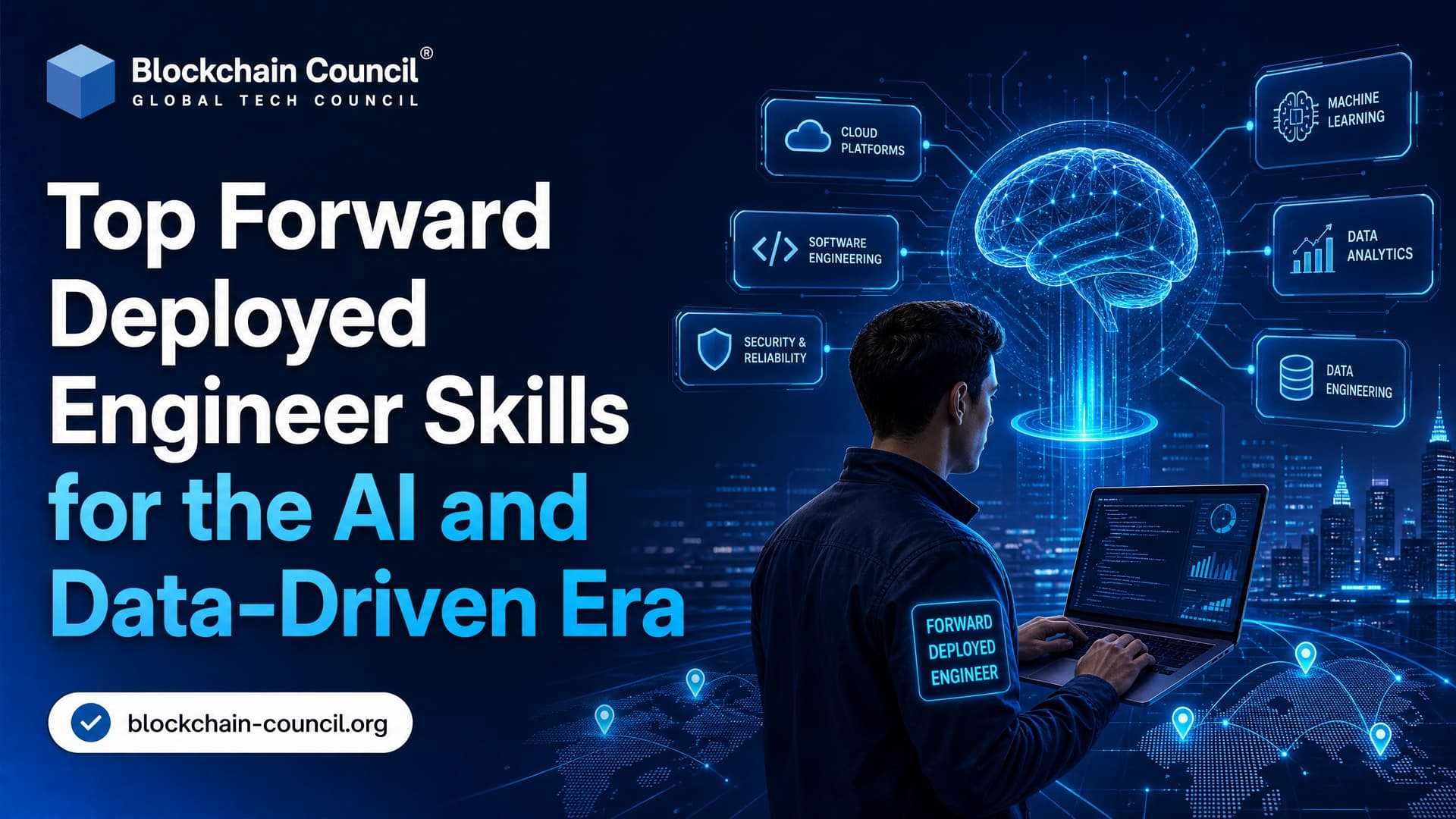
Forward deployed engineer skills sit at the intersection of software engineering, data engineering, applied AI, security, and customer-facing product work. You are not just shipping code. You are taking an AI or data platform into a messy customer environment, connecting it to real systems, proving value, and leaving behind something the customer can run on their own.
That mix is rare. It is also why the role keeps gaining attention. PwC's AI Jobs Barometer reports that AI-exposed roles are far more likely to require leadership and strategic thinking, even at junior levels. IBM's workforce research continues to place AI and cybersecurity among the most urgent skill areas. For a forward deployed engineer, those trends show up in a single week: a pipeline breaks, a model drifts, a security review blocks production, and an executive still wants a clear answer by Friday. Discover the most in-demand Forward Deployed Engineer skills including AI integration, cloud architecture, stakeholder management, and data-driven solution delivery through a Forward Deployed Engineer Certification, developing AI deployment expertise with an MLOps Certification, and strengthening business communication through a Digital Marketing Course.

What Does a Forward Deployed Engineer Actually Do?
A forward deployed engineer, often called an FDE, is a software engineer who works close to the customer, sometimes on-site and often in daily contact with customer teams. The job sits between product engineering, solution architecture, consulting, and implementation.
In practice, you may be asked to:
Integrate an AI platform with the customer's data warehouse, APIs, identity provider, and internal applications.
Build custom workflows that reflect how operators, analysts, doctors, bankers, or logistics teams actually work.
Turn vague business goals into measurable technical outcomes.
Deploy, monitor, and improve AI systems in production.
Train users and hand over enough documentation so the system survives after you leave.
To be blunt, this is not a role for engineers who only want neatly scoped tickets. The customer environment is the product environment. You need judgment, not just syntax.
1. Strong Software Engineering and Systems Design
The first layer of forward deployed engineer skills is still plain software engineering. You need to write clean code, debug distributed systems, and understand how services behave under load.
Python is the default language in many AI and data teams, but do not stop there. Java, Scala, Go, TypeScript, and SQL all show up in enterprise stacks. If the customer has a decade-old Java service feeding a Kafka topic, your Python notebook will not be enough.
What you should be comfortable with
API design, authentication flows, and service-to-service communication.
Containers with Docker and orchestration with Kubernetes or managed cloud services.
CI/CD pipelines, environment promotion, rollback plans, and release hygiene.
Cloud infrastructure across AWS, Microsoft Azure, or Google Cloud.
Observability: logs, metrics, traces, and alerts that help you find the real failure.
A common beginner mistake is treating deployment as the final step. It is not. In a customer environment, deployment is where the truth starts. Network rules, IAM policies, proxy settings, data residency controls, and change boards can all turn a working demo into a failed rollout.
2. Data Engineering Skills That Hold Up in Production
AI projects fail more often because of bad data than bad algorithms. That is why data engineering is one of the most important skill groups for FDEs.
You should be able to inspect source systems, write SQL without guessing, design data models, and build pipelines that do not collapse when volume doubles. SQL and Python stay foundational because they sit close to the daily work: querying, profiling, transforming, validating, and explaining data.
Core data engineering skills for FDEs
SQL: joins, window functions, query plans, indexes, and basic performance tuning.
Python: data processing, API clients, testing, and automation scripts.
Data modeling: facts, dimensions, entities, event streams, and domain models.
Big data tools: Apache Spark for large-scale processing and Kafka for streaming use cases.
Orchestration: Airflow, Dagster, Prefect, or cloud-native workflow services.
Data quality: schema checks, null checks, anomaly detection, lineage, and ownership.
One detail that catches new engineers: Spark's CSV reader treats columns as strings unless schema inference is enabled or an explicit schema is supplied. That tiny default can quietly break downstream model features, especially dates and numeric fields. Real FDE work is full of these small, expensive details.
3. Applied AI, Generative AI, and MLOps
A forward deployed engineer does not always need to be a research scientist. In most enterprise projects, the higher-value skill is knowing how to make AI useful, safe, observable, and maintainable.
Generative AI demand has climbed sharply in job postings, and many organizations now expect engineers to understand model APIs, retrieval-augmented generation, embeddings, vector databases, evaluation, and prompt behavior. The bar is rising fast.
What applied AI means for an FDE
Know when to use an existing model API and when a custom model is justified.
Design retrieval pipelines that ground answers in approved enterprise data.
Measure model output quality with task-specific evaluations, not vibes.
Monitor latency, cost, drift, hallucination patterns, and user feedback.
Plan fallback behavior when a model, vector store, or external API is unavailable.
Here is a practical opinion: do not fine-tune first. For many enterprise use cases, retrieval, better data cleaning, improved prompts, and workflow redesign solve more problems than fine-tuning. Fine-tuning has a place, but it is often the wrong first move when the real issue is missing context or poor data governance.
MLOps also matters. You should understand model registries, deployment strategies, monitoring, drift detection, feedback loops, and version control for data and prompts. When a LangChain project moves from older 0.1-style imports to the 0.2 package structure, you may hit errors such as ModuleNotFoundError: No module named 'langchain_community' unless dependencies and imports are updated. That is not glamorous work. It is production work.
4. Security, Privacy, and Compliance Awareness
FDEs often touch customer data before anyone else on the vendor side. That makes security awareness non-negotiable.
You do not need to be a full-time security engineer, but you do need the basics well enough to avoid dangerous architecture choices. That covers identity and access management, encryption, secure secret storage, audit logging, network boundaries, and least-privilege access.
AI adds another layer. You may need to think about prompt injection, data leakage through model outputs, access-controlled retrieval, model abuse, and whether sensitive data should ever leave the customer's environment. In regulated sectors such as finance, healthcare, insurance, and critical infrastructure, compliance is not paperwork after the build. It is part of the design.
5. Product Thinking and Customer Discovery
The best FDEs do not simply ask customers what feature they want. They watch the workflow, find the constraint, and build toward an outcome.
Product leaders, including the Silicon Valley Product Group, have described forward deployed engineering as a way to speed up product discovery because engineers sit close to real users. That is exactly the point. You see what breaks, what users ignore, and what decision-makers actually measure.
Questions strong FDEs ask early
What decision will this AI system improve?
Who will use it each day?
What data is trusted today, and what data is ignored?
What happens if the model is wrong?
Which metric proves that this deployment worked?
That last question matters. A model with 92 percent offline accuracy may still fail if it adds three minutes to a frontline workflow. Your job is not to defend the model. Your job is to make the system useful.
6. Communication, Consulting, and Executive Presence
AI-exposed roles increasingly demand strategic thinking and leadership. For FDEs, this is daily work. You may need to explain data readiness to a CTO, risk controls to a compliance team, and workflow changes to frontline users, all before lunch.
Good communication is specific. Instead of saying the data is messy, say that 18 percent of customer records are missing a stable identifier, which prevents reliable entity matching. Instead of saying the model needs improvement, say that false positives are concentrated in one region because the training data underrepresents that workflow.
You should be able to write clear project notes, run technical workshops, manage expectations, and say no when a request is unsafe or unrealistic. That last part is underrated. Client-facing does not mean agreeing with everything.
7. Change Management and Enablement
AI systems change how people work. If users do not trust the output, or if managers do not adapt the process, the deployment stalls.
Forward deployed engineers often become change agents by default. You may create training materials, write runbooks, collect user feedback, refine workflows, and help customer teams build internal capability. NACE has reported rising demand for AI skills even in entry-level roles, which shows how broad the upskilling need has become.
Plan for adoption from the start. Build documentation while you build the system. Identify power users. Create escalation paths. Show where the AI is confident, where it is uncertain, and where a human must stay in control.
8. Responsible AI and Governance
Bias detection, model interpretability, fairness-aware sampling, data lineage, and governance are no longer specialist-only topics. FDEs need enough fluency to spot risks early.
This matters most when AI influences hiring, lending, healthcare, fraud detection, public services, or safety-related operations. You should know how to document model behavior, explain inputs and outputs, track data provenance, and raise concerns when a use case crosses ethical or legal boundaries.
Learn how technical, analytical, and client-facing skills combine to make successful Forward Deployed Engineers in modern AI organizations through a Forward Deployed Engineer Certification, mastering operational machine learning with an MLOps Certification, and building customer engagement expertise through a Digital Marketing Course.
How to Build Forward Deployed Engineer Skills
If you want to become a stronger FDE, build a portfolio that proves you can operate across the stack. Do not only publish notebooks. Ship systems.
Build a data pipeline: ingest data, validate it, transform it, and serve it through an API or dashboard.
Add an AI layer: use embeddings, retrieval, or a model API to solve a real workflow problem.
Deploy it: use Docker, cloud hosting, CI/CD, monitoring, and rollback steps.
Secure it: add authentication, role-based access, secret management, and audit logs.
Document it: write a handover guide, user guide, and known-failure playbook.
Present it: explain the business goal, trade-offs, risks, and measurable outcome.
Build the Skill Stack Now
The strongest forward deployed engineer skills are not isolated. Software engineering without customer judgment produces unused tools. AI knowledge without data engineering produces fragile demos. Communication without technical depth produces slideware.
FAQs
1. What are the most important skills for a Forward Deployed Engineer in the AI era?
The most valuable skills include AI implementation, cloud computing, system integration, software development, data engineering, problem-solving, stakeholder communication, and enterprise solution deployment. These capabilities help FDEs bridge the gap between technology and business outcomes.
2. Why is AI knowledge becoming essential for Forward Deployed Engineers?
Organizations are increasingly deploying AI-powered solutions, AI agents, and intelligent automation systems. Forward Deployed Engineers must understand how these technologies work, how they integrate with existing systems, and how they can be optimized for business use cases.
3. How important is programming for a Forward Deployed Engineer?
Programming is a core skill because FDEs frequently build integrations, automate workflows, customize solutions, and troubleshoot technical issues. Languages such as Python, JavaScript, SQL, and Go are especially valuable.
4. Why are cloud computing skills critical for Forward Deployed Engineers?
Most modern enterprise applications and AI platforms operate in cloud environments. Knowledge of AWS, Microsoft Azure, and Google Cloud Platform enables FDEs to deploy, scale, and manage solutions effectively.
5. What role does data engineering play in Forward Deployed Engineering?
Data is the foundation of AI and analytics systems. FDEs often work with data pipelines, ETL processes, data integration, storage solutions, and analytics platforms to ensure systems function correctly.
6. How do API integration skills help Forward Deployed Engineers?
Enterprise solutions rarely operate in isolation. API integration skills allow FDEs to connect applications, automate workflows, exchange data between systems, and create seamless user experiences.
7. Why is understanding AI agents important for modern FDEs?
AI agents are increasingly being used to automate tasks, support decision-making, and manage workflows. FDEs must understand how to deploy, configure, monitor, and optimize these intelligent systems.
8. What DevOps skills should Forward Deployed Engineers develop?
Knowledge of Docker, Kubernetes, Terraform, Git, CI/CD pipelines, and infrastructure automation tools helps FDEs streamline deployments and manage scalable environments.
9. Why are solution architecture skills valuable for Forward Deployed Engineers?
Solution architecture helps FDEs design systems that meet technical and business requirements. Understanding architecture principles allows them to create scalable, secure, and efficient implementations.
10. How important is cybersecurity knowledge in the FDE role?
Security is a critical consideration in every deployment. FDEs should understand authentication, access control, encryption, compliance requirements, and security best practices to protect enterprise systems.
11. Why is stakeholder communication considered a key skill?
Forward Deployed Engineers frequently interact with executives, project managers, developers, and end users. Strong communication skills help translate technical concepts into business-friendly language and ensure alignment among stakeholders.
12. What problem-solving abilities are required for Forward Deployed Engineers?
FDEs regularly encounter complex deployment challenges involving infrastructure, integrations, workflows, and user requirements. Strong analytical and troubleshooting skills are essential for identifying and resolving issues efficiently.
13. How does project management contribute to FDE success?
Project management skills help FDEs coordinate resources, manage timelines, prioritize tasks, and ensure successful technology implementations while meeting customer expectations.
14. Why is adaptability important for Forward Deployed Engineers?
Technology evolves rapidly, especially in AI and cloud computing. FDEs must continuously learn new tools, platforms, frameworks, and methodologies to remain effective in changing environments.
15. What role does customer-centric thinking play in the FDE profession?
Successful FDEs focus on solving business problems rather than simply implementing technology. Understanding customer goals ensures solutions deliver measurable value and support long-term success.
16. How can data analytics skills benefit Forward Deployed Engineers?
Data analytics helps FDEs monitor system performance, identify optimization opportunities, measure deployment success, and provide actionable insights to customers and stakeholders.
17. Why are workflow automation skills increasingly valuable?
Organizations seek efficiency through automation. FDEs who can design and implement automated workflows using AI and software tools help businesses reduce manual effort and improve productivity.
18. How important is collaboration in Forward Deployed Engineering?
FDEs work closely with engineering teams, product managers, customer success teams, executives, and clients. Strong collaboration skills help ensure successful project execution and technology adoption.
19. Which emerging skills will become more important in the future?
Skills related to Agentic AI, large language models (LLMs), AI orchestration, intelligent automation, AI governance, cloud-native architectures, and enterprise AI deployment are expected to become increasingly valuable.
20. How can professionals build these Forward Deployed Engineering skills?
Professionals can develop these skills through hands-on projects, cloud and AI certifications, open-source contributions, enterprise implementation experience, technical training programs, and continuous learning focused on emerging technologies.
Related Articles
View All
AI & ML
Is the Certified Forward Deployed Engineer Certification Worth It in 2026? A Complete Review
The Certified Forward Deployed Engineer certification validates the technical, consulting, and customer-facing skills needed for one of tech's fastest-growing roles. Discover whether it's worth pursuing in 2026, who should earn it, and the career opportunities it can unlock.

AI & ML
Why Top Tech Companies Are Hiring Forward Deployed Engineers in 2026
Top technology companies are hiring Forward Deployed Engineers to bridge the gap between engineering and customers, accelerate AI deployments, and deliver tailored enterprise solutions. Learn why demand for this role is growing in 2026.
AI & ML
How to Prepare for GPT 5.6: Skills, Tools, and AI Careers
Learn how to prepare for GPT 5.6 with practical generative AI skills, tools, career paths, and a roadmap for professionals and teams.
Trending Articles
The Role of Blockchain in Ethical AI Development
How blockchain technology is being used to promote transparency and accountability in artificial intelligence systems.
How Blockchain Secures AI Data
Understand how blockchain technology is being applied to protect the integrity and security of AI training data.
How to Create Claude Skills?
Claude Skills are one of the most important features Anthropic has introduced for users who want automation that is structured, consistent and reusable. Instead of giving Claude long instructions ever