

Snke Unveils SnkeXR, an Open-Platform AR Headset
 Michael Willson
Snke has officially unveiled SnkeXR, a next-generation augmented reality headset built as an open platform for enterprise and medical applications. Designed for precision, safety, and scalability, the SnkeXR brings immersive visualization and real-time collaboration to industries where reliability matters most. Its arrival reflects a growing shift in AR technology — from entertainment tools to professional instruments that integrate seamlessly with AI-driven workflows. This makes it an exciting development for professionals pursuing an AI certification to deepen their understanding of how artificial intelligence and immersive systems converge.
What Makes SnkeXR Different
Unlike consumer AR devices, SnkeXR has been engineered for technical, medical, and industrial use. It features a lightweight, ergonomic design optimized for long wear, high-definition optics for clarity in complex environments, and powerful onboard computing for real-time spatial mapping.

The most distinctive aspect of SnkeXR is its open-platform architecture. Developers, manufacturers, and integrators can build customized applications directly on top of the headset. This flexibility allows it to serve as both a research tool and a production-ready device across multiple sectors.
The device includes precision tracking, advanced sensor arrays, and a modular hardware framework that supports add-ons such as surgical navigation systems, 3D scanning tools, and AI-enhanced analytics. Its open ecosystem is designed to support innovation rather than restrict it — a crucial step toward building adaptable AR solutions for professional use.
The Shift from Consumer to Clinical and Industrial AR
The SnkeXR’s design philosophy is built around real-world reliability. In healthcare, it can project 3D medical imaging onto patients during surgery or allow remote specialists to assist procedures in real time. In manufacturing, it can overlay assembly instructions or highlight errors in product lines. In research, it can simulate complex models that respond to user gestures.
This move signals a broader industry transformation: AR is evolving from a novelty into a productivity platform. The headset’s accuracy, open development framework, and compatibility with professional tools make it suitable for high-risk, precision-dependent environments where error margins are minimal.
Technical Capabilities
SnkeXR’s hardware and software suite combine AR optics with deep spatial computing:
- Optical see-through display: Provides clear visuals while keeping users connected to their surroundings.
- High-accuracy tracking: Captures spatial orientation and depth for millimeter-level precision.
- Ergonomic build: Designed for comfort during long-duration procedures or training sessions.
- AI integration support: Enables real-time analysis, pattern recognition, and adaptive visual guidance.
- Open developer toolkit: Encourages third-party innovation across industries like healthcare, defense, logistics, and education.
These features ensure that SnkeXR can function as a flexible platform capable of supporting both enterprise-grade and research-level demands.
Use Cases Across Industries
Healthcare
In medicine, SnkeXR can enhance surgical planning, training, and remote collaboration. Surgeons can visualize CT or MRI scans in 3D directly over a patient, while medical trainees can practice operations in a risk-free, simulated environment.
Manufacturing
In manufacturing and maintenance, workers can follow AI-guided visual instructions projected onto machinery, reducing human error and downtime. It can also facilitate remote inspections, enabling experts to supervise operations from different locations.
Education and Research
SnkeXR offers institutions a new way to explore interactive learning. Complex subjects such as anatomy, architecture, and physics can be visualized in immersive, hands-on formats that increase retention and engagement.
Enterprise Collaboration
In corporate settings, the headset can host virtual meetings where team members interact with 3D models, charts, and holographic dashboards in real time.
Professionals looking to understand and integrate such technologies can benefit from a Tech certification, which focuses on bridging technical systems with real-world business applications.
The Role of Open-Platform Design
The open-platform approach makes SnkeXR more than just hardware — it’s a foundation for innovation. Developers can tailor AR interfaces to meet domain-specific needs, from hospital integration to industrial quality assurance. This adaptability encourages collaboration between software teams, device manufacturers, and enterprise users.
It also opens opportunities for startups and independent developers to create specialized AR solutions without building hardware from scratch. As AI becomes central to spatial computing, this flexibility will accelerate the fusion of augmented reality and machine intelligence.
Challenges Ahead
While SnkeXR represents a leap forward, its adoption depends on key factors:
- Cost and accessibility: Medical-grade hardware tends to be expensive, potentially limiting early rollout.
- Software ecosystem: Widespread success requires a robust library of industry-specific applications.
- Training and onboarding: Teams must learn how to use and maintain the headset efficiently.
- Regulatory approval: For healthcare applications, compliance and validation will be crucial.
- User comfort: Long sessions demand lightweight design, adjustable optics, and minimal fatigue.
These challenges highlight the importance of aligning AR hardware innovation with business and operational strategies — an area covered by the Marketing and business certification for leaders planning to implement such technologies responsibly.
The Strategic Significance
SnkeXR’s launch underscores a broader technological convergence. The line between AI, AR, and IoT is blurring, giving rise to environments where machines and humans collaborate through spatial interfaces. With AR now entering regulated and data-intensive sectors, trust and accountability are as important as performance.
Enterprises adopting SnkeXR will need experts who understand both the technical and ethical implications of immersive technologies. From predictive maintenance to digital twin simulations, the possibilities are expanding — and so is the need for skilled professionals who can manage them.
Looking Ahead
The release of SnkeXR marks a defining moment for enterprise AR. It represents a commitment to openness, interoperability, and industry-grade reliability. As adoption grows, expect to see partnerships across medtech, manufacturing, and academia that push AR beyond visual augmentation into intelligent decision support.
By combining immersive visualization with AI-driven insights, SnkeXR sets the foundation for the next generation of spatial computing. For professionals, this is a call to action — to upskill, innovate, and prepare for a future where augmented intelligence becomes a daily reality.
Conclusion
SnkeXR is more than a headset; it’s a blueprint for how AR can integrate seamlessly with enterprise and clinical ecosystems. Its open-platform approach invites collaboration, its precision design ensures reliability, and its AI compatibility prepares it for the connected workplaces of tomorrow.
For individuals and organizations alike, the launch highlights the growing importance of interdisciplinary expertise. Investing in structured programs like AI certification, Tech certification, and Marketing and business certification can empower professionals to lead confidently in an era defined by augmented and intelligent technologies.
Related Articles
View All
AI & ML
Meet KIMI K3
KIMI K3 is the latest AI model in the Kimi family, designed to deliver stronger reasoning, coding, multilingual capabilities, and agentic workflows. Discover its key features, use cases, and how it compares with other leading AI models.

AI & ML
How to Use ChatGPT at Work: Practical Guide for Teams and Professionals
Learn how to use ChatGPT at work for reports, research, automation, coding, and team workflows while keeping data security and human review in place.
AI & ML
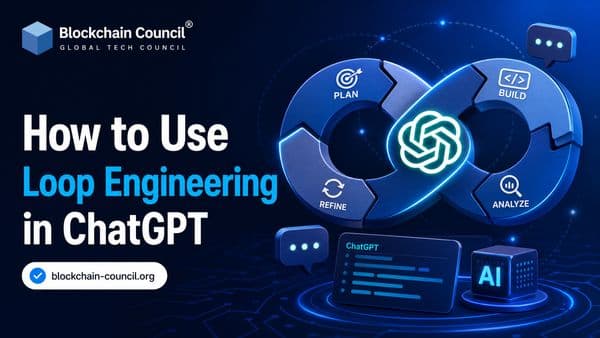
How to Use Loop Engineering in ChatGPT
Learn how Loop engineering turns ChatGPT into a repeatable AI workflow with goals, verifiers, memory, tools, budgets, and safe stop conditions.
Trending Articles
The Role of Blockchain in Ethical AI Development
How blockchain technology is being used to promote transparency and accountability in artificial intelligence systems.
AWS Career Roadmap
A step-by-step guide to building a successful career in Amazon Web Services cloud computing.
How Blockchain Secures AI Data
Understand how blockchain technology is being applied to protect the integrity and security of AI training data.