

How to Secure AI Models in Production: Hardening Pipelines, APIs, and Inference Endpoints
 Suyash Raizada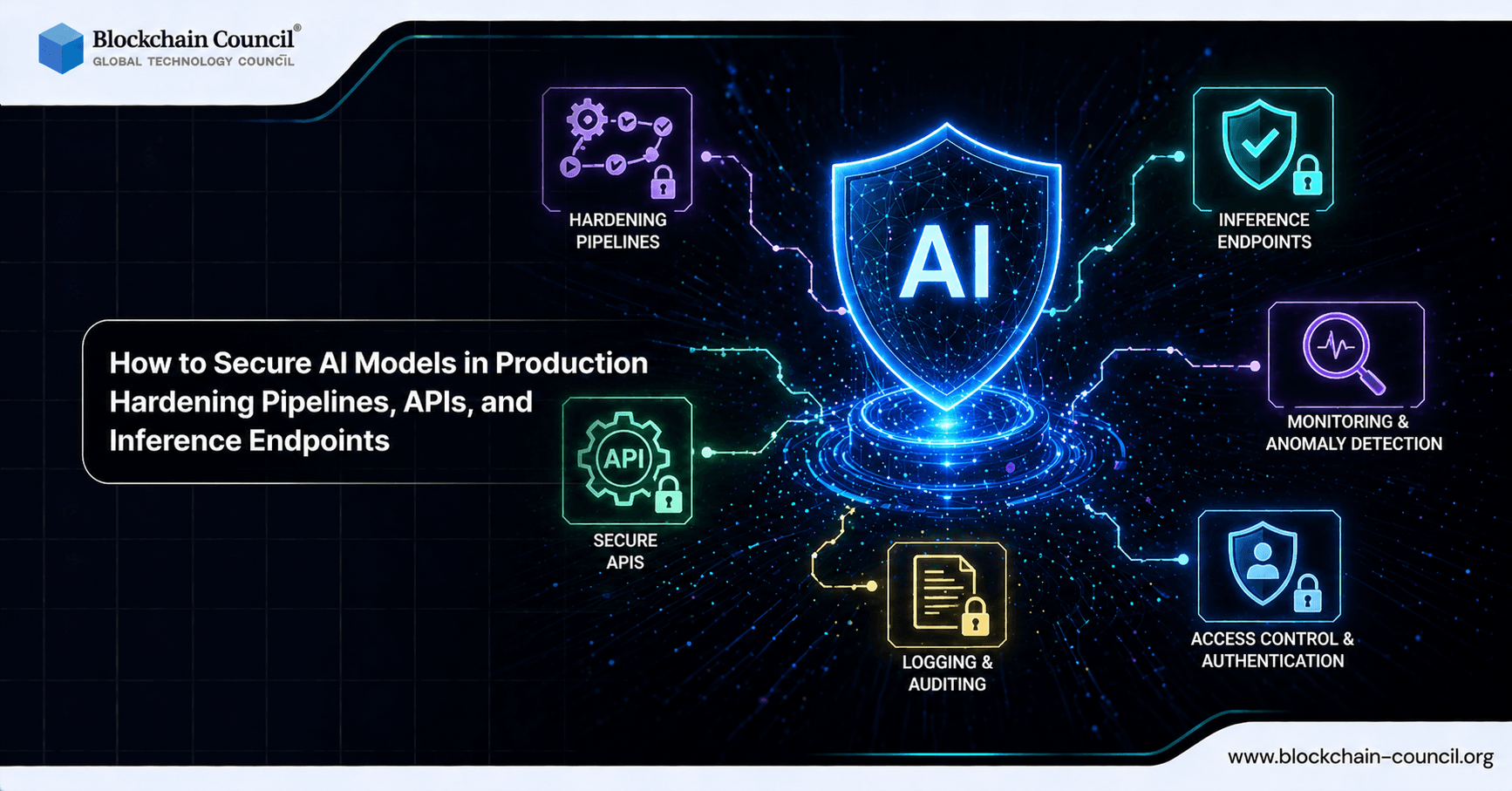
Securing AI models in production requires more than protecting a single server or adding an API key. Modern AI systems span data ingestion, training, packaging, CI/CD, and always-on inference endpoints. Each layer introduces distinct attack paths, including supply chain tampering, prompt injection, GPU abuse, model extraction, and privacy leaks. A practical security strategy hardens the pipeline with artifact signing and verification, protects AI APIs with strong authentication and rate controls, and safeguards inference endpoints with isolation, monitoring, and AI-specific defenses such as differential privacy and watermarking.
This guide explains how to secure AI models in production using a multi-layered approach aligned with Zero Trust and DevSecOps practices central to enterprise deployments in 2025 and beyond.

Why Inference Endpoints Are the Primary Attack Surface
Inference endpoints are public or semi-public by design. They must accept high-volume requests, process untrusted inputs, and return outputs that can be probed repeatedly. This makes them a common target for:
Model extraction and inversion: attackers send repeated queries to replicate behavior or infer training data characteristics.
Prompt injection and adversarial inputs: malicious prompts attempt to override system instructions, leak data, or trigger unsafe tool use.
Infrastructure and GPU abuse: unauthorized usage increases cost and can degrade availability for legitimate users.
Because attacks can resemble normal traffic, production security must combine traditional controls - identity, network segmentation, logging - with AI-specific detection and response capabilities.
Harden the AI Pipeline: Supply Chain Security from Data to Weights
Pipeline hardening ensures that what you trained and tested is exactly what you deploy. This is where many high-impact compromises occur, particularly when teams rely on external datasets, open-source dependencies, and pre-trained weights.
1) Enforce Artifact Signing and Integrity Checks
Use cryptographic signing for all deployable artifacts, including model weights, tokenizer files, configuration files, and inference containers. Common patterns include SHA256 checksums and signature verification gates in CI/CD.
Sign model artifacts at build time in a controlled environment.
Verify signatures at deploy time, failing closed if verification fails.
Store artifacts in trusted registries with immutable versioning.
This reduces the risk of swapped or modified weights and helps prevent deployment of unapproved models.
2) Add Backdoor and Tamper Checks for Pre-Trained Weights
Pre-trained weights can contain hidden triggers or malicious behavior. Incorporate backdoor detection checks into the pipeline and restrict sources to trusted registries. Where feasible, run targeted evaluations that attempt to elicit anomalous behaviors or known trigger patterns before promoting a model to production.
3) Apply SBOM-Style Visibility to AI Components
As AI stacks grow more complex, track provenance for models and serving components in a manner similar to software bills of materials. Capture:
Dataset sources and versions
Training code commits and dependency versions
Base container image digests
Model and tokenizer hashes
Even without perfect standardization, this improves auditability and accelerates incident response and rollback when poisoning or tampering is suspected.
4) Embed DevSecOps Checks into AI CI/CD
Treat AI services as first-class production software: apply automated scanning, fuzz testing, and explicit security sign-offs before release. Recommended CI/CD controls include:
Dependency and container scanning for known vulnerabilities
Static and dynamic testing for inference APIs and gateways
Adversarial testing using malicious prompts and malformed inputs
Policy checks that enforce approved models, configurations, and permissions
For teams formalizing these practices, Blockchain Council programs such as the Certified AI Security Professional (CAISP), Certified Cybersecurity Expert (CCE), and Certified DevSecOps Professional provide structured, role-based competency frameworks.
Protect AI APIs: Identity, Rate Limiting, and Input Controls
APIs are both the control plane and the cost center for production AI. Poorly protected endpoints can enable account takeover, unauthorized inference, and systematic probing.
1) Strong Authentication and Authorization (Zero Trust Aligned)
Use short-lived credentials and function-specific permissions. Separate permissions by capability:
Inference-only tokens for standard clients
Fine-tuning or training permissions reserved for controlled automation
Administrative actions restricted with MFA and strong audit trails
Implement RBAC and enforce MFA for privileged actions such as model promotion, key rotation, and policy changes.
2) Rate Limiting to Reduce Abuse and Extraction
Rate limiting is both a security and cost-control mechanism. High-volume query patterns are commonly used in model extraction attempts and GPU abuse. Consider layered controls:
Token-based limits per user, per key, and per organization
Concurrency caps to protect GPU pools and avoid noisy-neighbor impact
Adaptive limits based on risk signals such as new keys, unusual geography, or repeated failures
In production, pair these limits with clear error messaging and retry guidance to avoid disrupting legitimate traffic.
3) Input Validation, Sanitization, and Schema Constraints
Prompt injection and adversarial inputs exploit ambiguous input handling. Reduce risk by narrowing what the model can accept and what downstream tools can execute:
Validate content type, size, and allowed fields (strict JSON schemas for tool calls)
Sanitize untrusted user input before placing it into system prompts or tool contexts
Constrain tool permissions and enforce allowlists for external URLs or connectors
For retrieval-augmented generation, validate document sources and separate contexts for system instructions, retrieved content, and user messages to reduce cross-contamination in multi-turn interactions.
Secure Inference Endpoints: Isolation, Obfuscation, and Monitoring
Inference security combines infrastructure hardening with AI-aware protections. The goal is to reduce the blast radius of a compromised component and detect abnormal usage early.
1) Isolate Workloads with Segmentation and Dedicated GPU Pools
Harden the serving environment using:
Network segmentation so inference nodes cannot freely reach internal services
Private clusters for compliance-driven separation between teams and data domains
Dedicated GPU pools for sensitive workloads to reduce multi-tenant risk
Infrastructure best practice emphasizes minimal container images, runtime protections, and continuous vulnerability scanning for serving stacks.
2) Reduce Model Theft with Obfuscation, Watermarking, and Query Monitoring
No single control fully prevents model extraction, but a layered defense raises attacker cost and improves detectability:
Output watermarking to support forensic attribution when outputs are reused or resold
Model obfuscation or splitting so an attacker cannot easily replicate full model behavior from a single endpoint
Probe detection by monitoring repeated, systematic queries and unusual parameter sweeps
Monitoring should flag patterns such as high-entropy prompts, repeated near-duplicate queries, abnormal sampling settings, and sustained high-volume traffic with low business value.
3) Protect Privacy with Differential Privacy and Encrypted Inference
Privacy leaks can occur through memorization, inversion attempts, or overly permissive logs. Mitigations include:
Differential privacy techniques that reduce the likelihood of reproducing sensitive training examples
Homomorphic encryption for inference on encrypted data in scenarios that can tolerate performance overhead
Secure multi-party computation for collaborative models where parties do not fully trust each other
These approaches are advancing, but each requires careful engineering tradeoffs across latency, cost, and accuracy.
4) Implement Runtime Detection and Response
Production-grade AI requires security-aware observability. At minimum, capture and retain:
Authentication events and key usage
Request metadata (volume, latency, token counts, error rates)
Safety and policy decisions (blocked prompts, tool denials, content filter triggers)
Model version and configuration per response for traceability
Pair monitoring with containment playbooks: throttling, key rotation, rolling back model versions, and isolating GPU pools if abuse or poisoning is suspected.
A Marketing Certification can help professionals communicate security risks, incident response priorities, and governance requirements more effectively, ensuring that technical containment measures are aligned with business objectives and stakeholder expectations.
Practical Checklist: Securing AI Models in Production End to End
Pipeline integrity: sign artifacts, verify at deploy, use trusted registries.
Model vetting: scan dependencies, test for backdoors, document provenance.
API security: RBAC, MFA for admins, short-lived tokens, least privilege.
Abuse controls: rate limits, concurrency caps, adaptive throttles.
Prompt defenses: input validation, sanitization, schema constraints for tools and RAG.
Infrastructure hardening: minimal containers, vulnerability scanning, segmentation, isolated GPU pools.
Extraction mitigations: watermarking, obfuscation, probe detection, anomaly monitoring.
Privacy safeguards: differential privacy where needed, encrypted inference for sensitive use cases.
Response readiness: logging, alerting, rollback plans, and regular adversarial testing.
Conclusion
Securing AI models in production is a lifecycle problem, not an endpoint-only patch. The most resilient deployments harden pipelines with artifact signing and supply chain verification, protect APIs with strong identity controls and rate limiting, and secure inference endpoints through isolation, monitoring, and theft-resistant techniques like watermarking and obfuscation. As AI security matures toward SBOM-like transparency, automated adversarial testing, and privacy-preserving inference, organizations that embed these controls into MLSecOps and DevSecOps workflows will be better positioned to manage risk without sacrificing reliability.
For professionals building or governing production AI systems, structured learning paths in AI security, DevSecOps, and cybersecurity help standardize controls and operational readiness. Blockchain Council certifications such as the Certified AI Security Professional (CAISP), Certified DevSecOps Professional, and Certified Cybersecurity Expert (CCE) provide relevant frameworks for teams formalizing these capabilities.
FAQs
1. What does it mean to secure AI models in production?
Securing AI models in production involves protecting deployed models, APIs, and data pipelines from threats. It includes access control, monitoring, and validation. The goal is to ensure safe and reliable operation.
2. Why is production security critical for AI systems?
Production systems are exposed to real users and potential attackers. Vulnerabilities can lead to data leaks or incorrect outputs. Strong security prevents costly failures.
3. What are common risks in AI production environments?
Risks include data leakage, model theft, adversarial inputs, and API abuse. These threats can impact performance and security. Continuous monitoring is essential.
4. How can AI pipelines be hardened for production?
Use secure data validation, encryption, and access controls. Monitor pipelines for anomalies. Regular audits help maintain integrity.
5. What is API security in AI systems?
API security involves protecting endpoints that expose AI functionality. It includes authentication, rate limiting, and monitoring. Secure APIs prevent unauthorized access.
6. How do you secure inference endpoints?
Inference endpoints should use strong authentication and input validation. Limit request rates and monitor usage. This reduces attack surface.
7. What is input validation in production AI systems?
Input validation ensures incoming data meets expected formats and constraints. It filters out malicious or invalid inputs. This helps prevent attacks.
8. How does rate limiting improve AI security?
Rate limiting restricts the number of requests a user can send. It prevents abuse and extraction attacks. This protects system resources.
9. What role does encryption play in production AI?
Encryption protects data during storage and transmission. It ensures confidentiality and integrity. This is essential for compliance and security.
10. How can monitoring improve AI model security?
Monitoring tracks system performance and detects anomalies. It helps identify threats early. Continuous monitoring supports quick response.
11. What is model hardening in production?
Model hardening involves improving resistance to attacks like adversarial inputs. It includes robust training and validation. This enhances reliability.
12. How can organizations prevent data leakage in production?
Use strict access controls, output filtering, and encryption. Limit exposure of sensitive data. Regular testing helps identify risks.
13. What is the role of logging in AI production security?
Logging records system activity and model interactions. It helps track issues and investigate incidents. Detailed logs improve accountability.
14. How does access control protect AI systems?
Access control limits who can interact with models and data. It prevents unauthorized actions. Strong authentication reduces risk.
15. What are best practices for securing AI APIs?
Use authentication, rate limiting, and monitoring. Validate inputs and filter outputs. Regular updates improve security.
16. How can organizations detect attacks on AI systems?
Use anomaly detection, monitoring tools, and alerts. Analyze unusual patterns in usage. Early detection reduces impact.
17. What tools support AI production security?
Tools include monitoring platforms, security frameworks, and API gateways. These tools help enforce policies and detect threats. Selection depends on system needs.
18. How often should AI production systems be tested?
Testing should be done regularly and after updates. Continuous testing helps identify new vulnerabilities. Frequent checks improve security.
19. What challenges exist in securing AI models in production?
Challenges include evolving threats, complex systems, and balancing performance with security. Integration can also be difficult. Ongoing improvement is necessary.
20. What is the future of AI production security?
Security will become more automated and integrated into deployment pipelines. Advanced tools will improve detection and response. Protecting production systems will remain a top priority.
Related Articles
View All
AI & ML
NVIDIA’s New AI Models: Nemotron 3.5 Lightning, Cosmos 3 and the Future of Agentic AI
Explore NVIDIA Nemotron 3.5 Lightning and Cosmos 3, how they support agentic and Physical AI, and what these models reveal about NVIDIA’s broader vision for autonomous intelligent systems.

AI & ML
Jev Inference Architecture
Explore Jev’s inference architecture, including parallel sampling, structured outputs, calibrated probabilities, and how TypeSafe AI enables fast machine-native decisions.

AI & ML
System One Models for Software
Explore how System One Models can be used in software to make fast, structured, probabilistic decisions for automation, routing, scoring, verification, and real-time applications.
Trending Articles
AWS Career Roadmap
A step-by-step guide to building a successful career in Amazon Web Services cloud computing.
What is AWS? A Beginner's Guide to Cloud Computing
Everything you need to know about Amazon Web Services, cloud computing fundamentals, and career opportunities.

Can DeFi 2.0 Bridge the Gap Between Traditional and Decentralized Finance?
The next generation of DeFi protocols aims to connect traditional banking with decentralized finance ecosystems.