

Retrieval-Augmented Generation (RAG) Explained
 Suyash Raizada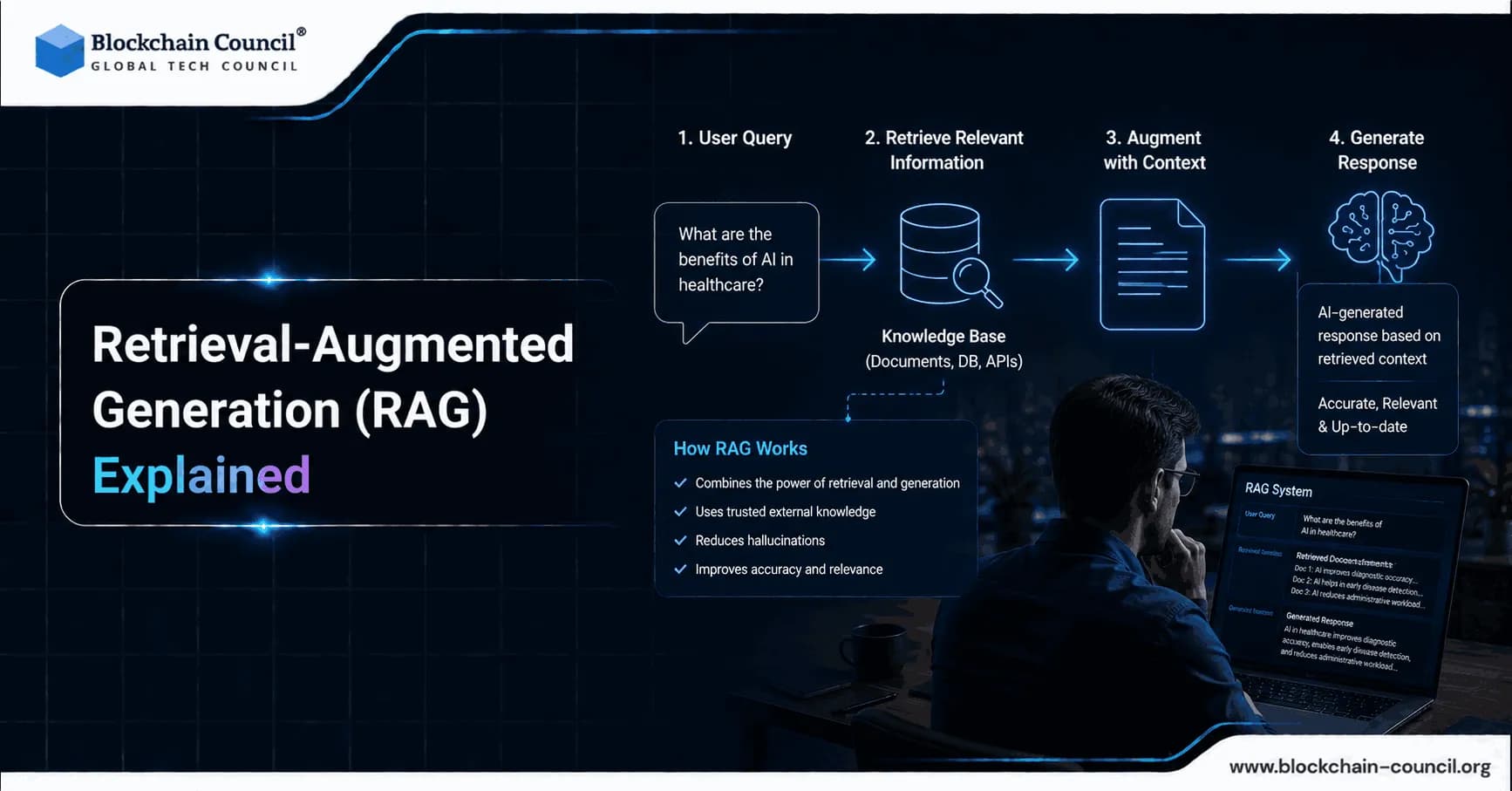
Retrieval-Augmented Generation (RAG) is one of the most practical ways to make large language models (LLMs) more reliable for production use. Instead of relying only on what the model learned during training, RAG retrieves relevant external information first, then uses that context to generate an answer. This design improves factual grounding, reduces hallucinations, and helps models stay current with fast-changing or highly specialized knowledge without retraining.
For professionals building production GenAI systems, RAG is often the default architecture because it balances accuracy, cost, and data freshness. It is especially valuable when responses must align with internal policies, regulated content, or proprietary enterprise knowledge.

What is Retrieval-Augmented Generation (RAG)?
Retrieval-Augmented Generation (RAG) is a hybrid approach that combines:
Parametric memory: knowledge stored implicitly in model weights
Non-parametric memory: knowledge stored externally in documents, databases, wikis, and other sources
In practice, RAG works by retrieving the most relevant passages (often called chunks) from a knowledge base using vector search, then injecting those passages into the prompt so the LLM can answer with grounded context. This makes RAG a cost-effective approach for domain adaptation and knowledge freshness compared with repeated fine-tuning cycles for every content update.
RAG Architecture: Core Components and How They Fit Together
A standard RAG system includes retrieval and generation modules working as a single pipeline. The architecture typically consists of the following components:
1) Knowledge Base (External Corpus)
The knowledge base is the source of truth. It might include:
Internal policies, SOPs, HR documents, and product manuals
Customer support tickets, incident reports, and runbooks
Databases, wikis, knowledge graphs, and approved web sources
This content is preprocessed offline so it can be searched efficiently at query time.
2) Chunking and Preprocessing
Most RAG systems split documents into smaller segments to improve retrieval precision and keep prompts within token limits. Common chunk sizes range from approximately 200 to 1,000 tokens, targeting semantic coherence rather than arbitrary cuts. Many teams now prefer semantic and agentic chunking over fixed-size chunking, particularly for complex or structured documents.
3) Embedding Model
An embedding model converts text into vectors that capture semantic meaning. Common choices include Sentence Transformers and widely used commercial embedding APIs. These vectors allow the system to find content that is conceptually similar to the query, rather than relying on exact keyword matches.
4) Vector Database (Index)
The vector database stores embeddings and supports fast similarity search. Popular options include Pinecone, ChromaDB, and FAISS. Enterprises often attach metadata such as source, access control labels, timestamps, and department to support filtering and governance requirements.
5) Retriever
The retriever embeds the user query and runs approximate nearest neighbor search to return the top-k most relevant chunks. Retrieval quality is often the deciding factor for end-to-end accuracy, which is why modern systems frequently use hybrid search and reranking rather than naive similarity-only retrieval.
6) Generator (LLM)
The generator is the LLM that produces the final answer. It receives the user question along with the retrieved context. When RAG is implemented well, the LLM answers primarily from the provided context and applies its general reasoning capabilities to synthesize and explain that information clearly.
RAG Workflow: Offline Indexing and Online Inference
The RAG workflow is split into two phases: offline preprocessing and online inference.
Phase 1: Offline Preprocessing (Index Build)
Ingest data from PDFs, web pages, databases, or internal systems.
Clean and normalize content, remove boilerplate, and preserve structure where helpful (headings, tables, sections).
Chunk documents into coherent segments suitable for retrieval.
Embed chunks using an embedding model.
Store vectors (plus metadata) in a vector database for fast search.
Phase 2: Online Inference (Query Time)
Embed the user query into a vector.
Retrieve top-k chunks via similarity search and optional metadata filtering.
Augment the prompt with the retrieved context and the user question.
Generate the response with the LLM using the context as grounding.
Common query-time optimizations include multi-query retrieval (generating alternative phrasings of the query), reciprocal rank fusion (combining multiple ranked lists), and real-time index updates for frequently changing sources.
Advanced RAG Variants Used in Modern Deployments
Basic RAG can underperform at enterprise scale due to poor recall, irrelevant context, or missing critical documents. This has led to a broad set of advanced patterns designed to address these limitations:
Standard RAG
The classic retrieve-then-generate pipeline. It is simple and effective for smaller corpora when chunking and indexing are done well.
Hybrid Search RAG
Hybrid search combines vector similarity with keyword matching (often BM25). This is particularly useful when exact terms, product IDs, error codes, or policy references are important. Many teams also add reranking with cross-encoders and metadata filtering to further improve precision.
Iterative or Self-RAG
These systems assess answer confidence and retrieve additional information if the response seems weak. They may reformulate the query, expand the search scope, and run multiple retrieval-generation loops to reduce the risk of missed evidence.
Dynamic RAG
Dynamic RAG uses feedback loops to determine when sufficient evidence has been gathered, stopping retrieval at that point. This approach helps control latency and token usage while improving answer completeness.
Agentic RAG
Agentic RAG adds orchestration layers. Agents can select the most appropriate knowledge base, decide when to invoke tools, reformulate queries, and synthesize results across multiple sources. This approach is increasingly common for complex enterprise workflows that require multi-step reasoning.
Parametric RAG
Instead of retrieving text chunks, parametric RAG retrieves and merges model parameters such as adapter weights. This approach targets knowledge injection through weight-level updates rather than context injection, and is typically managed as an offline process.
Real-World Use Cases of Retrieval-Augmented Generation
RAG delivers the most value where accuracy, traceability, and information freshness are critical requirements. Common use cases include:
1) HR Chatbots for Policies and Employee-Specific Queries
An HR assistant can retrieve employee-specific leave records alongside the correct policy version to answer questions such as: "How much annual leave do I have?" This reduces the risk of generic or incorrect answers and ensures responses align with current internal rules.
2) Enterprise Knowledge Systems for Internal Wikis and SOPs
Many organizations deploy RAG assistants that answer from internal documentation, runbooks, and engineering knowledge bases. This improves onboarding speed, incident response times, and support team productivity because the assistant is grounded in company-approved sources rather than general training data.
3) Financial Services and Regulated Environments
Banking and financial services organizations frequently treat RAG as a strategic requirement because outputs must be compliant and based on verified, current proprietary data. Constraining retrieval to approved content reduces misinformation risks and supports audit and governance obligations.
4) Dynamic Environments and Real-Time Data Sources
RAG can be connected to frequently changing sources such as news streams, operational telemetry, or live databases. With real-time ingestion and indexing pipelines, the assistant responds with current context without waiting for a full model retrain cycle.
Why RAG Often Outperforms Fine-Tuning for Changing Knowledge
Fine-tuning is valuable for consistent style, task behavior, or structured output formats. However, for knowledge that changes frequently, RAG is generally preferred for several reasons:
Faster updates: update the index, not the model
Lower cost: avoids repeated training cycles for content refresh
Better grounding: answers can be tied directly to retrieved source documents
Governance: easier to control which sources the model is permitted to use
Many mature production stacks use both approaches together: fine-tuning to shape model behavior and RAG to supply current knowledge.
The Current State of RAG: Key Trends Shaping Deployments
From early prototypes to full production systems, RAG has matured significantly. Retrieval quality has become the primary bottleneck at scale, driving the industry toward more sophisticated solutions. Key trends shaping the field include:
Semantic and agentic chunking replacing fixed chunk sizes for better evidence coverage and coherence
Multimodal RAG that retrieves across text, images, audio, and video
Learned retrieval that optimizes retrieval for generation quality, not just vector similarity
Unified indexes spanning relational databases, APIs, and knowledge graphs for broader recall
Implementation Checklist: What to Get Right in Production
Data quality: remove outdated versions, duplicates, and untrusted sources before indexing.
Chunking strategy: preserve logical structure and semantic meaning, not just token count.
Hybrid retrieval: combine semantic and keyword search when exact term matching matters.
Reranking: apply cross-encoder rerankers to improve precision among top candidates.
Security: enforce access control at retrieval time using metadata filters tied to user permissions.
Evaluation: measure answer correctness, citation alignment, and retrieval recall systematically.
Observability: log retrieved chunks and augmented prompts for debugging and compliance audits.
Learning Path for Building RAG Systems
Building RAG in production requires skills across LLM prompting, embeddings, vector databases, evaluation frameworks, and secure deployment. Relevant areas of study include artificial intelligence fundamentals, generative AI architecture, prompt engineering, data science, and cybersecurity for governance and access control. Blockchain Council offers structured certifications across these domains to support professionals building or managing GenAI systems.
Many professionals also complement these technical learning paths with a Tech Certification to strengthen their understanding of emerging technologies, systems architecture, and AI infrastructure, while a Marketing Certification can help connect technical innovation with customer needs, business strategy, and the successful adoption of AI-powered solutions.
Conclusion
Retrieval-Augmented Generation (RAG) has become a foundational pattern for production GenAI because it grounds LLM outputs in external knowledge, improves factual accuracy, and supports real-time updates without constant retraining. From HR assistants and enterprise knowledge search to regulated financial applications, RAG provides a scalable and cost-effective path to deploying AI that is both accurate and auditable.
As RAG continues to evolve into agentic, hybrid, and multimodal systems, teams that invest in retrieval quality, rigorous evaluation, and strong governance practices will be best positioned to deploy reliable AI in high-stakes environments.
FAQs
1. What is Retrieval-Augmented Generation (RAG)?
RAG is a method that combines information retrieval with text generation. It retrieves relevant data from external sources before generating a response. This improves accuracy and reduces hallucinations.
2. How does RAG work in simple terms?
RAG first converts a query into an embedding and searches a database for relevant content. The retrieved data is then passed to a language model. The model uses this context to generate a response.
3. Why is RAG important in AI applications?
RAG improves factual accuracy by grounding responses in real data. It reduces reliance on the model’s internal knowledge. This makes outputs more reliable.
4. What are the main components of a RAG system?
Key components include a retriever, a vector database, and a generator model. The retriever finds relevant data, and the model generates responses. These components work together.
5. What is a vector database in RAG?
A vector database stores embeddings for efficient similarity search. It allows fast retrieval of relevant documents. This is essential for RAG performance.
6. What are embeddings in RAG systems?
Embeddings are numerical representations of text or data. They capture semantic meaning and relationships. These vectors enable similarity-based retrieval.
7. How does RAG reduce hallucinations in LLMs?
RAG provides real data as context for the model. This limits the need to guess or fabricate answers. It improves factual consistency.
8. What are common use cases of RAG?
Use cases include chatbots, customer support, document search, and knowledge bases. It is also used in enterprise AI applications. These systems require accurate information retrieval.
9. What is chunking in a RAG pipeline?
Chunking splits large documents into smaller sections. This improves retrieval accuracy. Smaller chunks provide more precise context.
10. How does metadata improve RAG performance?
Metadata adds structured information like tags or categories to data. It helps filter and refine search results. This improves relevance.
11. What is hybrid search in RAG systems?
Hybrid search combines vector search with keyword-based search. It improves both recall and precision. This leads to better results.
12. How can developers evaluate a RAG system?
Evaluation includes measuring retrieval accuracy, response quality, and latency. Test queries and benchmarks are used. Continuous evaluation improves performance.
13. What are common challenges in RAG implementation?
Challenges include poor data quality, retrieval errors, and system latency. Integration complexity can also be an issue. Proper design is required.
14. How does RAG handle real-time data updates?
New data is ingested and indexed regularly. Incremental updates keep the system current. This ensures up-to-date responses.
15. What tools are used to build RAG systems?
Tools include vector databases like Pinecone and frameworks like LangChain and LlamaIndex. Language models provide generation capabilities. These tools support development.
16. How does prompt design affect RAG outputs?
Prompts guide how retrieved data is used by the model. Clear instructions improve accuracy and coherence. Poor prompts can reduce effectiveness.
17. What is reranking in RAG pipelines?
Reranking reorders retrieved results based on relevance. It uses additional models or rules. This improves the quality of selected context.
18. Can RAG be combined with fine-tuning?
Yes, combining RAG with fine-tuning improves both knowledge and behavior. Fine-tuning handles style, while RAG provides data. This creates more robust systems.
19. How does latency impact RAG performance?
High latency can slow down responses and affect user experience. Efficient indexing and caching reduce delays. Optimization is important.
20. What are best practices for building RAG systems?
Use high-quality data, optimize chunking, and include metadata. Tune retrieval and monitor performance. Focus on accuracy, scalability, and reliability.
Related Articles
View All
AI & ML
NVIDIA Cosmos 3 Explained: The Next Generation of Physical AI
Explore NVIDIA Cosmos 3, an open foundation model for Physical AI that combines vision reasoning, world simulation, multimodal generation, and action prediction for robotics and autonomous systems.

AI & ML
Meta Launches Muse Wonder: Its New AI Model Explained
Meta has launched Muse Wonder and Muse Wonder Full, new AI models built for personal and professional agents. Learn the features, pricing, access options and how they compare with rivals.

AI & ML
AI Explained: From Machine Learning to Generative AI
AI Explained in simple terms. Learn the differences between AI, machine learning, and deep learning, how neural networks and LLMs work, and how generative and multimodal AI create content.
Trending Articles
AWS Career Roadmap
A step-by-step guide to building a successful career in Amazon Web Services cloud computing.

Top 5 DeFi Platforms
Explore the leading decentralized finance platforms and what makes each one unique in the evolving DeFi landscape.
Claude AI Tools for Productivity
Discover Claude AI tools for productivity to streamline tasks, manage workflows, and improve efficiency.