

Privacy-Preserving AI Compared: Differential Privacy, Federated Learning, and Secure Enclaves
 Suyash Raizada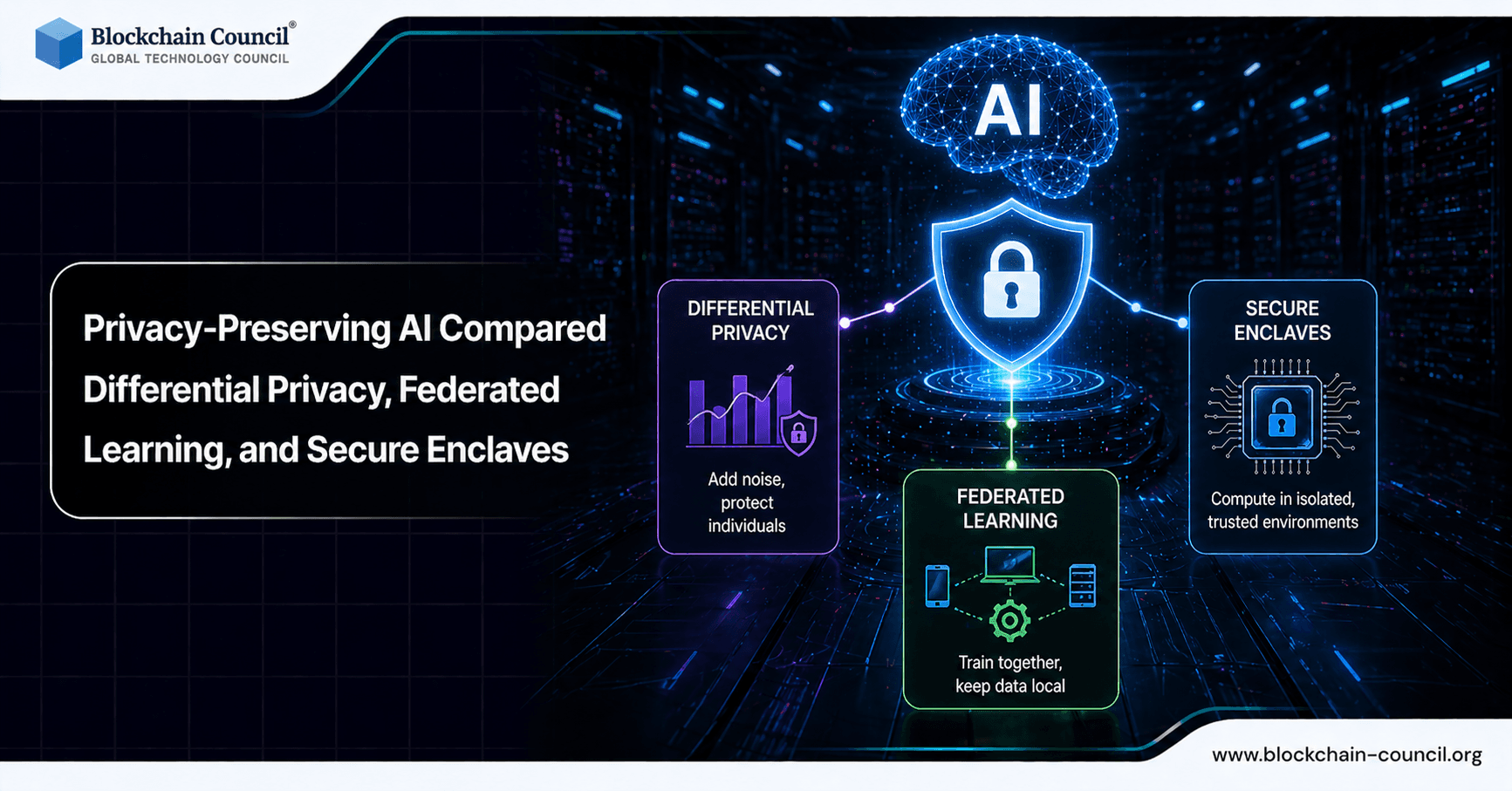
Privacy-preserving AI has moved from a niche research topic to a practical requirement for enterprises building models on regulated, sensitive, or proprietary data. Three techniques dominate modern deployments: differential privacy (DP), federated learning (FL), and trusted execution environments (TEEs) or secure enclaves. Each reduces data exposure differently, and in 2025-2026 architectures they are increasingly combined to provide layered protection against reconstruction, inference, and infrastructure threats.
As organizations expand AI adoption across regulated and sensitive environments, professionals increasingly need a deeper understanding of privacy-preserving technologies, AI governance, and secure deployment practices. An AI Certification can help practitioners build expertise in machine learning systems, responsible AI implementation, privacy frameworks, and risk management strategies that support compliant AI development. For those focused on securing AI systems against emerging threats, developing the skills of an AI Security Professional can further strengthen expertise in AI risk management, model protection, adversarial defense, and secure AI operations.

This guide compares DP, FL, and TEEs, explains the trade-offs, and outlines how to choose the right privacy stack for real-world AI systems.
Why Privacy-Preserving AI Is Now a Baseline Requirement
Organizations want the value of shared learning across teams, subsidiaries, or partner firms, but face constraints from privacy regulation, contractual limitations, and IP risk. Modern attacks can also extract sensitive information from training signals - including gradient inversion, model inversion, and membership inference - particularly when training is distributed or infrastructure is partially untrusted.
As a result, industry practice increasingly treats privacy as a system design problem. Teams combine statistical guarantees (DP), decentralized training (FL), and system-level isolation (TEEs), often alongside secure aggregation, secure multi-party computation (SMPC), or homomorphic encryption where needed.
Technique 1: Differential Privacy
Differential privacy provides a mathematical guarantee that the presence or absence of a single individual record has limited influence on a model output. In practice, DP is implemented by adding calibrated noise and controlling sensitivity - commonly during training via DP-SGD or by perturbing updates in a federated setting.
How DP Works in AI Pipelines
Noise injection: Adds noise to gradients, model updates, or outputs to obscure individual contributions.
Privacy accounting: Tracks the privacy budget (expressed as epsilon) over training rounds or queries.
Deployment modes: Central DP (trusted server), local differential privacy (noise added on device), and distributed DP for mixed-trust settings.
Strengths
Quantifiable guarantees: DP is one of the few approaches that offers measurable privacy loss bounds.
Resists reconstruction: Applied correctly, DP reduces the risk of learning specific training examples from model behavior.
Composable with FL: DP integrates well with federated training to protect per-client updates.
Limitations
Utility trade-off: More noise improves privacy but can reduce accuracy, particularly for small datasets or rare classes.
Not a complete shield: DP reduces leakage but does not automatically eliminate all inversion or inference risks if the system is misconfigured or the privacy budget is too permissive.
Engineering complexity: Teams must manage clipping, accounting, and evaluation of the privacy-utility balance.
Technique 2: Federated Learning
Federated learning trains a shared model across multiple clients - devices, organizations, or data centers - by keeping raw data local. Clients compute updates on their own data and send only model updates to an aggregator. Mature frameworks now support transitions from simulation to production across heterogeneous environments, including personal devices, cloud platforms, and high-performance computing systems.
Why FL Matters for Enterprise AI
No raw data movement: Sensitive records stay within the original security boundary.
Cross-organization collaboration: Enables joint models between entities with strict data-sharing constraints, such as those in legal, healthcare, and finance sectors.
Scalability: Modern enterprise frameworks support orchestration, policy controls, and deployment across mixed infrastructure.
Real-World Performance and Overhead
In a contract review scenario, an FL framework augmented with DP and SMPC achieved 94.2% clause classification accuracy while improving resistance to data reconstruction by 96% compared to non-DP models. The reported training time was 13.1 hours for FL compared to 10.4 hours for centralized training, indicating modest overhead for meaningful privacy gains. In the same benchmark context, FL was more computationally efficient than using homomorphic encryption or secure enclaves alone, since cryptographic and enclave-centric designs can impose heavy runtime and operational costs.
Key Risks Without Add-Ons
Gradient and update leakage: Model updates can reveal information without DP or secure aggregation.
Poisoning and backdoors: Malicious clients can submit harmful updates unless robust aggregation and validation are used.
Server trust assumptions: If the aggregator is honest-but-curious or malicious, additional protections are required.
Technique 3: Secure Enclaves and Confidential Computing
Trusted execution environments (TEEs) isolate sensitive computation inside hardware-protected memory regions. Common implementations include Intel SGX and cloud offerings such as AWS Nitro Enclaves. TEEs are frequently paired with encryption and remote attestation to ensure that code runs in a verified environment even when the host OS or cloud administrator cannot be fully trusted.
Where TEEs Fit Best
Untrusted infrastructure: Protects training or inference workloads from a compromised host.
Secure aggregation and key handling: Enclaves can protect cryptographic operations and secrets in FL orchestration.
Hybrid enterprise stacks: Confidential containers and enclave-backed services help standardize deployment across environments.
Limitations and Considerations
Hardware dependency: Requires enclave-capable CPUs and compatible cloud services.
Side-channel exposure: TEEs reduce attack surface but do not eliminate side-channel risks, so secure coding and threat modeling remain necessary.
Operational cost: Attestation, enclave configuration, and monitoring add complexity compared to pure software approaches.
DP vs FL vs TEEs: What They Protect and What They Do Not
The most direct way to choose a technique is to map it to the specific threat you face.
High-Level Comparison
DP: Best when you need a measurable privacy guarantee against learning information about any single record. It is a statistical defense, not an infrastructure defense.
FL: Best when you cannot centralize data. It reduces exposure by design, but still requires defenses for update leakage and adversarial clients.
TEEs: Best when infrastructure is not fully trusted, such as in multi-tenant cloud environments. TEEs protect computation at runtime but do not provide a statistical privacy guarantee on their own.
Typical Pairings in 2025-2026 Deployments
FL + DP: DP protects client updates and helps mitigate reconstruction and inference risks.
FL + secure aggregation: Hides individual updates from the server, reducing the need to fully trust the aggregator.
FL + TEEs: Uses enclaves to harden aggregation, key management, and sensitive coordination services.
FL + DP + TEEs: A layered design that addresses both statistical leakage and infrastructure threats, commonly recommended for regulated sectors.
Use Cases: When Each Approach Is Most Effective
1) Contract Analysis Across Firms or Departments
Contract repositories are sensitive, distributed, and often legally constrained. FL allows firms to train clause classification and risk detection models without sharing raw documents. Adding DP and SMPC improves resistance to reconstruction while maintaining strong accuracy in reported benchmarks.
2) Scientific and Regulated Data Collaborations
Federated frameworks have been adopted across domains such as biomedicine, smart grids, and astrophysics to enable training without data centralization. This is particularly relevant when datasets are geographically distributed or governed by strict access controls.
3) GenAI and Edge Device Learning
On-device learning for generative or personalized models benefits from FL because data never leaves the device. DP, secure aggregation, and encryption provide layered defense when sharing model updates back to a coordinator.
4) Enterprise Deployments Across Cloud and HPC
Modern FL platforms increasingly support hybrid infrastructure with secure containers and TEEs for confidential computing, helping teams move from prototyping to production while preserving privacy guarantees across varied environments.
How to Choose the Right Privacy-Preserving AI Stack
Use this practical checklist to align your architecture with your risk and compliance requirements.
Step-by-Step Selection Guide
Define the threat model: Is the server trusted, honest-but-curious, or potentially malicious? Are clients trustworthy?
Decide whether data can move: If centralization is impossible, start with FL.
Pick a statistical guarantee level: If you need measurable privacy, add DP and implement privacy accounting.
Protect updates in transit and at rest: Use secure aggregation, encryption, and strong identity controls.
Harden infrastructure: If training or aggregation runs in untrusted environments, consider TEEs and remote attestation.
Plan for adversarial robustness: Add defenses against poisoning and backdoors via robust aggregation, anomaly detection, and governance.
Successfully implementing privacy-preserving AI requires more than knowledge of machine learning models. Teams must also understand cloud infrastructure, distributed computing, cybersecurity controls, data architectures, and emerging technologies. A Tech Certification can help professionals strengthen these foundational skills and better manage the complex environments that support modern AI deployments.
Skills and Certification Pathways
Implementing privacy-preserving AI requires cross-disciplinary expertise spanning AI engineering, cryptography concepts, and security operations. For structured learning, consider training paths in AI, Data Science, Cybersecurity, and Blockchain - particularly for teams building regulated AI systems and secure Web3 data collaborations.
Future Outlook: PPFL as the Default Pattern
Research and industry signals in 2025-2026 point to privacy-preserving federated learning (PPFL) becoming a standard approach for distributed AI. Enterprise-grade frameworks will emphasize scalable orchestration, hybrid privacy stacks that combine DP with secure aggregation and TEEs, and confidential containers that reduce adoption friction across heterogeneous environments.
Evaluation of privacy-performance trade-offs is also becoming more rigorous, driven by the need to defend against evolving inference and inversion attacks while keeping training efficient. The practical answer is rarely a single technique. The strongest architectures combine:
DP for measurable privacy guarantees,
FL to eliminate raw data movement, and
TEEs to protect computation and secrets in untrusted infrastructure.
As privacy expectations and AI regulations continue to evolve, organizations need professionals who can connect technical implementation with business objectives and stakeholder trust. A Marketing Certification can help strengthen communication, governance alignment, and customer-focused decision-making, making it a valuable complement to technical expertise in privacy-preserving AI initiatives.
Conclusion
Privacy-preserving AI is best approached as layered engineering: DP limits what can be inferred statistically, FL minimizes direct data exposure by keeping data local, and secure enclaves harden the execution environment when infrastructure trust is limited. For most enterprise scenarios - particularly regulated or cross-organization collaboration - the most robust design is a hybrid: FL + DP for privacy and TEEs or confidential computing for system-level protection. The result is AI that can learn from distributed sensitive data while reducing exposure risk, meeting governance expectations, and remaining operationally feasible.
FAQs
1. What is privacy-preserving AI?
Privacy-preserving AI refers to techniques that allow models to learn from data without exposing sensitive information. It protects user privacy during training and inference. This is essential for regulated industries.
2. What is differential privacy in AI?
Differential privacy adds controlled noise to data or outputs to prevent identification of individuals. It ensures that no single data point significantly affects results. This provides strong mathematical privacy guarantees.
3. What is federated learning?
Federated learning trains models across multiple devices or servers without centralizing data. Each participant keeps data locally and shares only model updates. This reduces data exposure and improves privacy.
4. What are secure enclaves in AI?
Secure enclaves are hardware-based environments that protect data during processing. They isolate sensitive computations from the rest of the system. This ensures data confidentiality even during execution.
5. How does differential privacy differ from federated learning?
Differential privacy protects outputs by adding noise, while federated learning protects data by keeping it decentralized. They address privacy at different stages. Both can be combined for stronger protection.
6. How do secure enclaves differ from other privacy techniques?
Secure enclaves rely on hardware-level security rather than data transformation or distribution. They protect data during computation. Other methods focus on training or data sharing.
7. Which privacy method is most secure for AI?
No single method is universally best. Differential privacy offers strong guarantees, federated learning reduces data exposure, and secure enclaves protect computation. The choice depends on the use case.
8. Can these privacy techniques be combined?
Yes, combining techniques enhances privacy protection. For example, federated learning can use differential privacy for added security. Hybrid approaches are increasingly common.
9. What are the benefits of differential privacy?
It provides strong, quantifiable privacy guarantees. It is widely used in data analysis and reporting. However, it may reduce accuracy due to added noise.
10. What are the advantages of federated learning?
It keeps data decentralized, reducing the risk of breaches. It allows collaboration without sharing raw data. This is useful for cross-organization AI training.
11. What are the benefits of secure enclaves?
Secure enclaves protect data during processing, even from system administrators. They offer strong hardware-based security. This is ideal for sensitive workloads.
12. What are the limitations of differential privacy?
Adding noise can reduce model accuracy. Balancing privacy and utility is challenging. Proper configuration is required to maintain effectiveness.
13. What are the challenges of federated learning?
Challenges include communication overhead and model synchronization. It may also be vulnerable to malicious participants. Proper coordination is needed.
14. What are the limitations of secure enclaves?
Secure enclaves depend on specialized hardware. They may have performance constraints. Implementation can be complex and costly.
15. Which industries use privacy-preserving AI techniques?
Industries like healthcare, finance, and telecommunications use these methods. They handle sensitive data and require compliance. Privacy-preserving AI supports secure innovation.
16. How do these methods support regulatory compliance?
They help meet data protection requirements by minimizing data exposure. Techniques like differential privacy align with regulations. This reduces legal risks.
17. Can federated learning prevent data breaches?
It reduces the risk by keeping data local. However, it does not eliminate all threats. Additional safeguards are necessary.
18. How does differential privacy impact model performance?
It can slightly reduce accuracy due to noise injection. The impact depends on the privacy level chosen. Careful tuning helps balance performance and privacy.
19. Are secure enclaves suitable for cloud environments?
Yes, many cloud providers support secure enclave technology. This allows secure processing in shared environments. It enhances data protection in cloud AI systems.
20. What is the future of privacy-preserving AI techniques?
These techniques will become more integrated and efficient. Hybrid approaches will improve both privacy and performance. Adoption will grow as regulations and data concerns increase.
Related Articles
View All
AI & ML
AI Explained: From Machine Learning to Generative AI
AI Explained in simple terms. Learn the differences between AI, machine learning, and deep learning, how neural networks and LLMs work, and how generative and multimodal AI create content.

AI & ML
Jev vs Machine Learning Models
Compare Jev with traditional machine learning models, including differences in architecture, outputs, training, decision-making, automation, and real-time software use.

AI & ML
Built to Catch AI Cheating: Rethinking Pre-Employment Assessments with HireValid
Explore how HireValid is rethinking pre-employment assessments with AI-resistant test design, integrity signals, candidate evidence, and human review to address AI-assisted cheating.
Trending Articles
AWS Career Roadmap
A step-by-step guide to building a successful career in Amazon Web Services cloud computing.
What is AWS? A Beginner's Guide to Cloud Computing
Everything you need to know about Amazon Web Services, cloud computing fundamentals, and career opportunities.
How to Install Claude Code
Learn how to install Claude Code on macOS, Linux, and Windows using the native installer, plus verification, authentication, and troubleshooting tips.