

Blueprint for Building Secure AI Systems: Architecture Patterns, Least-Privilege Access, and Zero-Trust Design
 Suyash Raizada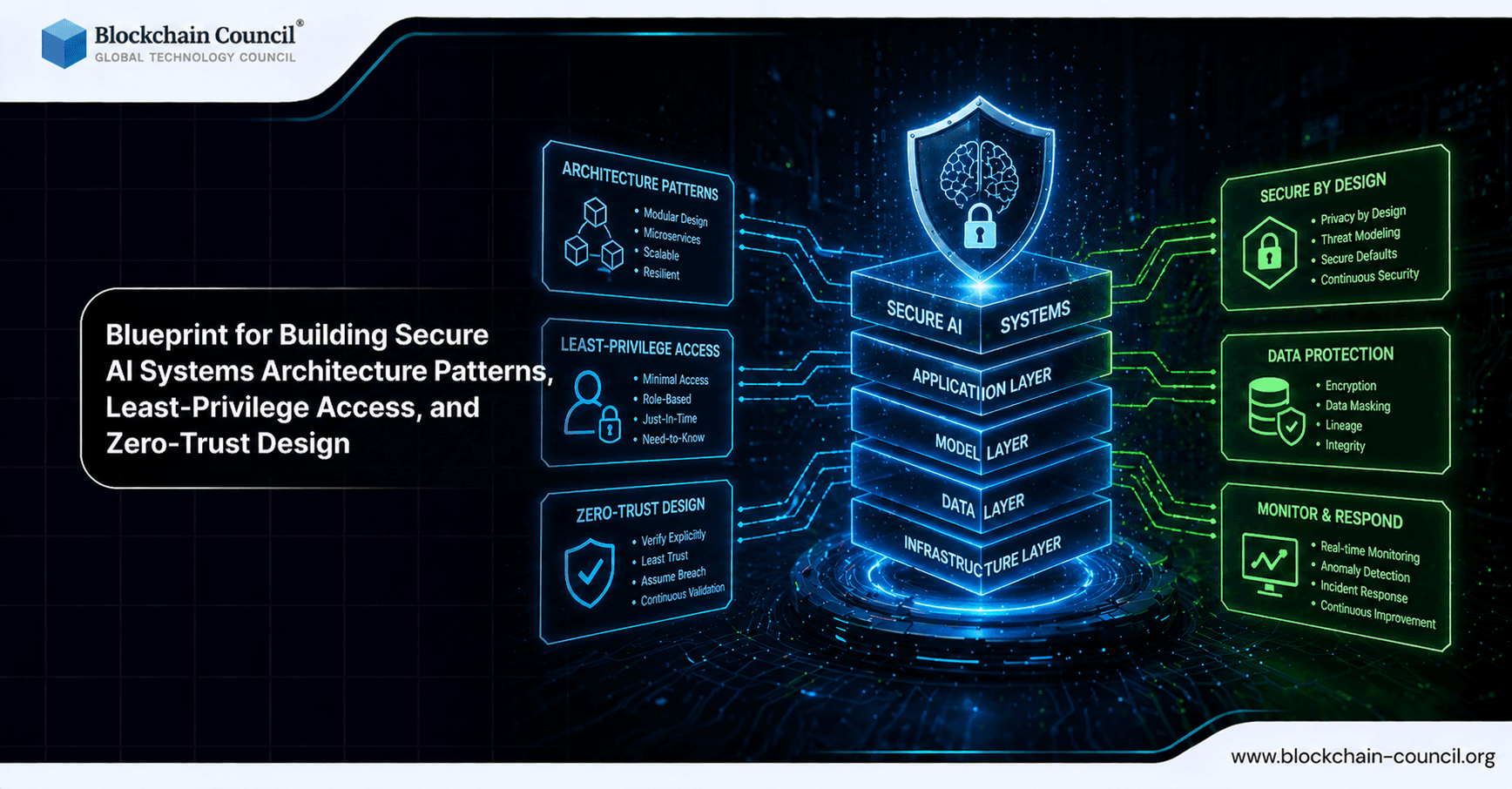
Secure AI systems are no longer just a research concern. As generative AI (GenAI) moves into production, organizations inherit a larger attack surface through open-ended inputs, tool integrations, retrieval-augmented generation (RAG), and autonomous agents. The most common failure modes include prompt injection, data exfiltration, data poisoning, and model theft, all highlighted as key risks in industry guidance such as the OWASP Top 10 for LLM Applications. The practical response is a repeatable blueprint built on zero-trust design, least-privilege access, and modular security patterns that can scale across teams and environments.
This article provides an actionable architecture blueprint aligned with widely adopted frameworks including the NIST AI Risk Management Framework (AI RMF), ISO/IEC 42001, GDPR, and emerging regulatory expectations such as the EU AI Act. It focuses on patterns applicable across data pipelines, training, deployment, and inference, without relying on ad hoc exceptions.

Why Secure AI Systems Need a New Blueprint
Traditional application security assumes relatively predictable inputs, bounded business logic, and well-defined data flows. GenAI changes that in several important ways:
Inputs are untrusted by default: Prompts can be adversarial, ambiguous, and intentionally crafted to override instructions or extract secrets.
Outputs can leak data: Models can regurgitate sensitive content from context windows, retrieval sources, or training data under certain conditions.
Integrations multiply risk: Tool calling, plugins, and agent workflows create new paths for privilege escalation and exfiltration.
Identity sprawl grows fast: AI services often introduce numerous service accounts and API keys, and many deployments lack deliberate least-privilege design.
Industry analyses indicate a higher risk of unauthorized access and model theft in hybrid cloud environments when zero-trust controls are absent. Many AI deployments also struggle to reach production due to gaps in governance, auditability, and monitoring. When security is added as an afterthought, adoption slows and operational risk increases.
Core Principles: Zero-Trust, Least Privilege, and Defense in Depth
A robust blueprint for secure AI systems rests on three principles:
Zero-trust design: Trust nothing by default. Verify every request, every identity, every network path, and every data access, even inside your perimeter.
Least-privilege access: Grant only the permissions required, scoped to the task, and time-bound wherever possible.
Defense in depth: Layer controls across the full AI lifecycle, from data intake and training through to deployment and inference.
These principles map directly to established security baselines used in high-security environments, including control catalogs such as NIST 800-53 and common requirements in regulated programs.
Architecture Patterns for Secure AI Systems
The goal is to make the safest path the easiest by using reusable patterns. The following are the most effective patterns for production GenAI and agentic systems.
1) AI Gateway Pattern
An AI gateway sits in front of model endpoints and serves as the enforcement point for request and response security. This is especially valuable when multiple applications and teams share the same models.
Core controls typically include:
Input filtering to reduce prompt injection and malicious instructions
Context controls for RAG, including retrieval isolation, allow-listed sources, and query constraints
Output sanitization such as PII detection, DLP checks, and policy-based redaction
Rate limiting and anomaly detection to limit automated extraction attempts
In healthcare and finance, this pattern is commonly paired with RAG segmentation to reduce the risk of sensitive records appearing in model outputs.
2) Least-Privilege IAM for Humans and Workloads
Identity becomes the control plane for AI. A strong least-privilege design should cover both human users and non-human identities, including model runtimes, retrieval services, agents, pipelines, and CI/CD systems.
Recommended practices include:
Short-lived credentials and token rotation to reduce blast radius
Workload identity instead of long-lived API keys embedded in code
RBAC and ABAC to scope permissions by role, attribute, data sensitivity, and environment
Human-in-the-loop approvals for high-impact actions such as data export, financial transactions, or privileged tool invocation
As agentic systems grow, organizations are moving toward ABAC-style policies because they can express constraints such as tenant, purpose, data classification, and session risk in a single coherent model.
3) Zero-Trust Segmentation and Segmented AI Zones
Zero-trust is not purely a network concept. For secure AI systems, treat prompts, retrieved context, tools, and outputs as untrusted by default. A practical implementation is a segmented AI zone with strict boundaries between:
Prompt ingress (user or application inputs)
Retrieval layer (vector stores, databases, knowledge systems)
Model inference (hosted model endpoints or on-premises runtimes)
Tool execution (agent tools, external APIs, internal services)
Response egress (output distribution to applications, users, and logs)
Controls that matter include encryption in transit and at rest, strong key management via KMS or HSM, regular key rotation, and explicit allow-lists for data sources and outbound destinations. Encryption without disciplined key operations provides limited protection when real incidents occur.
4) Observability and Governance by Design
Many AI initiatives fail to scale because teams cannot answer basic operational questions: Who accessed what? Which data informed this output? Did an agent call a sensitive tool? Was a policy violated?
Build governance into the lifecycle with:
Audit logs for prompts, retrieval queries, tool calls, model versions, and policy decisions, with careful handling of sensitive content
Telemetry integrated with security operations tooling for alerting and incident response
Policy-as-code enforced in CI/CD, including approval gates for model promotion and configuration changes
Evaluation pipelines for adversarial testing and regression checks before deployment
Security must be continuous and measurable, not a one-time review. Platforms that embed governance and access controls across layers reflect this direction.
5) Defense-in-Depth Across the AI Lifecycle
Secure AI systems require controls at each layer, not just at the UI or API boundary:
Data pipeline security: provenance tracking, data minimization, classification, and integrity checks to reduce poisoning and compliance risk
Training environment security: isolated compute, restricted egress, vetted dependencies, and controlled dataset access
Model artifact protection: access controls, signing, versioning, and secure storage to reduce theft and tampering
Deployment hardening: secure containers, patched base images, runtime policies, and isolated secrets management
Inference safeguards: harm filters, jailbreak resistance testing, and robust response policies for sensitive domains
High-security deployments may add air-gapped environments and stricter compliance controls, but the underlying pattern remains consistent: verify continuously and limit blast radius.
Putting the Blueprint Together: A Reference Flow
The following sequence outlines a practical approach for designing a production-ready system:
Classify the use case by impact and data sensitivity, mapping controls to NIST AI RMF risk management and relevant regulations including GDPR, EU AI Act expectations, and ISO/IEC 42001 governance requirements.
Place an AI gateway in front of all model endpoints and enforce prompt, context, and output policies centrally.
Implement least-privilege IAM for every component: retrieval service, model runtime, agent tools, CI/CD, and human operators.
Segment the AI zone so RAG sources, tools, and outputs are isolated with strict allow-lists and egress controls.
Encrypt and manage keys properly with rotation schedules, access controls, and separation of duties for key administration.
Operationalize monitoring by exporting logs and telemetry to detection and response workflows.
Automate evaluations for prompt injection, exfiltration attempts, and policy violations as part of CI/CD and pre-release gates.
Real-World Patterns in Action
These patterns appear consistently across industries:
Federal and high-security environments often adopt isolated networks or air-gapped AI with strict MLOps controls to satisfy rigorous compliance requirements.
Healthcare and finance commonly deploy AI gateways and segmented RAG zones to reduce PII leakage and enforce strict access boundaries.
Enterprise agent deployments increasingly assign unique identities to agents, incorporate built-in safeguards, and use adversarial testing tools to harden systems before scaling.
Skills and Organizational Readiness
Secure AI systems are inherently interdisciplinary. Teams need shared language and competency across security, data, and engineering functions. For structured upskilling, organizations often map roles to relevant certifications - Blockchain Council programmes such as the Certified Artificial Intelligence (AI) Expert, Certified Cybersecurity Expert, and Certified Data Science Professional can support capability building across AI engineering, governance, and security operations.
A Marketing Certification can help professionals strengthen stakeholder communication, risk awareness, and strategic decision-making, while a Tech Certification can build expertise in emerging technologies, system architecture, automation, and the technical foundations required to support secure and scalable AI deployments.
Future Outlook: Where Secure AI Systems Are Heading
From 2025 onward, the trend is toward standardizing zero-trust AI through AI TRiSM-style operational controls, regulatory pressure, and reusable architectural templates. Wider adoption of AI gateways, automated evaluations, and policy-as-code is expected. ABAC-style authorization is also likely to expand as teams require more granular, context-aware access decisions for agents and tools. The most successful programmes will be those that make governance largely invisible to developers by embedding it into platforms and pipelines from the start.
Conclusion
A modern blueprint for secure AI systems is not a single control or product. It is an architecture: AI gateway enforcement, least-privilege IAM, zero-trust segmentation, strong key operations, and continuous observability and governance. These patterns directly reduce the risk of prompt injection, exfiltration, data poisoning, and model theft, while improving the likelihood that AI pilots can safely reach production.
Building security as the default path, rather than an exception, allows teams to move faster, reduces operational risk, and gives organizations a sound basis for adopting GenAI in regulated and high-impact environments.
FAQs
1. What is a secure AI system architecture?
A secure AI system architecture defines how models, data, and infrastructure are designed to minimize risks. It includes controls for access, monitoring, and data protection. The goal is to ensure reliability and security throughout the lifecycle.
2. Why is security important in AI system design?
AI systems process sensitive data and make critical decisions. Poor design can lead to breaches or misuse. Security must be built in from the start, not added later.
3. What are common architecture patterns for secure AI systems?
Common patterns include modular design, isolated components, and layered security. These patterns limit the impact of failures or attacks. They improve system resilience.
4. What is least-privilege access in AI systems?
Least-privilege access means users and services only have the permissions they need. This reduces the risk of unauthorized actions. It is a core principle of secure system design.
5. How does least-privilege improve AI security?
By limiting access, it reduces the potential damage from compromised accounts. It prevents unnecessary exposure of sensitive data. This strengthens overall system security.
6. What is zero-trust architecture in AI systems?
Zero-trust architecture assumes no user or system is automatically trusted. Every access request must be verified. This approach reduces the risk of internal and external threats.
7. How does zero-trust apply to AI workflows?
Zero-trust ensures all interactions between data, models, and users are authenticated and authorized. It enforces strict access controls. This protects sensitive AI processes.
8. What are key components of a secure AI architecture?
Key components include data pipelines, model training environments, APIs, and monitoring systems. Each must be secured individually. Integration ensures overall protection.
9. How can data pipelines be secured in AI systems?
Use encryption, validation, and access controls. Monitor data flow for anomalies. Secure pipelines prevent data tampering and leakage.
10. What role does encryption play in AI architecture?
Encryption protects data at rest and in transit. It ensures only authorized users can access sensitive information. This is essential for compliance and security.
11. How do APIs affect AI system security?
APIs expose AI functionality to users and systems. Weak APIs can be exploited by attackers. Secure APIs require authentication, rate limiting, and monitoring.
12. What is model isolation in secure AI design?
Model isolation separates models from other system components. This limits the impact of breaches or failures. It improves security and stability.
13. How does monitoring improve AI system security?
Monitoring tracks system behavior and detects anomalies. It enables early detection of threats. Continuous monitoring supports rapid response.
14. What are common risks in AI system architecture?
Risks include data leakage, unauthorized access, and model manipulation. Poor design can increase vulnerability. Addressing risks early improves security.
15. How can organizations implement zero-trust in AI systems?
Use strong authentication, continuous verification, and strict access controls. Monitor all interactions within the system. This ensures no implicit trust exists.
16. What is role-based access control in AI systems?
Role-based access control assigns permissions based on user roles. It ensures users only access relevant resources. This supports least-privilege principles.
17. How does segmentation improve AI security?
Segmentation divides systems into smaller, isolated components. This limits the spread of attacks. It enhances control and security.
18. What tools support secure AI system design?
Tools include security frameworks, monitoring platforms, and access management systems. These tools help enforce policies and detect threats. Selection depends on system needs.
19. What are best practices for building secure AI systems?
Use layered security, enforce least-privilege, and adopt zero-trust principles. Monitor systems continuously and update regularly. Combine automation with human oversight.
20. What is the future of secure AI system architecture?
Future architectures will be more automated and adaptive. Security will be integrated into all stages of development. Zero-trust and advanced monitoring will become standard.
Related Articles
View All
AI & ML
AI Loops, Harnesses & Autonomous Systems: The Architecture Behind Agentic AI
Learn how AI Loops, Harnesses & Autonomous Systems work. Understand the observe-reason-act-evaluate cycle, why agents need a harness, guardrails, evaluation, and long-running tasks.

AI & ML
Jev Inference Architecture
Explore Jev’s inference architecture, including parallel sampling, structured outputs, calibrated probabilities, and how TypeSafe AI enables fast machine-native decisions.
AI & ML
Jev Model Architecture
Explore the Jev model architecture, including TypeSafe AI’s System One design, parallel sampling, RLCD training, typed outputs, and calibrated probabilistic decisions.
Trending Articles
The Role of Blockchain in Ethical AI Development
How blockchain technology is being used to promote transparency and accountability in artificial intelligence systems.

Top 5 DeFi Platforms
Explore the leading decentralized finance platforms and what makes each one unique in the evolving DeFi landscape.
How Blockchain Secures AI Data
Understand how blockchain technology is being applied to protect the integrity and security of AI training data.