

Parameter-Efficient Fine-Tuning (LoRA, QLoRA, Adapters) Explained: Faster, Cheaper LLM Customization
 Suyash Raizada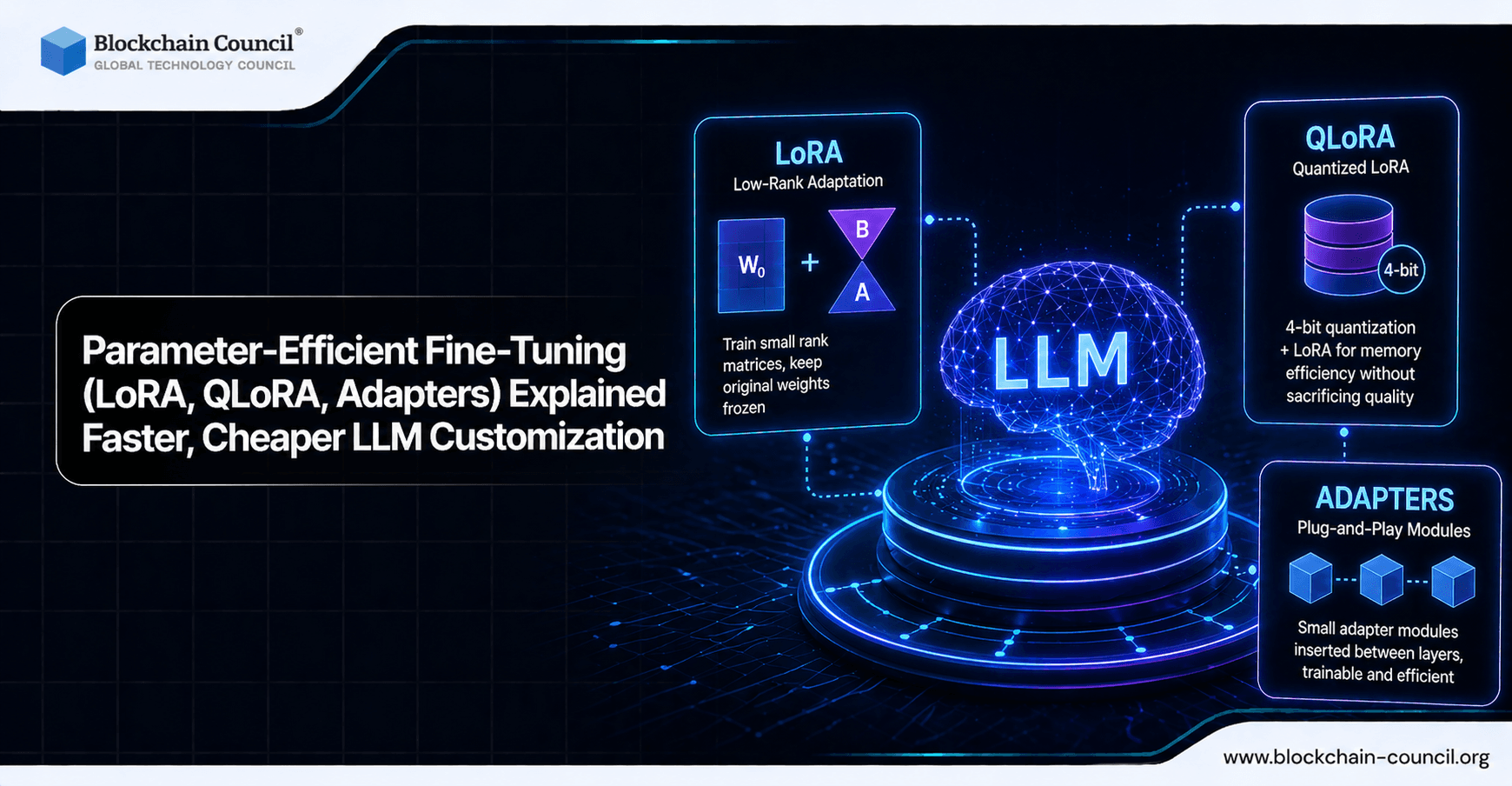
Parameter-Efficient Fine-Tuning is now the most practical way to customize large language models (LLMs) without the full computational cost of training billions of parameters. Instead of updating every weight in a transformer, PEFT methods such as LoRA, QLoRA, and Adapters train only a small set of additional parameters. This can reduce memory requirements by roughly 10-20x, cut costs significantly, and still retain around 90-95% of full fine-tuning quality for many tasks. In 2026, PEFT is also the primary reason serious LLM fine-tuning can happen on a single consumer GPU.
As PEFT techniques become a standard part of modern AI development, many professionals are pursuing an LLM Developer Certification to build practical skills in model fine-tuning, evaluation, deployment, and the efficient customization of large language models for production use.

This guide explains how LoRA, QLoRA, and Adapters work, what the trade-offs are, and how to choose the right method for production and research. It also covers where PEFT fits into modern enterprise LLM workflows, including evaluation, deployment, and governance.
What is Parameter-Efficient Fine-Tuning (PEFT)?
Parameter-Efficient Fine-Tuning (PEFT) is a family of techniques that adapts a pretrained model to a new dataset or behavior while updating only a small fraction of its parameters. The base model stays mostly frozen, and learnable components are introduced or selectively trained.
Why this matters for LLMs:
Cost: Full fine-tuning for a 7B to 13B model requires substantial VRAM and multi-GPU setups, which quickly becomes expensive.
Memory: Keeping optimizer states and gradients for billions of weights is the primary bottleneck, not just storing the model itself.
Operational flexibility: PEFT enables storing many task-specific variants as small adapter files instead of duplicating full model checkpoints.
Why Full Fine-Tuning Is Often Avoided in 2026
Full fine-tuning updates all parameters. That can deliver the best possible task fit, but it carries significant practical costs:
VRAM requirements: Full FP16 fine-tuning of a 7B model requires roughly 56GB just for model storage, and total training requirements climb higher once optimizer states are included.
Infrastructure cost: Full fine-tuning of 7B-class models in practice typically demands 100-120GB VRAM for standard training stacks, pushing teams toward H100-class hardware.
Iteration speed: Experimentation slows when each run requires multi-GPU scheduling, careful sharding, and elevated cloud spend.
PEFT has become the default approach because it delivers near-parity results for many instruction tuning and domain adaptation workloads while enabling fast iteration on a single GPU.
LoRA Explained: Low-Rank Adaptation in Simple Terms
LoRA (Low-Rank Adaptation) modifies a transformer by injecting small trainable matrices into attention and sometimes feed-forward layers. Instead of updating the original weight matrix, LoRA learns a low-rank update that approximates the needed change.
How LoRA Reduces Trainable Parameters
For a 7B model, a common LoRA setup using rank r=16 trains approximately 16.78 million parameters, which is roughly 0.24% of the full model. That is the core PEFT principle: train a small set of weights that steer the frozen base model toward the target behavior.
Key Advantages of LoRA
High quality: Reported benchmarks show LoRA often closely matches full fine-tuning. For example, LoRA performance on GLUE has been reported near full fine-tuning averages, around 89.5% versus 89.8%, with similar task-level scores on MNLI and QQP.
Mergeable for inference: After training, LoRA weights can be merged into the base model, enabling zero added inference latency in the merged configuration.
Smaller artifacts: Task-specific behavior can be stored as compact adapter files rather than full model copies, simplifying versioning and distribution.
QLoRA Explained: 4-Bit Quantization Plus LoRA Adapters
QLoRA extends LoRA by applying 4-bit quantization to the frozen base model weights while training LoRA adapters in higher precision, typically 16-bit. The result is a major reduction in VRAM with minimal quality degradation.
Why QLoRA Is the Single-GPU Standard
For LLaMA-7B class models, QLoRA enables fine-tuning in approximately 6GB of memory, compared with roughly 56GB for full FP16 storage. Training stacks vary in practice, but the direction is consistent: QLoRA moves fine-tuning from multi-GPU servers to a single consumer GPU.
By 2026, QLoRA is widely regarded as the most practical path for:
Instruction tuning a 7B model on a 24GB GPU
Domain adaptation and style alignment for internal enterprise assistants
Rapid experimentation on constrained budgets
Practical Efficiency Numbers
Memory savings: QLoRA commonly delivers around 10x memory savings versus LoRA-only setups in comparable conditions, and far larger savings versus full fine-tuning.
Cost shift: QLoRA on a single RTX 4090-class GPU can handle workloads that would otherwise require expensive H100-class capacity for full fine-tuning.
Small deployment files: Adapter files range from tens to hundreds of MB depending on the base model and configuration, which simplifies distribution and versioning.
Adapters Explained: Small Modules for Task Switching
Adapters are small neural network layers inserted directly into the transformer, typically within each block. During fine-tuning, the base model remains frozen and only the adapter modules are trained.
Where Adapters Shine
Multi-task and multi-domain systems: Different adapters can be loaded for different tasks without retraining or replacing the full model.
Modular governance: Keeping task logic in separate adapter modules simplifies approvals, rollbacks, and audits in regulated environments.
Main Trade-off: Inference Overhead
Adapters add extra layers to the forward pass. Unlike mergeable LoRA and QLoRA configurations, this introduces inference overhead. For latency-sensitive production systems, this distinction matters and should factor into architecture decisions.
LoRA vs QLoRA vs Adapters: Quick Comparison
The figures below are typical reference points for 7B-class models:
Full fine-tuning: All 7B parameters trainable (100%), roughly 56GB for FP16 model storage, with significantly higher VRAM needed during training once optimizer states are included.
LoRA (r=16): Approximately 16.78M trainable parameters (0.24%), around 18GB memory footprint for common setups, mergeable with no inference overhead after merge.
QLoRA (4-bit): Trains a similar adapter fraction to LoRA, with reported memory around 6GB for 7B-class base weights in 4-bit plus adapters.
Adapters: Approximately 33.55M trainable parameters (0.48%) on 7B models, comparable memory order to LoRA setups, but with extra inference layers and generally no merge-to-base option.
Choosing the Right PEFT Method
Choose LoRA When
You want strong quality with a straightforward implementation.
You need zero-latency inference after merging adapters into the base model.
You have more VRAM headroom than QLoRA requires but still want significant savings versus full fine-tuning.
Choose QLoRA When
You want to fine-tune on a single GPU, including consumer hardware.
You are iterating rapidly and want lower cost per experiment.
You are fine-tuning larger models (13B and above) where VRAM is the limiting factor.
Choose Adapters When
You need fast task switching by hot-swapping adapter modules.
You are building a multi-domain assistant where modularity takes priority over absolute lowest latency.
Real-World Use Cases for PEFT
1. Custom Enterprise Assistants with Data Control
Teams fine-tune a base LLM on internal support conversations, product documentation, and policy language. PEFT reduces compute costs and enables more frequent updates as policies evolve. Many teams also combine fine-tuning with retrieval-augmented generation (RAG) for freshness and traceability.
2. Developer Productivity Models
Code-focused instruction tuning can be completed with QLoRA on limited hardware, enabling organizations to align model outputs with internal coding standards and repository conventions.
3. Production Deployment with Small Artifacts
Because LoRA and QLoRA adapters can be merged into the base model, teams can deploy a single merged checkpoint for standard inference. Adapter sizes are small relative to the base model, sometimes in the tens of MB range for smaller models, which supports rapid distribution and rollback.
Latest Developments: DoRA, Paging, and Scaling to 70B+
PEFT has continued to evolve beyond basic LoRA:
DoRA: A LoRA-style improvement that uses magnitude decomposition to modestly boost quality while maintaining similar efficiency characteristics.
Paged optimizers and paging strategies: Often used alongside QLoRA to reduce memory spikes and stabilize training on limited VRAM. Some configurations report 7B-class tuning near 5GB in optimized setups.
Scaling guidance: QLoRA is commonly applied to 70B-class models using multi-GPU setups such as 2x A100 depending on configuration, while 140B+ models typically require additional high-end GPU capacity.
Skills That Matter: Data, Evaluation, and Safety
PEFT makes fine-tuning more accessible, but it does not remove the need for disciplined machine learning practice:
Data curation: Instruction quality, label noise, and domain coverage typically have the largest impact on results.
Evaluation: Task metrics, preference tests, and regression suites are necessary to detect and prevent performance drift.
Security and privacy: Training data handling, access control, and red-teaming should be standard parts of the fine-tuning workflow.
For teams building professional capability in these areas, Blockchain Council offers programs covering modern AI and LLM engineering, including certifications such as Certified AI Professional (CAIP), Certified Generative AI Expert, and Certified Machine Learning Professional.
Professionals often complement these learning paths with a Tech Certification to strengthen their understanding of emerging technologies, systems architecture, and AI infrastructure, while a Marketing Certification can help connect technical innovation with product strategy, customer needs, and business growth objectives.
Conclusion: PEFT Is the Default Path for LLM Customization
Parameter-Efficient Fine-Tuning has become the practical standard for customizing LLMs because it dramatically reduces compute and memory requirements while delivering near full fine-tuning quality for most real-world tasks. LoRA remains the baseline choice for its simplicity and mergeability, QLoRA is the preferred option when VRAM is limited, and Adapters remain valuable for modular multi-task systems.
As quantization, paging, and LoRA variants like DoRA continue to mature, PEFT is likely to remain the dominant approach for enterprise and developer fine-tuning pipelines. For most teams, the path forward is clear: invest in strong data curation and evaluation practices, then use PEFT to iterate quickly and deploy safely.
FAQs
1. What is parameter-efficient fine-tuning (PEFT)?
Parameter-efficient fine-tuning is a method that updates only a small subset of model parameters. It reduces compute, memory, and cost compared to full fine-tuning. This makes LLM customization more practical.
2. Why is PEFT important for LLM customization?
PEFT allows developers to adapt large models without retraining everything. It lowers hardware requirements and speeds up training. This makes fine-tuning accessible to more teams.
3. What is LoRA in fine-tuning?
LoRA (Low-Rank Adaptation) injects small trainable matrices into a pre-trained model. It updates only these matrices instead of the full model. This significantly reduces training cost.
4. How does LoRA improve efficiency?
LoRA limits the number of parameters being trained. This reduces memory usage and speeds up training. It also allows multiple task-specific adapters to be stored efficiently.
5. What is QLoRA in LLM fine-tuning?
QLoRA combines LoRA with model quantization to reduce memory usage further. It enables fine-tuning of large models on limited hardware. This makes it highly cost-effective.
6. How does quantization help in QLoRA?
Quantization reduces the precision of model weights, lowering memory requirements. It allows larger models to fit on smaller GPUs. This enables efficient fine-tuning.
7. What are adapters in PEFT?
Adapters are small neural network layers inserted into a pre-trained model. They are trained for specific tasks while keeping the base model unchanged. This allows modular customization.
8. How do adapters differ from LoRA?
Adapters add new layers to the model, while LoRA modifies existing layers with low-rank updates. Both reduce training cost but use different approaches. Choice depends on use case.
9. When should you use PEFT instead of full fine-tuning?
Use PEFT when resources are limited or when quick experimentation is needed. It is ideal for most practical applications. Full fine-tuning is better for highly specialized tasks.
10. What are the benefits of using PEFT methods?
Benefits include lower cost, faster training, and reduced memory usage. They also allow easy switching between tasks. This improves flexibility and scalability.
11. What are common use cases for LoRA and QLoRA?
They are used in chatbots, domain-specific models, and recommendation systems. They also support fine-tuning for RAG pipelines. These methods enable efficient customization.
12. What tools support PEFT methods?
Popular tools include Hugging Face Transformers, PEFT library, and PyTorch. These frameworks provide built-in support for LoRA and adapters. They simplify implementation.
13. How much hardware is needed for PEFT?
PEFT can run on a single GPU or even consumer-grade hardware. QLoRA further reduces requirements. This makes it accessible to smaller teams.
14. Does PEFT affect model performance?
PEFT can achieve performance close to full fine-tuning for many tasks. However, results depend on data quality and configuration. Proper tuning is important.
15. What are the limitations of PEFT methods?
They may not match full fine-tuning for highly complex tasks. Some configurations require careful tuning. Compatibility with certain models can also be a limitation.
16. How do you choose between LoRA, QLoRA, and adapters?
Choose LoRA for general efficiency, QLoRA for low-resource environments, and adapters for modular setups. The decision depends on hardware and use case. Testing helps determine the best option.
17. What is the role of hyperparameters in PEFT?
Hyperparameters like rank, learning rate, and batch size impact performance. Proper tuning improves results. Experimentation is required for optimization.
18. Can PEFT models be deployed in production?
Yes, PEFT models are lightweight and easy to deploy. They can be integrated into APIs and applications. Monitoring ensures consistent performance.
19. How does PEFT reduce costs compared to full fine-tuning?
PEFT trains fewer parameters, reducing compute and energy usage. It also lowers storage requirements. This makes it more cost-efficient.
20. What is the future of parameter-efficient fine-tuning?
PEFT methods will continue to evolve with better efficiency and performance. They will become standard for LLM customization. Adoption will grow across industries.
Related Articles
View All
AI & ML
Meta Launches Muse Wonder: Its New AI Model Explained
Meta has launched Muse Wonder and Muse Wonder Full, new AI models built for personal and professional agents. Learn the features, pricing, access options and how they compare with rivals.

AI & ML
AI Explained: From Machine Learning to Generative AI
AI Explained in simple terms. Learn the differences between AI, machine learning, and deep learning, how neural networks and LLMs work, and how generative and multimodal AI create content.

AI & ML
NVIDIA Cosmos 3 Explained: The Next Generation of Physical AI
Explore NVIDIA Cosmos 3, an open foundation model for Physical AI that combines vision reasoning, world simulation, multimodal generation, and action prediction for robotics and autonomous systems.
Trending Articles

Top 5 DeFi Platforms
Explore the leading decentralized finance platforms and what makes each one unique in the evolving DeFi landscape.
How Blockchain Secures AI Data
Understand how blockchain technology is being applied to protect the integrity and security of AI training data.
Claude AI Tools for Productivity
Discover Claude AI tools for productivity to streamline tasks, manage workflows, and improve efficiency.