

Mini-SWE-Agent
 Michael Willson
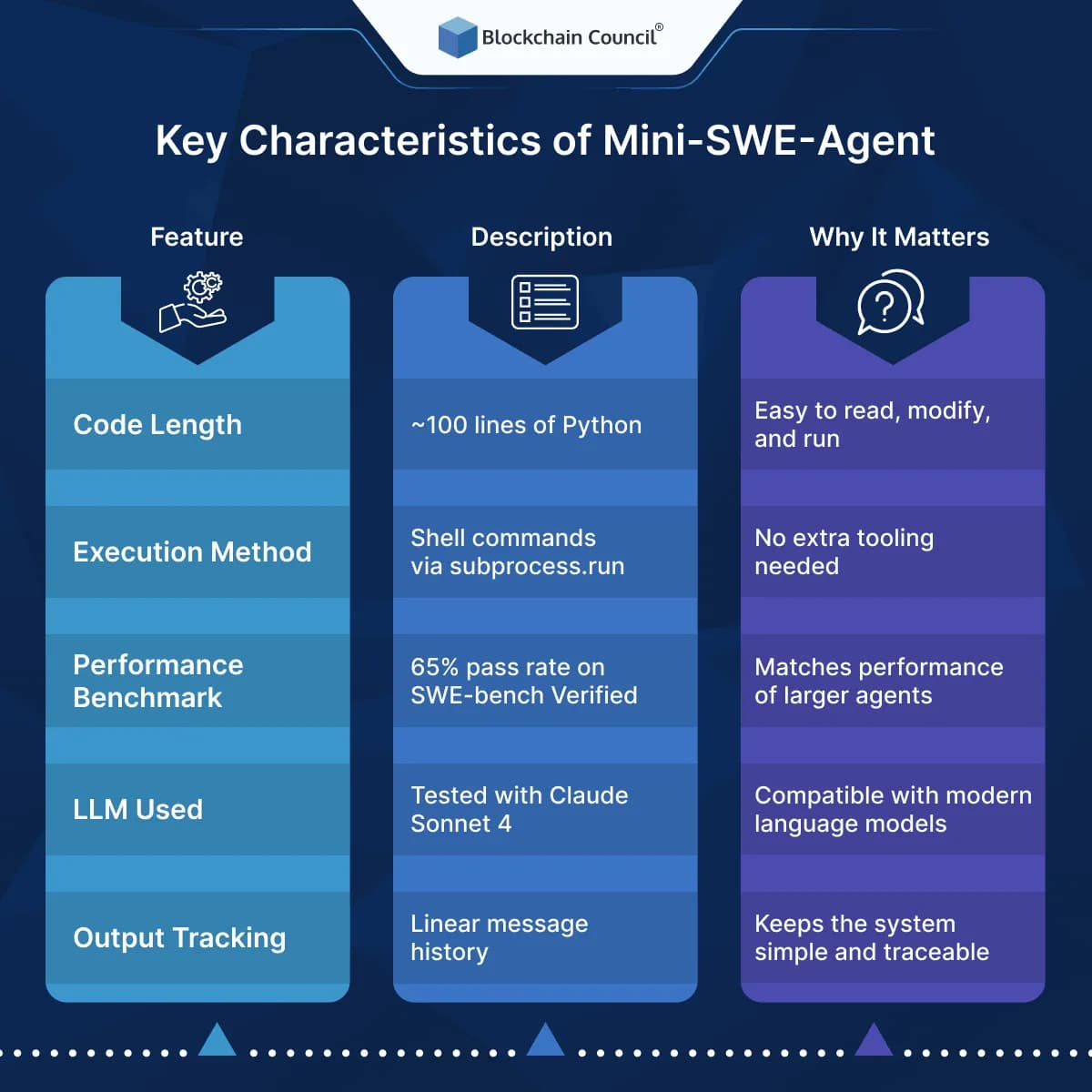
Mini-SWE-Agent is a lightweight AI coding assistant built using just 100 lines of Python. Despite its minimal design, it achieves strong results in software engineering tasks. It was developed by researchers from Princeton and Stanford as a stripped-down alternative to larger coding agents. The surprising part? It solves about 65% of GitHub issues from the SWE-bench Verified benchmark, putting it close to more complex tools.
In this article, we’ll explain what Mini-SWE-Agent is, how it works, why it matters, and how it compares to other software engineering agents. If you’re interested in LLM-based agents, efficient coding workflows, or future tech in AI development, this is for you.

What Is Mini-SWE-Agent?
Mini-SWE-Agent is a simplified coding agent that automates bug fixes and issue resolutions using prompts and shell commands. It builds directly on top of SWE-Agent, the earlier agent framework known for launching the SWE-bench benchmark. The key difference is in the architecture. Mini-SWE-Agent has no complicated tools, no hidden processes, and no heavy frameworks.
It’s made to be transparent and reproducible. Developers can run it locally using just Python and bash. That makes it ideal for research, testing, or teaching the basics of agent workflows.
Why It Was Created
The main goal behind Mini-SWE-Agent was to test how far a simple agent could go. The original SWE-Agent was feature-rich but complex. The creators wanted to see if they could remove most of the scaffolding while keeping performance high.
And it worked. With just ~100 lines of logic, Mini-SWE-Agent solves 65% of issues on the SWE-bench Verified benchmark. That’s very close to what much larger systems using Claude Sonnet 4 can achieve.
How Mini-SWE-Agent Works
Mini-SWE-Agent is designed around a simple loop. It takes a prompt, executes actions using bash and subprocess.run, and maintains a short history of what’s happened so far. There are no plugins, no retrievers, and no cloud tools. Everything is local and transparent.
Workflow Overview
- It reads a GitHub issue and the corresponding code repo.
- It asks the LLM how to fix the issue.
- It performs code edits suggested by the model.
- It tests the fix using existing test cases.
- If the fix fails, it asks the model what to try next.
This process repeats until the bug is fixed or the test fails multiple times.
Key Characteristics of Mini-SWE-Agent
What It Can Do
Mini-SWE-Agent is capable of solving a wide range of GitHub issues. It’s not limited to small projects. By using prompt-based edits and bash execution, it can:
- Identify bugs in the code
- Propose and apply fixes
- Run tests automatically
- Improve documentation
- Suggest refactoring ideas
All of this happens with no manual coding once the process starts. It’s fully autonomous within the bounds of the task.
Industry and Developer Response
Mini-SWE-Agent became popular almost instantly among developers on Reddit and Hacker News. Many praised its simplicity, saying it should be the new baseline for research in agent workflows. Others were impressed by the performance-to-size ratio. Several users have already adapted the code to work with other LLMs and test suites.
What stands out is that this agent offers real productivity without relying on third-party APIs or bloated frameworks.
How It Compares to Other Agents
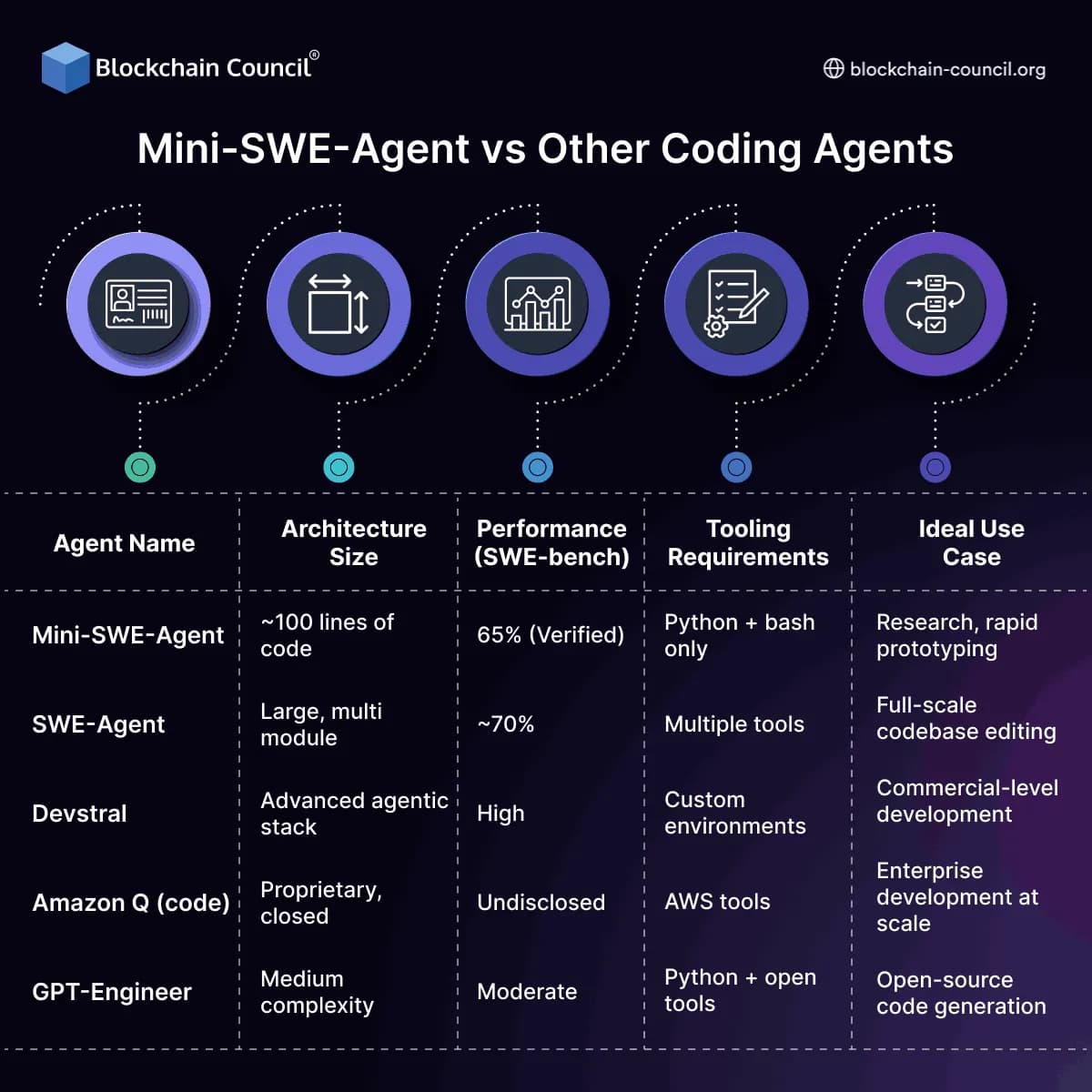
To understand Mini-SWE-Agent better, here’s how it stacks up against other well-known AI coding agents in the market.
Mini-SWE-Agent vs Other Coding Agents
Why It Matters
Mini-SWE-Agent proves that small models with simple logic can still achieve impressive results. This is important for researchers, developers, and anyone working on LLM-based tools. It lowers the barrier to entry and promotes open experimentation.
For professionals looking to build similar agents or improve existing workflows, learning how these systems work under the hood is crucial. This is where programs like the AI Certification can help by teaching foundational skills in prompt design, tool use, and agent orchestration.
If your goal is to build data-driven agent pipelines or benchmarks, consider the Data Science Certification to strengthen your understanding. And if you’re applying AI to marketing automation or business tools, the Marketing and Business Certification offers strategic training across industries.
Final Takeaway
Mini-SWE-Agent shows that size doesn’t always matter. With just 100 lines of Python and smart prompt design, it can solve real-world software issues on par with advanced tools. It’s a perfect example of efficient AI in practice. As more developers test it and tweak it, Mini-SWE-Agent could become a foundation for future agent design.
For anyone serious about working with AI tools in development, this project is worth studying—and possibly extending.
Related Articles
View All
AI & ML
Built to Catch AI Cheating: Rethinking Pre-Employment Assessments with HireValid
Explore how HireValid is rethinking pre-employment assessments with AI-resistant test design, integrity signals, candidate evidence, and human review to address AI-assisted cheating.

AI & ML
AI-Era Hiring Needs AI-Proof Tests: How HireValid Is Redefining Talent Assessment
Explore how HireValid is rethinking talent assessment for the AI era with job-relevant tests, anti-cheating design, integrity signals, and human-reviewed evidence of candidate ability.

AI & ML
Google Launches Gemini 4 Argon: Features and Capabilities
Google has launched Gemini 4 Argon, its flagship AI model for coding, finance, law, cybersecurity and science. Learn its key features, availability, pricing and safety details.
Trending Articles
The Role of Blockchain in Ethical AI Development
How blockchain technology is being used to promote transparency and accountability in artificial intelligence systems.
How Blockchain Secures AI Data
Understand how blockchain technology is being applied to protect the integrity and security of AI training data.
What is AWS? A Beginner's Guide to Cloud Computing
Everything you need to know about Amazon Web Services, cloud computing fundamentals, and career opportunities.