

How Kimi K2.7 Code Is Transforming Software Development with Advanced AI Assistance
 Suyash Raizada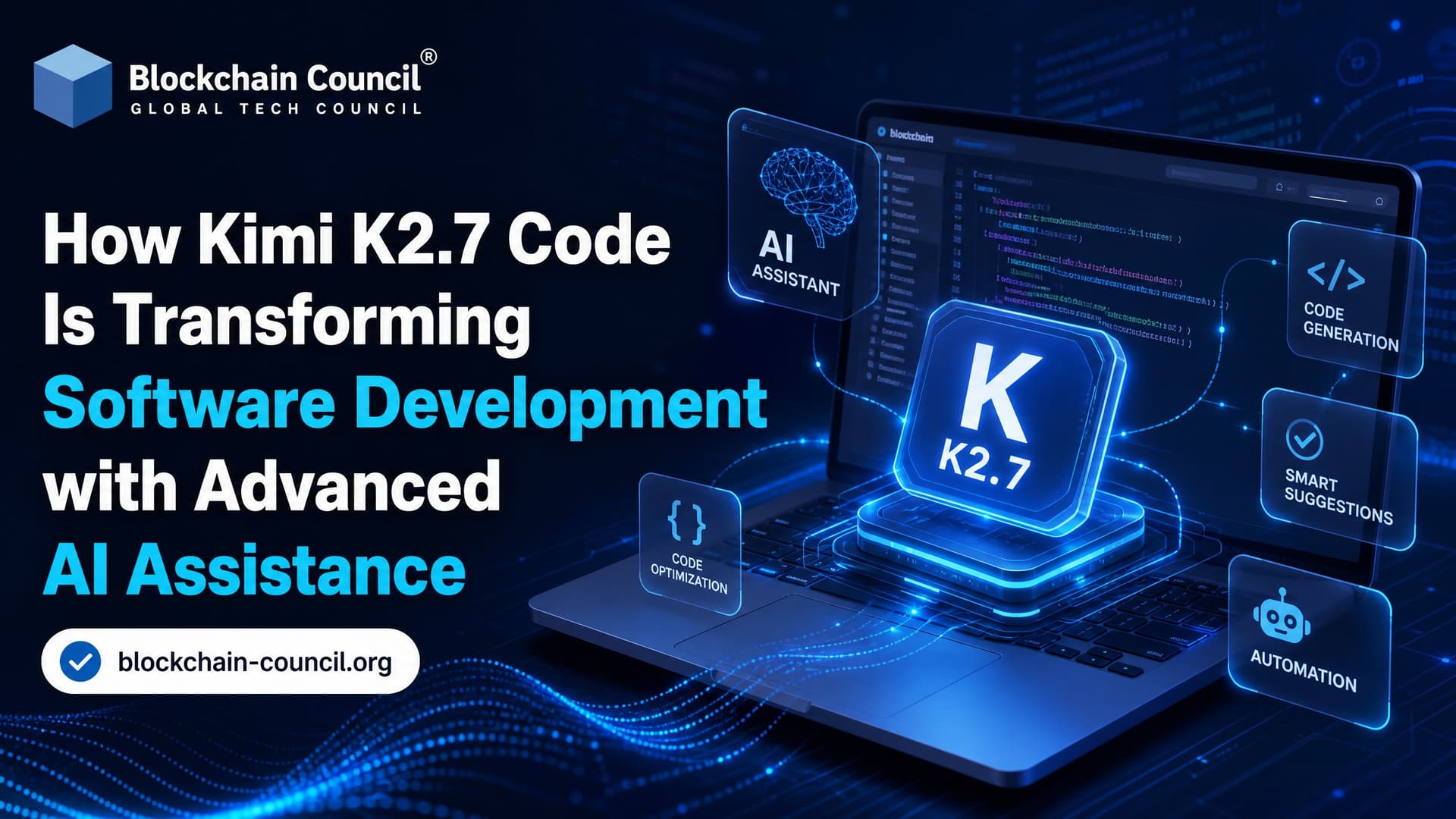
Kimi K2.7 Code changes software development because it treats coding as a long-running engineering task, not a one-line autocomplete problem. Released by Moonshot AI on 12 June 2026, it is an open-source, coding-focused Mixture-of-Experts model built for repository-scale work, agentic workflows, and lower-cost reasoning.
That distinction matters. Developers do not only need a model that writes a function. You need a system that can read a large codebase, form a plan, edit several files, run tests, inspect failures, and try again without losing the plot. Kimi K2.7 Code is aimed squarely at that workflow.

As AI-assisted software development continues to evolve, becoming an AI Powered Coding Expert can help professionals strengthen their skills in repository-level reasoning, AI-driven coding workflows, tool orchestration, and responsible software automation for enterprise development.
What Is Kimi K2.7 Code?
Kimi K2.7 Code is the latest coding model in Moonshot AI's Kimi series and the direct successor to K2.6. It uses a Mixture-of-Experts architecture with roughly 1 trillion total parameters and about 32 billion active parameters per token. In plain terms, the model has very large capacity, but only part of it runs for each token, which helps control inference cost.
The model supports a large 256k token context window, with some managed platforms listing 262k context availability. That is enough room for source files, tests, package manifests, CI configuration, architecture notes, and issue descriptions in the same session.
Key characteristics include:
Open-source weights under a Modified MIT style license.
Agentic design for tool use, terminal workflows, planning, and multi-step coding tasks.
Large context for project-scale understanding.
Lower reasoning-token usage compared with K2.6.
Availability across platforms, including Kimi API, Kimi Code terminal agent, OpenRouter, and Cloudflare Workers AI.
Cloudflare Workers AI lists @cf/moonshotai/kimi-k2.7-code as a hosted model option, giving teams a managed route for code-focused and agent-like workloads. Kimi's own documentation describes K2.7 Code as its strongest coding model so far, especially for long-context instruction following.
Why Kimi K2.7 Code Matters for Developers
The biggest shift is not that Kimi K2.7 Code can generate code. Many models can. The real change is that it stays useful across a messy engineering session.
Think about a typical migration from Jest to Vitest, or from an older Next.js project layout to the App Router. The work is not one patch. It involves config updates, import changes, test fixes, package changes, and repeated runs of npm test or pnpm test. A weaker assistant often edits the first file correctly, then forgets the pattern by the fourth file. That is where long-context reliability starts to matter.
In practice, a strong coding agent should do four things:
Read the repository before editing.
Explain the plan in small steps.
Make changes with minimal blast radius.
Run checks, inspect errors, and repair its own patch.
Kimi K2.7 Code is built around that loop.
Performance Gains Over K2.6
Moonshot AI and early technical analyses report several measurable improvements over K2.6:
About 21.8 percent improvement on Kimi CodeBench v2.
Around 11 percent improvement on Program Bench.
Roughly 31.5 percent improvement on MLS Bench Lite, which focuses on machine learning and systems coding tasks.
About 30 percent fewer reasoning tokens compared with K2.6.
Around 10 percent improvement in agentic capability in external evaluations.
The reasoning-token reduction is easy to underestimate. It affects cost, latency, and how often an organization can afford to run coding agents inside CI or internal developer tools. If an agent must inspect a repository, reason through a test failure, edit code, rerun tests, and explain the final diff, token efficiency becomes a practical budget issue.
Kimi also offers a high-speed variant, kimi-k2.7-code-highspeed, with reported output speeds around 180 tokens per second and up to about 260 tokens per second in shorter contexts. For interactive development, speed changes behavior. If the model responds slowly, developers stop asking smaller questions. If it responds quickly, it becomes part of the normal coding rhythm.
From Autocomplete to Agentic Software Engineering
Traditional AI coding assistants usually operate inside a file. They complete a line, write a function, or explain an error. Kimi K2.7 Code pushes the assistant closer to an engineering agent.
Repository-Level Planning
With Kimi Code, Moonshot's terminal-first agent, the model can inspect repositories, edit files, run shell commands, and execute tests. This makes it better suited for tasks such as:
Refactoring a shared utility across several services.
Adding tests around brittle code before changing it.
Updating CI workflows after a Node.js or Python version change.
Reviewing a pull request for logic errors, not just style issues.
A useful habit is to ask the agent for a plan first, then approve the plan before it edits files. Do not skip this. In real projects, the first draft plan often exposes a wrong assumption, such as mistaking npm for pnpm or editing package-lock.json in a repository that only uses pnpm-lock.yaml.
Long-Horizon Refactoring
The 256k context window helps Kimi K2.7 Code hold more of the system in memory. That is valuable for migrations where scattered files depend on the same architectural rule.
For example, when replacing a hand-rolled authentication middleware, the model may need to inspect route handlers, session utilities, environment variables, tests, and deployment configuration. A short-context assistant may patch the obvious import and miss the edge case in a background worker. K2.7 Code is designed to reduce that kind of context loss.
Testing and Debugging
Community feedback has highlighted more frequent "advice solves", where the model diagnoses a bug and gives targeted guidance instead of dumping a patch. That can be more useful than code generation.
Every developer has seen the pattern: the test fails with TS2307: Cannot find module, the assistant proposes a new dependency, but the real issue is a path alias mismatch between tsconfig.json and the test runner. A better assistant checks both files before suggesting a fix. That is the difference between autocomplete and debugging help.
Enterprise Use Cases for Kimi K2.7 Code
For enterprises, Kimi K2.7 Code is most interesting when connected to controlled internal workflows. Do not give an agent unrestricted production access. Use it where review, logging, and rollback already exist.
DevOps and Infrastructure Automation
Kimi K2.7 Code can assist with Terraform modules, Kubernetes manifests, GitHub Actions workflows, and monitoring configuration. The win is not just generation. It can compare a proposed change against existing standards and produce a smaller diff.
Good enterprise use cases include:
Updating CI pipelines after dependency or runtime changes.
Generating test environments from existing infrastructure patterns.
Analyzing logs and suggesting instrumentation points.
Creating pull requests for low-risk maintenance tasks.
Set boundaries. Require human review before merge. Run git diff --check, unit tests, static analysis, and secret scanning before accepting agent-authored code.
As AI coding assistants become part of production software delivery, developing expertise as an MLOps Expert helps professionals understand model deployment, CI/CD automation, monitoring, governance, and the operational practices needed to manage AI systems reliably at scale.
Internal Developer Assistants
Because Kimi K2.7 Code is available through APIs and hosted platforms, teams can embed it into internal tools. A QA team might use it to generate test cases from bug reports. An SRE team might use it to explain alert patterns and draft remediation playbooks. A data engineering team might use it to review SQL transformations and pipeline code.
Open weights also create a path for domain adaptation. For companies with specialized codebases, prompt-only customization is often not enough. Fine-tuning or retrieval over internal documentation can reduce hallucinated APIs and improve style consistency.
Risks and Governance Considerations
Kimi K2.7 Code is powerful, but it is still an AI system. Treat it like a junior engineer with excellent memory and no production judgment.
Key risks include:
Data exposure: Repository content, logs, secrets, and customer data must be protected under GDPR and relevant sector rules.
Unsafe actions: Agentic tools need permission controls for file edits, command execution, and network calls.
License issues: Open-source weights and generated code still require legal and security review.
Over-trust: Passing tests do not prove the design is correct.
Use branch protection, mandatory code review, audit logs, and scoped credentials. If an agent can run shell commands, restrict the environment. A simple mistake such as running a watcher command like npm test -- --watch can hang an automated workflow until the job times out.
How Professionals Should Build Skills Around Kimi K2.7 Code
If you want to use Kimi K2.7 Code well, do not only study prompts. Study software engineering fundamentals. The best results come when you can judge the model's plan, spot a bad abstraction, and verify the patch.
Focus on these skills:
Prompting for plans, constraints, and test-first changes.
Code review and secure development practices.
CI/CD design and automated quality gates.
Model evaluation for coding tasks.
Governance for AI agents in enterprise environments.
For structured learning, Blockchain Council readers can explore certifications such as Certified Artificial Intelligence (AI) Expert™, Certified Prompt Engineer™, and Certified Generative AI Expert™. Developers working with blockchain systems can pair these with Certified Blockchain Developer™ to understand how AI coding agents fit into smart contract and Web3 development workflows.
The Future of AI-Assisted Development
Kimi K2.7 Code points toward a practical future: specialized AI agents embedded across the software development lifecycle. Not magic. Not replacement. More like a tireless pair programmer that can read a large repo, propose a plan, and keep working through the boring parts while you make the engineering calls.
The next competitive frontier will be cost, latency, security, and tool integration. High benchmark scores matter, but enterprises will ask harder questions: Can it work inside our CI system? Can we audit every file change? Can it respect our coding standards? Can it run cheaply enough to use every day?
Start small. Pick one non-critical repository, connect Kimi K2.7 Code through a controlled agent workflow, and ask it to add tests before it changes production code. Then measure what matters: review time, defect rate, failed builds, and developer satisfaction. If you want formal grounding before deploying AI agents at work, begin with Blockchain Council's AI certification track and build a hands-on project that uses an AI coding assistant inside a real Git workflow.
As AI-powered developer tools continue to gain enterprise adoption, a Marketing Certification can also help professionals understand product positioning, user adoption, stakeholder communication, and go-to-market strategies for innovative AI technologies.
FAQs
1. What Is Kimi K2.7 Code?
Kimi K2.7 Code is an AI-powered coding assistant designed to help developers write, explain, debug, and optimize code. It aims to improve software development productivity through advanced code generation and intelligent programming assistance.
2. How Does Kimi K2.7 Code Help Software Developers?
It assists with code generation, debugging, refactoring, documentation, testing, and code explanations, enabling developers to complete programming tasks more efficiently while reducing repetitive work.
3. Why Is Kimi K2.7 Code Important for Modern Software Development?
It accelerates development cycles, improves coding efficiency, supports faster problem-solving, and helps developers focus on designing solutions rather than repetitive coding tasks.
4. How Does Kimi K2.7 Code Work?
The model analyzes developer prompts, understands programming context, generates code suggestions, explains existing code, identifies potential issues, and assists with technical problem-solving across supported programming languages.
5. Which Programming Languages Does Kimi K2.7 Code Support?
AI coding assistants commonly support languages such as Python, JavaScript, TypeScript, Java, C++, C#, Go, Rust, PHP, SQL, HTML, and CSS, though support depends on the specific implementation.
6. Can Kimi K2.7 Code Generate Complete Applications?
It can help generate application components, APIs, scripts, functions, and project structures. Developers should still review, test, and validate generated code before production use.
7. How Does Kimi K2.7 Code Improve Code Quality?
It can identify inefficient logic, recommend cleaner coding practices, improve readability, suggest optimizations, and help developers follow established programming standards.
8. Can Kimi K2.7 Code Help Debug Software?
Yes. It can analyze error messages, review source code, explain bugs, identify likely causes, and recommend possible fixes to help developers resolve issues faster.
9. How Does Kimi K2.7 Code Assist with Code Refactoring?
It helps simplify complex code, reduce duplication, improve maintainability, reorganize functions, and recommend better software architecture while preserving functionality.
10. Can Kimi K2.7 Code Generate Documentation?
Yes. It can generate function descriptions, API documentation, code comments, README files, technical explanations, and developer documentation that improves project maintainability.
11. Can Kimi K2.7 Code Help with Software Testing?
Yes. It can generate unit tests, integration test examples, test cases, mock data, and testing strategies while helping developers identify potential edge cases.
12. How Does Kimi K2.7 Code Support API Development?
It can assist with designing REST APIs, generating endpoint logic, explaining API workflows, producing request and response examples, and documenting API specifications.
13. Which Technologies Can Developers Use with Kimi K2.7 Code?
Developers can use it alongside IDEs, Git, CI/CD pipelines, cloud platforms, APIs, databases, containers, and modern software development frameworks depending on available integrations.
14. Which Industries Can Benefit from Kimi K2.7 Code?
Software companies, fintech, healthcare, education, cybersecurity, e-commerce, gaming, manufacturing, telecommunications, and enterprise IT teams can all benefit from AI-assisted development.
15. What Are the Benefits of Using Kimi K2.7 Code?
Benefits include faster software development, improved productivity, reduced debugging time, better documentation, higher code consistency, easier onboarding, and enhanced developer efficiency.
16. What Are the Limitations of Kimi K2.7 Code?
Like other AI coding assistants, it may generate incorrect, outdated, insecure, or inefficient code. Human review, testing, and security validation remain essential before deployment.
17. How Can Development Teams Adopt Kimi K2.7 Code Successfully?
Organizations should establish AI coding guidelines, integrate code reviews, validate generated code, implement automated testing, monitor security, and train developers on responsible AI-assisted programming.
18. What Skills Are Needed to Use Kimi K2.7 Code Effectively?
Developers should understand programming fundamentals, software architecture, debugging, version control, testing, prompt engineering, cybersecurity, and code review best practices.
19. What Common Mistakes Should Developers Avoid When Using Kimi K2.7 Code?
Avoid accepting generated code without review, skipping security testing, ignoring performance optimization, relying entirely on AI for system design, and failing to verify outputs against project requirements. AI is a capable assistant, not a substitute for engineering judgment.
20. How Will Kimi K2.7 Code Shape the Future of Software Development?
AI coding assistants like Kimi K2.7 Code are expected to streamline software development by accelerating coding, improving debugging, enhancing documentation, and supporting intelligent automation throughout the software lifecycle. As AI capabilities continue to evolve, developers will increasingly collaborate with AI to build more reliable, scalable, and innovative applications while maintaining human oversight for architecture, security, and quality assurance.
Related Articles
View All
AI & ML
Jev for Software Automation
Explore how Jev supports software automation with fast, typed, probabilistic decisions for routing, scoring, classification, verification, branching, and workflow control.
AI & ML
System One Models for Software
Explore how System One Models can be used in software to make fast, structured, probabilistic decisions for automation, routing, scoring, verification, and real-time applications.
AI & ML
Why Recursive Self-Improvement Matters for AGI Development
Recursive self-improvement could shape AGI by accelerating capability growth, changing safety risks, and forcing new governance for self-updating AI systems.
Trending Articles

Top 5 DeFi Platforms
Explore the leading decentralized finance platforms and what makes each one unique in the evolving DeFi landscape.
What is AWS? A Beginner's Guide to Cloud Computing
Everything you need to know about Amazon Web Services, cloud computing fundamentals, and career opportunities.
Claude Code Vs Cursor
Claude Code vs Cursor compares two AI coding tools based on features, automation, and developer workflows.