

How GPT 5.6 Could Transform Enterprise Automation and AI-Powered Workflows

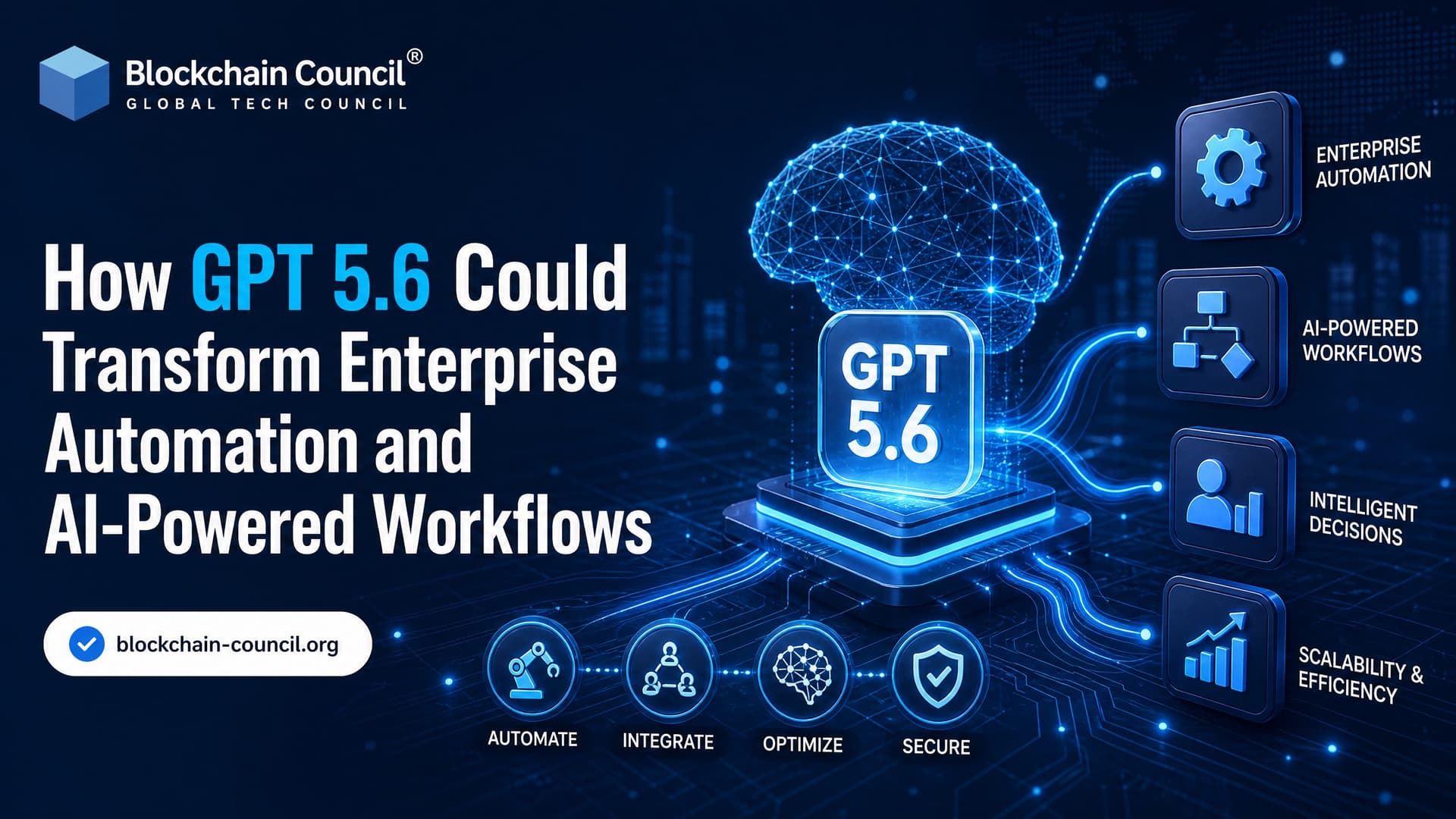
GPT 5.6 enterprise automation is less about a smarter chatbot and more about a new control layer for business processes. If the limited-preview reports hold up in production, GPT 5.6 could help enterprises automate work that currently breaks across five systems, three teams, and a messy spreadsheet nobody wants to own.
The useful shift is simple: stronger reasoning, better coding, longer context, and agentic execution. That combination matters because real enterprise automation is rarely a single prompt. It is a chain of decisions. Pull logs. Check policy. Open a ticket. Run a test. Ask for approval. Update the record. GPT 5.6 appears designed for that kind of work.

What Is GPT 5.6?
GPT 5.6 is described as a frontier model family from OpenAI with three variants: Sol, Terra, and Luna. Sol is positioned as the flagship model for reasoning, coding, science, and cybersecurity. Terra is the balanced option for lower-cost enterprise workloads. Luna is the fast model for high-volume tasks such as classification, summarization, routing, and content review.
That split is practical. You do not want your most expensive reasoning model labeling 2 million support tickets if a faster model can do it well enough. Save Sol for hard work: a failed deployment, a security investigation, a contract review with conflicting clauses, or a cross-system workflow that needs judgment.
GPT 5.6 is still described as limited preview, with access initially routed through API and Codex for selected partners. OpenAI has also signaled a cautious rollout because the model's cybersecurity and coding abilities are strong enough to raise safety and regulatory questions. That is not a side note. For enterprises, governance will decide whether these systems create value or create incident reports.
Why GPT 5.6 Matters for Enterprise Automation
Most automation inside large companies is brittle. A workflow works until a field name changes, a vendor API returns a slightly different error, or a human sends an attachment in the wrong format. Traditional robotic process automation handles stable screens and predictable paths. GPT 5.6 points toward a different pattern: agents that can reason through variation, use tools, and keep state across long tasks.
The reported GPT 5.6 upgrades fit five enterprise needs:
- Reasoning controls: The new "max" reasoning effort setting lets the model spend more compute on difficult problems.
- Agentic "ultra" mode: Subagents can divide a large task into smaller jobs and coordinate results.
- Long context: Some commentary discusses context windows around one to 1.5 million tokens for certain configurations.
- Command-line competence: Sol is reported as state of the art on Terminal-Bench 2.1, a benchmark for multi-step terminal workflows.
- Tiered economics: Sol, Terra, and Luna let teams match cost and latency to workload type.
A small setting can matter here. In agent tests, raising reasoning effort often improves planning, but it also changes latency and token spend. If you let an agent use "max" on every ticket, your finance team will notice before your users do. Route work by risk. Easy tasks go to Luna or Terra. Escalations go to Sol.
From Task Automation to Workflow Orchestration
The biggest GPT 5.6 enterprise automation story is workflow orchestration. A model that can call tools, inspect outputs, adjust its plan, and continue for many steps starts to look less like a help widget and more like an operations worker with restricted permissions.
1. Software Development and DevOps
Development teams are obvious early adopters. GPT 5.6 in Codex-style environments could inspect repositories, run tests, debug failures, and propose pull requests. The long-context angle is especially useful for older codebases where the real logic is split across services, YAML files, and comments written in 2018.
A concrete example: a CI agent sees a failing Python build with ModuleNotFoundError: No module named 'src'. A weak assistant suggests installing a package. A better agent checks pyproject.toml, sees that tests run from the repository root locally but from a nested working directory in CI, updates the test command, runs pytest, and adds a short note to the pull request. That is the difference between answer generation and workflow execution.
Use Sol for repository-wide refactors and hard debugging. Use Terra for routine code review comments, release note drafts, and test-fix loops with clear boundaries.
2. Cybersecurity Operations
GPT 5.6 Sol is reported to perform strongly on cyber benchmarks such as ExploitBench and ExploitGym, especially as reasoning effort increases. That can help defenders. It can also help attackers, which is why the rollout has drawn regulatory attention.
For security teams, the productive use cases are controlled and auditable:
- Alert triage across SIEM logs, endpoint reports, and incident notes
- Vulnerability research in internal code with human approval gates
- Threat modeling for new product features
- Drafting incident response playbooks from real telemetry
Do not give an AI security agent broad production access on day one. Treat it like a privileged automation account. Use least privilege, log every tool call, and require approval for exploit reproduction, network scanning, or production changes.
3. Legal, Compliance, and Finance Workflows
Long-context reasoning could change document-heavy work. A GPT 5.6 agent may review a vendor contract, compare it against procurement policy, flag non-standard indemnity language, and draft a risk summary for legal review. The same pattern applies to compliance attestations, audit evidence collection, and financial scenario analysis.
The model should not be the final authority. It should reduce the first-pass burden. You still need a human owner for interpretation, sign-off, and accountability.
4. Customer Support and Service Operations
Support workflows often require memory and action. A customer sends a screenshot, an error log, and three previous ticket references. GPT 5.6's reported multimodal improvements, including commentary around a 40 percent gain over the previous generation, could help agents interpret mixed inputs and choose the next step.
A strong support agent could summarize the case, search the knowledge base, create a ticket, suggest a fix, and update the CRM after approval. That is valuable. But be blunt: if your internal knowledge base is stale, the model will automate stale advice faster. Fix the content layer first.
Performance and Cost Trade-Offs
Early enterprise commentary points to Sol pricing near 5 US dollars per million tokens, with Terra and Luna positioned for cheaper scaled workloads. Cerebras-hosted Sol has also been discussed at throughput up to roughly 750 tokens per second for select customers. Validate these figures against official pricing and deployment terms before budget planning, but the design direction is clear.
You should not standardize on one model for everything. A practical routing policy looks like this:
- Luna: Bulk summarization, tagging, routing, sentiment checks, duplicate detection.
- Terra: Standard workflow automation, support drafts, ticket enrichment, routine code assistance.
- Sol: Complex reasoning, high-risk analysis, cyber work, architectural decisions, long-horizon agents.
This matters because enterprise AI bills rarely break because of one expensive prompt. They break because someone put a frontier model behind a high-volume endpoint with no cache, no batching, and no routing.
Governance: The Part You Cannot Skip
GPT 5.6 could transform enterprise automation, but only inside a clear operating model. Agentic systems need more than prompt guidelines. They need controls that look familiar to security, risk, and platform teams.
- Access control: Give agents scoped credentials, not shared admin accounts.
- Audit trails: Store prompts, tool calls, outputs, approvals, and rejected actions.
- Human checkpoints: Require review for production writes, security actions, legal decisions, and customer-impacting changes.
- Evaluation suites: Test agents against real failure cases before release.
- Cost limits: Set token budgets, rate limits, and escalation rules by workflow type.
If you are building internal capability, this is where structured learning helps. Blockchain Council's Certified Artificial Intelligence (AI) Expert™, Certified Prompt Engineer™, and Certified ChatGPT Expert™ give teams grounding in model behavior, prompt design, and AI workflow implementation. Security teams evaluating agentic cyber use cases may also pair AI training with the Certified Cybersecurity Expert™.
How Enterprises Should Prepare for GPT 5.6
Do not start with the model. Start with one workflow that is painful, measurable, and safe enough to test.
- Pick a bounded workflow: CI failure triage, support ticket summarization, policy document review, or alert enrichment.
- Map the tools: Identify APIs, databases, ticketing systems, repositories, and approval points.
- Define failure: Decide what the agent must never do, such as pushing to production or emailing a customer without review.
- Build evaluations: Use old incidents, failed builds, messy tickets, and edge-case documents.
- Route by difficulty: Use Luna or Terra for routine work and Sol for escalations.
- Measure outcomes: Track time saved, error rate, human override rate, latency, and cost per completed workflow.
One practical warning: long context is not free intelligence. Stuffing an entire repository or policy archive into context can hide the signal. Retrieval, chunking, and clear task framing still matter. In many cases, a smaller context with the right files beats a million-token dump.
The Real Impact of GPT 5.6 on AI-Powered Workflows
GPT 5.6 could move enterprises from AI-assisted tasks to AI-supervised workflows. That is a meaningful jump. The model family appears built for planning, coding, tool use, multimodal inputs, and long-running work. Sol handles the hard cases. Terra and Luna make scaled deployment more realistic.
The winners will not be the companies that connect GPT 5.6 to every system first. The winners will be the teams that choose narrow workflows, add guardrails, measure behavior, and train employees to manage AI agents like serious production software.
Your next step: select one workflow where mistakes are recoverable, define the approval gates, and build a small evaluation set before wider deployment. If your team needs a common foundation, start with Blockchain Council's AI certification path, then move into hands-on agent design, governance, and workflow testing.
Related Articles
View All
AI & ML
OpenAI Launches GPT 6.1-Sol
OpenAI launches GPT-6.1 Sol, a new reasoning model offering near-Astra performance at lower cost for complex coding, computer use, agentic workflows, and professional tasks.

AI & ML
How NVIDIA Cosmos 3 Enables Physical AI and Multi-Agent Workflows
Explore how NVIDIA Cosmos 3 enables Physical AI and agent-based workflows through multimodal reasoning, world simulation, action prediction, synthetic data, and autonomous system development.
AI & ML
Jev for Software Automation
Explore how Jev supports software automation with fast, typed, probabilistic decisions for routing, scoring, classification, verification, branching, and workflow control.
Trending Articles
The Role of Blockchain in Ethical AI Development
How blockchain technology is being used to promote transparency and accountability in artificial intelligence systems.
AWS Career Roadmap
A step-by-step guide to building a successful career in Amazon Web Services cloud computing.
Claude AI Tools for Productivity
Discover Claude AI tools for productivity to streamline tasks, manage workflows, and improve efficiency.