

How to Hire an OpenAI Consultant: A Complete Guide for Businesses
 Suyash Raizada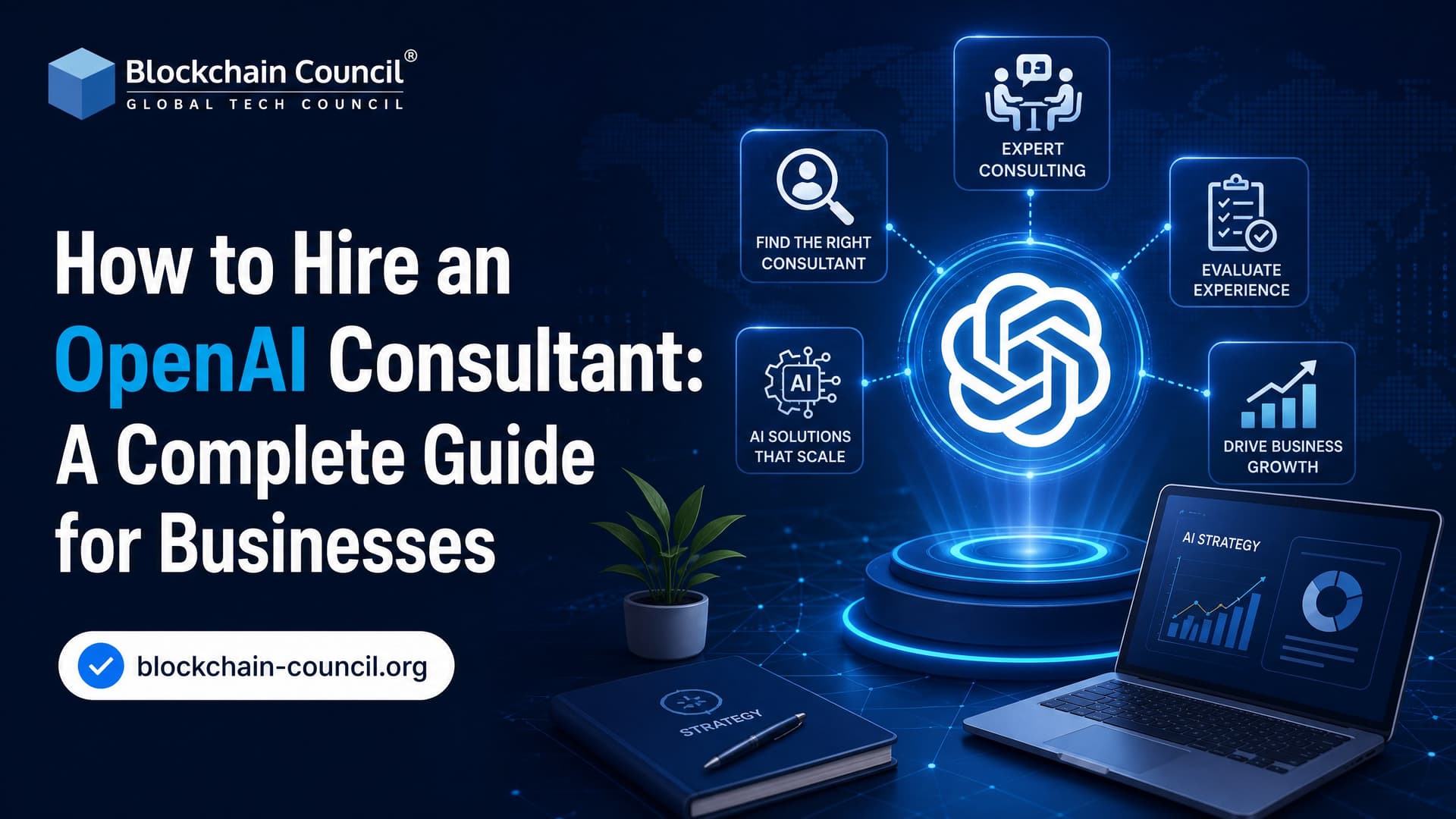
Hiring an OpenAI consultant is no longer about finding someone who can write clever prompts. You are hiring for production AI judgment: architecture, data security, workflow design, evaluation, and handover. The right person turns OpenAI models into a working business system. The wrong one leaves you with a demo that breaks the first time a user asks an unexpected question.
The market has matured fast. OpenAI now offers enterprise deployment support through its own consulting and embedded engineering work, while freelance platforms, mentor networks, and specialist firms all advertise OpenAI consulting services. That gives you choice. It also means you need a hiring process that separates real operators from slideware.

As the field becomes more competitive, the value of a Certified OpenAI Consultant increasingly comes from demonstrating practical experience in deployment, governance, integration, and business transformation rather than simply understanding AI concepts at a high level.
What an OpenAI Consultant Actually Does
An OpenAI consultant helps a business design, build, and run systems using OpenAI technologies such as GPT models, embeddings, tool calling, assistants, and APIs. The work may cover strategy, application development, data integration, prompt design, model evaluation, and AI governance.
In practice, you will meet five consultant types:
Strategy advisors: Help executives select use cases, estimate value, and avoid low-return experiments.
AI solution architects: Design how OpenAI connects with your CRM, help desk, data warehouse, identity provider, and internal applications.
Applied AI engineers: Build with OpenAI APIs, retrieval systems, vector databases, backend services, and front-end workflows.
Prompt and product specialists: Shape user experience, prompt patterns, instructions, and human review flows.
Risk and compliance advisors: Handle governance, privacy, bias, auditability, and regulated data issues.
Do not hire a strategy-only consultant if you need working software in six weeks. Do not hire a pure API developer if your real problem is process redesign. Match the profile to the job.
Why Demand for OpenAI Consulting Has Grown
OpenAI consulting has moved from informal experimentation into a structured professional services market. The reason is simple: API access is not the hard part anymore. The hard part is connecting models to business data, testing outputs, controlling cost, keeping sensitive data safe, and training employees to use the system correctly.
That shift is where the money goes now: implementation quality, not prototypes. Third-party options have expanded too. Upwork lists OpenAI developers as a distinct talent category. MentorCruise offers pre-vetted OpenAI mentors and consultants. Several development firms market OpenAI and ChatGPT consulting for custom applications and long-term support. Demand on job boards has been strong, with hourly rates often landing in the mid double digits in USD.
Step-by-Step Guide to Hire an OpenAI Consultant
1. Define the business outcome before you contact anyone
Start with the work, not the model. Be specific. "Use AI in customer support" is too vague. "Reduce tier-1 ticket handling time by 25 percent while keeping escalation accuracy above 95 percent" is a brief a consultant can price and test.
List the following:
The workflow you want to improve
The people who will use the system
The data sources involved
Security or regulatory constraints
Success metrics, such as time saved, quality score, resolution rate, or cost per task
If HR data, health data, financial records, or children's data is involved, say so early. A capable consultant will immediately raise access control, data minimization, retention, and audit logs.
2. Choose the right engagement model
Your sourcing model should fit your risk level and internal capability.
Embedded enterprise partner: Best for large organizations with high-stakes workflows and internal teams ready to collaborate daily.
Specialist OpenAI consulting firm: Good for mid-sized projects such as a customer support agent, internal knowledge assistant, or sales co-pilot.
Freelancer: Useful for prototypes, integrations, evaluation scripts, and narrow technical tasks.
Retainer advisor: Strong option when your internal developers are building but need architecture reviews and expert feedback.
Dedicated engineer model: Works when you need a long-term contributor but are not ready to hire full time.
To be blunt, a freelancer can be the best choice for a small proof of concept. For a company-wide HR assistant touching employee records, use a firm or embedded team with compliance experience.
3. Write a clear role brief
A good brief filters out weak candidates fast. Include your stack, systems, constraints, and expected deliverables.
Ask for experience with:
OpenAI APIs, including chat, embeddings, tool calling, and structured outputs
Retrieval-augmented generation, often called RAG
Vector databases such as Pinecone, Weaviate, pgvector, or Milvus
Backend development in Python, Node.js, or your preferred stack
Evaluation methods for accuracy, hallucination, latency, and cost
Security practices, including secrets management and role-based access
Documentation and knowledge transfer
Add domain requirements if needed. Healthcare, HR, insurance, and finance are not generic AI projects. The consultant needs to understand the consequences of a bad answer.
For teams that rely heavily on Python-based AI and backend systems, a Python Certification can help validate practical skills in application development, API integration, automation, debugging, and the engineering foundations required for successful AI deployments.
4. Source candidates from credible channels
You can find OpenAI consultants through several routes:
OpenAI's enterprise deployment channels, if your organization is large enough for that model
Specialist AI consultancies and system integrators
Freelance platforms such as Upwork
Mentor networks such as MentorCruise
LinkedIn referrals from engineering leaders and product teams
Developer communities where LLM builders discuss real implementation problems
References matter. Ask for introductions to clients who kept using the consultant's work after the invoice was paid. Production survival is the best case study.
5. Test for real implementation skill
Do not rely on a polished deck. Ask each shortlisted OpenAI consultant to walk through a past project at implementation depth. You want details.
Useful interview questions include:
How did you decide between fine-tuning, RAG, and prompt-only design?
How did you measure answer quality before launch?
What did you do when retrieval returned irrelevant context?
How did you control token cost and latency?
How did you handle personally identifiable information?
What broke in production, and how did you fix it?
A practitioner will have scars. A real builder knows that stuffing long PDF chunks into a prompt often triggers a 400 context_length_exceeded error, or worse, produces confident nonsense because the relevant paragraph is buried. They will talk about chunk size, overlap, metadata filters, reranking, and evaluation sets. A pretender will say the model "understands the documents." It does not. Your retrieval pipeline does most of that work.
6. Start with a diagnostic or proof of concept
Before signing a long contract, run a small paid diagnostic. Two to four weeks is often enough.
The deliverables should include:
A ranked use-case backlog
A reference architecture
A working prototype using your sample data
A risk register
An evaluation plan
A cost estimate for production usage
Keep the scope narrow. "Build an internal policy assistant for 200 HR documents" is testable. "Transform employee experience with AI" is not.
7. Put governance and ownership into the contract
Your contract should state who owns code, prompts, configurations, documentation, evaluation data, and deployment assets. It should also cover confidentiality, data handling, security review, support windows, and termination.
Include these clauses or equivalent language:
No client data may be used for unrelated training, benchmarking, or demos without written approval
All API keys and credentials remain under your organization's control
The consultant must document prompts, model settings, data flows, and failure modes
Production release requires agreed evaluation thresholds
Knowledge transfer is a required deliverable, not an optional meeting
For sensitive functions, create an AI governance group with business, legal, security, data, and engineering representation. Keep it small enough to make decisions.
Red Flags When Hiring an OpenAI Consultant
They recommend fine-tuning before understanding your data and workflow.
They cannot explain RAG trade-offs in plain language.
They promise zero hallucinations.
They ignore cost, latency, and monitoring.
They ask for broad access to production data on day one.
They have no plan for human review or escalation.
They treat prompt engineering as the whole project.
One strong opinion: for most business knowledge assistants, start with RAG and solid evaluation before fine-tuning. Fine-tuning can help with style, format, or specialized behavior, but it is usually the wrong first move for keeping answers grounded in changing company documents.
Skills Your Internal Team Should Build
Even if you hire an OpenAI consultant, do not outsource understanding. Your team must know enough to operate the system after launch.
For internal capability building, Blockchain Council readers may find related learning paths useful, especially the Certified AI Expert™, Certified Prompt Engineer™, and Certified ChatGPT Expert™ programs. They suit teams building AI literacy, prompt design skills, and practical generative AI knowledge.
Technical teams should also learn API integration, evaluation design, model safety, and basic MLOps. Business teams should learn how to write use-case briefs, review AI outputs, and spot risk.
A Marketing Certification can further strengthen these capabilities by helping professionals understand customer needs, stakeholder communication, adoption planning, and the business context needed to evaluate whether AI initiatives are delivering meaningful results.
Hiring Checklist
Define one clear business problem and success metric.
Choose the engagement model: embedded team, firm, freelancer, retainer, or dedicated engineer.
Write a role brief with technical, domain, and security requirements.
Shortlist candidates with relevant production work.
Run a paid diagnostic or proof of concept.
Evaluate safety, privacy, bias, and compliance practices.
Clarify IP, code ownership, data rules, and support.
Require documentation and knowledge transfer.
Set up governance before production rollout.
Final Takeaway
The best way to hire an OpenAI consultant is to treat the role as an implementation partner, not a prompt writer. Start with a narrow business problem, test candidates on real architecture decisions, and insist on measurable outcomes, security discipline, and clean handover. If your team is new to generative AI, pair the engagement with structured training through Blockchain Council certifications so your staff can question decisions, maintain the system, and build the next use case with less outside help.
FAQs
1. What Is an OpenAI Consultant?
An OpenAI Consultant is a professional who helps businesses identify, implement, optimize, and manage AI solutions using generative AI technologies to improve productivity, automation, customer experiences, and business outcomes.
2. Why Should Businesses Hire an OpenAI Consultant?
Businesses hire OpenAI Consultants to accelerate AI adoption, reduce implementation risks, identify high-value use cases, and ensure AI investments deliver measurable results.
3. When Should a Company Consider Hiring an OpenAI Consultant?
Organizations should consider hiring a consultant when planning AI initiatives, automating workflows, improving customer experiences, optimizing operations, or developing an AI strategy.
4. What Services Does an OpenAI Consultant Typically Provide?
Services often include AI strategy development, workflow automation, prompt engineering, chatbot implementation, employee training, AI governance, and performance optimization.
5. How Can an OpenAI Consultant Help Improve Business Operations?
Consultants identify inefficiencies, automate repetitive tasks, streamline workflows, enhance decision-making, and improve productivity across departments.
6. What Skills Should Businesses Look for in an OpenAI Consultant?
Key skills include AI strategy, prompt engineering, business analysis, workflow design, communication, project management, automation expertise, and AI governance knowledge.
7. Should Businesses Prioritize Technical or Business Expertise?
The ideal consultant combines both. Technical knowledge ensures effective implementation, while business expertise ensures AI solutions align with organizational goals.
8. What Industries Benefit Most from OpenAI Consulting Services?
Industries such as healthcare, finance, retail, manufacturing, education, legal services, technology, and professional services commonly benefit from AI consulting.
9. How Can Businesses Evaluate an OpenAI Consultant's Experience?
Review past projects, client testimonials, case studies, certifications, implementation results, and demonstrated expertise in solving business challenges.
10. What Questions Should Businesses Ask During the Hiring Process?
Organizations should ask about experience, methodologies, project outcomes, governance practices, implementation approaches, and industry expertise.
11. How Important Is Prompt Engineering Expertise?
Prompt engineering is highly valuable because it directly affects AI performance, workflow quality, output consistency, and overall project success.
12. Should Businesses Look for AI Governance Experience?
Yes, governance expertise is essential for managing privacy, compliance, security, risk mitigation, and responsible AI adoption.
13. What Is the Role of Workflow Automation in AI Consulting?
Workflow automation is often one of the highest-value consulting services because it helps businesses reduce manual work and improve operational efficiency.
14. How Can OpenAI Consultants Support Employee Adoption?
Consultants can provide training, develop best practices, create usage guidelines, and help teams integrate AI into daily workflows.
15. What Pricing Models Do OpenAI Consultants Typically Offer?
Common pricing models include hourly rates, project-based fees, monthly retainers, strategic advisory agreements, and enterprise consulting contracts.
16. How Can Businesses Measure the Success of an OpenAI Consultant?
Success can be measured through productivity improvements, cost reductions, workflow efficiency gains, customer satisfaction, revenue growth, and ROI.
17. What Red Flags Should Businesses Watch For?
Warning signs include unrealistic promises, lack of governance knowledge, limited business understanding, absence of case studies, and an inability to explain measurable outcomes.
18. Should Businesses Hire Freelancers or Consulting Firms?
The choice depends on project scope, budget, complexity, and support requirements. Freelancers may offer flexibility, while firms often provide broader expertise and resources.
19. What Common Mistakes Do Companies Make When Hiring AI Consultants?
Common mistakes include focusing only on technical skills, failing to define business objectives, ignoring governance considerations, selecting based solely on price, and expecting immediate transformation. AI can deliver substantial value, but it is not a magic switch that instantly reorganizes an entire company into perfect efficiency.
20. What Is the Best Approach to Hiring an OpenAI Consultant?
The best approach is to clearly define business goals, evaluate relevant experience, assess both technical and strategic capabilities, review past results, verify governance expertise, and establish measurable success criteria. Businesses that choose consultants based on demonstrated business impact rather than AI buzzwords are more likely to achieve successful and sustainable outcomes from their AI initiatives.
Related Articles
View All
AI & ML
Jev AI: Complete Guide
Explore Jev AI in this complete guide, including how TypeSafe AI’s System One model works, its features, use cases, benefits, limitations, and role in software automation.
AI & ML
Complete Guide to GPT 5.6
GPT 5.6 is presented as the next evolution of OpenAI's language models, with a focus on improved reasoning, multimodal capabilities, AI agents, coding, and enterprise applications. This guide covers its features, use cases, and potential impact on the AI ecosystem.

AI & ML
Why Businesses Are Hiring OpenAI Consultants and How Certification Gives You the Edge
Businesses are increasingly hiring OpenAI consultants to integrate AI into operations, improve productivity, and drive innovation. Learn why demand is rising and how professional certification can help you stand out in a competitive AI job market.
Trending Articles
The Role of Blockchain in Ethical AI Development
How blockchain technology is being used to promote transparency and accountability in artificial intelligence systems.

Top 5 DeFi Platforms
Explore the leading decentralized finance platforms and what makes each one unique in the evolving DeFi landscape.

Can DeFi 2.0 Bridge the Gap Between Traditional and Decentralized Finance?
The next generation of DeFi protocols aims to connect traditional banking with decentralized finance ecosystems.