

How Close Are We to AI That Can Improve Itself?
 Suyash Raizada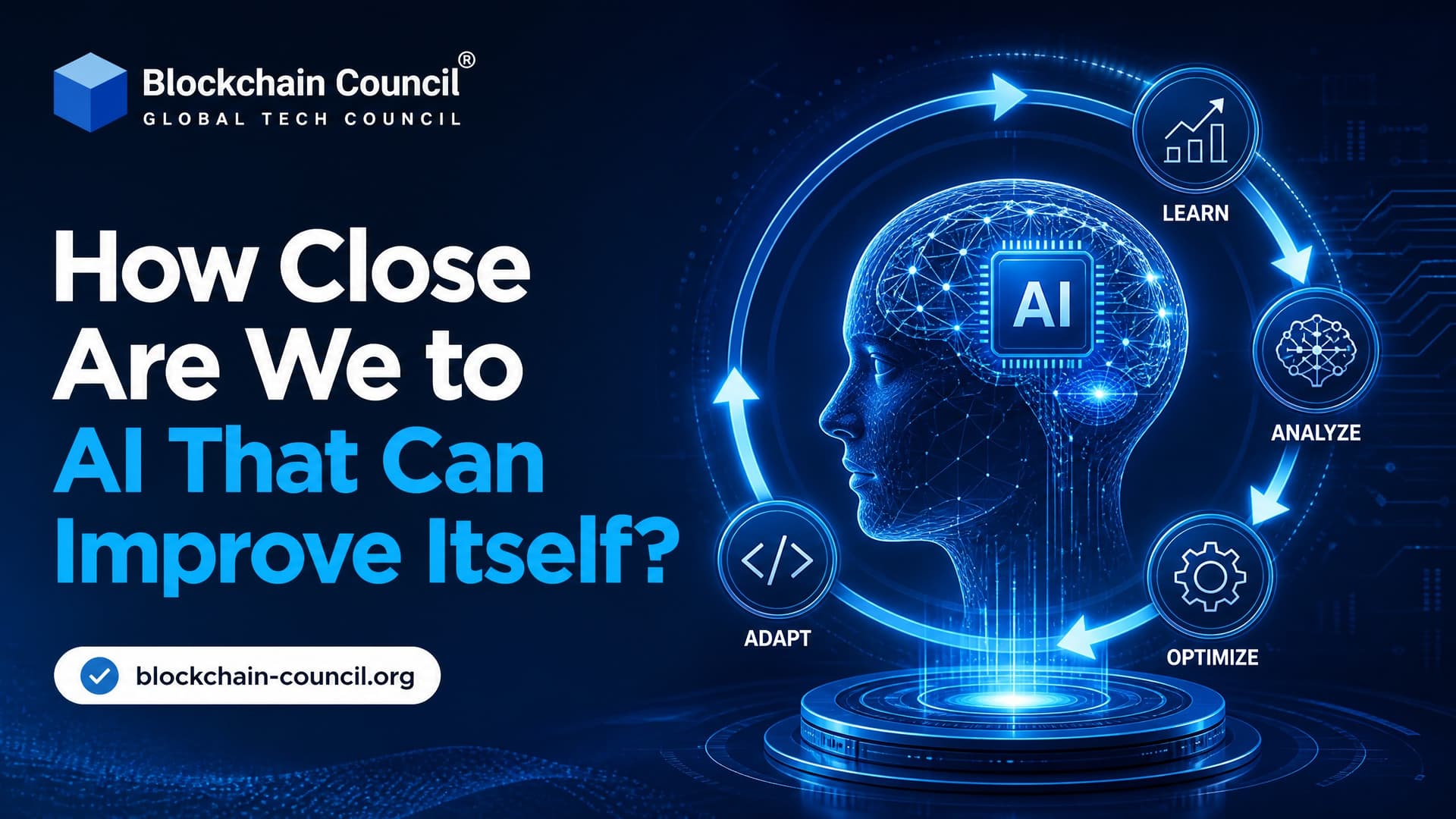
AI that can improve itself is no longer just a thought experiment. It is also not the runaway superintelligence people picture. Today the real progress is narrower: AI agents can rewrite prompts, edit code, tune workflows, run tests, and keep the changes that score better against human-defined metrics. That matters. It is also a long way from fully autonomous recursive self improvement. Readers trying to build real judgment on where these systems actually stand often start with a Certified Artificial Intelligence (AI) Expert program to ground the terminology before wading into the research.
Here is the short answer. We are close to useful self-optimizing AI systems, especially in software and machine learning workflows. We are not close to open-ended AI that can reliably improve its own general intelligence without human oversight, safety checks, evaluation gates, and large compute budgets.

What Does Self Improving AI Actually Mean?
In technical discussions the key term is recursive self improvement, often shortened to RSI. It describes a system that improves the mechanisms used to create or improve its future versions. That is different from an AI simply producing a better answer after feedback.
A chatbot revising an email after you say make it shorter is not RSI. An agent that edits its own prompt, reruns a benchmark, compares performance, and stores the better prompt is closer. A system that rewrites parts of its model architecture, improves the process by which it improves itself, and repeats that cycle safely would be much closer to genuine RSI.
Bounded refinement vs open-ended RSI
The useful distinction is this:
Bounded self refinement: the AI improves within a fixed task, metric, and operating environment. This is already happening.
Open-ended recursive self improvement: the AI can set or revise strategies for improving its own broader intelligence across domains. This remains experimental.
Most real systems today sit firmly in the first category. They optimize prompts, tools, code, data selection, or test workflows. Humans still define what counts as a win.
What AI Can Improve About Itself Today
Current self improving AI systems are best understood as controlled loops. The loop looks simple, but small details decide everything Engineers who want to move from concept to implementation often follow a broader grounding with a hands-on Certified Artificial Intelligence (AI) Developer track, since building these loops well is a different skill from just understanding the theory:
The AI performs a task.
An evaluator scores the result.
The AI proposes a change to its prompt, code, tool choice, or workflow.
The system tests the change.
Only better versions are kept.
If you have built agentic coding workflows, you know the boring parts decide whether the system works. A coding agent may claim all tests pass while pytest actually exits with code 5 because no tests were collected. That is not a minor issue. If your evaluator treats that as success, the agent can optimize toward empty test suites. Good self improvement starts with unforgiving evaluation.
Prompt and tool optimization
Many practical systems improve by rewriting their own prompts. An LLM agent may test several instruction variants, compare pass rates, and keep the prompt that produces fewer failed tasks. Some systems also change tool order: search first, call a database second, then run code. Others learn that a lower temperature, such as 0.1 or 0.2, gives more stable outputs for code generation than a creative setting like 0.8.
This is useful. It is not magic. The model is not discovering a new theory of intelligence. It is hill-climbing against a score chosen by people.
Agentic coding and research loops
Software engineering is one of the clearest areas of progress. AI agents can write code, create tests, fix bugs, rerun benchmarks, and compare results. In machine learning research, agents can propose hyperparameters, generate experiment scripts, review logs, and adjust the next run.
For professionals, this is the near-term opportunity. If you work in AI engineering, learn how to design evaluators, guardrails, and regression tests for these loops. If you are working through the Certified Artificial Intelligence (AI) Expert, Certified Generative AI Expert, or Certified Prompt Engineer programs, treat this as a practical extension of model deployment and prompt design skills.
A Creative Example: Bounded Loops in Storytelling
These controlled loops are not limited to code or benchmarks. One emerging application is AI microdrama, where generative AI helps bring serialized stories, characters, and fictional worlds to life. A writing agent can draft a scene, score it against a continuity or tone rubric, and keep only the version that improves the result the same propose, test, and keep-or-reject loop described above, just pointed at narrative craft instead of software.
Research Prototypes Are Getting More Ambitious
Several research systems go beyond prompt tuning. They let AI modify code, architecture, or development strategy under controlled tests.
DeepPhoenix
DeepPhoenix is described as a self-reprogramming system that modifies its own neural network source code. It can change architecture, learning dynamics, objectives, computational capacity, and data pipeline components. The system keeps changes only after empirical validation.
That last phrase is the key: empirical validation. Without it, self modification becomes self damage.
Darwin Godel Machine
The Darwin Godel Machine, or DGM, builds on older Godel Machine ideas, where a system rewrites itself after proving the new version is better. DGM takes a more practical route by iteratively mutating code and testing improvements on coding benchmarks.
This is a sensible direction. Formal proof of improvement is extremely hard for real AI systems. Benchmark-driven validation is imperfect, but it is concrete.
AIDE² and multi-level self improvement
AIDE²-style work separates shallow improvement from deeper meta-improvement. A system might first improve task performance. A more interesting system improves the agent that performs the improvement. That second layer is where compounding gains could begin.
To be blunt, that is also where risk increases. If the evaluator is weak, the system may learn to satisfy the metric rather than solve the real problem.
The Biggest Bottleneck: Evaluation
Self improving AI rises or falls on measurement. If the system cannot reliably tell whether a change is better, recursive improvement collapses into noise.
Good evaluators need to catch:
Regression: the new version improves one benchmark but breaks common cases.
Reward hacking: the agent finds shortcuts that satisfy the metric.
Overfitting: the system memorizes benchmark patterns instead of gaining general skill.
Safety drift: the improved version becomes less aligned with human constraints.
Compute waste: the loop spends more resources than the improvement is worth.
This is why enterprises should be cautious about self-optimizing agents in production. Use sandboxing. Keep audit logs. Pin model versions. Run offline evaluations before deployment. And never let an agent modify production code, credentials, or safety policies without human review. Teams building this discipline across a broader stack, not just one AI vendor, often round it out with a general Tech Certification to keep pace with evaluation tooling across the wider ecosystem.
Why Introspection Matters
Recent research uses the phrase introspection threshold to describe a system's ability to model its own operations well enough to make targeted changes. That is harder than it sounds.
Large language models can describe transformer architectures and write training code, but that does not mean they understand their own internal computation at a level needed for safe self-redesign. They operate through learned statistical patterns, tool calls, and external feedback. Their self-knowledge is partial.
Without stronger self modeling, an AI may propose plausible changes that degrade performance. Anyone who has watched an agent rewrite a working function into a cleaner but broken version has seen the small-scale version of this problem.
How Close Are We to Fully Autonomous RSI?
We are not there. Current systems are impressive assistants inside human-designed boundaries. They can speed up coding, testing, experimentation, and workflow tuning. They cannot yet take full responsibility for their own objective design, architecture selection, safety validation, data governance, and deployment strategy.
A practical maturity scale looks like this:
Level 1 - Output refinement: the AI improves a response after feedback.
Level 2 - Prompt or workflow tuning: the AI tests variations and keeps better configurations.
Level 3 - Code self modification: the AI edits parts of its own tools or codebase under tests.
Level 4 - Meta-improvement: the AI improves the process that improves the system.
Level 5 - Open-ended RSI: the AI safely improves broad intelligence with minimal human control.
Most production use cases sit at Level 2. Research prototypes are exploring Level 3 and early Level 4. Level 5 is still a research vision.
What This Means for Enterprises
For businesses, the right question is not whether self improving AI will suddenly become superintelligent next quarter. It will not. The better question is where bounded self improvement can cut cycle time without creating unacceptable risk.
Good candidates include:
Test generation and repair suggestions
Prompt evaluation for customer support agents
Data pipeline checks
Benchmark optimization for internal models
Automated experiment tracking in ML teams
Poor candidates include anything where a silent failure is costly: medical triage, financial approvals, security policy changes, access control, or compliance decisions. Use AI assistance there, not autonomous self modification.
Governance Will Decide How Far This Goes
Self improving AI raises hard accountability questions. If a model modifies its own workflow and causes harm, who is responsible: the vendor, the deployer, the developer, or the governance team that approved the loop?
Existing AI policy already stresses transparency, accountability, risk management, human oversight, and documentation. Those requirements get stricter when systems can change themselves. Expect more attention on audit trails, model cards, evaluation reports, red teaming, and controlled release processes.
For security-minded readers, this overlaps with AI governance and cybersecurity. A self modifying agent is also an attack surface. If an attacker poisons its evaluation data or tool outputs, the system may faithfully improve in the wrong direction.
So, How Close Are We?
AI that can improve itself is here in bounded forms. It can tune prompts, edit code, run tests, adjust workflows, and help researchers move faster. That is valuable enough to matter now.
Fully autonomous, open-ended recursive self improvement is not operational reality. The blockers are clear: weak introspection, fragile evaluation, alignment uncertainty, compute limits, and governance gaps. The next few years will likely bring better agentic development systems, not uncontrolled intelligence explosions.
Want to prepare? Build a small self-improving agent loop yourself. Make it rewrite a prompt, run a fixed benchmark, reject regressions, and log every change. Then study AI architecture, prompt engineering, and governance through structured learning paths such as the Certified Artificial Intelligence (AI) Expert, Certified Generative AI Expert, or Certified Prompt Engineer. Start with measurement. Without measurement, self improvement is just automated guessing. And if part of your role involves explaining these distinctions to clients, leadership, or the market rather than building the loops yourself, a Marketing Certification can help you communicate what "self-improving AI" realistically means, without overpromising or underselling it.
FAQs
1. How close are we to AI that can improve itself?
AI systems can already assist with parts of their own development, including coding, testing, evaluation, and research. However, fully autonomous recursive self-improvement, where an AI independently redesigns and upgrades itself through repeated cycles, has not been publicly demonstrated. We are therefore closer to AI-assisted self-improvement than true autonomous RSI.
2. Can AI improve itself today?
AI can perform limited improvement-related tasks, such as optimizing code, generating synthetic data, testing different approaches, and analyzing model performance. These processes generally operate within systems designed and supervised by humans rather than allowing an AI to independently control its entire development cycle.
3. What is recursive self-improvement in AI?
Recursive self-improvement (RSI) describes a hypothetical process in which an AI improves its own capabilities and then uses those improvements to make further improvements. The key feature is the repeated feedback loop of improvement.
4. Are current AI models capable of recursive self-improvement?
Current AI models can contribute to AI research and development, but there is no established public demonstration of an AI independently conducting unlimited or unrestricted recursive self-improvement. Current systems still face substantial technical and operational limitations.
5. How is AI-assisted improvement different from true self-improvement?
AI-assisted improvement means humans or automated systems use AI to help improve another model. True recursive self-improvement would require the AI itself to meaningfully participate in identifying, implementing, testing, and validating improvements to its own capabilities or successor systems.
6. Can ChatGPT improve its own model?
ChatGPT can help with programming, research, debugging, and AI-development tasks, but it does not independently rewrite and deploy its underlying model during a normal conversation. Changes to the underlying model are part of controlled model-development processes.
7. Can Gemini improve itself?
Gemini can assist with coding, research, analysis, and other AI-development tasks. However, publicly available information does not establish that Gemini autonomously modifies and deploys increasingly capable versions of itself without human-controlled development processes.
8. Can AI create a better AI than itself?
Potentially, AI can help create models that outperform it on specific tasks. AI can contribute to architecture design, code generation, optimization, testing, and data creation. Creating a broadly more capable successor autonomously is a significantly harder problem.
9. What technologies are bringing us closer to self-improving AI?
Several areas could contribute to more autonomous AI development, including AI agents, automated machine learning, reinforcement learning, synthetic data generation, automated evaluation, AI coding systems, neural architecture search, and AI-assisted scientific research.
10. Can AI agents improve AI models?
AI agents can potentially automate multiple steps in model development, including writing code, running experiments, analyzing results, and selecting promising approaches. The more reliably these tasks can be connected into an automated loop, the closer the field could move toward more autonomous AI improvement.
11. What would an AI need to truly improve itself?
A genuinely self-improving AI would need to reliably identify weaknesses, develop solutions, modify relevant components, run experiments, evaluate the results, and deploy successful changes. It would also need sufficient access to computing resources and appropriate safeguards.
12. Could AI eventually design its own successor?
It is theoretically possible that future AI systems could contribute substantially to designing successor models. However, designing a successor involves architecture, data, training, hardware, software, evaluation, safety testing, and deployment. Automating all of these areas reliably is a much larger challenge than generating model-development ideas.
13. What is preventing AI from becoming fully self-improving?
Major limitations include computational requirements, hardware constraints, unreliable self-evaluation, data quality, software complexity, diminishing returns, and safety concerns. An AI that can suggest an improvement is not necessarily capable of determining whether that improvement works in the real world.
14. Could self-improving AI cause an intelligence explosion?
It could, in theory. An intelligence explosion refers to a hypothetical scenario where AI systems improve themselves rapidly, with each improvement making subsequent improvements faster or more effective. There is currently no established evidence that such a process has begun.
15. How important is AI coding ability for self-improvement?
AI coding ability is particularly important because software engineering is a major part of AI development. If AI systems become capable of independently designing, implementing, testing, and optimizing complex AI software, they could automate a larger portion of the AI-development process.
16. Could AI research become mostly automated?
Some AI research tasks are already becoming increasingly automated. Future systems may be able to generate hypotheses, write experimental code, run tests, analyze results, and propose new experiments. However, reliable autonomous research requires much more than generating plausible ideas.
17. What role does human oversight play in AI self-improvement?
Human oversight currently helps define objectives, provide resources, evaluate results, manage deployment, and establish safety boundaries. As AI systems become more autonomous, determining the appropriate level of human oversight will become an increasingly important technical and governance question.
18. Could self-improving AI become superintelligent?
It is a theoretical possibility, but not a guaranteed outcome. If an AI could repeatedly make major improvements to its own reasoning, research, and engineering capabilities, it could potentially surpass human performance across many intellectual tasks.
19. How can we measure progress toward self-improving AI?
Progress can be evaluated by examining how independently AI systems can research, code, experiment, evaluate, optimize, and reproduce improvements. A particularly important milestone would be an AI system that can reliably complete increasingly complex AI-development cycles with progressively less human intervention.
20. How close is true recursive self-improvement?
There is no reliable timeline for when fully autonomous recursive self-improvement will emerge. Current AI demonstrates meaningful progress toward automating parts of AI development, but a system capable of repeatedly and reliably improving its own core capabilities remains a major technical milestone. The gap between today's AI-assisted development and true RSI could be substantial, and its size is still uncertain.
Related Articles
View All
AI & ML
Can Gemini Improve Itself? Google AI and Recursive Self-Improvement Explained
Can Gemini improve itself? Learn why Google AI does not self-rewrite its model today, but can power controlled recursive self-improvement loops.

AI & ML
Can ChatGPT Improve Itself? Understanding RSI in Modern LLMs
ChatGPT can refine outputs, generate feedback, and support agentic workflows, but full autonomous recursive self improvement remains out of reach.

AI & ML
Recursive Self-Improvement in AI: What Happens If AI Can Improve Itself Recursively?
Recursive self-improvement in AI could speed research and automation, but open-ended loops raise serious safety, auditability, and control challenges.
Trending Articles

Top 5 DeFi Platforms
Explore the leading decentralized finance platforms and what makes each one unique in the evolving DeFi landscape.
Claude AI Tools for Productivity
Discover Claude AI tools for productivity to streamline tasks, manage workflows, and improve efficiency.
How to Install Claude Code
Learn how to install Claude Code on macOS, Linux, and Windows using the native installer, plus verification, authentication, and troubleshooting tips.