

From DGX to Data Center: Building an NVIDIA-Powered AI Infrastructure for Scale
 Suyash Raizada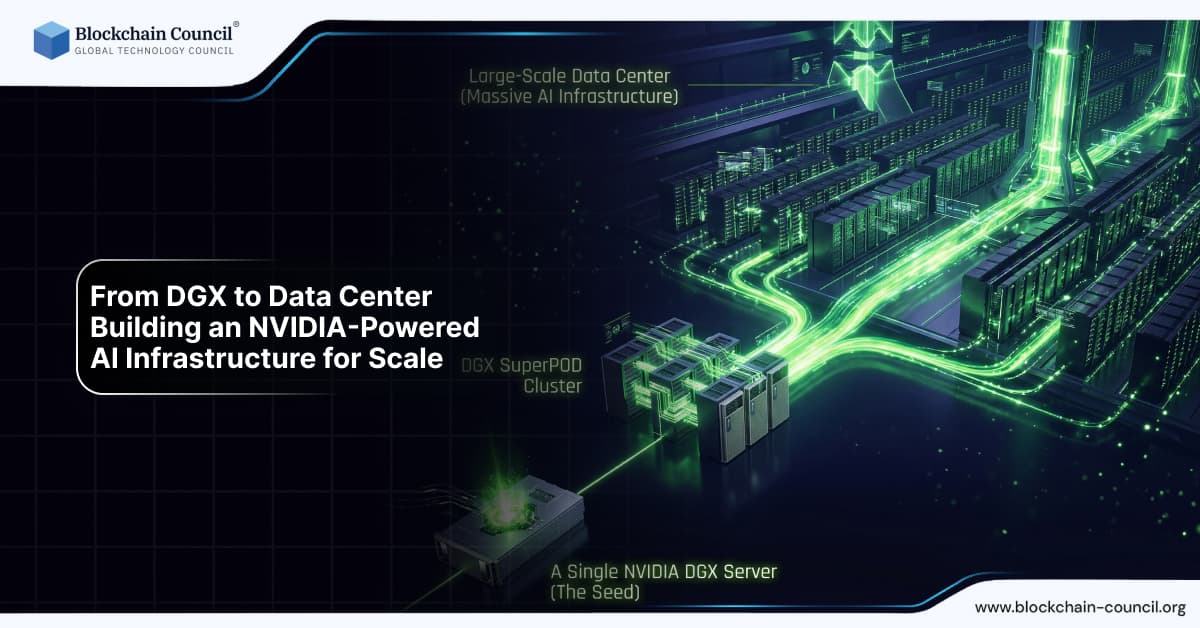
From DGX to data center is no longer a disruptive leap that forces teams to rewrite code, replatform workflows, or rethink their entire operations model. With NVIDIA's DGX ecosystem evolving from deskside systems like DGX Station and DGX Spark to rack-scale deployments built on the GB300 Grace Blackwell and Vera Rubin architectures, organizations can validate models locally and scale to AI factories designed for trillion-parameter workloads.
This article outlines how to architect an NVIDIA-powered AI infrastructure for scale, what to standardize early, and how to move from desktop experimentation to high-density data center execution using consistent building blocks.

Why the DGX-to-Data-Center Path Matters for Scaling AI
Modern AI systems are moving toward larger foundation models, agentic workflows, and continuous training and inference cycles. The infrastructure challenge is not only performance, but also portability, governance, and operational repeatability. NVIDIA's approach treats the desk-to-rack transition as a single lifecycle, where the same architectural foundation supports:
Local validation of models and autonomous agents on a deskside supercomputer
Predictable scaling into rack-scale training and inference systems
Deployment flexibility across enterprise data centers and certified colocation facilities
Scaling AI from DGX systems to full data centers requires orchestration across compute, storage, and networking-build this expertise with an AI certification, implement pipelines using a Python Course, and understand enterprise deployment via an AI powered marketing course.
Start at the Desk: DGX Station and DGX Spark for Local Development
For many teams, the fastest route to production reliability is tightening the loop between experimentation and validation. NVIDIA's latest DGX desktops are designed to run frontier workloads locally that previously required shared clusters.
DGX Station (GB300 Grace Blackwell Ultra Desktop Superchip)
DGX Station is positioned as a deskside supercomputer for long-running, autonomous agent development and validation, including regulated and air-gapped environments. Key capabilities include:
748 GB coherent memory for large model working sets
Up to 20 petaFLOPS FP4 AI performance
72-core Grace CPU paired with a Blackwell Ultra GPU linked via NVLink-C2C for coherent CPU-GPU memory access
Support for models up to 1 trillion parameters in a deskside form factor
DGX Station uses the same GB300 architectural foundation as rack-scale NVL72 systems, helping teams keep code and performance assumptions consistent as they move from prototyping to scale-out execution.
DGX Spark for Open Model Acceleration
DGX Spark targets developers working with open-source frontier models, compressing time-to-first-result by enabling local iteration on workloads that historically lived in a data center queue. This is particularly useful for model evaluation, RAG pipeline tuning, and early-stage agent tool-calling logic.
Scale-Out Targets: Rack-Scale Rubin and GB300 Systems
Once training recipes and inference graphs are stable, scaling becomes a systems engineering problem. NVIDIA's current rack-scale direction emphasizes dense GPU configurations, high-throughput networking, and liquid cooling as defaults for efficient high-power deployments.
Rack-Scale Example: DGX Vera Rubin NVL72-Class Systems
Partner solutions illustrate what modern rack-scale AI factories look like. A DGX Vera Rubin NVL72-based rack can integrate:
72 Rubin GPUs paired with 36 Vera CPUs
Up to 2.5 exaFLOPS NVFP4 training performance
Up to 3.6 exaFLOPS NVFP4 inference performance
Full liquid cooling for high-density operation
This rack-scale profile is designed for giga-scale training, high-throughput inference, and agentic AI workloads that require both compute and memory bandwidth at extreme levels.
Node-Scale Example: Rubin NVL8 Servers
For organizations scaling in smaller increments, NVL8-class servers represent a modular building block. Example configurations include:
8 Rubin GPUs per server
High NVFP4 inference throughput in the hundreds of petaFLOPS range
Substantial HBM bandwidth suitable for inference and training stages that are bandwidth-bound
These systems are commonly used to build clusters that grow one node at a time, while still aligning with a larger rack-scale blueprint.
Composable Infrastructure with MGX: Flexibility for AI Training, Inference, and HPC
Not every deployment uses a single reference system. Many enterprises mix training, inference, and data processing across multiple form factors. NVIDIA MGX-based servers are designed to be modular across CPU options and networking configurations, while still meeting AI factory requirements.
What to Look for in MGX-Class Servers
GPU density: up to 8 dual-width PCIe Gen5 GPUs in 4U to 6U designs
Memory capacity: large DDR5 footprint with up to 32 DIMM slots
Storage scalability: high-count PCIe Gen5 NVMe bays for fast local datasets and caching
Networking throughput: 400G-class Ethernet, including 8x 400G ports in high-end designs with modern SuperNICs
Cooling readiness: liquid cooling support for stable performance at higher TDP
This flexibility supports mixed workloads such as computer vision and video analytics, where GPU throughput, network ingest, and storage IOPS must align for real-time processing across many camera streams.
Data Center Readiness: Power, Cooling, and Colocation for High-Density AI
At scale, the limiting factor is rarely compute availability alone. The greater challenge is delivering and removing energy predictably. AI clusters increasingly push power density beyond legacy rack assumptions, so the data center plan should be designed alongside the compute plan.
Key Facility Requirements for DGX-Class Deployments
High power density support: planning for 50+ kW per rack is standard for modern AI racks
Liquid cooling options: direct-to-chip and related approaches to maintain thermals and efficiency
Fast deployment models: colocation partners that can deliver megawatt-scale capacity within months
Network proximity and backbone: robust upstream connectivity for data ingestion, replication, and service delivery
DGX-Ready Colocation as an Acceleration Path
NVIDIA's DGX-Ready Colocation program certifies partners for DGX deployments, with an emphasis on liquid cooling readiness and high-density power delivery. This matters when moving from a pilot cluster to production capacity without waiting for a full facility build-out. Certified providers typically offer rapid timelines for multi-megawatt deployments and scalable inventory pools to support growth.
Reference Architecture Approach: Standardize Early to Scale Faster
To make the DGX-to-data-center path repeatable, standardize the parts of the stack that are most costly to change later. A practical approach defines a reference architecture across five layers.
1) Compute and Model Portability
Choose development systems that align architecturally with data center targets. When the desk system shares the same architectural family as the rack-scale deployment, it reduces rework and performance surprises as model sizes grow.
2) Networking
Plan networking as a first-class design element:
400G-class networking for GPU clusters and storage backplanes
Low-latency fabrics for distributed training and parameter exchange
Segmentation for regulated, multi-tenant, or air-gapped requirements
3) Storage and Data Pipeline
AI infrastructure scales only if the data pipeline scales with it. Use fast NVMe tiers for hot datasets and caching, and ensure data ingestion and preprocessing can keep GPUs consistently fed. End-to-end lifecycle management across the full data pipeline matters as much as raw training throughput.
4) Observability and Efficiency
Track performance per watt, utilization, and thermal stability as core operational KPIs. DGX systems appear on energy-efficiency rankings such as the Green500, and each hardware generation tends to improve performance per unit of energy. For enterprises, this translates into better cost control and more predictable capacity planning.
5) Governance and Security
For sovereign and regulated environments, plan for:
Air-gapped operation where required
Controlled model access and artifact signing
Audit-ready MLOps processes across training and deployment
A Practical Scaling Workflow: Desk to Rack to Production
The following workflow reflects a repeatable path that production AI teams commonly adopt:
Prototype locally on DGX Station or DGX Spark: validate model choice, agent behaviors, tool-calling logic, and evaluation harnesses.
Harden the pipeline: lock data schema, preprocessing, training scripts, and inference graphs.
Scale to cluster: move to NVL8 or NVL72-class infrastructure for distributed training and high-throughput inference.
Industrialize operations: implement monitoring, cost controls, rollout strategies, and reliability testing.
Deploy in a facility built for density: enterprise data center upgrades or DGX-Ready colocation when time-to-capacity is critical.
Optimizing GPU workloads involves scheduling, inference tuning, and monitoring-develop these capabilities with an Agentic AI Course, deepen ML performance skills via a machine learning course, and align systems with business needs through a Digital marketing course.
Conclusion: Design Once, Scale Many Times
From DGX to data center represents a shift toward a unified AI infrastructure lifecycle: local validation on a deskside system, predictable portability to rack-scale architectures, and operational deployment in facilities designed for high-density AI. The enabling factors are consistent architecture families such as GB300 and Rubin-era systems, modular server designs with modern networking, and colocation programs that reduce time-to-capacity while meeting power and cooling requirements.
Organizations that standardize early across compute, networking, data pipelines, observability, and governance will scale faster, spend more efficiently, and reduce risk as they advance toward trillion-parameter models and production-grade agentic AI.
FAQs
1. What is NVIDIA DGX in AI infrastructure?
NVIDIA DGX is a high-performance system designed for AI training and inference. It integrates GPUs, software, and networking for accelerated computing.
2. What does “from DGX to data center” mean?
It refers to scaling AI workloads from a single DGX system to a full data center environment. This enables handling larger datasets and more complex models.
3. Why is scalable AI infrastructure important?
Scalability ensures that systems can handle growing workloads and data. It supports faster training and efficient deployment of AI models.
4. What components are required for an AI data center?
Key components include GPUs, storage systems, networking, and cooling infrastructure. Software platforms and orchestration tools are also essential.
5. How do GPUs power AI infrastructure?
GPUs provide parallel processing capabilities for AI workloads. They significantly speed up training and inference tasks.
6. What is the role of networking in AI data centers?
High-speed networking connects systems and enables data transfer. It is critical for distributed training and large-scale operations.
7. How does NVIDIA support large-scale AI deployments?
NVIDIA provides hardware, software, and frameworks for AI infrastructure. Its ecosystem supports scalable and efficient deployments.
8. What is distributed training in AI?
Distributed training involves using multiple systems to train models simultaneously. It reduces training time and improves performance.
9. How does storage impact AI workloads?
Storage systems manage large datasets required for training. High-performance storage ensures fast data access and processing.
10. What are the benefits of using NVIDIA DGX systems?
Benefits include optimized performance, integrated software, and ease of deployment. DGX systems are designed for AI-specific workloads.
11. How can organizations transition from DGX to full data centers?
Organizations can expand infrastructure by adding more systems and integrating networking and storage. Planning and scalability are key.
12. What is the role of AI frameworks in infrastructure?
AI frameworks provide tools for building and deploying models. They integrate with hardware to optimize performance.
13. How does cooling affect AI data centers?
AI workloads generate significant heat. Efficient cooling systems are essential to maintain performance and reliability.
14. What challenges arise in scaling AI infrastructure?
Challenges include cost, complexity, and resource management. Proper planning and automation help address these issues.
15. How does cloud integration support AI infrastructure?
Cloud services provide additional scalability and flexibility. They allow organizations to extend capacity without physical expansion.
16. What is the importance of orchestration in AI systems?
Orchestration tools manage workloads across systems. They ensure efficient resource allocation and system coordination.
17. How does NVIDIA software enhance AI infrastructure?
NVIDIA software includes optimized libraries and tools. These improve performance and simplify development.
18. What industries benefit from large-scale AI infrastructure?
Industries like healthcare, finance, and research benefit significantly. They require high-performance computing for complex tasks.
19. How can organizations ensure reliability in AI data centers?
Reliability is achieved through redundancy, monitoring, and maintenance. Proper design reduces downtime and ensures consistent performance.
20. What is the future of NVIDIA-powered AI infrastructure?
AI infrastructure will continue to scale with advanced hardware and software. Integration with cloud and edge systems will drive future growth.
Related Articles
View All
AI & ML
OpenAI Launches GPT-6.1 Terra: What’s New?
OpenAI has launched GPT-6.1 Terra, a faster and cheaper mid-tier model with stronger computer use, better image understanding and fewer errors. See what is new, what it costs, and who can use it.

AI & ML
Built to Catch AI Cheating: Rethinking Pre-Employment Assessments with HireValid
Explore how HireValid is rethinking pre-employment assessments with AI-resistant test design, integrity signals, candidate evidence, and human review to address AI-assisted cheating.

AI & ML
AI-Era Hiring Needs AI-Proof Tests: How HireValid Is Redefining Talent Assessment
Explore how HireValid is rethinking talent assessment for the AI era with job-relevant tests, anti-cheating design, integrity signals, and human-reviewed evidence of candidate ability.
Trending Articles
AWS Career Roadmap
A step-by-step guide to building a successful career in Amazon Web Services cloud computing.

Can DeFi 2.0 Bridge the Gap Between Traditional and Decentralized Finance?
The next generation of DeFi protocols aims to connect traditional banking with decentralized finance ecosystems.
How to Install Claude Code
Learn how to install Claude Code on macOS, Linux, and Windows using the native installer, plus verification, authentication, and troubleshooting tips.