

Fine-Tuning vs RAG vs Prompt Engineering: Choosing the Right Approach for Custom AI Applications
 Suyash Raizada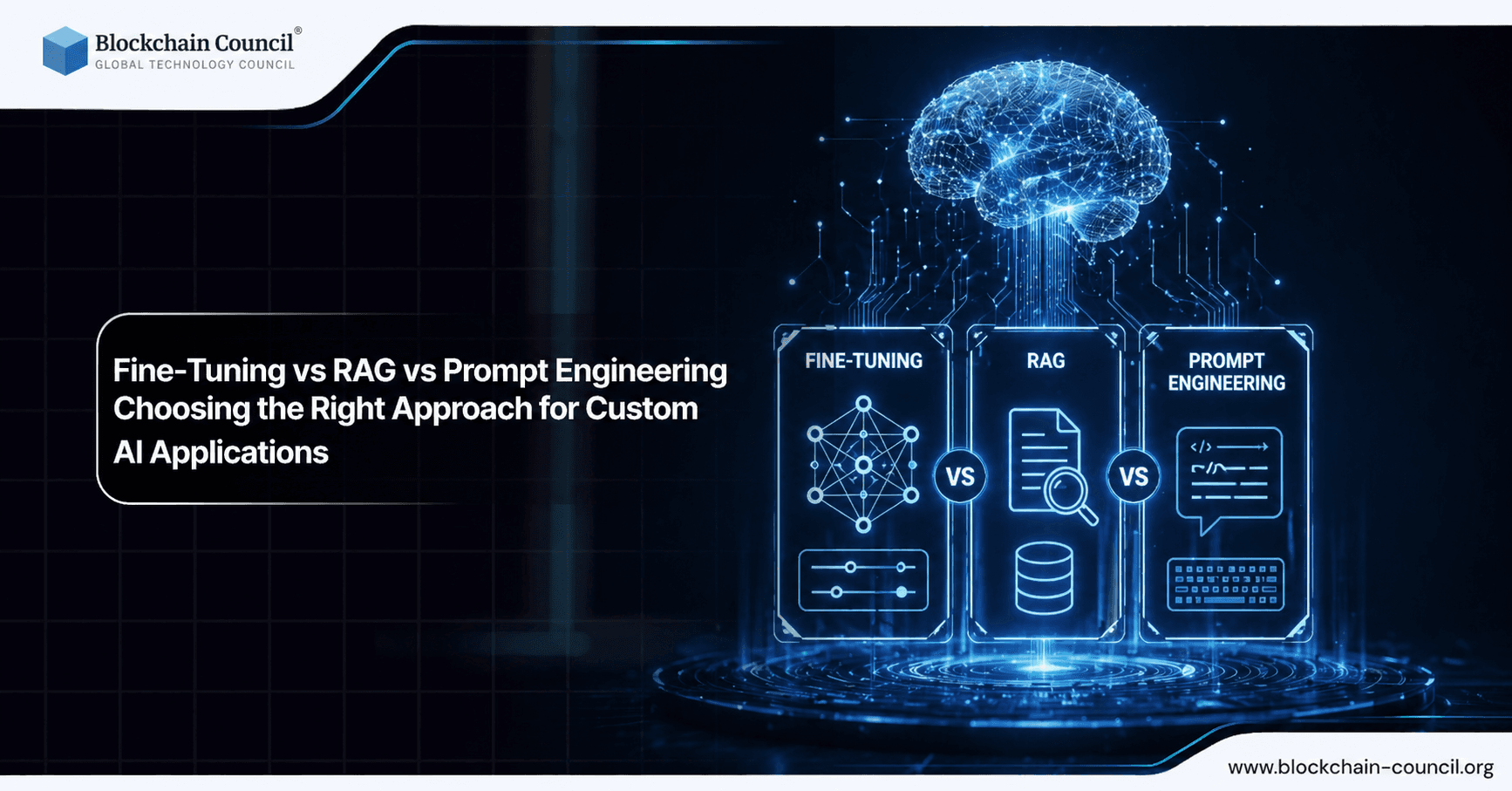
Fine-tuning vs RAG vs prompt engineering is one of the most practical decisions teams face when building custom AI applications with large language models (LLMs). Each method customizes model behavior differently: prompt engineering optimizes instructions, Retrieval-Augmented Generation (RAG) injects fresh external knowledge at query time, and fine-tuning changes model weights to lock in specialized behavior. Most production systems today use a hybrid approach, but the right starting point depends on your data, latency, security, and quality requirements.
What is Prompt Engineering?
Prompt engineering is the practice of writing structured instructions that guide an LLM to produce a desired output. It is typically the fastest and lowest-cost way to customize results because it requires no additional infrastructure beyond an LLM API and involves no model training.

Common Prompt Engineering Techniques
Role or persona prompting: Setting a context such as "You are a senior tax accountant" to establish tone and domain assumptions.
Step-by-step reasoning prompts: Asking the model to reason through a problem in a structured way, often implemented as hidden reasoning or structured intermediate steps in production.
Output constraints: Forcing formats like JSON, YAML, or a strict schema for downstream automation.
Few-shot examples: Providing a small set of input-output pairs that reflect your application's requirements.
Prompt engineering suits rapid prototyping, UX iteration, and enforcing consistent response structure. Teams commonly start here because iteration is immediate and changes are deployed simply by updating a prompt template.
What is RAG (Retrieval-Augmented Generation)?
RAG combines an LLM with a retrieval layer that fetches relevant documents at query time, then injects those passages into the prompt so the model can answer using grounded context. A typical RAG pipeline uses embeddings and a vector database to perform semantic search over a knowledge base.
Why RAG is the Default for Knowledge-Heavy Applications
Real-time knowledge freshness: Update documents and re-index without retraining the model.
Better factual reliability: Grounding retrieved content in the prompt reduces hallucinations substantially compared with prompts alone.
Unlimited corpus scale: RAG handles large and growing document sets, unlike fine-tuning which captures a fixed snapshot.
Security and access control: Modern vector databases support granular authorization, enabling user-specific retrieval for enterprise applications.
Trade-offs exist. Retrieval adds latency and infrastructure overhead. Current benchmarks show RAG can add roughly 100 ms to 2 seconds of latency depending on index size, filters, and reranking. Per-request costs are often higher than pure prompting because retrieval incurs additional processing and typically sends more context tokens to the LLM.
What is Fine-Tuning?
Fine-tuning updates an LLM's weights using a curated dataset so the model internalizes domain-specific reasoning, tone, and patterns. Unlike RAG, which supplies context at runtime, fine-tuning changes baseline behavior permanently until you retrain.
What Fine-Tuning Does Best
Consistent style and brand voice: Useful for customer-facing content with strict tone requirements.
Stable structured outputs: Improves adherence to JSON schemas, tool-calling patterns, or domain-specific templates.
Specialized reasoning and policy behavior: Encodes a specific escalation rubric, review checklist, or classification logic directly into the model.
Fine-tuning typically requires hundreds to thousands of labeled examples, plus ML expertise to prepare data, evaluate regressions, and manage retraining cycles. Costs have fallen with more efficient GPU pipelines, but the process still commonly ranges from roughly $5,000 to $50,000 or more depending on model choice, dataset complexity, and evaluation requirements. Fine-tuning also carries the risk of embedding sensitive information if training data governance is not carefully enforced.
Fine-Tuning vs RAG vs Prompt Engineering: Practical Comparison
The following operational breakdown helps when choosing an approach for custom AI applications:
Setup time: Prompt engineering in hours, RAG in days to weeks, fine-tuning in weeks to months.
Starting cost: Prompt engineering is near zero, RAG is moderate (often under $10,000 for basic infrastructure), and fine-tuning is higher (often $5,000 to $50,000 or more).
Data freshness: Prompt engineering is static unless manually updated, RAG reflects changes after re-indexing, and fine-tuning remains frozen until the next retraining cycle.
Hallucination reduction: Prompt engineering helps somewhat, RAG improves reliability significantly through grounding, and fine-tuning helps somewhat but does not guarantee factual accuracy.
Latency: RAG introduces retrieval latency, while a fine-tuned model can often run faster because prompts are shorter and retrieval is bypassed.
How to Choose the Right Approach: A Decision Framework
Expert consensus generally recommends starting with prompt engineering, moving to RAG for knowledge grounding, and fine-tuning only when you need durable behavioral changes that prompts and RAG cannot reliably achieve.
Step 1: Start with Prompt Engineering When Any of These Apply
You are prototyping or validating product-market fit.
You need a specific response format, such as JSON fields or a structured checklist.
Your knowledge is small, stable, and can be included in the prompt or system instructions.
You need fast iteration with minimal engineering investment.
Tip: For teams building internal AI tools, prompt templates combined with automated evaluation tests often deliver most of the early value before more complex infrastructure is justified.
Step 2: Choose RAG First When Facts, Freshness, or Citations Matter
You have private, proprietary, or frequently changing documents.
Your application must provide source-backed answers and reduce hallucinations.
You are building enterprise search tools, knowledge assistants, or customer support bots that reference live policies and help articles.
You need access controls so different users see different content.
RAG is often the most robust option for knowledge-centric systems because it separates knowledge from behavior: you update the knowledge base without retraining the model.
Step 3: Use Fine-Tuning When Behavior Must Be Consistent at Scale
You need consistent brand voice across thousands of outputs.
You require high adherence to a specific schema or tool-calling protocol.
You want the model to internalize specialized reasoning patterns, such as a scoring rubric or escalation threshold.
You want lower inference latency by avoiding large prompts and retrieval overhead for common workflows.
Fine-tuning is most effective when you already know the exact behavior you want and can create a high-quality dataset that accurately reflects it.
Real-World Architectures: Why Hybrids Win in Production
Layered systems have become the norm in production deployments: prompt engineering handles per-query control, RAG supplies up-to-date knowledge, and selective fine-tuning enforces consistent behavior. This combination improves reliability and keeps applications adaptable as models and data evolve.
Example 1: Customer Support Assistant
Prompt engineering: Enforces tone, empathy, and response structure.
RAG: Retrieves help center articles, recent ticket history, and product policies.
Fine-tuning: Encodes escalation logic, such as handing off when confidence is low or when a policy exception is detected.
Example 2: Enterprise Search Over 10,000 Documents
RAG: Semantic retrieval with access control and optional reranking.
Prompt engineering: Standardizes summaries, applies answer style guidelines, and requests citations from retrieved passages.
Example 3: Code Review and Engineering Standards Tool
Fine-tuning: Learns codebase conventions and review heuristics.
Prompt engineering: Specifies changed files, risk categories, and output format.
RAG (optional): Retrieves internal engineering documentation and style guides to support recommendations.
Team, Tooling, and Governance Considerations
Resourcing often determines which approach is practical:
Prompt engineering: Commonly handled by one engineer or product developer with evaluation support.
RAG: Typically requires 2 to 4 people across backend, data engineering, and security to build ingestion, indexing, and monitoring pipelines.
Fine-tuning: Commonly needs 3 to 6 or more specialists across ML engineering, data labeling, evaluation, and MLOps.
Governance requirements also differ across approaches. RAG can enforce document-level permissions and reduces the risk of permanently embedding sensitive data in a model. Fine-tuning demands stricter dataset controls, retention policies, and regression testing to prevent memorization of confidential content.
As organizations evaluate RAG and fine-tuning strategies, many professionals pursue a Machine Learning Certification to deepen their understanding of model training, data governance, evaluation methodologies, and the controls needed to build reliable and compliant AI systems.
Learning Path and Internal Training Opportunities
For teams formalizing skills in custom AI application development, building competency across all three layers is worthwhile:
Prompt engineering and LLM application design: Internal link opportunity to Blockchain Council prompt engineering and generative AI programs.
RAG and vector databases: Internal link opportunity to Blockchain Council AI and data engineering coursework covering embeddings, retrieval, and evaluation.
Fine-tuning and MLOps: Internal link opportunity to Global Tech Council machine learning, MLOps, and AI engineering certifications.
Conclusion: Selecting the Best Approach for Custom AI Applications
Fine-tuning vs RAG vs prompt engineering is not a winner-take-all decision. Prompt engineering is the fastest path to a functional baseline and often addresses formatting and UX needs without additional infrastructure. RAG is the most reliable option for dynamic, private, and citation-driven knowledge work, particularly as enterprise vector databases continue improving latency and access control capabilities. Fine-tuning is the right tool when you need durable behavioral changes, such as brand voice consistency, schema compliance, or specialized reasoning, and your team can support ongoing retraining and evaluation.
For most teams, the most dependable strategy is a layered one: start with prompts, add RAG when knowledge grounding matters, and fine-tune selectively when consistency and performance require it.
FAQs
1. What is fine-tuning in AI applications?
Fine-tuning involves training a pre-trained model on specific data to improve performance. It adapts the model to a particular domain or task. This provides deeper customization.
2. What is retrieval-augmented generation (RAG)?
RAG combines a language model with a retrieval system. It pulls relevant data from external sources to generate accurate responses. This improves factual accuracy.
3. What is prompt engineering?
Prompt engineering is the practice of designing inputs to guide model outputs. It does not change the model itself. It is the fastest and simplest way to customize behavior.
4. How do fine-tuning, RAG, and prompt engineering differ?
Fine-tuning modifies the model, RAG adds external knowledge, and prompt engineering controls inputs. Each approach solves different problems. Choosing the right one depends on requirements.
5. When should you use fine-tuning?
Use fine-tuning when you need domain-specific behavior or consistent output style. It is useful for specialized tasks. It requires more resources and data.
6. When is RAG the best choice?
RAG is ideal when you need up-to-date or large external knowledge. It works well for search and question answering. It reduces hallucinations by grounding responses.
7. When should you rely on prompt engineering?
Prompt engineering is best for quick improvements and prototyping. It requires no training or infrastructure changes. It is useful for simple use cases.
8. What are the advantages of fine-tuning?
Fine-tuning provides high accuracy and consistent outputs. It enables deep customization. It is effective for domain-specific applications.
9. What are the advantages of RAG?
RAG improves factual accuracy by using external data. It supports dynamic and up-to-date information. It reduces the need for retraining.
10. What are the advantages of prompt engineering?
Prompt engineering is fast, cost-effective, and easy to implement. It requires no additional infrastructure. It is ideal for rapid experimentation.
11. What are the limitations of fine-tuning?
Fine-tuning can be expensive and time-consuming. It requires high-quality data and compute resources. Updates may require retraining.
12. What are the limitations of RAG?
RAG depends on the quality of retrieved data. Poor retrieval can lead to incorrect outputs. It also adds system complexity.
13. What are the limitations of prompt engineering?
Prompt engineering may not provide consistent results for complex tasks. It relies heavily on model behavior. It cannot add new knowledge to the model.
14. Can fine-tuning and RAG be used together?
Yes, combining both can improve performance. Fine-tuning handles behavior, while RAG provides knowledge. This approach is common in advanced systems.
15. How does cost compare between these approaches?
Prompt engineering is the cheapest, RAG has moderate costs, and fine-tuning is the most expensive. Costs depend on infrastructure and usage. Budget considerations are important.
16. How do these approaches impact scalability?
RAG scales well with large datasets. Fine-tuning requires retraining for changes. Prompt engineering scales easily but has limitations in complexity.
17. Which approach reduces hallucinations the most?
RAG is most effective at reducing hallucinations. It provides grounded information from external sources. Fine-tuning and prompts alone may not be sufficient.
18. How do you evaluate which approach to use?
Evaluate based on use case, data availability, and performance needs. Consider cost, scalability, and accuracy. Testing different approaches helps determine the best fit.
19. What are common use cases for each approach?
Fine-tuning is used for domain-specific tasks, RAG for knowledge retrieval, and prompt engineering for simple workflows. Each serves different needs. Combining them can enhance results.
20. What is the future of custom AI application development?
The future involves hybrid approaches combining fine-tuning, RAG, and prompt engineering. Systems will become more efficient and adaptive. Choosing the right mix will be critical.
Related Articles
View All
AI & ML
How Prompt, Loop, and Context Engineering Shape Reliable AI Agents
Learn how prompt, loop, and context engineering improve AI agent reliability, enterprise GenAI workflows, orchestration, guardrails, and governance.

AI & ML
Prompt Engineering vs Loop Engineering vs Context Engineering: Key Differences for AI Developers
Learn how prompt engineering, context engineering, and loop engineering differ, where each fits, and why production AI needs all three layers.

AI & ML
How to Use Loop Engineering in ChatGPT
Learn how Loop engineering turns ChatGPT into a repeatable AI workflow with goals, verifiers, memory, tools, budgets, and safe stop conditions.
Trending Articles
The Role of Blockchain in Ethical AI Development
How blockchain technology is being used to promote transparency and accountability in artificial intelligence systems.
AWS Career Roadmap
A step-by-step guide to building a successful career in Amazon Web Services cloud computing.
What is AWS? A Beginner's Guide to Cloud Computing
Everything you need to know about Amazon Web Services, cloud computing fundamentals, and career opportunities.