Digital Currencies and the Future of Financial Sovereignty


What Does Financial Sovereignty Mean in the Age of Digital Currencies?
Financial sovereignty means having control over one’s own money, decisions, and economic future without being dependent on centralized intermediaries. In the digital era, this concept extends beyond individuals to include entire nations. It asks a simple but powerful question: who truly controls value — the user, the bank, or the code?
Digital currencies are reshaping that balance. Whether they come in the form of government-issued Central Bank Digital Currencies (CBDCs), private stablecoins, or decentralized cryptocurrencies, they’re redefining how people hold, transfer, and store wealth. The rise of programmable money makes financial control both more personal and more complex.

To understand the systems powering these digital currencies, professionals can begin with an AI certification that explores how automation, machine learning, and blockchain intersect in modern finance.
How Are Digital Currencies Transforming Global Financial Systems?
Over the last few years, the pace of digital currency development has accelerated dramatically. Governments, central banks, and fintech firms are testing digital forms of money that blend the efficiency of modern technology with the trust of sovereign backing.
The result is a fragmented but fast-evolving ecosystem. Some countries, like China and India, have embraced large-scale pilot programs. Others, like the United Kingdom and the European Union, are building strict regulatory frameworks to ensure innovation does not undermine financial stability.
At the heart of this transformation are three models:
- Central Bank Digital Currencies (CBDCs): State-issued digital versions of national money.
- Stablecoins: Privately issued tokens pegged to traditional assets like the dollar or euro.
- Tokenized Deposits: Bank-backed digital money used on distributed ledgers for instant settlement.
Each model offers a different vision of how money can function in a digital society — and each carries implications for sovereignty.
What Are the Global Trends Driving the Digital Currency Movement?
1. Regulatory Momentum
- The EU’s MiCA regulation came into force in 2024, setting the world’s first unified framework for crypto and stablecoins.
- The UK’s 2025 proposals plan to treat fiat-backed stablecoins as money equivalents with strict custody and redemption rules.
- The United States continues to debate a federal approach while states experiment with sandbox models.
2. CBDC Expansion
- China’s e-CNY has reached millions of wallets and continues to integrate with retail and cross-border platforms.
- India’s e-rupee now links with the UPI network, adding offline functionality to reach rural users.
- The European Central Bank (ECB) is moving through its preparation phase for the digital euro, focusing on privacy and offline payments.
3. Cross-Border Collaboration
Projects like mBridge — a multi-CBDC experiment involving China, Hong Kong, the UAE, and Thailand — are exploring direct cross-border settlements without correspondent banks.
These trends indicate that digital currencies are not just a technical innovation but a shift in global monetary power.
How Do Central Bank Digital Currencies Affect Sovereignty?
CBDCs can strengthen or weaken financial sovereignty depending on their design.
- For governments, CBDCs ensure the national currency remains relevant in a world dominated by private digital money. They preserve the ability to manage monetary policy and ensure resilience against foreign digital influence.
- For citizens, CBDCs can offer secure, low-cost access to digital money that works offline and guarantees privacy — if privacy is built into the system.
The challenge is balance. Too much control could lead to surveillance and reduced autonomy. Too little oversight could create instability.
This duality makes CBDCs both promising and controversial.
What Makes the Digital Euro Different?
The European Central Bank’s digital euro focuses on privacy, offline use, and balance limits. It is designed to function like cash in digital form — easy to spend, secure, and private for small transactions.
Key design features include:
- Offline Capability: Users can pay without an internet connection.
- Intermediated Compliance: Banks and payment providers handle KYC and AML checks, not the central bank itself.
- Data Protection: Personal spending data remains decentralized and protected.
These design choices reflect Europe’s priority on maintaining citizen privacy while supporting a unified digital market.
Professionals analyzing these shifts can enhance their analytical skills through the Data Science Certification, which covers how data models drive financial inclusion and policy innovation.
How Is India’s Digital Rupee Redefining Inclusion?
India’s digital rupee, or e-INR, is a case study in population-scale adoption. It demonstrates how a country can leverage digital money for inclusion while maintaining monetary control.
Highlights include:
- Integration with UPI, allowing users to send and receive money instantly.
- Offline features enabling payments in low-connectivity areas.
- Plans for cross-border pilots connecting with neighboring economies.
By distributing CBDC access through banks and payment providers, India ensures that financial sovereignty extends to rural citizens, not just urban elites.
What Does China’s e-CNY Reveal About State-Led Innovation?
China’s digital yuan, or e-CNY, reflects a top-down approach where sovereignty is centralized. It integrates programmable payments, real-time monitoring, and cross-border functionality.
While it enhances efficiency and policy reach, critics warn it could expand government surveillance. Still, its success shows that digital currency can operate at scale under strong regulatory control.
China’s system also demonstrates how a nation can reduce reliance on Western payment networks, reinforcing economic self-determination.
How Do Stablecoins Challenge or Complement Sovereignty?
Stablecoins play an unusual role in this discussion. They empower users by offering fast, borderless payments but raise concerns about control and oversight.
Regulators worry that widespread use of private stablecoins could weaken state control over money supply. That’s why frameworks like MiCA in Europe and the UK’s stablecoin consultation exist — to keep private innovation within public safety boundaries.
When properly regulated, stablecoins can complement CBDCs, giving users more options without threatening monetary stability.
How Do Multi-CBDC Systems Like mBridge Change the Rules?
Cross-border transactions remain slow and costly because they rely on multiple intermediaries. Project mBridge aims to fix that by connecting central banks directly.
This initiative allows instant settlements across jurisdictions, improving transparency and reducing reliance on the U.S. dollar for regional trade. For emerging economies, that’s a step toward monetary independence.
However, governance questions remain: who maintains the shared ledger, and how are disputes resolved? Those answers will determine whether such systems enhance or dilute sovereignty.
What Are the Main Design Trade-Offs in Digital Money?
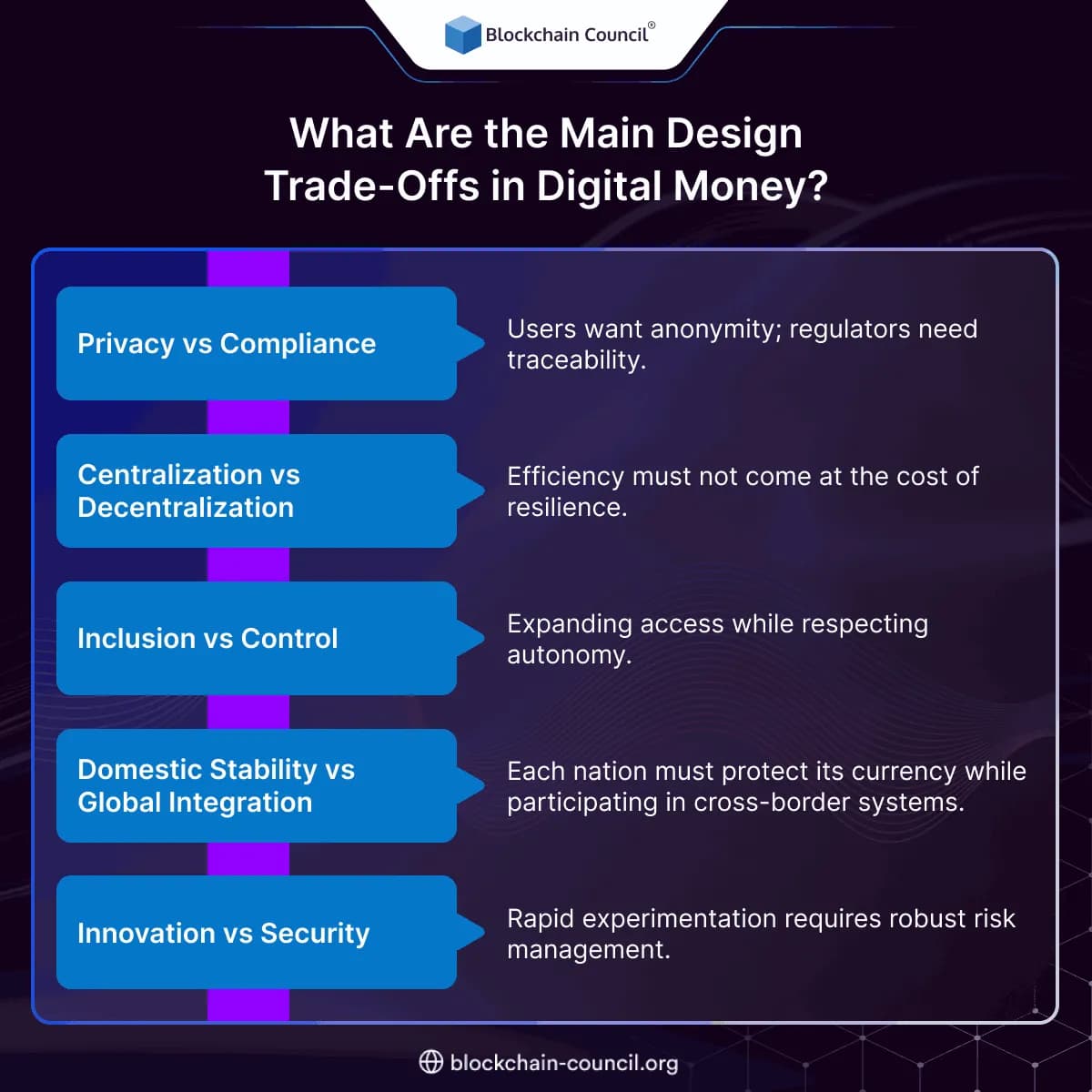
Digital currency design involves balancing five priorities:
- Privacy vs. Compliance: Users want anonymity; regulators need traceability.
- Centralization vs. Decentralization: Efficiency must not come at the cost of resilience.
- Inclusion vs. Control: Expanding access while respecting autonomy.
- Domestic Stability vs. Global Integration: Each nation must protect its currency while participating in cross-border systems.
- Innovation vs. Security: Rapid experimentation requires robust risk management.
Every country’s solution reflects its values and risk appetite.
To explore how intelligent systems make trade-offs in real time, professionals can study the agentic ai certification, which covers how AI agents balance autonomy with accountability — similar to how digital currencies balance freedom with oversight.
How Do Offline Payments Support Sovereignty?
Offline capability might seem minor, but it’s critical for sovereignty. It ensures that citizens can transact even if digital networks fail or power is disrupted.
- The digital euro promises cash-like offline use.
- India’s e-rupee pilots show rural communities paying without connectivity.
- Bahamas’ Sand Dollar already supports offline functionality.
This feature protects against both cyber risks and geopolitical disruptions.
How Are Privacy and Civil Liberties Being Protected?
A digital currency that compromises privacy is self-defeating. The European Central Bank emphasizes tiered privacy, allowing anonymous small payments but traceable large ones. India and other nations follow similar models.
Design choices include:
- Encryption for offline transactions.
- Decentralized storage of personal data.
- Independent oversight to prevent misuse.
Privacy by design will determine public trust — and adoption.
What Is the Role of Technology Infrastructure in Sovereignty?
At the core of every digital currency is a technology stack built for transparency, scalability, and resilience. This includes cryptographic protocols, APIs for integration, and open standards for interoperability.
Investing in such frameworks ensures a country’s financial independence from foreign vendors.
Professionals interested in mastering these systems can build their foundation with tech certifications that cover blockchain, cybersecurity, and data engineering.
To deepen technical understanding, technology courses provide practical exposure to how decentralized systems function under real-world constraints.
How Do Tokenized Deposits Preserve Bank-Level Sovereignty?
Tokenized deposits combine the best of both worlds — programmable payments without losing the safety of the banking system. They let banks issue digital assets fully backed by customer deposits, using blockchain for settlement.
This approach maintains the central role of banks in credit creation while enabling faster, cheaper, and programmable payments.
Central banks see tokenized deposits as a way to modernize without fragmenting financial stability.
What Are the Ethical and Political Dimensions of Digital Sovereignty?
Financial sovereignty isn’t only technical — it’s political. Governments must decide how much control is appropriate, what data they collect, and how to protect individual freedoms.
Key ethical questions include:
- Should governments track every transaction?
- Can programmable money enforce spending restrictions?
- How do we protect citizens from censorship through code?
Ethics must remain a guiding principle. Policymakers, engineers, and citizens share responsibility for ensuring that digital money serves human interests.
How Can Blockchain Strengthen Financial Autonomy?
Blockchain technology enables verifiable, tamper-proof transactions that remove single points of failure. For individuals, it allows self-custody of assets; for nations, it ensures independence from foreign payment infrastructure.
Programs like blockchain technology courses teach how decentralization, consensus, and tokenization make finance more resilient.
As blockchain merges with AI, we’ll see self-auditing systems that guarantee compliance automatically.
How Do AI and Blockchain Work Together in Financial Systems?
AI and blockchain complement each other perfectly. AI analyzes massive data sets to detect anomalies and predict trends, while blockchain ensures that data and transactions remain verifiable.
Financial institutions already use this combination for fraud detection, credit scoring, and compliance.
Learners exploring algorithmic finance can begin with an AI trading course to understand how autonomous systems execute trades transparently and efficiently.
How Do Digital Currencies Empower Individuals?
For ordinary citizens, digital currencies can mean more control, lower costs, and faster access to services.
Benefits include:
- Self-Custody: No need for third-party storage.
- Global Reach: Send and receive money across borders instantly.
- Transparency: Real-time tracking of transactions builds accountability.
- Access: Even people without traditional bank accounts can participate.
As people learn to manage these new tools, they gain not just financial inclusion but also genuine autonomy.
How Can Investors Benefit from This Shift?
Investors are experimenting with tokenized assets, DeFi lending, and cross-border digital bonds. As these markets mature, understanding data and risk modeling becomes essential.
Those wanting to navigate digital investment ecosystems can explore the AI powered investment course for a practical view of how intelligent systems allocate and rebalance assets automatically.
How Do Digital Currencies Influence Marketing and Business Strategy?
Digital currencies are transforming business models. From loyalty tokens to programmable discounts, companies are using blockchain to enhance transparency and trust.
To stay competitive, marketing professionals can pursue the Marketing and Business Certification to learn how decentralized systems influence consumer behavior and data ownership.
Brands that adapt early will lead the next era of digital commerce.
What Are the Biggest Challenges Ahead?
Despite progress, digital currencies face serious obstacles:
- Cybersecurity Threats: More digital infrastructure means higher attack surfaces.
- Public Understanding: Many users still equate CBDCs with surveillance.
- Legal Clarity: Cross-border recognition remains patchy.
- Technical Interoperability: Different systems must connect seamlessly.
- Monetary Fragmentation: Competing digital standards may divide global markets.
Governments and developers must collaborate to overcome these hurdles without compromising privacy or innovation.
What Does the Future of Financial Sovereignty Look Like?
The future will be hybrid — combining public trust, private innovation, and open standards.
Expect:
- CBDCs with offline and privacy tiers.
- Regulated stablecoins used in everyday commerce.
- Cross-chain bridges linking national currencies securely.
- Smart contracts automating compliance.
- AI-driven analytics maintaining transparency.
Digital currencies will not erase traditional money. They will enhance it with programmability, traceability, and inclusiveness.
Conclusion: A New Definition of Freedom in Finance
Financial sovereignty in the digital era is not about isolation — it’s about empowerment. When citizens can transact freely, when nations can operate independent of external control, and when technology guarantees fairness rather than demanding faith, sovereignty gains new meaning.
Digital currencies are the foundation of that vision. They merge technological precision with social purpose, giving individuals and nations equal power to participate in a connected global economy.
The future of finance belongs to those who can navigate both the code and the context — understanding that sovereignty is not given, it’s designed.