

Defending Against Membership Inference and Privacy Attacks: Reducing Data Leakage from Models
 Suyash Raizada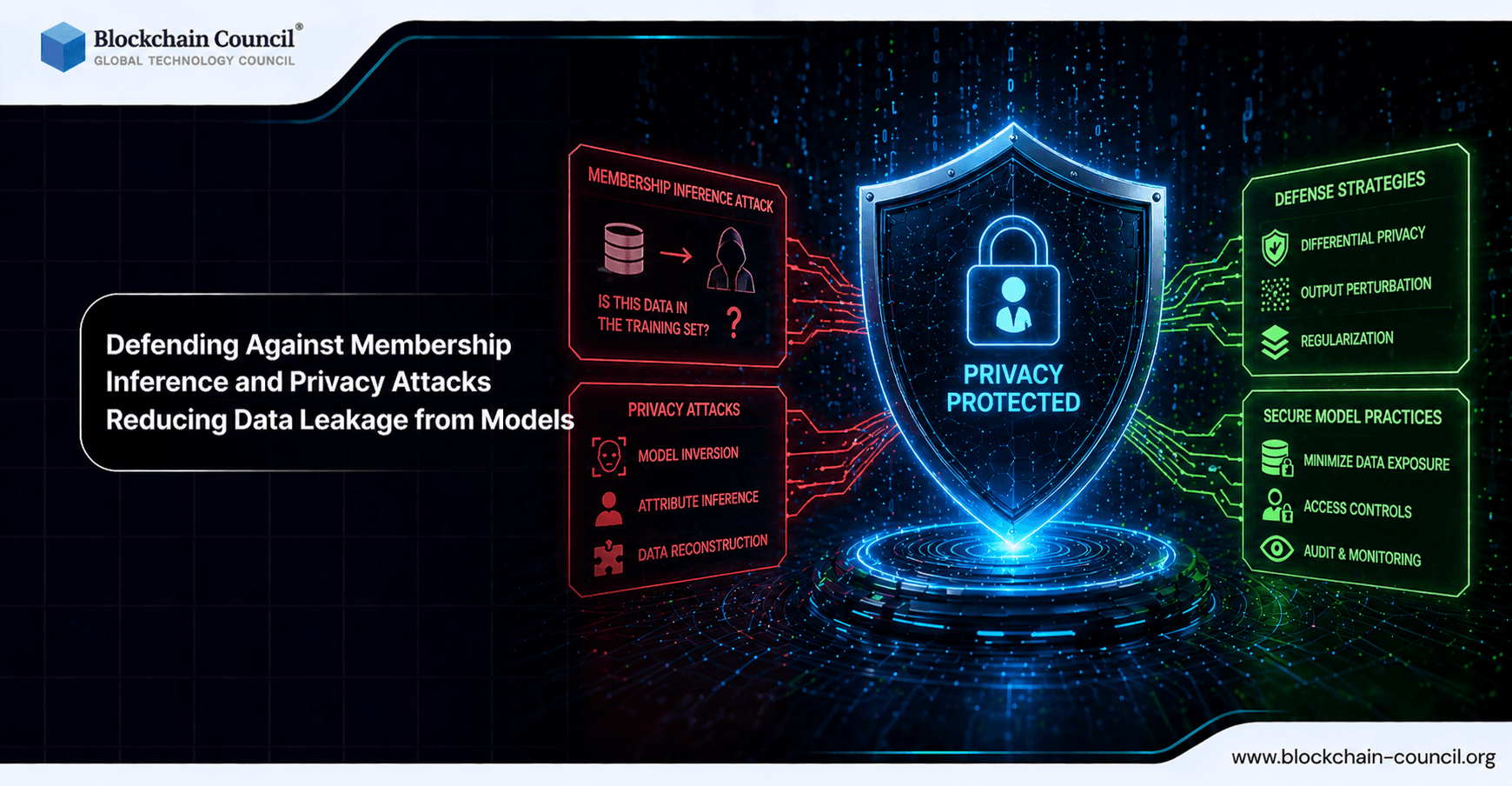
Defending against membership inference and privacy attacks has become a core requirement for organizations deploying machine learning in regulated or sensitive settings. Membership inference attacks (MIAs) exploit the fact that many models behave differently on training examples (members) versus unseen examples (non-members). When those differences are detectable through confidence scores, losses, or prediction entropy, an attacker can infer whether a particular record was used to train the model - creating real privacy and compliance risk for domains like healthcare, finance, identity, and customer analytics.
This article explains how MIAs work, why they succeed, and which techniques best reduce data leakage from models. It also covers recent advances like Membership-Invariant Subspace Training (MIST) and RelaxLoss, which improve the privacy-utility trade-off compared with older empirical defenses.

An AI Certification can help professionals build expertise in AI security, model governance, privacy-preserving techniques, and responsible AI deployment, while a Cybersecurity Certification can strengthen skills in threat detection, risk management, data protection, and the security controls needed to defend modern AI systems against emerging attacks.
What Is a Membership Inference Attack (MIA)?
A membership inference attack is a privacy attack where an adversary attempts to determine whether a specific data point was part of a model's training set. This matters because training set membership can itself be sensitive. For example, confirming that a patient record appeared in a disease model's training set can reveal that the patient received treatment at a given clinic or had a specific condition.
MIAs typically rely on a common signal: overfitting. Models often produce lower loss, higher confidence, or more stable predictions on training samples than on non-training samples. Attackers exploit these gaps.
Common MIA Attacker Capabilities
Black-box MIAs: The attacker queries the model and observes outputs such as probabilities, logits, or top-k predictions.
Shadow model training: The attacker trains models on similar data distributions to learn how member and non-member outputs differ.
Loss-based and likelihood attacks: Attacks often reduce to estimating whether a sample's loss is more likely under the member or non-member distribution.
Why MIAs Succeed: The Loss Gap and Confidence Gap
Most practical MIAs exploit a separation between member and non-member behavior. If a model's training loss is consistently lower than its test loss, an attacker can use that difference as a membership signal. The attacker benefits when there is a large generalization gap - more specifically, when there is a measurable difference between member and non-member loss distributions.
Attack variants have expanded well beyond classic confidence thresholding. Recent research highlights:
Likelihood ratio attacks (LRA) and LIRA-style approaches that compare how plausible an output is under member versus non-member hypotheses.
Subpopulation-based MIAs that target specific groups, which can be practical even without many shadow models.
User-level attacks that infer whether any sample from a user is in training, sometimes using metric embedding learning.
Attacks on diffusion models that use reconstruction-loss estimation techniques such as quantile regression to extract training samples.
LLM memorization attacks in in-context learning settings, including prompt-driven extraction strategies that attempt to trigger verbatim recall.
Defending Against Membership Inference and Privacy Attacks: The Main Approaches
Defenses generally fall into two categories: provable privacy and empirical defenses. In practice, many teams use a hybrid strategy - provable privacy where feasible, plus training and deployment hardening to reduce leakage.
1) Provable Privacy with Differential Privacy (DP)
Differential privacy offers formal guarantees that the presence or absence of one training sample has a limited effect on the trained model. A widely used training method is DP-SGD, which clips per-example gradients and adds calibrated noise during optimization.
Trade-offs to plan for:
Accuracy impact: DP often reduces utility, especially for small datasets, high-dimensional tasks, or complex models.
Engineering complexity: DP requires careful accounting, hyperparameter tuning, and evaluation of privacy budgets.
Scope limitations: DP reduces membership leakage but does not automatically address data poisoning, prompt injection, or model inversion in all settings.
2) Empirical Defenses That Reduce Memorization Signals
Empirical techniques attempt to make member and non-member behavior less distinguishable. Common options include:
Early stopping to prevent overfitting.
L2 regularization and dropout to reduce memorization.
Label smoothing and confidence penalties to avoid overly peaked posteriors.
Knowledge distillation to train a student model that generalizes better and leaks less.
Adversarial regularization approaches that discourage membership signals.
Many older defenses impose noticeable utility costs or fail under adaptive attackers that adjust strategies once they observe defense patterns.
Latest Developments: MIST and RelaxLoss
Recent advances aim to directly target the underlying signals MIAs use while preserving accuracy. Two notable methods are MIST and RelaxLoss, both motivated by a core observation: MIAs thrive when certain instances are vulnerable, meaning the model fits them too confidently or too uniquely compared to non-members.
A Marketing Certification can help professionals better communicate complex privacy and security concepts, align AI governance initiatives with business objectives, and build stakeholder trust when deploying data-driven and AI-powered solutions.
MIST: Membership-Invariant Subspace Training
MIST focuses on learning counterfactually-invariant representations and using subspace learning to avoid overfitting to membership-revealing features. Rather than applying a blanket regularizer that may reduce utility across the board, MIST reduces membership signals for vulnerable instances by constraining the representation space where those signals appear.
Key ideas and reported benefits:
Targets overfitting patterns that make specific records easy to distinguish as members.
Strong privacy-utility trade-off in black-box settings, including against modern attacks such as LIRA-style methods and CANARY-style evaluations.
Minimal accuracy loss compared to many older empirical defenses, based on experiments across multiple attacks and datasets.
RelaxLoss: Flattening Posterior Signals by Relaxing Targets
RelaxLoss addresses the fact that a Bayes-optimal membership attacker can often succeed primarily by using the sample loss. RelaxLoss modifies training by relaxing loss targets and using a gradient-based procedure that flattens posterior scores. This narrows the generalization gap and reduces the separability between member and non-member loss distributions.
Empirical evaluations in the research literature show RelaxLoss outperforming common baselines such as Memguard, adversarial regularization, early stopping, dropout, label smoothing, confidence penalties, distillation, and DP-SGD in several settings - reducing attack AUC while maintaining test accuracy across multiple datasets.
Additional Practical Defenses: Pruning and Information Perturbation
Iterative Pruning Defenses
Pruning is typically used for compression and efficiency, but iterative pruning defenses can be adapted to weaken memorization patterns. Research suggests pruning-based approaches can reduce leakage without requiring a full retraining redesign, which can matter in production pipelines where retraining cost is high. The key is evaluating whether pruning changes the member and non-member loss distributions in the desired direction, rather than assuming compression automatically improves privacy.
Information Perturbation
Information perturbation includes adding customized noise to inputs, representations, or outputs, and sometimes applying domain adaptation techniques to reduce reliance on membership-revealing features. These methods can be effective, but require careful testing because excessive perturbation can degrade accuracy, fairness, or robustness.
Deployment Guidance: A Practical Checklist
Defending against membership inference and privacy attacks should be treated as an engineering discipline with measurable metrics. A practical workflow includes:
Measure baseline leakage: Evaluate MIA risk using loss-based and black-box attacks that match your threat model.
Reduce overfitting first: Apply early stopping, regularization, and calibration, then re-measure leakage.
Adopt modern training defenses: Consider RelaxLoss or MIST-style approaches to narrow member vs non-member separability with minimal utility loss.
Use DP where required: If regulations or contracts demand formal guarantees, implement DP-SGD and quantify the privacy budget.
Harden outputs: Limit unnecessary confidence exposure - for example, avoid returning full probability vectors when not needed - and monitor query patterns.
Validate across slices: Test subpopulation and user-level leakage to avoid protecting average cases while leaving vulnerable groups exposed.
Reassess for new model classes: Diffusion models and LLM-based systems introduce new extraction pathways; include prompt-based defenses and memorization tests where applicable.
Use Cases: Why This Matters in Healthcare, Finance, and Generative AI
Healthcare and Finance
In healthcare and finance, membership leakage can expose whether a person's record was used in a model, which can correlate with diagnoses, procedures, account activity, or fraud investigations. Methods like RelaxLoss are practical in these settings because they reduce leakage without sacrificing accuracy - a critical requirement in regulated industries.
Diffusion Models and Reconstruction-Based Leakage
Diffusion models can leak training data through reconstruction or memorization. Attackers may estimate reconstruction losses to infer membership or extract samples. Regularization, careful dataset governance, and privacy-aware training strategies are increasingly important for these generative systems.
LLMs and In-Context Memorization
For large language models, prompt-driven extraction and memorization can intersect with membership inference. Prompt-based defenses, output filtering, and clear system instructions can help, but should be validated with realistic red-team prompts and memorization benchmarks.
Skills and Certification Pathways
Teams tackling privacy attacks need cross-functional skills across ML engineering, security testing, and governance. Relevant learning pathways include Blockchain Council programs such as Certified Artificial Intelligence (AI) Expert, Certified Machine Learning Expert, and role-aligned tracks in Certified Cybersecurity Expert. These certifications map directly to building secure model pipelines, designing evaluations, and implementing privacy-preserving training practices.
Conclusion
Defending against membership inference and privacy attacks is a required discipline for high-stakes AI deployments. MIAs exploit predictable differences between how models treat training versus non-training records, driven primarily by overfitting and loss gaps. While differential privacy provides formal guarantees, the utility costs can be difficult to accept in production. Newer approaches like MIST and RelaxLoss demonstrate that it is possible to significantly reduce membership leakage while preserving model performance by targeting the specific mechanisms MIAs exploit.
The most resilient strategy is iterative: measure leakage, reduce overfitting, adopt modern privacy-aware training methods, validate across subpopulations, and revisit the threat model as new attacks emerge for LLMs and diffusion models.
FAQs
1. What is a membership inference attack in AI?
A membership inference attack tries to determine whether a specific data point was used in a model’s training dataset. Attackers analyze model outputs to make this inference. This can expose sensitive information.
2. Why are membership inference attacks a privacy risk?
These attacks can reveal whether personal or confidential data was included in training. This may violate privacy regulations. It undermines trust in AI systems.
3. How do membership inference attacks work?
Attackers query the model and analyze confidence scores or outputs. They compare responses to known patterns. This helps them infer whether data was part of training.
4. What types of models are vulnerable to membership inference?
Overfitted models and those trained on sensitive datasets are more vulnerable. Models that expose detailed outputs are also at risk. Proper design reduces exposure.
5. What is data leakage in machine learning?
Data leakage occurs when sensitive or private information is unintentionally exposed through model outputs. It can happen during training or inference. Preventing leakage is critical for privacy.
6. How does overfitting increase privacy risks?
Overfitting causes models to memorize training data instead of generalizing. This makes it easier for attackers to extract specific information. Regularization helps reduce this risk.
7. What is differential privacy in defending against attacks?
Differential privacy adds noise to model outputs or training data. It limits the ability to infer individual data points. This provides strong privacy protection.
8. How does regularization help prevent data leakage?
Regularization reduces overfitting by penalizing complex models. It encourages generalization instead of memorization. This lowers the risk of privacy attacks.
9. What is model confidence masking?
Confidence masking limits the detail of output probabilities. It reduces the information available to attackers. This makes inference attacks more difficult.
10. How can access control reduce privacy risks?
Access control restricts who can query the model and how often. It limits exposure to potential attackers. Strong authentication improves protection.
11. What is the role of data minimization in AI privacy?
Data minimization ensures only necessary data is used for training. This reduces the amount of sensitive information in the model. It lowers the risk of leakage.
12. How can organizations detect membership inference attacks?
Monitor query patterns and look for unusual behavior. High-frequency or structured queries may indicate attacks. Detection tools can help identify risks.
13. What are best practices for reducing data leakage from models?
Use differential privacy, limit output detail, and monitor usage. Combine technical controls with governance policies. Regular testing improves security.
14. How does federated learning improve privacy?
Federated learning keeps data decentralized and local. Only model updates are shared. This reduces exposure of raw data.
15. What is model auditing in privacy protection?
Model auditing evaluates models for privacy risks and vulnerabilities. It identifies potential leakage points. Regular audits help maintain compliance.
16. Can encryption prevent membership inference attacks?
Encryption protects data during storage and transmission. However, it does not prevent inference from model outputs. Additional measures are needed.
17. What is the impact of privacy attacks on organizations?
Privacy attacks can lead to data breaches, legal penalties, and reputational damage. They reduce trust in AI systems. Prevention is essential.
18. How does limiting query rates improve security?
Limiting query rates reduces the ability of attackers to gather enough data for inference. It slows down attack attempts. This is an effective defensive measure.
19. What are challenges in defending against privacy attacks?
Balancing privacy and model performance is difficult. Strong protections may reduce accuracy. Continuous adaptation is required as attacks evolve.
20. What is the future of defending against AI privacy attacks?
Future solutions will include stronger privacy techniques and automated detection. Regulations will also play a larger role. Privacy will remain a core focus in AI development.
Related Articles
View All
AI & ML
NVIDIA’s New AI Models: Nemotron 3.5 Lightning, Cosmos 3 and the Future of Agentic AI
Explore NVIDIA Nemotron 3.5 Lightning and Cosmos 3, how they support agentic and Physical AI, and what these models reveal about NVIDIA’s broader vision for autonomous intelligent systems.

AI & ML
Jev Inference Architecture
Explore Jev’s inference architecture, including parallel sampling, structured outputs, calibrated probabilities, and how TypeSafe AI enables fast machine-native decisions.

AI & ML
System One Models for Software
Explore how System One Models can be used in software to make fast, structured, probabilistic decisions for automation, routing, scoring, verification, and real-time applications.
Trending Articles

Top 5 DeFi Platforms
Explore the leading decentralized finance platforms and what makes each one unique in the evolving DeFi landscape.
What is AWS? A Beginner's Guide to Cloud Computing
Everything you need to know about Amazon Web Services, cloud computing fundamentals, and career opportunities.

Can DeFi 2.0 Bridge the Gap Between Traditional and Decentralized Finance?
The next generation of DeFi protocols aims to connect traditional banking with decentralized finance ecosystems.