

Day in the Life of a Forward Deployed Engineer: From Customer Discovery to Production Deployment


Day in the life of a Forward Deployed Engineer looks different from traditional software engineering because the job sits at the intersection of customer needs, product strategy, and production reliability. Forward Deployed Engineers (FDEs), sometimes titled Forward Deployed Software Engineers (FDSEs), embed with customer teams to configure, integrate, and extend complex platforms in real environments. The work is hands-on, outcome-driven, and shaped by fast feedback loops with users and internal engineering or research teams.
This article walks through a realistic lifecycle of an FDE engagement, from customer discovery to production deployment, with patterns observed across data platforms, AI startups, and automation providers.

What is a Forward Deployed Engineer (FDE)?
A Forward Deployed Engineer is a software engineer who works directly with customers to deliver value in their environment. Instead of building generic features for every user, the FDE focuses on making a platform successful for one customer at a time through configuration, integration, and targeted development.
In practice, forward deployed engineers embed with customers to configure existing platforms and solve domain-specific problems. Many take end-to-end ownership, acting as a bridge between external users and internal product, engineering, and research teams. The role is adjacent to solutions engineering and implementation engineering, but carries deeper engineering ownership and stronger production accountability.
Common titles you may see
- Forward Deployed Engineer (FDE)
- Forward Deployed Software Engineer (FDSE)
- Solutions Engineer or Implementation Engineer (company dependent)
- Customer Engineer or Field Engineer (adjacent roles)
Why the FDE role is expanding in AI and enterprise software
The forward deployed model first gained mainstream visibility through complex, high-stakes deployments in government and defense environments. Today, the same delivery approach is common in AI, data infrastructure, cybersecurity, and automation, particularly when products require careful integration, governance, and change management.
What has changed in modern forward deployment
- Hybrid customer embedding: many engagements combine short on-site discovery with remote implementation and iteration.
- Tighter product and research alignment: FDEs regularly feed real-world insights back into product roadmaps and model improvement cycles.
- Outcome ownership: success is measured by adoption, uptime, reliability, and business KPIs, not just shipped code.
- Growth in AI and LLM deployments: forward deployed work now commonly includes evaluation harnesses, guardrails, workflow integration, and reliability tuning for generative AI systems.
For professionals building skills in production AI delivery, relevant learning paths include Blockchain Council programs in AI certifications, machine learning, data engineering, DevOps, and cybersecurity.
Day in the life of a Forward Deployed Engineer: the lifecycle from discovery to deployment
While no two customer engagements are identical, most FDE projects follow a repeatable arc. The day-to-day work changes depending on which phase you are in, but the core workflow remains consistent: discover, design, pilot, harden, deploy, and iterate.
1) Customer discovery and scoping
Discovery is where an FDE builds leverage. The goal is to translate ambiguous stakeholder goals into technical and measurable requirements. This phase typically includes workshops, stakeholder interviews, and a technical assessment of the existing environment.
Typical activities
- Clarifying success metrics: define what a successful outcome looks like - time saved, error reduction, improved decision speed, or compliance outcomes.
- User interviews and workflow mapping: observe current processes, identify bottlenecks, and capture edge cases that break automation.
- Technical discovery: review APIs, data schemas, access controls, deployment constraints, and security requirements.
Common deliverables
- Solution design document and scope boundaries
- High-level architecture and integration diagram
- Initial KPIs and acceptance criteria
- A prioritized backlog of features and experiments
During a typical discovery day, you might spend the morning facilitating a workshop with business and security stakeholders, then spend the afternoon validating integration feasibility alongside customer engineers.
2) Solution design and prototyping
After discovery, the FDE shapes a workable design and builds a prototype that can be tested with real users. This is where platform knowledge matters: many forward deployed projects succeed through configuration and composition rather than large greenfield builds.
Typical activities
- Platform configuration to the domain: data models, ontologies, workflows, dashboards, access policies, and role-based controls.
- Integration and data plumbing: connectors, ETL jobs, event pipelines, and API gateways.
- Prototyping AI workflows: evaluation dashboards, prompt templates, retrieval pipelines, guardrails, and test harnesses for LLM reliability.
- Internal tooling: scripts and utilities that help the team move faster, especially during repeated pilot setups.
A realistic daily rhythm
- Morning: sync with product and engineering to confirm assumptions, tradeoffs, and risks.
- Midday: implement and test in a sandbox or customer-like environment.
- Afternoon: pairing sessions, QA, and quick demos to validate direction before investing further.
3) Pilot implementation and tight feedback loops
Pilots are where the forward deployed model demonstrates its value. Instead of waiting for quarterly releases, the FDE iterates with users daily or weekly. For AI systems, this cadence is often essential because evaluation and reliability issues only surface with domain-specific data and real workflows.
What the FDE does during a pilot
- Run rapid iterations: ship small changes, validate with users, and adjust quickly.
- Instrument everything: capture usage, latency, error rates, and business outcome signals.
- Train users and drive adoption: demos, office hours, and documentation, particularly when users are not deeply technical.
- Maintain a tight customer-to-engineering loop: translate feedback into actionable tasks and product insights.
In many teams, an FDE manages multiple pilots simultaneously. Practitioners report heavy context switching, with weeks spanning many meetings across multiple customers. The core skill is not just technical execution, but prioritizing the highest-impact work when time is fragmented.
4) Hardening and production deployment
When a pilot demonstrates value, the work shifts from speed to durability. Production deployment is where engineering fundamentals and operational discipline determine whether the solution holds up under real-world load and governance requirements.
Hardening typically includes
- Reliability improvements: stronger error handling, retries, idempotency, and graceful degradation.
- Performance optimization: query tuning, caching, batching, and pipeline efficiency.
- Security and compliance: access controls, audit logs, data retention rules, and secure secrets management.
- Production readiness: monitoring, alerting, runbooks, on-call plans, and documented rollback procedures.
- CI/CD: repeatable deployments and automated tests that reflect production risks.
Handover and enablement
Forward deployed does not always mean the customer operates everything independently after launch, but sustainable success requires structured enablement. The FDE typically trains customer admins and engineers, documents key workflows, and establishes governance guidelines so the solution can evolve safely over time.
5) Ongoing iteration and account stewardship
Post-deployment, an FDE stays engaged to protect outcomes. This phase combines elements of product management and production engineering.
- Regular check-ins: review KPIs, incidents, and user feedback.
- Triage and prioritization: bugs, feature requests, and new experiments aligned with measurable impact.
- Roadmap influence: patterns from the field inform platform investments and future product design.
Key skills that define high-performing FDEs
A strong forward deployed engineer combines solid engineering fundamentals with effective customer-facing execution. The role rewards technical range, but also demands consistent discipline.
Technical skills
- Software engineering fundamentals: backend services, APIs, testing, code quality, and debugging.
- Data engineering basics: SQL, data modeling, ETL pipelines, and schema evolution.
- Cloud and DevOps: containers, CI/CD, monitoring, alerting, and incident response.
- AI delivery skills (in AI roles): evaluation design, reliability metrics, guardrails, and workflow integration.
Customer and product skills
- Product thinking: translate ambiguous needs into scoped deliverables and testable experiments.
- Communication: explain architecture to non-technical stakeholders and run effective workshops.
- Prioritization and ownership: choose what to solve first and remain accountable for outcomes.
Real-world examples of forward deployed work
Public descriptions of forward deployed engineering highlight three recurring environments:
- Government and defense data platforms: mission-critical workflows, complex access controls, and high uptime requirements.
- AI evaluation and safety: building domain-specific test suites, dashboards, and reliability processes for LLM-powered systems.
- Enterprise automation: mapping business processes and integrating tools and APIs to reduce manual work at scale.
Conclusion: what a Forward Deployed Engineer actually delivers
Day in the life of a Forward Deployed Engineer ultimately comes down to closing the gap between a capable platform and the realities of production environments. The FDE uncovers true customer constraints, builds and configures solutions that fit the domain, runs pilots with tight feedback loops, and then hardens everything for reliable production deployment. The role is demanding because it blends engineering, product judgment, and customer execution - but it is also one of the fastest ways to learn how real systems succeed or fail in the field.
For professionals aiming to build this skill set, structured upskilling across AI engineering, data pipelines, cloud operations, and security fundamentals is a practical starting point. Blockchain Council offers relevant certifications in Artificial Intelligence, Machine Learning, Data Science, DevOps, and Cybersecurity that map closely to the competencies modern forward deployed teams expect.
Related Articles
View All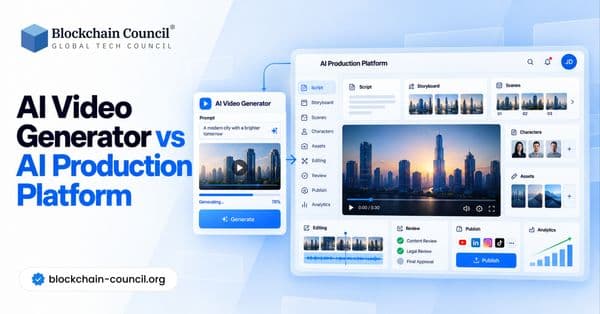
AI & ML
AI Video Generator vs AI Production Platform
AI video generators create videos from prompts, scripts, images, and other inputs, while AI production platforms support broader end-to-end video workflows. Explore the key differences between AI video generators and AI production platforms, including features, use cases, automation, scalability, and video production workflows.

AI & ML
AI Video Generator: The Future of Video Production
### Excerpt AI video generators are transforming video production by enabling creators and businesses to generate high-quality videos from text, images, scripts, and prompts. Explore how AI video generation is shaping the future of content creation, filmmaking, marketing, and automated video production.

AI & ML
Built to Catch AI Cheating: Rethinking Pre-Employment Assessments with HireValid
Explore how HireValid is rethinking pre-employment assessments with AI-resistant test design, integrity signals, candidate evidence, and human review to address AI-assisted cheating.
Trending Articles
Can DeFi 2.0 Bridge the Gap Between Traditional and Decentralized Finance?
The next generation of DeFi protocols aims to connect traditional banking with decentralized finance ecosystems.
Claude AI Tools for Productivity
Discover Claude AI tools for productivity to streamline tasks, manage workflows, and improve efficiency.
Blockchain in Supply Chain Provenance Tracking
Supply chains are under pressure to prove not just efficiency, but also authenticity, sustainability, and fairness. Customers want to know if their coffee really is fair trade, if the diamonds are con