

Data Poisoning Attacks Explained: Detecting and Preventing Training-Time Compromises in ML
 Suyash Raizada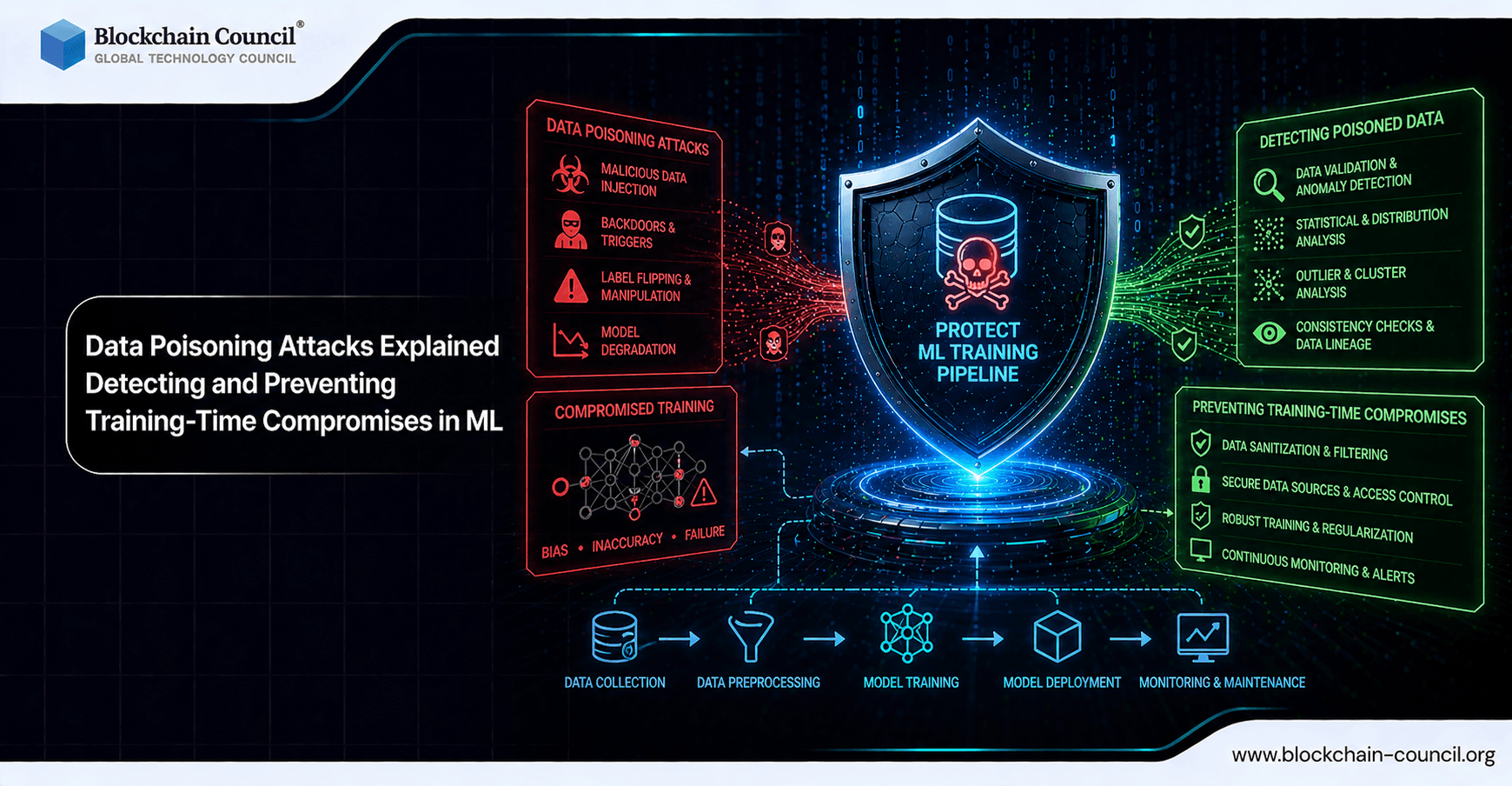
Data poisoning attacks are training-time compromises where an adversary intentionally corrupts a machine learning dataset to manipulate model behavior. Because ML systems learn patterns directly from data, even small, carefully crafted changes can cause a model to misclassify specific inputs, embed hidden backdoors, or lose accuracy across the board. This makes data poisoning especially dangerous in high-impact domains such as cybersecurity, finance, biometrics, and autonomous systems, where incorrect predictions can lead to fraud, unauthorized access, or safety incidents.
As AI adoption expands and more teams rely on open-source datasets, foundation models, and rapid fine-tuning pipelines, the attack surface grows. Security researchers increasingly warn that poisoning is no longer limited to initial training datasets. It now extends to fine-tuning data, retrieval-augmented generation (RAG) corpora, and even tool outputs that agentic systems consume. The result is a modern ML security problem where data integrity becomes as critical as code security.

An AI Certification can help professionals develop expertise in AI security, model governance, data integrity, and risk management, enabling them to better protect AI systems from emerging threats such as data poisoning, model manipulation, and adversarial attacks.
What Are Data Poisoning Attacks?
Data poisoning is the deliberate insertion, modification, or deletion of training data with the goal of compromising a model. Unlike inference-time attacks, which attempt to trick a model after it is deployed, poisoning attacks occur upstream. They target the data pipeline, labeling process, data sources, and any stage where training examples are collected and curated.
Attackers typically pursue one of two outcomes:
Targeted manipulation: cause specific inputs to produce attacker-chosen outputs, often without noticeably degrading overall performance.
Non-targeted degradation: reduce general accuracy, reliability, or fairness to create widespread errors and erode trust.
Types of Data Poisoning Attacks
Data poisoning attacks are commonly classified by intent (targeted vs. non-targeted) and by mechanism (backdoors, injection, mislabeling, and related variants).
1) Targeted Data Poisoning
Targeted poisoning is designed to change model behavior for specific inputs or scenarios while keeping normal performance largely intact. This is particularly dangerous because standard validation metrics may still appear healthy.
Example (biometrics): poisoning a facial recognition training set so that a particular individual is misidentified.
Example (cybersecurity): labeling malware samples as benign so the detector learns to ignore a family of threats.
2) Non-Targeted Data Poisoning
Non-targeted poisoning introduces noise, bias, or distribution shifts that broadly reduce model accuracy. The goal is systemic failure rather than a single hidden trigger.
Example: injecting biased samples into a spam filter or recommendation system so overall relevance and detection quality deteriorate.
3) Backdoor Attacks (Trigger-Based Poisoning)
Backdoor attacks embed hidden triggers into training data, such as subtle pixel patterns in images or specific phrases in text. When the trigger appears at inference time, the model produces attacker-intended behavior. Without the trigger, the model behaves normally, which allows the poisoning to remain undetected.
Example (autonomous systems): a small visual pattern that causes a vision model to misread a sign.
Example (enterprise chatbots): a trigger phrase that causes unauthorized actions or disclosure patterns.
4) Data Injection Attacks
Data injection adds malicious samples into the training pipeline. This is common in systems that continuously learn from user feedback, logs, or external sources.
Example (recommendation systems): false ratings and reviews to manipulate product ranking and perception.
Example (finance): skewing training data to influence automated loan approvals or risk scoring.
5) Mislabeling Attacks
Mislabeling changes labels on otherwise legitimate data, reducing model reliability and creating learned confusion.
Example: labeling dogs as cats in an image classifier to degrade classification accuracy and trust.
6) Clean-Label Poisoning
Clean-label attacks use data that appears legitimate and correctly labeled, but is subtly manipulated to steer decision boundaries. Because the labels look correct, many basic data quality checks fail to catch this technique.
Why Data Poisoning Is a Growing Threat
Several industry trends make training-time attacks more practical and more damaging:
Open-source datasets and rapid reuse: widely shared datasets can be contaminated upstream and redistributed broadly.
Fine-tuning at scale: teams frequently fine-tune LLMs or smaller task-specific models, sometimes with lightly vetted internal data.
RAG and tool augmentation: poisoning can occur in retrieved knowledge bases, embedding stores, or tool outputs, not only in classic training corpora.
Automation of attacks: tooling that generates malicious content can scale poisoning attempts against organizations at low cost.
Insider risk: employees or contractors with access to data pipelines can introduce subtle bias, triggers, or mislabeled examples.
Security teams also highlight combined attacks, such as poisoning paired with prompt injection. In these scenarios, a poisoned model may be more likely to follow malicious instructions or leak sensitive information when prompted in a specific way.
Real-World Impact: Where Poisoned Training Data Hurts Most
Data poisoning maps directly to common ML deployments across industries:
Cybersecurity: poisoning malware detectors or intrusion detection datasets so threats are missed, including through selective deletion that creates generalization gaps.
Fraud detection: altering transactional patterns used for training, which can reduce detection rates and distort risk scoring.
Recommendation and search: injecting fake engagement data to manipulate ranking and visibility.
Generative AI and copilots: poisoning fine-tuning data or enterprise knowledge bases so the model provides incorrect guidance or unsafe outputs.
Banking and biometrics: biased training examples that produce discriminatory outcomes or authentication failures.
Attackers may only need to alter a small fraction of the dataset to create meaningful harm. Subtle changes can slip through manual review, especially when data volumes are large.
How to Detect Data Poisoning Attacks
Detection requires a combination of data-centric controls and model-centric checks. Relying on a single layer is rarely sufficient.
Data-Level Detection
Statistical anomaly detection: check for unusual feature distributions, label shifts, or cluster changes over time.
Outlier and influence analysis: identify training points that disproportionately affect model loss or decision boundaries.
Label consistency checks: cross-validate labels using multiple annotators, consensus methods, or secondary models.
Provenance and source scoring: track where data came from and assign trust levels to sources and contributors.
Model-Level Detection
Backdoor scanning and trigger testing: evaluate whether specific patterns or phrases reliably flip predictions.
Robust validation splits: test across time-based splits and domain-shifted subsets to reveal hidden brittleness.
Drift monitoring post-deployment: monitor prediction distributions and performance metrics to catch slow, gradual poisoning in continuous learning systems.
Preventing Training-Time Compromises: Practical Defenses
Prevention is less costly than remediation. Once a poisoned model is deployed, recovery typically requires investigation, retraining, and business disruption. Layered controls across people, process, and technology provide the strongest defense.
1) Secure the Data Pipeline End-to-End
Access control and least privilege: restrict who can add, modify, and approve training data.
Cryptographic integrity: sign datasets, use checksums, and track lineage from source to training job.
Immutable logs and audits: maintain auditable records of dataset changes and labeling events.
2) Harden Training and Curation
Diverse, representative data: reduce the impact of small injected subsets by improving data coverage.
Robust training techniques: apply methods that reduce sensitivity to outliers and mislabeled examples.
Federated learning and aggregation safeguards: when training across parties, implement robust aggregation and client anomaly checks.
3) Reduce Risk from External and Open Datasets
Vendor and dataset due diligence: evaluate dataset maintainers, update practices, and historical integrity issues before adoption.
Quarantine and staged evaluation: test new data in isolated pipelines before merging into production training.
4) Build Continuous Monitoring for Modern LLM Stacks
RAG corpus validation: treat retrieval sources like training data - validate and monitor them for manipulation.
Tool output safeguards: when agents use tools, validate outputs, enforce schemas, and log actions for forensic review.
5) Operational Readiness
Incident response for ML: define playbooks for suspected poisoning, including dataset rollback and model replacement procedures.
Red teaming: simulate poisoning campaigns against your own pipelines and LLM applications.
For professionals building secure AI systems, structured upskilling supports this work. Relevant Blockchain Council certifications include the Certified AI Professional (CAIP), Certified Machine Learning Professional, Certified Cybersecurity Expert, and Certified Generative AI Expert.
Future Outlook
Defenders should expect poisoning to expand beyond classic supervised learning datasets into additional areas:
LLM fine-tuning datasets that shift model behavior subtly, including introducing bias and discrimination risks.
RAG knowledge bases where poisoned documents steer answers and decisions.
Indirect multi-step attacks that combine data poisoning with prompt injection to increase the probability of data leakage or unsafe actions.
Regulatory and enterprise governance trends increasingly point toward stronger requirements for dataset provenance, auditing, and transparency in high-stakes AI applications. Organizations that implement provenance tracking and robust validation now will be better positioned to meet future compliance and security requirements.
Conclusion
Data poisoning attacks target the foundation of machine learning: trusted training data. Whether the goal is a stealthy backdoor, a targeted misclassification, or broad performance degradation, poisoning is difficult to detect and costly to remediate after deployment. The most effective approach is layered defense across the data lifecycle - strict pipeline security, provenance tracking, statistical validation, robust training, and continuous monitoring across fine-tuning and RAG components.
As ML systems become more deeply integrated into business workflows and decision-making, training-time integrity must be treated as a first-class security objective alongside model performance and privacy.
FAQs
1. What is a data poisoning attack in machine learning?
A data poisoning attack involves injecting malicious or misleading data into a training dataset. The goal is to influence how the model learns. This can lead to incorrect or biased outputs.
2. Why are training-time attacks dangerous in ML?
Training-time attacks affect the model at its core learning stage. Once trained on poisoned data, the model may consistently produce faulty results. This makes detection harder after deployment.
3. How do attackers poison training data?
Attackers may insert fake data, manipulate labels, or alter existing datasets. These changes can be subtle and difficult to detect. The model then learns incorrect patterns.
4. What are common types of data poisoning attacks?
Common types include label flipping, backdoor attacks, and data injection. Each method targets training data differently. They aim to degrade performance or create hidden triggers.
5. What is a backdoor attack in data poisoning?
A backdoor attack embeds a hidden trigger in the training data. The model behaves normally until the trigger appears. When triggered, it produces incorrect results.
6. How does label flipping impact ML models?
Label flipping changes correct labels to incorrect ones. This confuses the model during training. It reduces accuracy and reliability.
7. Which models are most vulnerable to data poisoning?
Models trained on large, unverified datasets are more vulnerable. Systems with automated data collection are also at risk. Proper validation reduces exposure.
8. What are the signs of a data poisoning attack?
Signs include unexpected drops in accuracy and unusual prediction patterns. Models may behave inconsistently. Anomalies in training data can also indicate issues.
9. How can data poisoning attacks be detected?
Detection involves anomaly detection, data validation, and statistical analysis. Monitoring training data for irregularities is key. Regular audits improve detection.
10. What is data validation in ML security?
Data validation ensures that only clean and accurate data is used for training. It filters out suspicious or corrupted inputs. This is a primary defense against poisoning.
11. How does anomaly detection help prevent attacks?
Anomaly detection identifies unusual patterns in data. It helps flag potentially malicious inputs. Early detection reduces impact.
12. What role does data provenance play in security?
Data provenance tracks the origin and history of data. It ensures data comes from trusted sources. This improves accountability and reduces tampering risks.
13. How can organizations prevent data poisoning attacks?
Use trusted data sources, validate inputs, and monitor pipelines. Apply access controls and regular audits. Layered defenses improve protection.
14. What is robust training in machine learning?
Robust training uses techniques that make models resistant to noisy or malicious data. It improves stability and reliability. This reduces the impact of poisoning.
15. Can AI models recover from poisoned data?
Yes, models can be retrained using clean datasets. Removing corrupted data is essential. Continuous monitoring helps prevent recurrence.
16. What tools are used to detect data poisoning?
Tools include anomaly detection systems, data validation frameworks, and monitoring platforms. These tools automate detection and analysis. Selection depends on system complexity.
17. How does human oversight improve detection?
Human experts can identify subtle patterns that automated tools may miss. They provide context and judgment. This improves overall detection accuracy.
18. What are best practices for securing training data?
Use secure data pipelines, validate sources, and monitor continuously. Limit access and maintain data integrity. Regular testing improves security.
19. What challenges exist in preventing data poisoning?
Challenges include large datasets, evolving attack methods, and limited visibility. Detecting subtle manipulations can be difficult. Continuous improvement is required.
20. What is the future of defending against data poisoning?
Future solutions will include advanced detection techniques and more robust models. Automated tools will improve security. Defense strategies will evolve with new threats.
Related Articles
View All
AI & ML
Meta Launches Muse Wonder: Its New AI Model Explained
Meta has launched Muse Wonder and Muse Wonder Full, new AI models built for personal and professional agents. Learn the features, pricing, access options and how they compare with rivals.

AI & ML
AI Explained: From Machine Learning to Generative AI
AI Explained in simple terms. Learn the differences between AI, machine learning, and deep learning, how neural networks and LLMs work, and how generative and multimodal AI create content.

AI & ML
NVIDIA Cosmos 3 Explained: The Next Generation of Physical AI
Explore NVIDIA Cosmos 3, an open foundation model for Physical AI that combines vision reasoning, world simulation, multimodal generation, and action prediction for robotics and autonomous systems.
Trending Articles
The Role of Blockchain in Ethical AI Development
How blockchain technology is being used to promote transparency and accountability in artificial intelligence systems.

Top 5 DeFi Platforms
Explore the leading decentralized finance platforms and what makes each one unique in the evolving DeFi landscape.

Can DeFi 2.0 Bridge the Gap Between Traditional and Decentralized Finance?
The next generation of DeFi protocols aims to connect traditional banking with decentralized finance ecosystems.