

Context Engineering
 Michael Willson
Context engineering is the practice of shaping the information given to large language models so they deliver answers that are accurate, safe, and efficient. It is not about training the model itself but about managing what goes in at query time and how it is arranged. In simple words, it is the art of giving the model the right context at the right moment. This has become essential for building reliable AI systems in business, research, and everyday tools. For anyone serious about working in this field, an AI Certification is a practical way to gain structured knowledge and hands-on skill.
The Evolution of Context Engineering
At the beginning of the modern AI wave, “prompt engineering” was enough. A clear instruction often produced acceptable results. But as language models grew larger and began to support long inputs, the challenge shifted. It was no longer only about phrasing the prompt. The model could now take in thousands of words, multiple documents, and structured data. This raised new questions:

- How do you select what to include?
- How do you order it so the model pays attention to the right parts?
- How do you avoid wasted tokens and higher costs?
- How do you make sure malicious or irrelevant context does not pollute the output?
Answering these questions led to context engineering. It is now seen as a discipline that blends retrieval techniques, summarisation, compression, evaluation, and safety.
Why Context Engineering Matters
Modern models can accept huge inputs, but they are not perfect at using them. Studies show that tokens placed in the middle of long prompts may be ignored, while information at the beginning and end is weighted more heavily. This “lost in the middle” effect shows why ordering and chunking strategies matter.
Costs also scale with context length. Every token processed adds to latency and spending. Without engineering, teams risk slow, expensive systems that still miss key facts.
Finally, context is an attack surface. Prompt injection and malicious documents can trick models into producing false or harmful answers. Filtering, validation, and structured design make context engineering central to AI safety.
Foundations of Context Engineering
Context engineering covers a wide range of practices. Below are the most important foundations.
Retrieval and Query Preparation
Language models do not have real-time knowledge of external data. To answer questions, they need retrieval. A common method is retrieval-augmented generation (RAG), which pulls relevant documents from a database.
But raw retrieval is often messy. Queries may not return the best passages. To fix this, engineers use query rewriting. A rewritten query might add missing details, adjust terms, or generate a “hypothetical document” that represents the ideal answer. This improves recall and relevance.
Another approach is selective retrieval. Instead of always fetching documents, the system first decides if retrieval is needed. This reduces unnecessary context and lowers costs.
Chunking and Reranking
Documents are too large to insert directly into the context window. They must be split into chunks. The way this is done changes performance. Sentence-based windows, semantic grouping, and hierarchical splitting each provide trade-offs between granularity and completeness.
After chunking, rerankers score the relevance of each piece. Only the highest-ranking chunks are added to the context. This avoids overloading the model with noise.
Ordering of Context
Order matters. If important details are placed in the middle of a long prompt, the model may overlook them. Engineers counter this by putting the most critical passages at the start or end. Some teams also use calibration methods that redistribute attention across tokens.
In practice, a simple strategy often works: lead with essential facts, follow with supporting details, and close with instructions or constraints.
Compression and Cost Control
Context is expensive. Adding more tokens increases both processing time and cost. To manage this, context engineering uses compression methods. Summaries, extractive highlights, or embedding-based selection all reduce the size of context while preserving meaning.
Prompt caching is another technique. If a background instruction or document is repeated often, caching allows the system to reuse it without paying the cost each time. This can cut expenses dramatically in production systems.
Structured Outputs and Schema Design
One challenge with models is that their responses can be unstructured or inconsistent. By enforcing structured outputs, such as JSON or XML schemas, engineers ensure answers are machine-readable.
For example, instead of asking for a free-form explanation, a system might request:
{
“risk_level”: “low/medium/high”,
“summary”: “text”,
“evidence”: [“point1”, “point2”]
}
This approach improves accuracy, reduces parsing errors, and supports downstream automation.
Memory and Session Context
Many applications require the model to remember earlier interactions. Context engineering extends here too. Short-term memory retains the last few turns, while long-term memory stores summaries of older sessions. Engineers decide what to keep, what to drop, and how to represent it.
The trade-off is between accuracy, cost, and privacy. Keeping everything is expensive and risky. Smart memory systems compress and store only what is needed.
Evaluation and Testing
A system is only as good as its testing. Context engineering relies on frameworks that measure three things:
- Is the context relevant?
- Is the answer grounded in that context?
- Is the answer relevant to the question?
Evaluation tools such as TruLens and DeepEval provide structured scoring for these checks. They also help detect hallucinations and measure improvements after changes.
Industry Applications of Context Engineering
Context engineering is not just theory. It is already shaping how different industries apply AI. Each sector faces unique challenges, and context engineering provides the tools to solve them.
Finance
Banks and funds rely on AI for compliance checks, fraud detection, and market analysis. In these environments, accuracy and regulation are critical. Context engineering helps by filtering financial documents, reranking the most relevant filings, and enforcing structured outputs. This ensures reports are reliable and can be audited.
Trading desks also benefit. Models trained with engineered context can summarise research reports or analyse market sentiment without being misled by noise.
Healthcare
In healthcare, context engineering makes it possible to handle sensitive patient data responsibly. Large medical records can be summarised, chunked, and filtered before being processed. Structured outputs guarantee that recommendations follow consistent formats, reducing the risk of missing important details.
For doctors, this means clearer reports. For patients, it means safer handling of their information.
Education
Educators and students use AI for summarising research, generating lesson plans, and answering questions. Without context engineering, long textbooks or course materials could overwhelm the system. By chunking, ordering, and compressing the content, AI can provide reliable study support.
This also helps in adaptive learning platforms, where the AI remembers student progress and tailors content accordingly.
Legal
Law firms face mountains of case files and legislation. Context engineering helps structure these documents so models can retrieve only the most relevant sections. Ordering ensures that critical legal precedents are placed up front, while compression keeps the context cost manageable.
Structured outputs make sure citations are included, which is vital for credibility in legal work.
Customer Service
AI is increasingly used in customer support. Here, context engineering ensures that chatbots and virtual assistants respond with accurate and consistent information. Retrieval pulls from knowledge bases, while schema design ensures outputs align with business rules.
By filtering unsafe or irrelevant context, these systems also protect users from misleading responses.
Core Benefits of Context Engineering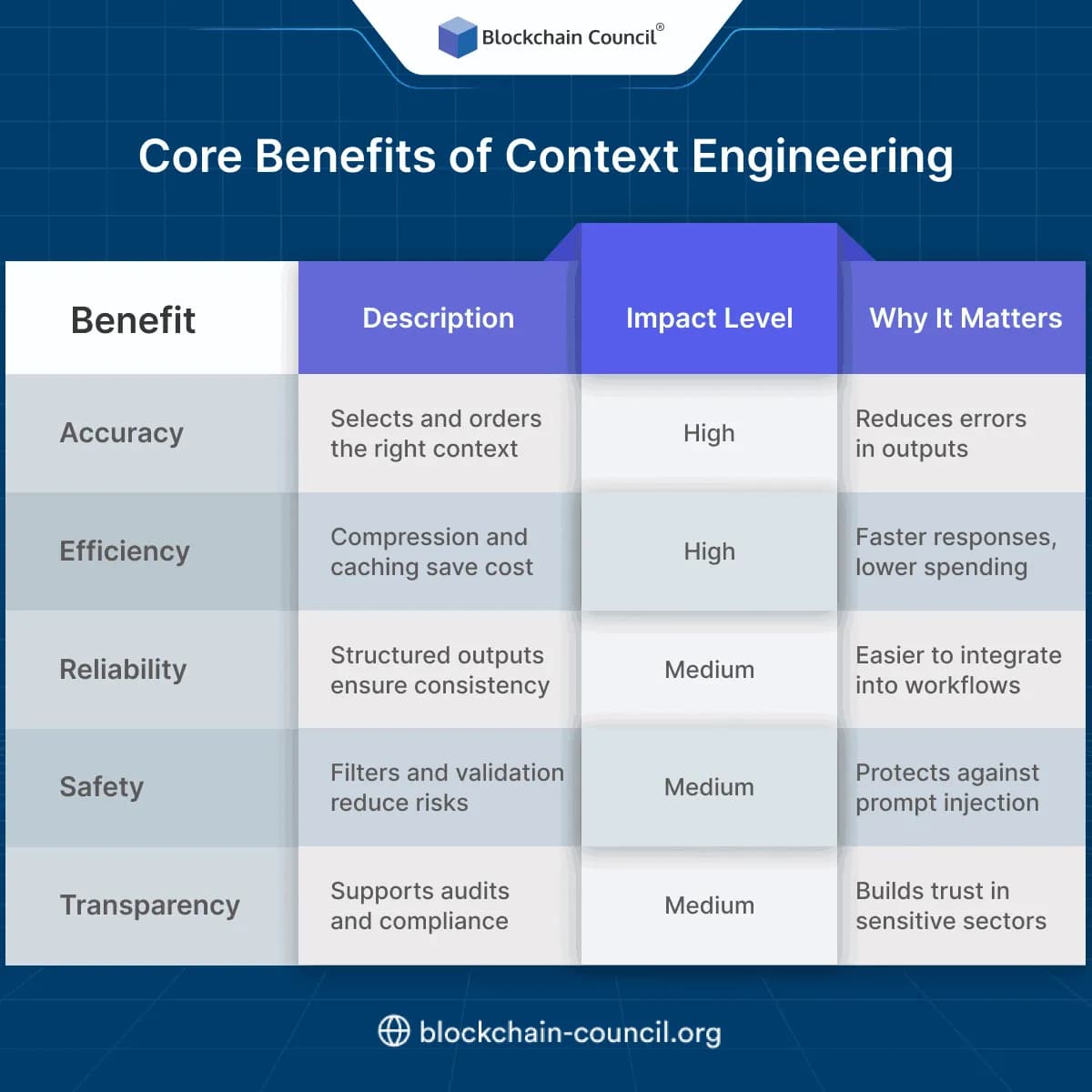
This table shows why context engineering is seen as a core part of modern AI systems.
Applications of Context Engineering Across Industries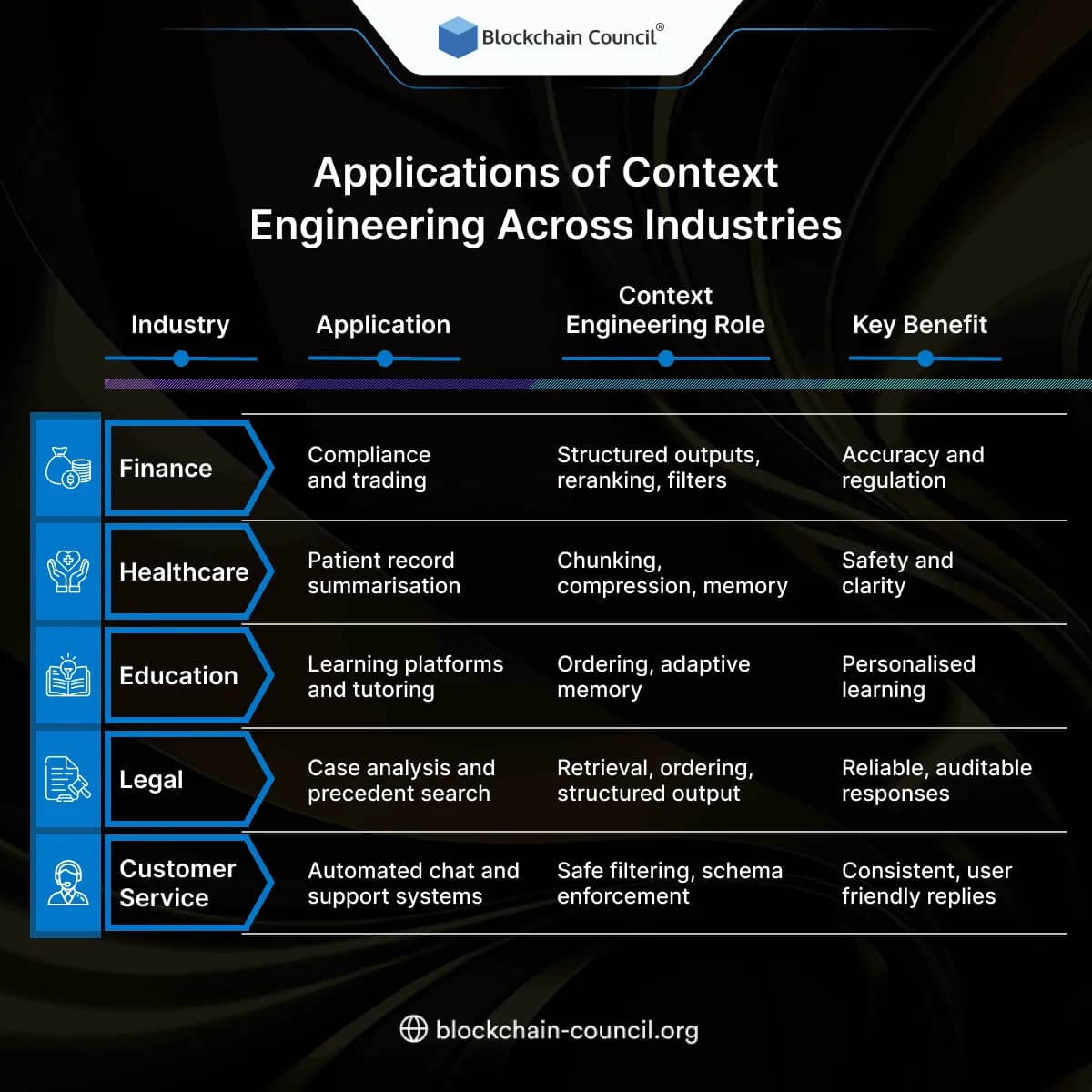
This second table highlights the variety of contexts where engineering techniques make AI not just usable but trustworthy.
The Future of Context Engineering
The field is developing quickly. The next few years will see context engineering become as central as software engineering.
Research Trends
Academic and industry labs are exploring query routing, where the system decides between retrieval and long-context use. This balances quality with cost. New benchmarks are also emerging to test how well models use information buried in long prompts. Research into attention calibration is helping models focus on mid-prompt tokens that often get ignored.
Business Adoption
Enterprises are beginning to formalise context engineering as a distinct role. Just as data engineers manage pipelines, context engineers manage what goes into the model at query time. Tools for chunking, reranking, and structured outputs are now part of enterprise AI stacks.
Upskilling is key here. Many professionals are pursuing AI certs to understand context engineering basics. Technical specialists often follow this with programs like the Data Science Certification to integrate AI with analytics. Business leaders choose options like the Marketing and Business Certification to align AI use with growth strategies.
Regulation and Governance
Governments and regulators are watching closely. Context is now recognised as part of the AI risk surface. Standards such as the NIST AI Risk Management Framework already advise documenting context practices. In Europe, the AI Act requires disclosure of AI-generated outputs and controls against unsafe use.
This makes context engineering not only a technical skill but also a compliance requirement. Teams must prove that their context selection, filtering, and ordering are deliberate, safe, and auditable.
Conclusion
Context engineering has moved from being a niche practice to a core discipline in AI. It ensures that models see the right information, in the right order, and in the safest way possible. The benefits are clear: higher accuracy, lower cost, greater safety, and stronger trust.
From finance to healthcare, education to Law, and customer service to research, context engineering is shaping how AI delivers value. The future points to even more integration, with research advances, enterprise adoption, and regulatory frameworks pushing the field forward.
For professionals, the message is clear. Building skills in context engineering is no longer optional. Those who learn now will be ready to lead as AI becomes part of every industry.
Related Articles
View All
AI & ML
Prompt Engineering to Context Engineering: How to Get Better Results From AI
Learn the journey from Prompt Engineering to Context Engineering. Understand prompts, few-shot and chain-of-thought techniques, context windows, memory, and RAG to get better results from AI.

AI & ML
Built to Catch AI Cheating: Rethinking Pre-Employment Assessments with HireValid
Explore how HireValid is rethinking pre-employment assessments with AI-resistant test design, integrity signals, candidate evidence, and human review to address AI-assisted cheating.

AI & ML
AI-Era Hiring Needs AI-Proof Tests: How HireValid Is Redefining Talent Assessment
Explore how HireValid is rethinking talent assessment for the AI era with job-relevant tests, anti-cheating design, integrity signals, and human-reviewed evidence of candidate ability.
Trending Articles
The Role of Blockchain in Ethical AI Development
How blockchain technology is being used to promote transparency and accountability in artificial intelligence systems.
How Blockchain Secures AI Data
Understand how blockchain technology is being applied to protect the integrity and security of AI training data.
Claude AI Tools for Productivity
Discover Claude AI tools for productivity to streamline tasks, manage workflows, and improve efficiency.