

Will ChatGPT Replace Your Financial Advisor?
 Michael Willson
The short answer is no—at least not entirely. ChatGPT and similar AI tools are powerful at crunching numbers, scanning documents, and simulating scenarios, but they lack the empathy, accountability, and holistic planning that come with a human financial advisor. Still, AI is already reshaping the way financial advice is delivered. Tasks that once required hours of research or manual analysis are being automated, leaving many to wonder how much of the advisory role will remain human. For investors looking to stay ahead of this shift, the AI-powered investor program is a timely way to understand how technology is changing wealth management.
ChatGPT as Your Financial Advisor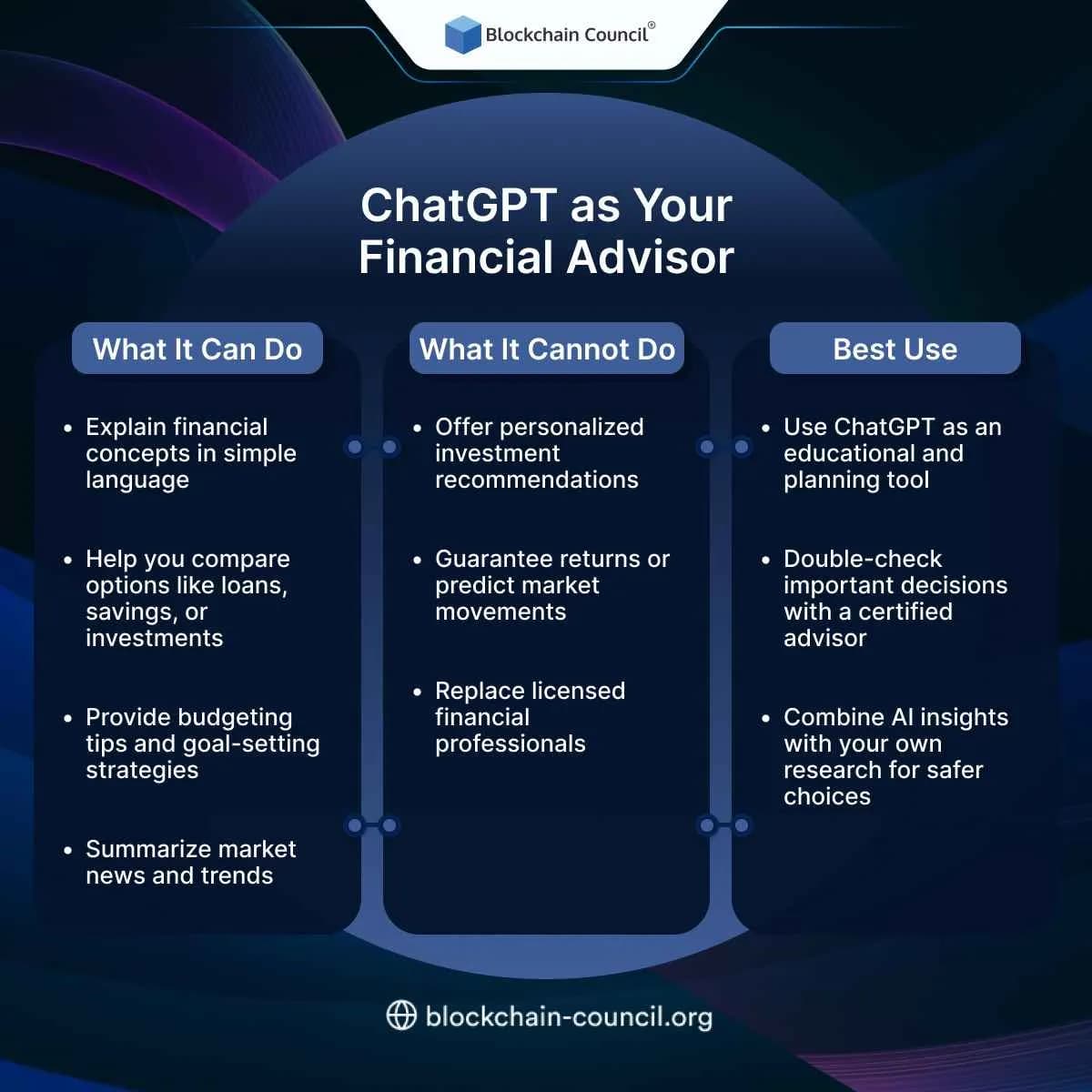
What It Can Do

- Explain financial concepts in simple language
- Help you compare options like loans, savings, or investments
- Provide budgeting tips and goal-setting strategies
- Summarize market news and trends
What It Cannot Do
- Offer personalized investment recommendations
- Guarantee returns or predict market movements
- Replace licensed financial professionals
Best Use
- Use ChatGPT as an educational and planning tool
- Double-check important decisions with a certified advisor
- Combine AI insights with your own research for safer choices
What ChatGPT Can Already Do
ChatGPT can process massive amounts of data faster than any person. It can scan quarterly reports, news headlines, and analyst commentary, then produce a summary of market sentiment in seconds. It can also run “what if” scenarios—what happens to a portfolio if inflation rises or energy prices drop—and offer simple explanations of investment strategies like dollar-cost averaging or diversification.
Many wealth firms are quietly embedding AI into their workflows. Advisors use tools like ChatGPT to draft reports, monitor risk exposure, and even generate personalized emails to clients. For do-it-yourself investors, the model is already serving as a round-the-clock tutor, breaking down financial jargon into everyday language.
Why ChatGPT Falls Short
Despite these capabilities, ChatGPT cannot step fully into an advisor’s shoes. The most obvious reason is regulation: financial advisors carry fiduciary responsibility, meaning they are legally bound to act in a client’s best interest. ChatGPT does not. If the AI suggests a strategy that leads to a loss, there is no accountability.
Personalization is another shortfall. A human advisor understands context—your tax situation, family goals, risk tolerance, and emotional triggers. ChatGPT cannot grasp those nuances beyond what is typed into the chat box. Similarly, while AI can recommend asset allocation, it cannot guide clients through estate planning, retirement drawdown strategies, or insurance needs in a way that ties everything together.
Perhaps most importantly, ChatGPT lacks empathy. When markets turn volatile, a major part of an advisor’s job is behavioural coaching—helping clients avoid rash decisions. AI may provide logic, but it cannot provide reassurance. Trust is built on relationships, not algorithms.
The Shift Toward Hybrid Advice
The future of advice seems less about replacement and more about collaboration. AI tools handle the repetitive, data-heavy tasks, while human advisors focus on interpretation and long-term strategy. A client might run initial portfolio questions through ChatGPT but still turn to a human for confirmation before taking action.
Surveys show this hybrid model is what most people actually want. Investors are comfortable when their advisor uses AI in the background to improve efficiency, but far fewer are willing to rely on AI alone for decisions about retirement, inheritance, or major investments.
Building Skills for the New Era
As this transformation unfolds, both professionals and investors will need new skills. An AI certification builds the technical foundation to understand how these systems work. For those exploring digital assets, a crypto certification offers expertise in blockchain-based markets. As algorithmic trading grows, an AI trading program helps individuals design and test automated strategies. Broader tech certifications ensure professionals grasp the digital infrastructure underpinning finance, while blockchain technology courses strengthen knowledge of transparency and trust in financial ecosystems.
The combination of these learning paths prepares people not just to keep pace with AI in finance, but to use it as an advantage. The rise of ChatGPT is not a threat to advisors—it’s a sign that the industry is evolving. Those who adapt will thrive.
ChatGPT, Hybrid Models, and Investor Trust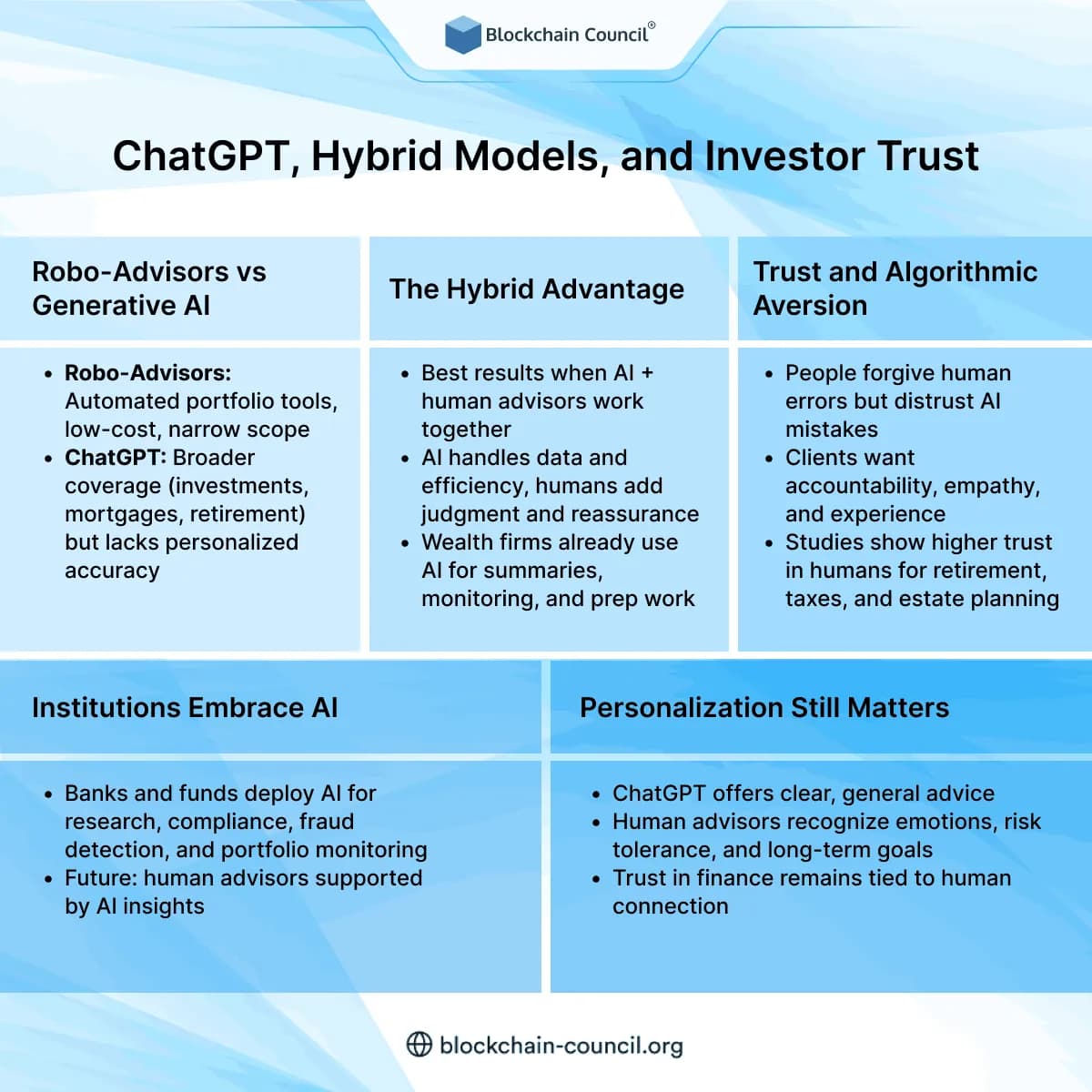
Robo-Advisors vs Generative AI
- Robo-Advisors: Automated portfolio tools, low-cost, narrow scope
- ChatGPT: Broader coverage (investments, mortgages, retirement) but lacks personalized accuracy
The Hybrid Advantage
- Best results when AI + human advisors work together
- AI handles data and efficiency, humans add judgment and reassurance
- Wealth firms already use AI for summaries, monitoring, and prep work
Trust and Algorithmic Aversion
- People forgive human errors but distrust AI mistakes
- Clients want accountability, empathy, and experience
- Studies show higher trust in humans for retirement, taxes, and estate planning
Institutions Embrace AI
- Banks and funds deploy AI for research, compliance, fraud detection, and portfolio monitoring
- Future: human advisors supported by AI insights
Personalization Still Matters
- ChatGPT offers clear, general advice
- Human advisors recognize emotions, risk tolerance, and long-term goals
- Trust in finance remains tied to human connection
The question of whether ChatGPT can replace financial advisors isn’t just theoretical. Around the world, experiments and studies are already testing how investors interact with AI-driven tools. The results point to a pattern: while ChatGPT and similar systems are highly effective at handling technical analysis, people still crave human judgment, empathy, and accountability. This section explores case studies, hybrid models, and the complex dynamics of investor trust.
Robo-Advisors Versus Generative AI
Robo-advisors have existed for more than a decade, offering automated portfolio allocation and rebalancing based on risk profiles. They proved that many investors are open to digital tools, especially for low-cost, passive strategies. However, robo-advisors are narrow in scope—they focus almost entirely on investment management. ChatGPT is broader. It can answer questions across personal finance, from explaining mortgage options to comparing retirement plans.
Yet, the difference is also a limitation. ChatGPT’s answers can be impressively clear but lack the tailored accuracy of licensed advice. For instance, if you ask about the best retirement contribution strategy, it might explain the difference between traditional and Roth accounts. But it cannot assess your unique tax situation, state laws, or employer benefits in detail. Robo-advisors, for all their simplicity, are more structured, while ChatGPT’s open-ended nature leaves room for both flexibility and error.
The Hybrid Advantage
Several field experiments reveal that hybrid models—where AI generates advice and humans validate it—deliver the best outcomes. One recent study, My Advisor, Her AI, and Me, found that clients were more likely to follow advice when it came from a human supported by AI than from either alone. This was especially true in situations involving risk. Clients trusted the efficiency of AI but valued the emotional reassurance of a human confirming the recommendation.
This hybrid model is now visible in wealth management firms. Advisors use ChatGPT-like tools to monitor portfolios, draft summaries of client performance, or prepare meeting notes. Instead of replacing the advisor, AI extends their capabilities, letting them spend more time on relationship-building and long-term strategy. For investors, this means lower costs, faster updates, and more personalised service—all without losing the human connection.
Trust and Algorithmic Aversion
A curious paradox shapes the debate. People often distrust algorithms even when they perform as well as or better than humans. Psychologists call this “algorithmic aversion.” If a human makes a mistake, clients forgive it as part of being human. If an AI makes the same mistake, clients may reject it entirely.
This is one reason trust remains higher in human advisors. According to Northwestern Mutual’s 2025 study, most Americans prefer human advisors for retirement planning, estate decisions, and tax strategies. They may use AI for quick answers or research, but they hesitate to rely on it for life-changing financial moves.
The issue isn’t just about accuracy. It’s about accountability. A human advisor can explain their reasoning, share their experience, and accept responsibility. ChatGPT can provide a well-written explanation, but if things go wrong, there is no one to hold accountable. That gap is hard to ignore in an industry where trust is everything.
Financial Institutions Embrace AI
Despite this trust gap, institutions are rapidly integrating AI. JPMorgan Chase developed an internal large language model suite to act as a research analyst. It can summarise corporate filings, extract key data, and generate investment insights in seconds. Other firms are embedding AI in compliance, fraud detection, and portfolio monitoring.
These institutional moves demonstrate that the question is not whether AI belongs in finance, but how it will be used. For clients, the outcome will likely be a blended experience: human advisors powered by AI systems that deliver sharper insights and faster responses.
Personalisation Still Matters
Investors are not just numbers in a spreadsheet. They bring emotions, goals, and fears to the table. This is where ChatGPT struggles most. It can generate generic advice but cannot read between the lines or notice subtle emotional cues.
For example, a client might ask whether to invest in a volatile tech stock. ChatGPT could provide risk analysis, market trends, and potential returns. But a human advisor would notice the client’s anxious tone, recall their risk-averse history, and suggest a safer alternative. This ability to weave together facts and feelings is why advisors remain indispensable.
Certification and Skills for the Future
As AI continues to influence finance, professionals need skills that go beyond traditional financial training. The future of advising is not just about knowing the markets—it’s about understanding and leveraging technology. Certifications provide structured paths for this.
- An AI certification ensures advisors understand how AI models function, their limitations, and how to apply them responsibly.
- The crypto certification equips advisors and investors with the expertise to navigate digital asset markets safely, an area where AI is already being used for predictive analysis.
- The AI-powered investor program gives investors practical skills to use AI tools directly for portfolio management.
- Broader tech certifications help professionals understand the infrastructure—cloud systems, data pipelines, and security—that powers AI in finance.
- Blockchain technology courses enhance knowledge of transparency and accountability, areas that complement AI’s predictive power.
Together, these certifications prepare professionals and investors to thrive in a financial landscape where AI is a constant partner.
The AI Trading Edge
Algorithmic trading is not new, but AI takes it further. Advanced models can identify patterns in massive datasets, simulate strategies, and execute trades in milliseconds. For individual investors, this opens access to tools once reserved for hedge funds.
An AI trading program equips learners to design and test these strategies responsibly. While ChatGPT itself is not a trading engine, it can support traders by explaining techniques, coding strategies, or backtesting ideas. For investors, this represents both opportunity and risk: AI can amplify gains, but without oversight, it can also accelerate losses.
The Emotional Core of Advice
Even as AI grows more capable, one element remains out of reach: emotional connection. Financial planning often involves life transitions—marriage, buying a home, retirement, or inheritance. These are not just financial moves but deeply personal experiences. A trusted advisor is part coach, part confidant, and part strategist.
This emotional role cannot be replicated by ChatGPT. It can generate a sympathetic tone, but it cannot genuinely empathise with a client’s fears or celebrate their successes. That human connection is a cornerstone of financial advice and a barrier to full automation.
A New Division of Labor
Looking ahead, the industry seems headed for a new division of labor. AI will take over the heavy lifting—data crunching, scenario generation, compliance checks, and risk monitoring. Human advisors will focus on big-picture planning, emotional guidance, and trust-building.
For clients, this may result in better service at lower costs. Routine tasks will be faster and more accurate, while advisors will have more time for personal engagement. For professionals, it means upgrading skills and embracing AI as a partner rather than a threat.
Long-Term Implications, Regulation, and the Future of Advice
The question of whether ChatGPT will replace financial advisors is not just about technology. It is also about human trust, industry regulation, and the evolving needs of clients. As AI tools become more advanced, the lines between human and machine advice blur, but replacement is far less likely than transformation.
Regulation and Responsibility
Financial services are among the most heavily regulated industries in the world. Advisors carry fiduciary duties, licensing requirements, and legal accountability. ChatGPT, on the other hand, is not a registered advisor. It has no fiduciary obligation, and there is no clear framework for holding it accountable if its suggestions lead to harm.
Regulators worldwide are starting to address these gaps. The European Union’s AI Act, for example, sets rules around transparency and high-risk AI applications. In the United States, financial regulators are exploring guidelines on AI disclosures in wealth management. These policies highlight a central truth: financial advice cannot be fully automated without clear accountability.
Until regulation catches up, human advisors remain indispensable, not only for trust but also for compliance. Firms that attempt to replace humans with AI entirely risk running afoul of the law.
How Clients Actually Use AI
Real-world patterns show that most investors use ChatGPT as a supplement, not a replacement. A client might ask ChatGPT for a quick breakdown of the S&P 500, then discuss the output with their advisor. Others use it to draft questions before meetings, ensuring more productive conversations.
This behaviour reflects a broader shift in financial services. Clients want instant access to information, but they also want human reassurance before acting on it. Advisors who ignore AI risk looking outdated, while those who embrace it gain efficiency and credibility.
The Role of Education and Upskilling
As the advisor’s role evolves, professionals need to expand their expertise. The new era of finance demands a blend of human and technical skills. Certifications play a critical role in this transformation:
- The AI certification builds an understanding of how AI systems work and how to apply them responsibly in finance.
- The crypto certification strengthens knowledge of blockchain-based assets, helping advisors integrate digital currencies into diversified portfolios.
- The AI-powered investor program equips investors with practical skills to use AI tools directly in portfolio management.
- An AI trading program helps learners design and test algorithmic strategies that complement long-term planning.
- Broader tech certifications prepare advisors to understand the infrastructure—cloud, data, and cybersecurity—that powers AI-driven finance.
- Blockchain technology courses deepen knowledge of transparency and accountability in financial ecosystems.
- The Marketing and Business Certification gives professionals the ability to apply AI not just for investment strategies but also for business growth, client engagement, and building trust in competitive markets.
Together, these learning paths help advisors and investors future-proof their skills.
The Emotional Edge
Even with the best ChatGPT certification and AI tools, one element remains uniquely human: empathy. Money is tied to emotion—fear during downturns, excitement during bull runs, anxiety about retirement, or pride in leaving a legacy. A financial advisor often becomes part coach, part counsellor, guiding clients through emotional highs and lows.
ChatGPT can simulate empathy with tone, but it cannot share lived experiences or genuinely understand human fear. This is why many investors insist on human oversight, even when AI provides technically sound advice. The emotional edge is a form of value that machines cannot replicate.
The Global Dimension
In some markets, AI is already filling gaps in financial advice. For instance, in countries with few licensed advisors, AI tools are helping first-time investors understand basic concepts. Yet in wealthy markets, where financial planning is complex, the demand for human advisors remains strong.
This suggests that adoption will be uneven. AI may dominate in entry-level or transactional advice, while humans remain central in high-net-worth and complex cases. The balance will depend on regulation, culture, and investor expectations.
Looking Ahead
So, will ChatGPT replace financial advisors? The evidence points to a different conclusion: AI will replace parts of the job, but not the whole. Routine research, document drafting, and risk monitoring are already shifting to AI. But the strategic, emotional, and ethical dimensions of financial planning still require human judgment.
The likely outcome is a redefinition of the advisor’s role. Advisors will act less as calculators and more as interpreters, coaches, and strategists. AI will sit in the background, delivering insights and options at lightning speed. The advisor will bring meaning, accountability, and trust to those outputs.
Conclusion
ChatGPT is transforming financial advice, but it is not a one-for-one replacement for human advisors. It excels at speed, scale, and data processing, while humans provide empathy, regulation, and holistic judgment. The most effective model is hybrid—AI as a powerful assistant, and advisors as trusted guides.
For investors and professionals, the lesson is clear: don’t resist the rise of AI. Instead, learn to work with it. Certifications in AI, crypto, blockchain, marketing, and technology create the skills needed to thrive in this new era. With the right preparation, advisors can use AI not as competition, but as a partner—one that enhances their value and secures their place in the future of finance.
Related Articles
View All
AI & ML
How to Use ChatGPT at Work: Practical Guide for Teams and Professionals
Learn how to use ChatGPT at work for reports, research, automation, coding, and team workflows while keeping data security and human review in place.

AI & ML
How to Use Loop Engineering in ChatGPT
Learn how Loop engineering turns ChatGPT into a repeatable AI workflow with goals, verifiers, memory, tools, budgets, and safe stop conditions.

AI & ML
How GPT-Live Could Transform Real-Time AI Conversations for ChatGPT Users Worldwide
GPT-Live could turn ChatGPT Voice into a full-duplex real-time AI conversation layer for learning, work, enterprise tools, and multimodal support.
Trending Articles
The Role of Blockchain in Ethical AI Development
How blockchain technology is being used to promote transparency and accountability in artificial intelligence systems.
How Blockchain Secures AI Data
Understand how blockchain technology is being applied to protect the integrity and security of AI training data.
What is AWS? A Beginner's Guide to Cloud Computing
Everything you need to know about Amazon Web Services, cloud computing fundamentals, and career opportunities.