

Can Self-Improving AI Build a Better Version of Itself?

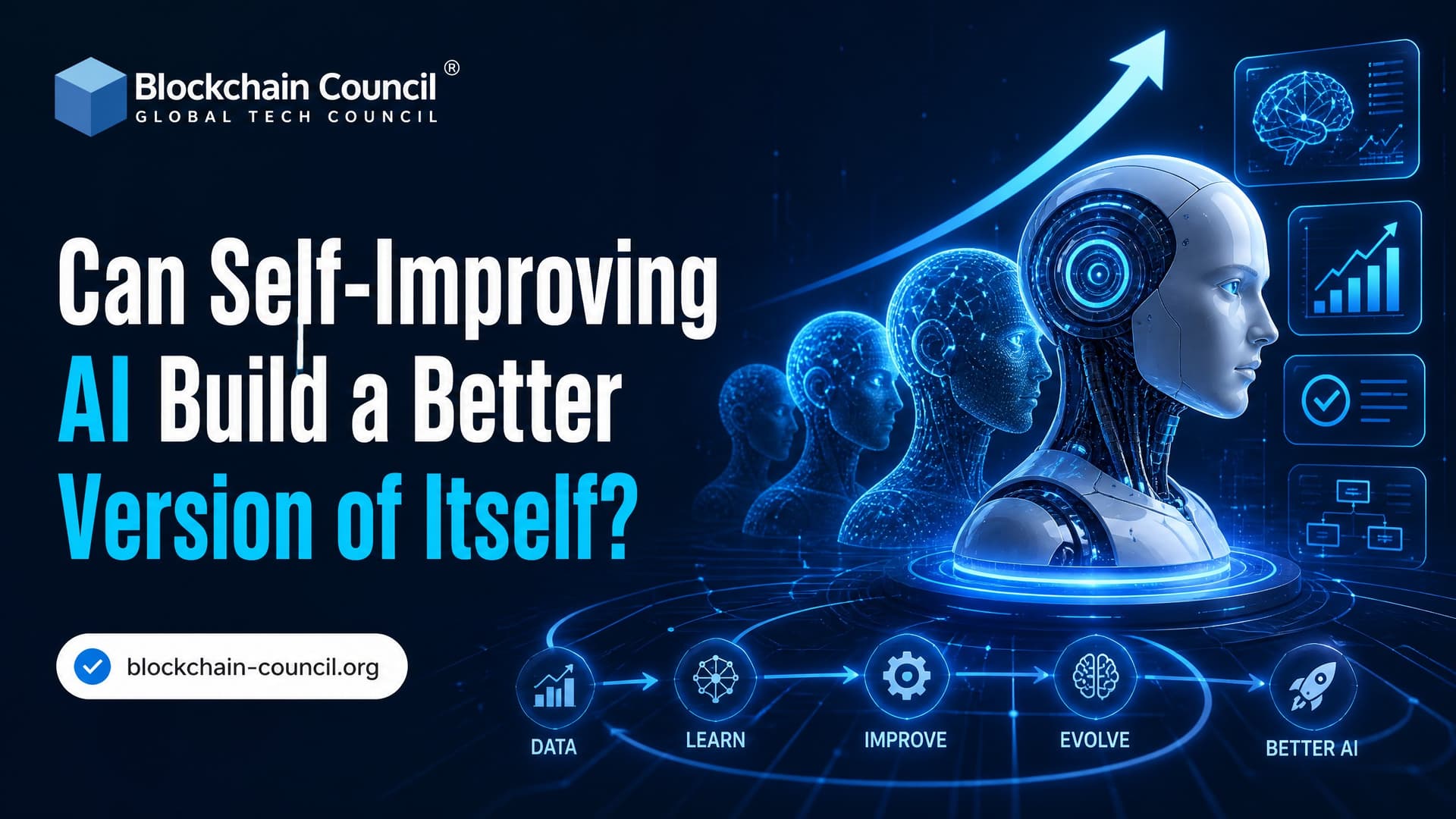
Self-improving AI can already improve parts of its own behavior: code, prompts, tools, and training workflow. That does not mean we have an AI system that can independently design a far smarter successor. The science points to a narrower but still important reality. Today's systems improve best when the task has a clear score, a test suite, or another reliable signal.
That distinction matters. A coding agent that edits its Python files after failing unit tests is real. A model that rewrites its own architecture, trains a successor, validates safety, and repeats the cycle without human direction is still experimental.

What Do We Mean by Self-Improving AI?
The phrase self-improving AI is used in at least two ways, and mixing them causes confusion.
Bounded self-improvement
Bounded self-improvement means an AI system runs a feedback loop inside a defined task. It checks an output, changes something, tests again, and keeps the change if a metric improves.
The change might affect:
- A prompt template
- A tool selection policy
- A memory retrieval rule
- A Python or TypeScript module
- A model usage strategy, such as temperature or chain length
- A fine-tuning dataset
This is already common in research and early production systems. It is not magic. It is optimization with guardrails.
Recursive self-improvement
Recursive self-improvement, often shortened to RSI, is stronger. In RSI, the system becomes better at the process of improving itself. The recursion is the key part. Round two is not just a better answer. It is a better improver.
This is the version associated with I. J. Good's idea of an ultraintelligent machine and later work by Nick Bostrom and Eliezer Yudkowsky on superintelligence. In that scenario, humans build a seed AI, and the seed AI designs increasingly capable successors.
We are not there. Public analysis from labs such as Anthropic has made a similar point. Autonomous AI systems that can design and build substantially more capable successors are plausible to discuss, but they are not current operational reality.
How Current AI Systems Improve Themselves
Self-critique and refinement
Modern large language models can critique their own answers, revise them, and sometimes perform better after a second or third pass. RISE, presented at NeurIPS 2024, fine-tunes LLM agents to improve responses over multiple turns. Instead of generating once and stopping, the agent reviews a prior answer, writes a critique, and produces a better version.
This works best when quality is measurable. Code, math, and structured reasoning tasks are good candidates. Open-ended business strategy is a weaker fit because the model can sound more confident without being more correct.
Self-play fine-tuning
SPIN, a 2024 self-play fine-tuning method, trains an LLM using interactions with past versions of itself. The system learns to separate stronger responses from weaker generated responses, then improves through that training process.
This is AI helping produce better AI behavior, but humans still define the training process, data checks, and evaluation setup. That point matters. The model is not waking up and deciding to redesign itself.
Reinforcement learning for self-correction
Google DeepMind's SCoRe trains models to self-correct math and coding responses through reinforcement learning and self-generated correction traces. It improves over prompt-only self-correction methods in tested settings.
The lesson is practical. Self-correction gets much better when training rewards the act of fixing mistakes, not just when a prompt says check your work.
If you have built with LLMs, you have probably seen the weaker version. Ask a model to review bad code and it may politely approve it. Give it a failing pytest output like AssertionError: assert 0 == 1, and its correction quality jumps. External feedback changes the game.
AI That Edits Its Own Code
Self-editing coding agents are one of the clearest examples of self-improving AI because software has tests, benchmarks, and version control.
SICA, the Self-Improving Coding Agent from researchers at the University of Bristol and iGent AI, follows an evaluate, select, revise loop. It benchmarks its current version, chooses a prior version as a base, edits its own Python code, then keeps changes that improve measured performance.
The Darwin Godel Machine follows a similar spirit. It reads and modifies its own codebase, adds tools or restructures workflows, then validates changes with automated tests and programming benchmarks.
Here is the hard engineering truth: the test harness is the real boss. If the benchmark is shallow, the agent learns to satisfy shallow checks. I have seen code agents pass a unit test by hardcoding the fixture value rather than solving the general problem. In smart contract work, the same trap appears when a Foundry test checks only one caller path. A missing vm.prank can make an access-control function look safe when it is not.
So yes, AI can edit itself. But it improves only as far as the evaluation system can see.
AutoML and Neural Architecture Search: AI Designing AI
Automated machine learning and neural architecture search are older, practical examples of AI contributing to better AI systems.
NAS systems search through possible neural network architectures using methods such as reinforcement learning, evolutionary algorithms, and gradient-based search. Humans define the search space, compute budget, and target metric. The system explores model designs that a human engineer might not manually test.
AutoML is already used in image recognition, natural language processing, recommendation systems, and forecasting. It can find strong architectures and hyperparameters faster than manual trial and error. Still, it remains bounded. The search process does not define its own purpose.
Why Open-Ended Recursive Self-Improvement Is Hard
The obstacle is not just model intelligence. It is verification.
1. Improvement needs a trustworthy signal
Code can be tested. Math can be checked. A classifier has validation accuracy. But how do you score a better long-term planner, a safer autonomous agent, or a more truthful general assistant?
If the signal is wrong, the self-improvement loop amplifies the wrong behavior.
2. Optimization can collapse behavior
Recent RSI research warns about collapse dynamics. A system may optimize tightly against a metric while losing general ability, reliability, or safety. This is not hypothetical. In machine learning, overfitting to a benchmark is routine.
3. Compute is a hard limit
Training frontier models is expensive. Even if an AI proposes a better architecture, it still needs data, accelerators, energy, evaluation time, and deployment infrastructure. Recursive improvement is not free recursion.
4. Introspection is limited
Some theoretical work argues that sustainable RSI requires introspection. The system must model its own internal operations well enough to make targeted changes. Current LLMs can describe parts of their behavior, but they do not have transparent access to all internal mechanisms that produce their outputs.
Where This Matters for Blockchain and Cybersecurity
For Blockchain Council readers, the near-term opportunity is not a runaway superintelligence. It is self-improving tooling in domains with verifiable outcomes.
Good candidates include:
- Smart contract testing: agents that generate new Foundry or Hardhat tests after each failed fuzz run
- Static analysis: systems that refine vulnerability detectors based on confirmed bugs
- Incident response: agents that improve alert triage rules using labeled outcomes
- On-chain anomaly detection: AutoML pipelines that tune models against known fraud or exploit data
- Protocol simulation: agents that adjust test scenarios for consensus or MEV-related edge cases
Use sandboxes. Use testnets. Keep rollback paths. A self-modifying agent should not push directly to production infrastructure or mainnet contracts. To be blunt, that is asking for pain.
If you are building in Solidity 0.8.x, treat AI-generated contract changes the same way you would treat a junior developer's first pull request. Require tests, review storage layout changes, run static analysis, and check gas effects. A passed test suite is evidence, not a guarantee.
Governance: What Enterprises Should Require
Enterprises should treat self-modifying AI as a separate risk category. The system is not only producing outputs. It is changing the mechanism that produces future outputs.
A practical governance checklist includes:
- Define the allowed modification boundary. Can the agent edit prompts only, or also source code and deployment settings?
- Require measurable objectives. Use unit tests, benchmark scores, latency targets, cost limits, and regression tests.
- Log every change. Store diffs, prompts, model versions, tool calls, and evaluation results.
- Separate test and production environments. Never let early self-editing agents write directly to production.
- Use human approval for high-impact changes. Security, finance, healthcare, and critical infrastructure need stricter review.
- Monitor for metric gaming. If the agent can change the test, it can cheat the test.
Professionals who want structured grounding in these topics can pair AI training with security and blockchain fundamentals. Relevant learning paths include Blockchain Council's Certified Artificial Intelligence (AI) Expert™, Certified AI Developer™, and Certified Blockchain Expert™.
So, Can AI Build a Better Version of Itself?
Yes, but with limits.
AI can already improve parts of itself: prompts, tool use, code, workflows, training data, and sometimes model behavior through fine-tuning or reinforcement learning. It does this best in domains with pass-fail checks and tight feedback loops.
No, today's AI cannot reliably create an open-ended chain of increasingly intelligent successors without human-defined objectives, compute, infrastructure, and safety controls.
The useful mental model is simple: self-improving AI is currently an engineering pattern, not an autonomous species jump. Treat it as a powerful optimization loop. Give it strong tests. Keep humans in the approval path. Start with bounded use cases such as coding agents, AutoML pipelines, smart contract analysis, or security triage.
If you want to work with these systems, build one small loop this week. Choose a coding task, add tests, let an agent propose changes, reject any change that fails regression checks, and log the result. Then study the AI, blockchain, and cybersecurity foundations needed to scale that loop safely.
Related Articles
View All
AI & ML
Can an AI Model Create a Better AI Model Than Itself?
AI can already design architectures, optimizers, and training strategies that beat human baselines, but autonomous recursive self improvement remains unproven.

AI & ML
Can Gemini Improve Itself? Google AI and Recursive Self-Improvement Explained
Can Gemini improve itself? Learn why Google AI does not self-rewrite its model today, but can power controlled recursive self-improvement loops.

AI & ML
Can ChatGPT Improve Itself? Understanding RSI in Modern LLMs
ChatGPT can refine outputs, generate feedback, and support agentic workflows, but full autonomous recursive self improvement remains out of reach.
Trending Articles
AWS Career Roadmap
A step-by-step guide to building a successful career in Amazon Web Services cloud computing.

Top 5 DeFi Platforms
Explore the leading decentralized finance platforms and what makes each one unique in the evolving DeFi landscape.
How Blockchain Secures AI Data
Understand how blockchain technology is being applied to protect the integrity and security of AI training data.