

Can an AI Model Create a Better AI Model Than Itself?
 Suyash Raizada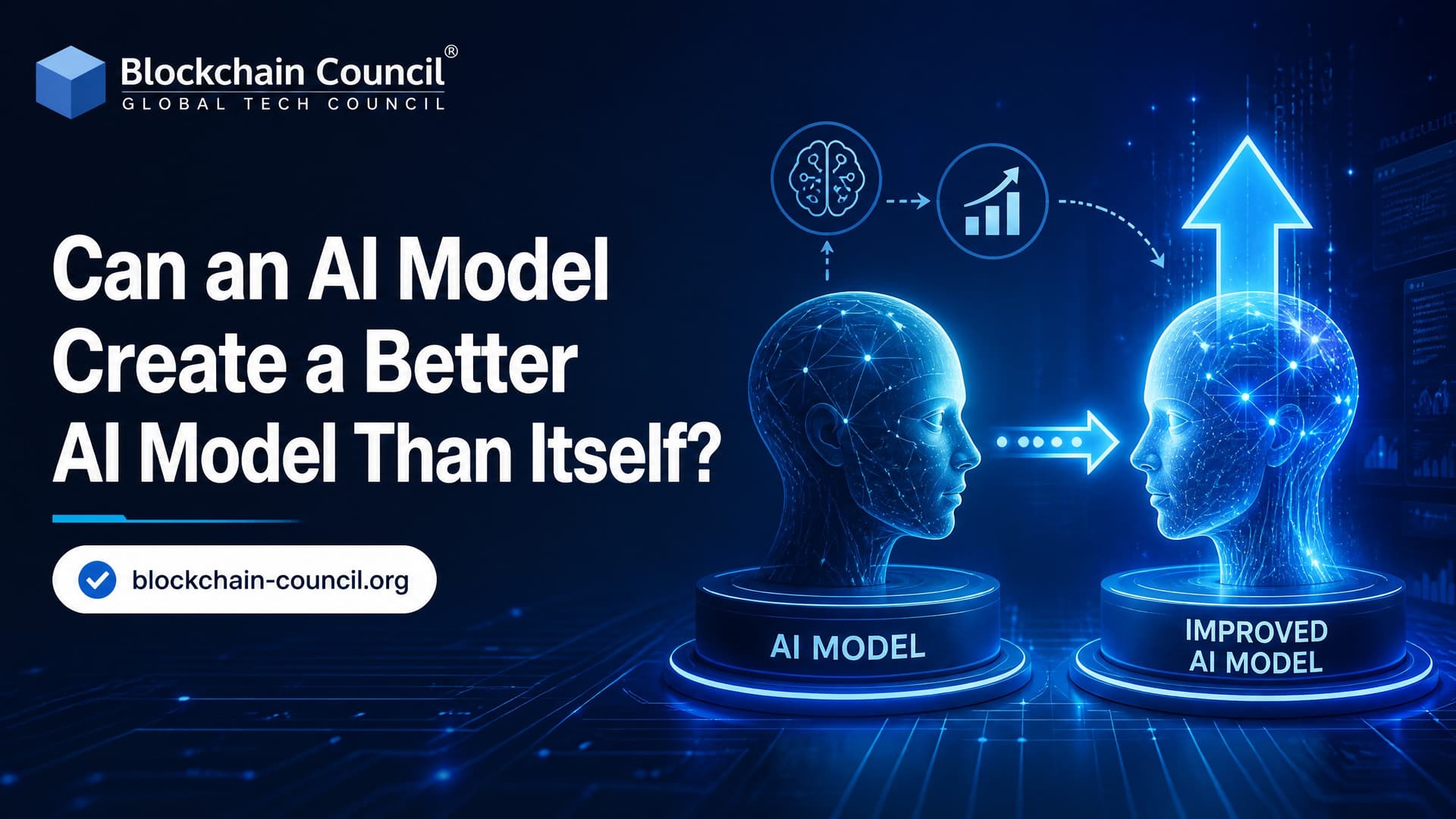
Can an AI model create a better AI model than itself? The honest answer is yes in constrained settings, not yet in the full recursive sense. AutoML systems, neural architecture search, and LLM-based coding agents already design architectures, optimizers, and training strategies that match or beat human baselines on specific tasks. But a frontier AI model autonomously building a substantially more capable successor, with no human oversight, remains unproven. If this is the kind of question you want to actually be able to answer with confidence rather than just repeat, a structured program like the Certified Artificial Intelligence (AI) Expert credential is a reasonable place to build that foundation.
That distinction matters. For developers and enterprises, the near-term opportunity is not science fiction. It is AI-assisted model development: faster experiments, better baselines, cleaner code, smarter evaluation, and tighter feedback loops. The risk is assuming these tools understand your business objective, your data quality problems, or your safety constraints. They do not.

What Does Better Than Itself Actually Mean?
People use the phrase loosely, so let us separate four different capabilities:
Architecture design: Can an AI system find neural network structures that outperform human-designed ones?
Training improvement: Can it tune hyperparameters, select data, or improve optimization strategies?
Algorithm discovery: Can it write code or discover algorithms that make AI systems faster or cheaper?
Recursive self-improvement: Can it fully design, train, evaluate, and deploy a more powerful successor without human guidance?
The first three are real today. The fourth is the open question. To be blunt, no public model has shown reliable full recursive self-improvement at the frontier-model level. If you want to actually build and test these capabilities yourself rather than just read about them, that hands-on gap is exactly what a program like the Certified Artificial Intelligence (AI) Developer track is designed to close.
Where AI Already Builds Better AI Components
AutoML: Strong Baselines Without Hand Tuning
Automated machine learning tools can choose algorithms, tune hyperparameters, and test candidate pipelines. On structured prediction tasks, that is often enough to beat many manual workflows.
A systematic evaluation across 12 OpenML tasks found that popular AutoML frameworks performed better than or equal to the broader machine learning community on 7 of the 12 tasks. Another study of Kaggle-style competitions reported that tools such as AutoGluon and H2O AutoML beat about 85 percent of human teams in competitions before 2017, though that figure dropped to roughly 30 percent in later, harder competitions.
That last detail is the real lesson. AutoML shines when the problem is clean: classification, regression, tabular data, clear target labels. It struggles when the hard part is not modeling but framing the problem. Fraud detection, healthcare triage, blockchain anomaly detection, and credit risk are messy. Labels drift. False positives cost money. Data leaks sneak in.
Here is a practitioner detail. If you run AutoGluon on an imbalanced fraud dataset and accept accuracy as the default metric, you can get a model that looks excellent while missing the rare events you actually care about. You usually want F1, average precision, recall at a fixed false-positive rate, or a cost-sensitive metric. The tool will not know that unless you tell it.
Neural Architecture Search: AI-Designed Networks
Neural architecture search, often called NAS, uses reinforcement learning, evolutionary search, or differentiable methods to generate model architectures. Google's NASNet is a well-known example. It reached 82.7 percent top-1 accuracy on ImageNet at the time, roughly 1.2 percentage points above prior published results.
Other systems such as AutoGAN applied architecture search to generative adversarial networks and found designs that beat hand-crafted GANs on image generation benchmarks. More recent generative NAS methods model high-performing architectures as distributions, then sample candidate networks from that learned space.
Still, NAS is not magic. Humans define the search space, the compute budget, the benchmark, and the success metric. If the search space excludes the right idea, the system cannot find it. If the metric rewards a brittle shortcut, the model may optimize that shortcut beautifully.
Algorithm Discovery: AlphaTensor, AlphaDev, and AI Infrastructure
DeepMind's AlphaTensor discovered new matrix multiplication algorithms that improved performance on hardware such as GPUs. That matters because matrix multiplication sits at the center of neural network training and inference.
AlphaDev pushed the idea into low-level code. It used reinforcement learning to discover faster sorting and hashing routines. For small sorting tasks, such as arrays of 5 elements, it reduced the number of instructions from 46 to 42 or 43 and achieved speedups of up to 70 percent in specific cases.
These are not complete new AI models. They are better building blocks. But better building blocks compound. Faster kernels, smarter scheduling, and improved optimization lower training cost and make larger experiments practical.
Can AI Improve Its Own Model?
Self-improving AI is no longer just a theoretical term. Researchers are testing systems that generate synthetic data, critique their own outputs, update weights, merge models, and refine inference behavior.
One 2025 self-developing framework let an LLM generate and learn model-improvement algorithms focused on model merging. On GSM8k math reasoning, the discovered merging strategies improved the seed model by 6 percent and beat human-designed methods by 4.3 percent. That is a meaningful result, but it is still inside a defined experiment with defined metrics.
Another line of work uses meta-judging. In self-improving alignment experiments, Llama 3 8B Instruct improved its AlpacaEval 2 win rate from 22.9 percent to 39.4 percent and its Arena Hard score from 20.6 percent to 29.1 percent through unsupervised meta-judging.
MIT researchers have also introduced SEAL, short for Self-Adapting LLMs. The idea is that a model can generate synthetic self-edits from new inputs, test which edits improve downstream performance, and update its own weights through reinforcement learning. That is closer to genuine adaptation than ordinary prompt engineering.
There is a catch. Self-generated data can amplify errors. Self-evaluation can slide into self-approval. A model that learns from its own weak judgments may get more confident without getting more correct. You need external tests, holdout sets, red-team prompts, rollback plans, and human review for high-impact systems. This is also a good point to think about how broad a skill set you're building versus how deep a general Tech Certification can help you situate this kind of self-improvement work within the wider landscape of AI and software engineering rather than treating it as an isolated specialty.
Why Fully Autonomous Recursive Self-Improvement Is Not Here Yet
Recursive self-improvement means an AI system can create a successor that is substantially better, and that successor can then repeat the process. Current systems do not meet that bar.
Anthropic has argued that AI systems are increasingly involved in their own development, but the company also states that current models cannot fully autonomously design their successors. Jack Clark, an Anthropic co-founder, has estimated a 60 percent probability that such a system could exist by the end of 2028, while acknowledging that no model can do it today.
The blockers are practical, not just philosophical:
Objective design: Humans still specify what counts as better.
Data quality: Messy data requires domain judgment.
Evaluation reliability: AI judges can miss hidden failure modes.
Compute and orchestration: Frontier training is an engineering project, not a single model call.
Safety: A self-modifying system can change behavior in ways its builders did not intend.
If you have trained models in production, you know the boring parts are where failures hide. A small preprocessing bug, a target leak, or a silent tokenizer mismatch can beat any clever architecture search. In PyTorch, even forgetting to call model.eval() during validation leaves dropout active and makes evaluation numbers bounce around. That is not glamorous. It is real.
What This Means for Enterprises and Developers
For business use, the right question is not whether AI will replace your machine learning team. The better question is where AI can shorten the experiment loop without reducing accountability.
Use AI-assisted model development for:
Creating first-pass baselines with AutoML.
Testing hyperparameter ranges faster than manual search.
Generating candidate feature transformations.
Writing evaluation scripts and model cards.
Finding performance bottlenecks in training and inference code.
Stress-testing prompts, agents, and retrieval workflows.
Do not hand over decisions involving safety, financial exposure, compliance, or user rights to an unsupervised self-improving system. In cybersecurity, crypto risk scoring, smart contract analysis, or autonomous Web3 agents, AI-generated improvements should pass deterministic tests, formal checks where possible, and human review.
For Blockchain Council readers, this points to a practical learning path. If your goal is model design and governance, consider pairing hands-on ML practice with the Certified Artificial Intelligence (AI) Expert™. If you are working with LLMs, agents, or synthetic data workflows, the Certified Generative AI Expert™ is a relevant option. Blockchain professionals can connect this with the Certified Blockchain Expert™ when applying AI to fraud detection, smart contract auditing, or decentralized infrastructure.
Generative AI Beyond Model Building: AI Microdrama
Not every advance in generative AI is about squeezing out better benchmarks or edging closer to self-improving systems. Some of the same underlying techniques are already showing up in far more everyday, creative contexts. One emerging application is AI microdrama, where generative AI helps bring serialized stories, characters, and fictional worlds to life. It's a good reminder that the value of generative AI isn't confined to the high-stakes model-design questions covered above the same core capabilities are quietly reshaping entertainment and storytelling in ways that are already reaching audiences today.
So, Can an AI Model Create a Better AI Model Than Itself?
Yes, if better means a stronger model or component inside a constrained task. AutoML can beat many human baselines. NAS can find competitive architectures. LLM-based agents can discover faster algorithms. Self-adapting research systems can improve specific model behaviors.
No, if you mean a fully autonomous AI that reliably builds a substantially more capable successor without humans defining goals, data, tests, infrastructure, and safety limits. That system does not publicly exist today.
The next useful step is hands-on. Take a real dataset, build a manual baseline, run AutoGluon or H2O AutoML, compare metrics beyond accuracy, then write down where human judgment changed the result. That exercise teaches the central truth better than any prediction: AI can improve AI, but the best outcomes still come from controlled systems and skilled people. And once you can explain that nuance clearly, pairing it with a Marketing Certification can help you communicate it convincingly to clients, leadership, or investors who only ever hear the science-fiction version of the story.
FAQs
1. Can an AI model create a better AI model than itself?
Yes, an AI model can potentially help create a better AI model than itself. It can generate code, suggest architectural changes, optimize hyperparameters, create training data, or evaluate model performance. However, fully autonomous creation of a significantly more capable AI model remains a developing area of AI research.
2. How can AI create a better AI model?
AI can assist with model development by analyzing existing architectures, generating or improving code, optimizing parameters, designing experiments, and identifying performance problems. Human researchers or automated systems can then test these proposed improvements.
3. Can AI train another AI model?
Yes. AI systems can help train other models by generating synthetic data, creating training programs, optimizing configurations, evaluating outputs, and providing feedback. This is already used in several forms of machine learning and AI development.
4. Can an AI model improve its own architecture?
To a limited extent, AI systems can search for or suggest architectural improvements. Techniques such as Neural Architecture Search (NAS) automate parts of the process of finding effective neural-network architectures. Completely autonomous architectural redesign is much more challenging.
5. Can a weaker AI create a stronger AI?
Potentially, yes. An AI does not necessarily need to be more intelligent than the system it helps create. It can contribute to specific tasks such as code generation, optimization, testing, or data processing that collectively help researchers build a more capable model.
6. What is recursive self-improvement in AI?
Recursive self-improvement (RSI) refers to the theoretical process in which an AI improves its own capabilities and then uses those improved capabilities to make further improvements. If each cycle produces substantial gains, AI development could potentially accelerate.
7. Can ChatGPT create a better AI than itself?
AI assistants such as ChatGPT can generate code, propose machine-learning architectures, analyze research ideas, and assist with AI development. However, independently creating, training, validating, and deploying a fundamentally more capable AI model requires substantial computing resources, data, infrastructure, and evaluation.
8. Can an AI model write the code for a more advanced AI?
Yes. Modern AI coding systems can generate substantial amounts of machine-learning code. The difficult part is not simply writing code but determining what architecture, training strategy, data, and optimization methods will actually produce a better model.
9. Can AI automatically optimize another AI model?
Yes. Automated optimization techniques can search through hyperparameters, architectures, training configurations, and other variables. AI-based optimization can potentially make this process faster and more efficient than manually testing every configuration.
10. What does AI-generated AI mean?
AI-generated AI generally refers to AI systems being used to design, develop, train, test, or optimize other AI systems. It does not necessarily mean that the first AI independently creates the entire second AI without human involvement.
11. Could an AI model eventually design a superintelligent AI?
It is theoretically possible, but there is no established evidence that current AI systems can independently accomplish this. A superintelligent AI would require capabilities far beyond simply generating code, including reliable research, experimentation, system design, evaluation, and potentially autonomous decision-making.
12. What is the difference between AI-assisted development and AI self-improvement?
AI-assisted development involves humans using AI tools to help build or improve AI systems. AI self-improvement implies that the AI itself identifies and implements improvements to its own capabilities. The latter involves a much higher degree of autonomy.
13. Can an AI model improve another model without human intervention?
In principle, an automated AI-development pipeline could generate changes, train models, evaluate results, and select better versions without continuous human intervention. However, reliable end-to-end autonomous AI development remains technically difficult and requires safeguards and validation.
14. Why would a better AI be able to create an even better AI?
A more capable AI could potentially perform AI research more effectively, identify better algorithms, run experiments faster, and optimize development processes. This is one reason recursive self-improvement is discussed in theories about rapidly accelerating AI capabilities.
15. What prevents AI from continuously making itself smarter?
Several factors can limit improvement, including computing resources, data quality, hardware constraints, algorithmic limitations, diminishing returns, evaluation difficulties, and safety requirements. Improving one capability does not automatically improve every aspect of intelligence.
16. Can AI-generated models outperform their creators?
Yes, in specific tasks. An AI-assisted development process can produce a model that outperforms the original model on particular benchmarks or applications. However, outperforming the original system on a task is different from creating a generally more intelligent AI.
17. What role does synthetic data play in creating better AI models?
Synthetic data can provide additional training examples generated by AI systems. It can be useful for expanding datasets, testing edge cases, and improving performance in certain applications. Its effectiveness depends heavily on the quality and diversity of the generated data.
18. Is creating a better AI model an example of an intelligence explosion?
Not necessarily. A new model being better than its predecessor is normal technological progress. An intelligence explosion refers to a hypothetical situation where AI systems repeatedly improve themselves so effectively that AI capabilities increase extremely rapidly.
19. Could AI eventually automate AI research?
AI is already being used to assist with parts of AI research, including coding, experimentation, literature analysis, and optimization. Greater automation is possible, but fully autonomous AI research would require highly reliable reasoning, experimentation, verification, and decision-making.
20. What would happen if an AI could reliably create better AI models?
If an AI could reliably design, train, test, and deploy increasingly capable successors with minimal human input, AI development could potentially accelerate dramatically. This scenario is closely related to recursive self-improvement and AI intelligence explosion theories, but it remains hypothetical and involves significant technical and safety challenges.
Related Articles
View All
AI & ML
Can Self-Improving AI Build a Better Version of Itself?
Self-improving AI can refine code, prompts, tools, and workflows today, but open-ended recursive AI successors remain experimental and constrained.

AI & ML
Can Gemini Improve Itself? Google AI and Recursive Self-Improvement Explained
Can Gemini improve itself? Learn why Google AI does not self-rewrite its model today, but can power controlled recursive self-improvement loops.

AI & ML
Can ChatGPT Improve Itself? Understanding RSI in Modern LLMs
ChatGPT can refine outputs, generate feedback, and support agentic workflows, but full autonomous recursive self improvement remains out of reach.
Trending Articles
The Role of Blockchain in Ethical AI Development
How blockchain technology is being used to promote transparency and accountability in artificial intelligence systems.
How Blockchain Secures AI Data
Understand how blockchain technology is being applied to protect the integrity and security of AI training data.
How to Install Claude Code
Learn how to install Claude Code on macOS, Linux, and Windows using the native installer, plus verification, authentication, and troubleshooting tips.