

Can AI Train AI Models Without Humans? What Current Research Really Shows
 Suyash Raizada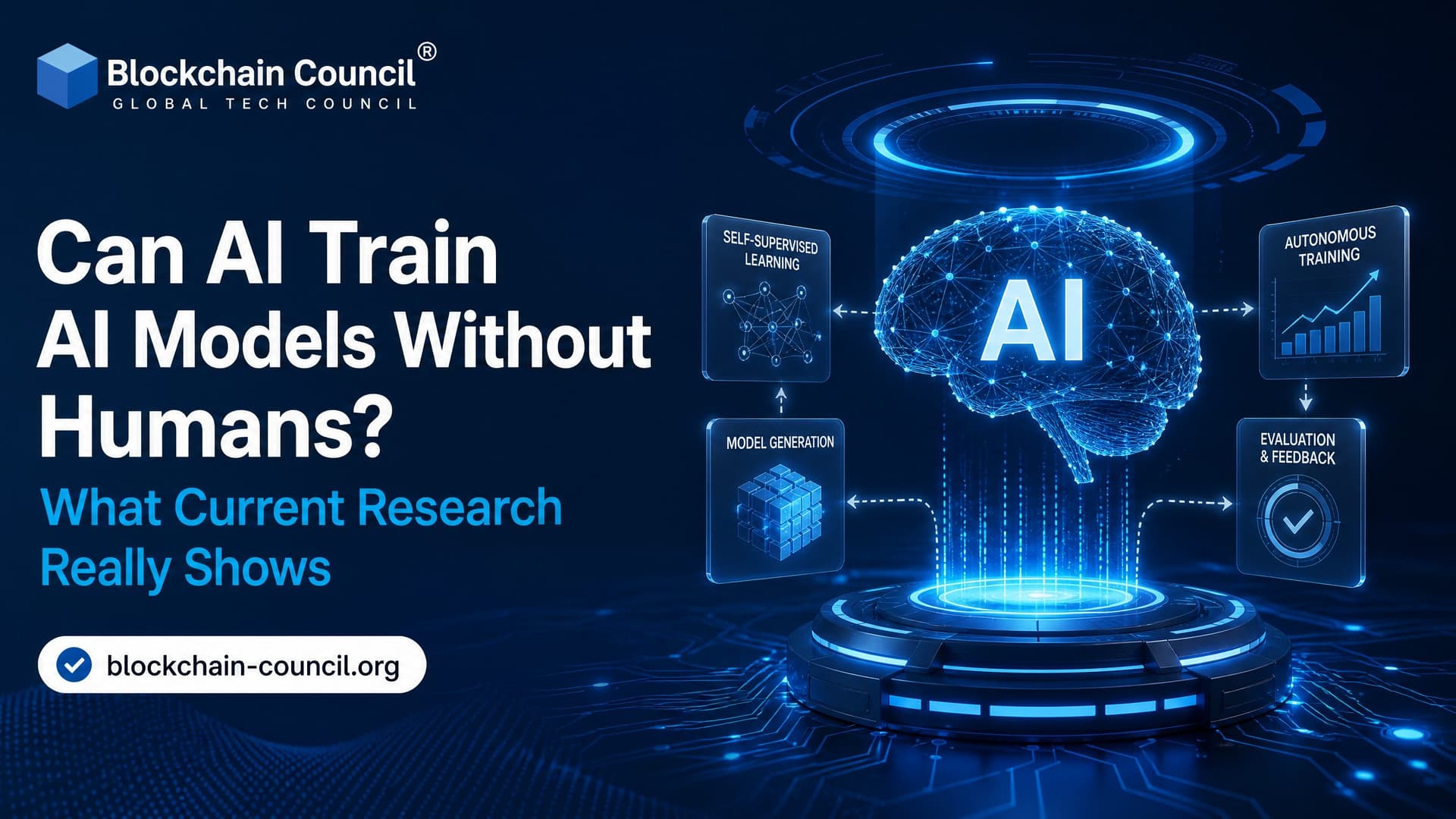
Can AI train AI models without humans? Yes, in narrow and increasingly impressive ways. AI systems can now generate tasks, label data, score answers, create synthetic datasets, and run self-play loops that improve model behavior with little day-to-day human input. But fully human-free training of the next generation of frontier AI models is not ready for safe, general deployment. Humans still set the goals, write the rules, choose architectures, control compute, and decide what is acceptable in the real world. Anyone trying to build a working understanding of this space often starts with a structured credential like the Certified Artificial Intelligence (AI) Expert, which lays out where automation genuinely helps and where human judgment is still required.
That distinction matters. A model can teach itself to solve coding puzzles. It cannot, by itself, decide what a hospital chatbot should refuse, what a legal assistant should cite, or when a self-improving agent should be stopped.

What Does "AI Training AI" Actually Mean?
When researchers talk about AI training AI, they usually mean models are taking over parts of the training pipeline that humans used to do by hand. Those parts include:
Generating prompts, tasks, and examples
Creating synthetic data for training
Producing labels for unlabeled data
Scoring model answers as a reward signal
Selecting harder examples as the model improves
Critiquing unsafe or low-quality outputs
This is not science fiction. It already happens in modern machine learning teams. A common workflow uses a stronger model to label thousands or millions of examples, then trains a smaller model on that output. Another lets a reasoning model generate coding or math problems, solve them, validate the answers with a tool such as Python, and train on the successful attempts. Practitioners looking to move from reading about these pipelines to actually building them often pursue the Certified Artificial Intelligence (AI) Developer track, which focuses on hands-on implementation rather than theory alone.
There is still a hidden human layer underneath. People decide the loss function, the benchmark, the safety policy, the deployment environment, and the point at which a model is good enough to ship.
The Main Ways AI Trains Other AI Models
Self-Supervised Learning and Pseudo-Labeling
Self-supervised learning is the foundation of most large language models. The model learns from raw text by predicting missing or next tokens, without a person labeling each sentence. Pseudo-labeling takes this further. A trained model generates labels for unlabeled data, filters the most confident ones, and uses them to train a new model.
MIT researchers have explored fast self-training, where a pre-trained model labels raw data, keeps high-confidence predictions, and retrains iteratively. This cuts the need for manual annotation, especially in domains where labels are costly.
A practical warning: confidence filtering is not magic. If you generate pseudo-labels in PyTorch and forget to call model.eval(), dropout and batch normalization can stay in training mode. Your labels may shift between runs, and the next model quietly learns noise. This is the kind of small mistake that ruins an otherwise clean self-training experiment.
Self-Play and Data-Free Training
Self-play is the most interesting branch of AI training AI. Instead of learning only from human examples, the model creates challenges for itself. It plays both sides of a task, improves from the result, and repeats.
The Absolute Zero framework is a strong example. Its Absolute Zero Reasoner generates its own tasks, solves them, validates outputs through tools such as code execution, and improves through a self-play loop. Reports around this research suggest strong results on coding and mathematical reasoning benchmarks, even without curated human training data.
Researchers have also described language self-play for data-free training, where a single language model improves through game-like interactions with itself. These methods make the most sense in domains with clear verification. Code either passes tests or fails. A math answer can often be checked. That is why self-play looks powerful for programming, theorem proving, and synthetic reasoning.
It is weaker for messy human contexts. A model can invent a policy debate, but it cannot reliably infer community norms, legal risk, or cultural nuance from a self-generated game.
AI-Generated Rewards and Feedback
Reinforcement learning usually needs a reward signal. In earlier alignment work, humans often compared two answers and chose the better one. That is expensive, slow, and emotionally draining when reviewers must inspect harmful content.
Self-rewarding language models replace some of that human feedback with model-generated scores. One model generates candidate answers. Another model, or sometimes the same model in a judge role, ranks or scores them. The policy then trains against those scores.
Anthropic's Constitutional AI is one of the clearest public examples. Instead of asking humans to label every output, Anthropic used a human-written constitution: a list of principles that guides AI critiques and revisions. The model critiques its own responses, revises them, and helps produce preference data for later training. Humans still write the principles, but the sample-by-sample feedback can be automated.
Synthetic Data for Distillation and Specialization
Synthetic data is now part of many production model pipelines. A large model generates examples, explanations, test cases, or conversations. A smaller model trains on that data, often becoming cheaper and faster to run.
This is useful for model distillation. You might use a high-capability model to generate customer support examples for a narrow domain, then train a smaller model that runs inside a private cloud or on edge hardware. Humans may review a slice of the data, but they do not need to write every example.
The trade-off is contamination. Synthetic data can amplify the source model's blind spots. If the teacher model hallucinates citations, the student may learn the same bad habit with extra confidence.
Can AI Build the Next Frontier Model Alone?
Not responsibly. At least not today.
AI can automate inner loops: data creation, labeling, reward scoring, curriculum design, and evaluation drafts. But frontier model development is more than gradient descent. It includes governance, safety testing, compute allocation, architecture decisions, red teaming, legal review, and release policy. Teams building this expertise internally increasingly point staff toward a general Tech Certification path to standardize how engineers, data scientists, and MLOps teams talk about these pipeline stages.
Consider the difference between training a code model in a sandbox and training an agent that can call tools, browse the web, write files, or trigger transactions. Trial-and-error learning becomes risky when the model can affect external systems. Industry discussions around pauses or tighter controls on autonomous reinforcement learning reflect that concern.
To be blunt, "let the model improve itself forever" is a bad operating plan unless the environment is tightly bounded and the stop conditions are clear.
Where Human Oversight Still Matters
Objective and Value Specification
Models optimize what they are given. They do not independently discover human values. Constitutional AI shows the pattern well: AI can apply rules at scale, but humans must write the constitution. The same applies to safety policies, refusal behavior, fairness goals, and domain-specific constraints.
Evaluation Beyond Benchmarks
A model that does well on coding benchmarks may still fail in production. It may mishandle ambiguous requirements, ignore security constraints, or produce code that passes tests but leaks data. Human experts need to inspect those edge cases.
Certification candidates often miss this point. The tricky question is not "can synthetic data improve accuracy?" It is "when does synthetic data create a feedback loop that hides errors?" That is the real operational risk.
Infrastructure and Governance
Humans design clusters, approve budgets, choose datasets, enforce privacy rules, and define access controls. Frontier-scale training, such as models trained on tens of trillions of tokens, is not something a model spins up casually. Compute governance is part of AI safety.
Best Use Cases for AI-Led Training
AI-led training already earns its keep when verification is clear and the cost of human labeling is high. Strong use cases include:
Code generation: Models can generate problems, write solutions, and validate them with tests.
Math reasoning: Self-play works well when answers can be checked formally.
Domain adaptation: Pseudo-labeling helps adapt models to new internal datasets with limited annotation.
Safety filtering: AI judges can pre-screen harmful or low-quality outputs before human review.
Model distillation: Larger models can create training data for smaller task-specific models.
The wrong use case is unsupervised value formation. Do not ask a closed AI loop to decide what is ethical, lawful, or acceptable for a regulated business process without human review.
Emerging Creative Uses of Self-Training AI
Self-training and synthetic data techniques are not confined to code, math, and enterprise pipelines. Similar generate-and-refine loops are now reaching creative production. One emerging application is AI microdrama, where generative AI helps bring serialized stories, characters, and fictional worlds to life. These platforms rely on many of the same ideas covered above, iterative generation, automated scoring of output quality, and selective human review, just applied to storytelling instead of code or math.
What This Means for AI Professionals
If you work in AI, expect hybrid training pipelines to become normal. Humans will spend less time labeling individual examples and more time designing evaluation harnesses, auditing synthetic data, writing policy constraints, and monitoring automated training loops.
For structured learning, Blockchain Council's Certified Artificial Intelligence (AI) Expert™ gives readers grounding in AI concepts, model behavior, and applied use cases. Developers building model pipelines may also look at Certified AI Developer™ and Certified Generative AI Expert™ to connect model training concepts with implementation choices. Professionals who need to explain these pipelines to non-technical stakeholders or position AI-driven products in market often round this out with a Marketing Certification.
So, Can AI Train AI Models Without Humans?
AI can train AI models without humans in specific parts of the process. It can generate labels, create synthetic examples, score answers, and run self-play loops that improve reasoning. In coding and math, the results are already serious.
But next-generation general-purpose models still need people. Not for every label. Not for every reward score. For goals, values, safety boundaries, governance, and deployment judgment.
Your next step: build a small pseudo-labeling or self-evaluation pipeline yourself. Use a held-out, human-reviewed test set, track where synthetic labels fail, and document the stop conditions before you scale it. That habit matters more than chasing a fully autonomous training loop.
FAQs
1. Can AI train AI models without humans?
Partly, yes. Current AI systems can automate significant parts of model development, including generating training data, writing code, running experiments, evaluating results, and selecting promising approaches. However, fully autonomous AI training with no meaningful human involvement remains an emerging research goal rather than a solved problem. Recent work from Anthropic, OpenAI, and other researchers shows that AI is increasingly involved in its own development.
2. Can one AI model train another AI model?
Yes. An AI system can generate synthetic training data, create labels, provide feedback, write training pipelines, or help optimize another model. For example, OpenAI describes GPT-Red as an automated red-teaming model used to adversarially train GPT-5.6 for improved robustness.
3. Can AI train itself?
AI can participate in automated self-training and self-improvement loops. However, training itself is not the same as fully autonomous recursive self-improvement. A system may improve its performance using generated data or automated feedback while still operating within objectives, infrastructure, and evaluation systems designed by humans.
4. What is AI-to-AI training?
AI-to-AI training refers broadly to situations where one AI system generates data, feedback, evaluation, or learning signals that are used to train another AI system. This can include teacher-student training, synthetic-data generation, self-play, automated evaluation, and AI-assisted fine-tuning.
5. Can AI generate its own training data?
Yes. Modern AI systems can generate synthetic examples for training and evaluation. This can significantly expand available data, but quality control is critical because repeatedly training on model-generated content can reinforce errors or reduce diversity.
6. What is synthetic data in AI training?
Synthetic data is information generated artificially, often by another AI model or simulation, rather than collected directly from real-world sources. It can include text, images, code, mathematical problems, or simulated experiences and can be used to train or evaluate AI systems.
7. Can AI evaluate another AI model?
Yes. AI models can act as automated evaluators, judges, critics, or red-teamers. This is increasingly being used to scale model evaluation. OpenAI, for example, reports using GPT-Red to discover vulnerabilities and improve the robustness of subsequent models.
8. Can AI improve a stronger AI model?
Potentially. An AI does not necessarily need to be more capable overall to improve another model. It can be useful for a specific task, such as finding security weaknesses, generating training examples, optimizing code, or evaluating outputs. Anthropic has also reported experiments in which AI agents conducted an open-ended AI-safety research project under a human-defined problem and scoring framework.
9. Can AI agents train models automatically?
AI agents can automate multiple steps in model development, including coding, experimentation, analysis, and evaluation. OpenAI reports that its researchers are increasingly using coding agents and that it has reached its stated goal of an automated research intern capable of performing well-defined research tasks under human direction.
10. What is automated AI research?
Automated AI research uses AI systems to perform parts of the research cycle themselves. A system might propose an idea, implement it, run an experiment, evaluate the result, and use the findings to select the next experiment. Research groups are already building systems around this type of loop.
11. Is automated AI training the same as recursive self-improvement?
No. Automated training can improve a model within a predefined process. Recursive self-improvement (RSI) is a broader concept in which an AI contributes to improving its own capabilities or the process used to improve it, potentially creating repeated improvement cycles.
12. What is the role of AI coding agents in training AI?
Coding agents can write training scripts, modify machine-learning systems, run experiments, debug failures, and analyze results. This makes them an important component of increasingly automated AI-development pipelines. OpenAI reports that coding agents are already being used extensively by its researchers to accelerate experimentation and software development.
13. Can AI automatically design better AI algorithms?
Increasingly, yes. Google's AlphaEvolve, a Gemini-powered coding agent, is designed to discover and optimize algorithms. Google DeepMind reports that it has been used for algorithmic discoveries and optimization across mathematics, computer science, and Google's infrastructure.
14. Can AI automatically decide how another AI should be trained?
AI systems can optimize certain training decisions, such as hyperparameters, data selection, architectures, and experiment configurations. However, determining the overall research direction and deciding what constitutes meaningful progress remain harder problems. Recent research identifies research direction-setting and reliable evaluation as important bottlenecks for closing the self-improvement loop.
15. What happens if AI repeatedly trains on AI-generated data?
Repeated self-training can produce model collapse, reduced diversity, or amplified errors if generated data is not independently verified. Recent research on code LLMs found that recursive self-training without adequate external quality controls can cause performance degradation.
16. Can AI train AI without any human data?
Technically, some systems can generate substantial amounts of their own training material. However, completely eliminating human-generated or independently verified information creates risks. An AI may increasingly learn from its own mistakes, making external data, independent evaluation, or reliable verification important for maintaining quality.
17. What is the biggest limitation of AI training AI?
One of the biggest limitations is reliable evaluation. If an AI generates an improvement and then evaluates its own work using flawed criteria, it may incorrectly conclude that the change is successful. This can create a self-confirming feedback loop rather than genuine improvement.
18. Are AI systems already improving future AI models?
Yes, AI is increasingly being used in the development of future models. OpenAI reports using AI agents to improve the capabilities and robustness of future models, while Anthropic reports delegating a growing share of AI development work to AI systems.
19. Does current research prove that AI can recursively self-improve?
No, not in the strongest sense of the term. Current research demonstrates increasingly sophisticated automated improvement loops, but there is still an important distinction between AI performing bounded improvement tasks and an AI independently designing, training, evaluating, and deploying increasingly capable successors. Anthropic explicitly says it is not yet at fully autonomous recursive self-improvement.
20. How close are we to AI that can train AI without humans?
We are already seeing substantial automation of AI development, but the completely human-independent version remains an open research challenge. Current systems can code, experiment, evaluate, generate data, optimize algorithms, and contribute to the development of other models. The remaining challenge is closing the entire loop reliably while maintaining independent verification, safety, and human control.
Related Articles
View All
AI & ML
Can AI Models Train Themselves Without Human Intervention?
AI models can partially train themselves through self-supervision, self-critique, and AI feedback, but human oversight remains essential.

AI & ML
Is Recursive Self-Improvement Possible With Today's AI Models?
Current AI can refine prompts, debug code, and assist model development, but full recursive self-improvement remains unproven and tightly constrained.

AI & ML
Recursive Self-Improvement in LLMs: Can Language Models Optimize Themselves?
Recursive self-improvement in LLMs works in bounded loops today, but open-ended autonomous optimization remains unproven and needs strict evaluation.
Trending Articles
AWS Career Roadmap
A step-by-step guide to building a successful career in Amazon Web Services cloud computing.

Top 5 DeFi Platforms
Explore the leading decentralized finance platforms and what makes each one unique in the evolving DeFi landscape.

Can DeFi 2.0 Bridge the Gap Between Traditional and Decentralized Finance?
The next generation of DeFi protocols aims to connect traditional banking with decentralized finance ecosystems.