
Building an AI Project Manager Workflow

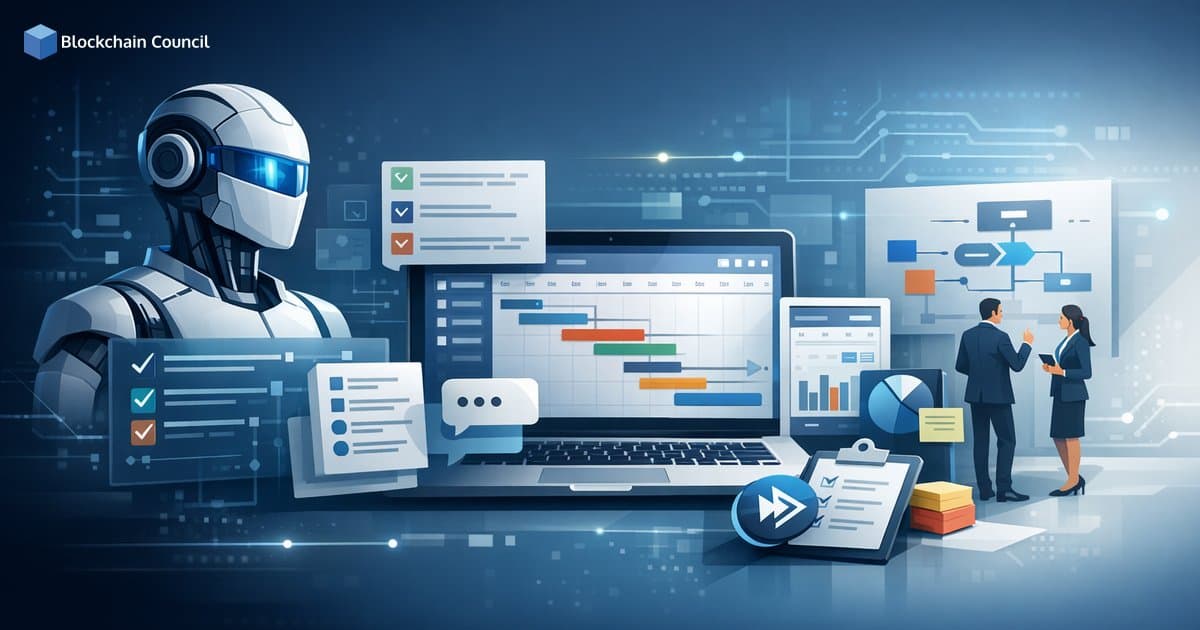
Building an AI project manager workflow is becoming a practical advantage for teams that need faster delivery without sacrificing governance. Rather than treating AI as a conversational assistant, modern organizations are implementing AI as a predictive and automated layer across planning, execution, communication, and reporting. AI project management has moved beyond static task tracking into proactive systems that forecast risk, optimize resources, and automate routine coordination.
This guide explains how to build an AI project manager workflow using the right tools, repeatable prompts, and ready-to-use templates. It is designed for professionals and teams who want an implementation blueprint they can apply in weeks, not quarters.

What an AI Project Manager Workflow Actually Is
An AI project manager workflow is a structured operating model where AI supports or executes parts of the project lifecycle. Modern AI project management software generally improves delivery through three core capabilities:
Unified platform architecture to centralize work, data, and collaboration across departments
Intelligent automation to handle repetitive tasks like triage, categorization, summaries, and routing
Proactive management using predictive analytics to surface risks, bottlenecks, and capacity issues early
The goal is not to remove human decision-making. The goal is to reduce manual oversight and increase the signal-to-noise ratio in day-to-day project operations.
Core Capabilities to Build Into Your AI Project Manager Workflow
1) Predictive Analytics and Risk Forecasting
Leading tools use historical and real-time data to forecast delays, identify emerging bottlenecks, and predict likely outcomes. In practice, this means teams can act preemptively by adjusting scope, reallocating resources, or escalating risks before deadlines slip.
2) Autonomous Workflow Automation
Many platforms now support autonomous agents that can execute multi-step tasks independently, such as:
Triaging emails, chat messages, and incoming tasks continuously
Generating task summaries and suggesting next steps from updates
Drafting meeting notes and follow-up emails based on board activity
Categorizing requests by type, urgency, or sentiment
Extracting key data from PDFs, documents, and images
This is where teams often see the largest time savings, as communication overhead and administrative work are reduced significantly.
3) Dynamic Resource Management and Capacity Planning
AI-powered resource optimization analyzes workloads and recommends distribution changes to prevent overloads and reduce lead times. A related capability is capacity forecasting, where AI predicts future availability based on current commitments so staffing gaps are visible before a project begins.
4) Intelligent Task Prioritization
Rather than a static plan that quickly becomes outdated, AI-driven prioritization adjusts task order based on resource availability, project status, and organizational goals. This reduces context switching and multitasking inefficiency across teams.
Tool Stack: Platforms to Consider
When building an AI project manager workflow, select tools based on your delivery model and integration requirements. A common pattern is one primary work management platform combined with an automation layer for cross-tool orchestration.
Wrike: AI agents and an agent builder for multi-step autonomous execution, suitable for enterprise and PMO teams
Asana: AI Studio for no-code autonomous workflows, well-suited for cross-functional, goal-driven work
ClickUp: Super Agents that triage communications and tasks, helpful for reducing tool sprawl
Epicflow: Predictive analytics and load balancing for complex multi-project environments
Motion: Intelligent daily calendar reprioritization for individuals and small teams
Taskade: AI Project Studio that converts prompts into project structures, useful for remote-first and creative teams
Zapier: Integration platform with broad connectivity and AI automation for cross-tool handoffs
Teams implementing AI-driven workflows often benefit from foundational training in AI strategy and governance. Blockchain Council programs such as the Certified AI Professional (CAIP) and the Certified Prompt Engineer certification cover the skills needed to standardize prompts, apply governance guardrails, and deploy AI responsibly across project environments.
A Practical AI Project Manager Workflow (End-to-End)
Use the workflow below as a baseline, then tailor it to your domain - whether software, marketing, operations, or PMO.
Step 1: Intake and Triage (AI-Assisted)
Objective: convert scattered requests from email, forms, and chat into structured work items with minimal human effort.
AI categorizes requests by type, urgency, and sentiment
AI extracts key details from briefs, attachments, and PDFs
AI routes items to the right queue or owner based on defined rules
Output: a clean backlog with consistent fields covering problem, goal, constraints, deadline, stakeholders, and acceptance criteria.
Step 2: Planning and Scope Definition (AI-Assisted)
Objective: generate a first-pass project structure, then refine it with human oversight.
AI proposes a work breakdown structure and milestones
AI drafts a RACI suggestion based on roles and historical patterns
AI highlights missing requirements and ambiguous language
Output: a project plan that is 60 to 80 percent complete before the kickoff meeting.
Step 3: Execution and Autonomous Coordination (AI Plus Humans)
Objective: reduce coordination overhead while keeping delivery aligned.
AI drafts standup summaries from updates and tickets
AI suggests next actions when dependencies are blocked
AI creates follow-up messages and status notes from board activity
Output: less time spent chasing updates, more time available for resolving constraints.
Step 4: Risk, Capacity, and Prioritization (AI-Driven Signals)
Objective: detect delivery threats early and respond with clear options.
Predictive analytics flags likely schedule slippage and bottlenecks
AI recommends resource shifts to prevent overload
AI reprioritizes tasks based on goals and capacity changes
Output: proactive interventions rather than last-minute escalations.
Step 5: Reporting and Stakeholder Communication (AI-Generated Drafts)
Objective: produce accurate, consistent reporting with minimal manual effort.
AI generates weekly status reports and executive summaries
AI produces decision logs and change summaries
Dashboards aggregate multi-project visibility in real time
Output: stakeholders receive clear updates while teams avoid repetitive administrative work.
Prompt Library: Reusable Prompts for AI Project Managers
Standardized prompts are the fastest way to operationalize an AI project manager workflow. Use the following as a starting prompt pack and store them in your PM tool, documentation hub, or an internal prompt repository.
Prompt 1: Intake to Structured Ticket
Prompt: Convert this request into a structured work item. Include: goal, background, scope, out of scope, key requirements, assumptions, dependencies, risks, stakeholders, deadline, acceptance criteria, and suggested priority. Request text: [paste]
Prompt 2: Work Breakdown and Milestone Plan
Prompt: Create a work breakdown structure with milestones and deliverables for this project. Include estimated effort ranges, dependencies, and a critical path assessment. Project brief: [paste]
Prompt 3: Risk Register Draft
Prompt: Draft a risk register for this project. For each risk include: description, likelihood, impact, early warning signals, mitigation, contingency, and owner role. Context: [paste]
Prompt 4: Meeting Notes to Actions
Prompt: Turn these meeting notes into: decisions, action items with owners, due dates (if stated), open questions, and follow-ups. Notes: [paste]
Prompt 5: Weekly Status Report
Prompt: Write a weekly project status update for executives. Include: accomplishments, plan for next week, top risks, key decisions needed, and metrics. Use concise bullets. Source updates: [paste]
Organizations formalizing prompt standards can benefit from role-based enablement. Blockchain Council's Certified Prompt Engineer certification provides training in prompt design, safety, and reusable prompt patterns that translate directly to consistent AI output quality in project environments.
Templates You Can Standardize Across Teams
Templates make AI outputs easier to validate and compare across projects. The following lightweight standards provide a practical starting point.
Template 1: One-Page Project Brief
Problem statement
Business goal and success metrics
Scope and constraints
Stakeholders and RACI
Timeline and milestones
Risks and assumptions
Template 2: RAID Log (Risks, Assumptions, Issues, Dependencies)
Item (R/A/I/D)
Description
Owner
Status
Next action
Due date
Template 3: Change Request Summary
Change description
Reason and urgency
Impact on scope, time, cost, and risk
Options (accept, defer, reject)
Decision and approver
Governance and Safety: Keeping Humans in Control
AI improves delivery only when teams define clear boundaries. Implement these controls early in the workflow design process:
Human approval gates for scope changes, stakeholder communications, and commitments
Data handling rules for confidential content, client information, and regulated data
Prompt and template standards to maintain consistent outputs across teams
Auditability by logging AI-generated decisions, summaries, and changes
For organizations aligning AI adoption with security and compliance requirements, Blockchain Council's Certified AI Professional (CAIP) program covers governance frameworks, risk management, and responsible deployment practices applicable to project and portfolio environments.
Conclusion: A Faster Delivery System, Not Just a Smarter Tool
Building an AI project manager workflow is best approached as an operating system upgrade: unify work and data, automate repetitive coordination, and act on proactive risk and capacity signals. With the right platform combination, a standardized prompt library, and a small set of templates, teams can reduce manual overhead, improve visibility, and deliver faster with fewer surprises.
Start with high-impact, low-complexity improvements: implement AI intake triage, automate weekly reporting, and add a risk register prompt. From there, expand into agentic automation and predictive resource optimization as data quality and governance practices mature. The result is a workflow that scales across projects and portfolios while keeping decision-making where it belongs - with accountable humans.
Related Articles
View All
AI & ML
From DGX to Data Center: Building an NVIDIA-Powered AI Infrastructure for Scale
Learn how to scale NVIDIA AI infrastructure from DGX Station and DGX Spark to rack-scale GB300 and Rubin systems with networking, cooling, and colocation best practices.

AI & ML
Best Certifications and Learning Paths for High-Paying AI Jobs (With Portfolio Project Ideas)
Explore the best certifications and learning paths for high-paying AI jobs in 2026, plus role-based roadmaps and portfolio project ideas for ML, MLOps, GenAI, and governance.

AI & ML
AI in Agile Project Management
Learn how AI in Agile project management improves sprint planning, backlog prioritization, and retrospectives with predictive insights, automation, and action recommendations.
Trending Articles
The Role of Blockchain in Ethical AI Development
How blockchain technology is being used to promote transparency and accountability in artificial intelligence systems.
AWS Career Roadmap
A step-by-step guide to building a successful career in Amazon Web Services cloud computing.
Top 5 DeFi Platforms
Explore the leading decentralized finance platforms and what makes each one unique in the evolving DeFi landscape.