
Best Certifications and Learning Paths for High-Paying AI Jobs (With Portfolio Project Ideas)


Best certifications and learning paths for high-paying AI jobs in 2026 are no longer about collecting course completions. Enterprises are rewarding professionals who can build, deploy, monitor, and govern AI systems in production. Top-paying roles commonly fall in the $130,000 to $225,000+ range, with the highest compensation tied to specialized domains like MLOps, AI governance, and cloud AI engineering.
This guide breaks down the best certifications by role, practical learning paths, and portfolio project ideas that hiring teams recognize as proof of real-world capability.

Why certifications alone are not enough in 2026
Hiring managers increasingly screen for evidence that candidates can take an AI system from prototype to production. Your certification choices should map directly to job responsibilities such as:
Production deployment (APIs, batch inference, scalable serving)
Monitoring and reliability (drift detection, performance tracking, cost controls)
Security and privacy (data protection, access controls)
Governance (model lineage, bias reviews, compliance readiness)
The highest ROI comes from vendor-recognized certifications paired with portfolio projects that demonstrate implementation depth rather than theoretical study alone.
Best certifications for high-paying AI roles
1) Enterprise-scale ML engineering
These credentials align with ML engineer and cloud AI engineer roles where salaries typically start in the low-to-mid $100,000s and scale with production ownership.
Google Professional Machine Learning Engineer: Covers end-to-end ML solution design, feature engineering, training, deployment, and monitoring. This certification is widely regarded as a high-ROI option given its modest exam cost and strong market recognition.
AWS Certified Machine Learning - Specialty: Validates the ability to select ML approaches, build data pipelines, train and tune models, and deploy using AWS services including SageMaker, with attention to security and performance.
Microsoft Certified Azure AI Engineer Associate (AI-102): Demonstrates practical ability to build and deploy AI solutions on Azure, making it attractive to developers and cloud engineers working in Microsoft-heavy enterprise environments.
For structured preparation across AI fundamentals, model development, and deployment, Blockchain Council offers programs such as the Certified AI Engineer and platform-focused AI specialization tracks that complement vendor certification study.
2) MLOps and AI infrastructure engineering
MLOps and infrastructure roles are among the best-compensated in the field because they address a core enterprise bottleneck: many AI prototypes never reach reliable production. Mid-level compensation for practitioners who can operationalize models is commonly reported in the $172,000 to $198,000 range.
Cisco Certified AI Infrastructure Specialist: Provides foundational knowledge around AI infrastructure concepts, particularly useful for professionals moving toward production platforms and enterprise operations.
Pairing a platform certification with an MLOps-focused credential, such as Blockchain Council's Certified MLOps Professional program, strengthens coverage of CI/CD pipelines, observability, and lifecycle automation.
3) AI governance and responsible AI
AI governance has shifted from a compliance checkbox to a board-level priority. Specialized practitioners who can operationalize responsible AI, model risk management, and compliance readiness can command $225,000+ in many markets, particularly in regulated industries such as finance, healthcare, and insurance.
Certified AI Governance Professional (CAGP): Focuses on governance implementation, risk controls, and organizational oversight.
IAPP AI governance certifications: Align well with privacy, GRC, legal, and compliance professionals working with AI policy and operational controls.
Governance professionals also benefit from adjacent training in security and compliance. Blockchain Council certifications such as Certified Blockchain and Cybersecurity Professional or an AI and data privacy learning track can round out technical and risk fundamentals effectively.
4) Generative AI development (platform-specialized)
Generative AI roles are becoming more specialized, particularly when tied to enterprise deployment patterns such as retrieval-augmented generation (RAG), evaluation frameworks, and cost governance.
AWS GenAI Developer Professional: A leading credential for developers building generative AI solutions within AWS ecosystems.
A strong portfolio in this area goes beyond prompt experiments. Employers want to see RAG systems, evaluation harnesses, and secure deployment configurations.
University-level AI programs: when they make sense
Prestige programs such as the Stanford AI Graduate Certificate and the MIT Professional Certificate in Machine Learning can be valuable for mid-to-senior professionals aiming to lead AI initiatives and signal technical depth. Both typically require a substantial time commitment of around one year and significant financial investment, often in the five-figure range.
These programs are best suited for professionals who already have strong fundamentals and need structured, academically rigorous coverage to support leadership or architecture-level responsibilities.
Cost-effective entry path for career switchers
For beginners or career switchers, the IBM AI Engineering Professional Certificate is frequently cited as a strong ROI option due to its low monthly cost and hands-on capstone projects. It is particularly useful for building early portfolio artifacts while learning core ML workflows.
A practical approach is to complete foundational projects through this program and then pursue a vendor credential such as Google or AWS once you are comfortable with the full ML lifecycle.
Role-based learning paths (with timelines)
Most professionals can make meaningful progress with 10 to 15 hours per week. Budget 3 to 6 months of consistent study plus portfolio development per major step.
Learning path A: Career switcher to ML engineer
Foundation (6 to 9 months part-time): IBM AI Engineering Professional Certificate plus 2 portfolio projects
Production validation (3 to 5 months): Google Professional Machine Learning Engineer certification
Specialization (optional): MLOps foundations or a cloud AI deployment track
Learning path B: Experienced software engineer to cloud AI engineer
Baseline ML and deployment: Build and deploy one end-to-end model API
Vendor certification: AWS Certified Machine Learning - Specialty or Azure AI-102
Portfolio hardening: Add monitoring, CI/CD, security controls, and cost optimization
Learning path C: Business, GRC, or legal professional to AI governance specialist
Core governance credential: CAGP or an IAPP AI governance certification
Applied governance portfolio: Model inventory, risk assessments, and audit-ready documentation
Technical fluency add-on: Lightweight ML and data fundamentals plus security basics
Portfolio project ideas that employers value
A strong portfolio demonstrates that you can deliver outcomes under real-world constraints: messy data, monitoring requirements, access control, and clear documentation. The following project ideas are organized by experience level.
Foundation projects (entry level)
End-to-end ML pipeline from an open dataset: data cleaning, feature engineering, model training, and evaluation with reproducible notebooks.
Model served as an API: deploy a classifier using FastAPI or Flask, with input validation, error handling, and a simple frontend.
Generative AI mini-app: build a prompt-based assistant for a narrow task, add guardrails, and document failure modes.
Intermediate projects (Google, AWS, Azure level)
RAG system with a vector database: ingest documents, define a chunking strategy, generate embeddings, and return grounded responses using Pinecone or Weaviate.
Experiment tracking and data versioning: implement MLflow or an equivalent tool, track metrics, and demonstrate reproducible runs.
Cloud deployment with CI/CD: train a model, deploy to a managed cloud service, and automate builds and deployments with a pipeline.
Monitoring and drift detection: define service level indicators, log predictions, and detect data or concept drift with automated alerts.
Advanced projects (MLOps, infrastructure, governance)
AI governance framework implementation: produce model cards, lineage documentation, bias testing results, and an audit-ready approval workflow.
Multi-model serving platform: design infrastructure supporting multiple concurrent deployments, rollback capabilities, canary releases, and cost controls.
AI security and privacy implementation: threat model your system, implement access controls, protect sensitive data, and document adversarial considerations.
Automated retraining pipeline: schedule retraining with validation gates that promote models to production only when performance and bias thresholds are met.
How to choose the right certification for your target AI job
Use these criteria to avoid mismatched credentials:
Match the platform to your market: if local employers are AWS-heavy, prioritize AWS credentials. Apply the same logic for Google Cloud or Azure environments.
Prioritize production proof: choose certifications that assess deployment, monitoring, and operations rather than theory alone.
Stack credentials deliberately: foundational AI plus a vendor platform credential plus a specialization in MLOps or governance tends to align well with enterprise hiring patterns.
Build portfolio evidence in parallel: every certification milestone should produce a project artifact, not just study notes.
Conclusion: the most effective path to high-paying AI roles
The best certifications and learning paths for high-paying AI jobs in 2026 share a common theme: production readiness. Vendor-recognized certifications from Google, AWS, and Azure validate platform competence, while specialized tracks in MLOps and AI governance increasingly command premium compensation because they address enterprise priorities around reliability, safety, and regulatory compliance.
To maximize career outcomes, combine a role-aligned certification plan with 2 to 4 portfolio projects that demonstrate deployment, monitoring, documentation, and governance capabilities. Blockchain Council certification pathways in AI engineering, MLOps, and AI governance and security offer structured, stackable options for professionals at every stage of this journey.
Related Articles
View All
AI & ML
AI Career Paths Explained: Machine Learning Engineer vs Data Scientist vs MLOps Engineer
AI career paths explained: compare machine learning engineer vs data scientist vs MLOps engineer, including responsibilities, skills, entry paths, and future trends.
AI & ML
Top AI Certifications for Remote Jobs in 2026
Remote work is no longer just a trend — it’s the future of employment. With companies across the world hiring remote talent, there’s an urgent need for professionals to upskill and stay competitive. Among the most in-demand remote-ready skills today is artificial intelligence. But how do you prove…

AI & ML
How to Start a Career in AI in 2026: Skills, Roles, and a 90-Day Learning Roadmap
Learn how to start a career in AI in 2026 with in-demand skills, key roles, and a practical 90-day roadmap covering ML, GenAI, RAG, agents, and MLOps.
Trending Articles
The Role of Blockchain in Ethical AI Development
How blockchain technology is being used to promote transparency and accountability in artificial intelligence systems.
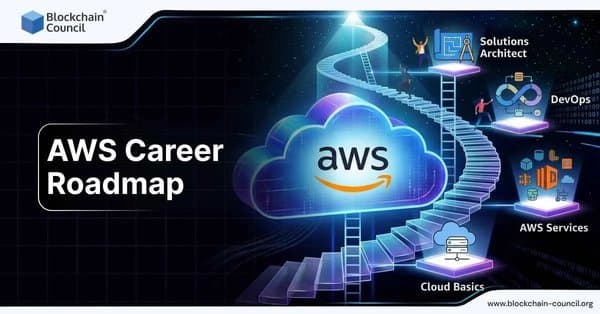
AWS Career Roadmap
A step-by-step guide to building a successful career in Amazon Web Services cloud computing.
Top 5 DeFi Platforms
Explore the leading decentralized finance platforms and what makes each one unique in the evolving DeFi landscape.