

AI Engineer vs Machine Learning Engineer vs Data Scientist
 Suyash Raizada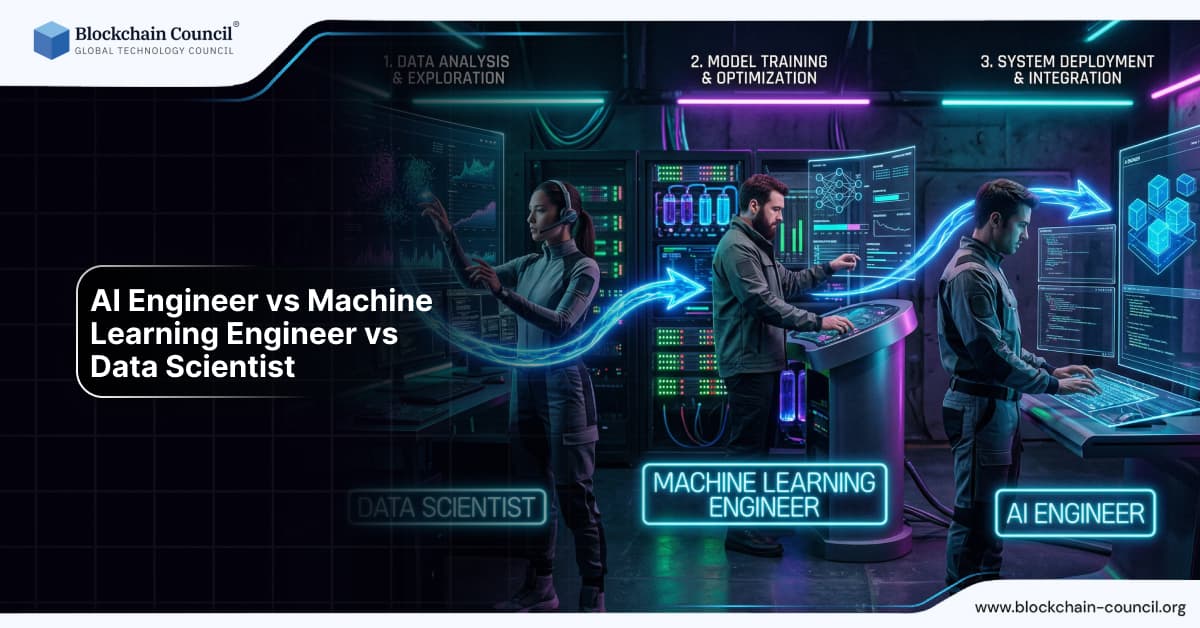
AI Engineer vs Machine Learning Engineer vs Data Scientist is one of the most common comparisons professionals make when planning an AI career. While these roles overlap in smaller teams, they typically map to different phases of an AI workflow: Data Scientists turn data into insights and decisions, Machine Learning Engineers turn models into reliable production systems, and AI Engineers build and deploy LLM-powered applications and agentic features.
This guide breaks down key differences, day-to-day responsibilities, skills, tools, salary benchmarks, and practical career paths to help you identify the role that best matches your strengths and goals.

Each role requires different strengths across data pipelines, model training, and deployment systems-build this understanding with an AI certification, develop coding skills using a Python Course, and explore real-world use cases via an AI powered marketing course.
High-Level Differences Across the AI Workflow
Modern AI delivery follows a pipeline: data and questions come first, then modeling and experimentation, then production systems, and finally product integration and iteration at scale. These roles generally align as follows:
Data Scientist: focuses on insights, experiments, and translating business questions into measurable analyses.
Machine Learning Engineer: focuses on operationalizing models with scalable pipelines, monitoring, and reliable serving.
AI Engineer: focuses on generative AI products, especially LLM applications, retrieval-augmented generation (RAG), and agents integrated into workflows.
In early-stage startups or smaller organizations, one person may cover all three areas. In mature teams, responsibilities diverge because each area requires depth in distinct skill sets.
Role-by-Role Breakdown
Data Scientist: Insights, Experiments, and Decision Support
A Data Scientist is often closest to business outcomes. The core job is to ask "why is this happening?" and "what should we do next?" using data, experiments, and statistical reasoning.
Typical responsibilities:
Exploratory data analysis (EDA), data cleaning, and feature exploration
Hypothesis testing, A/B testing, and experiment design
Causal inference and quasi-experimental approaches where applicable
Building prototypes that demonstrate predictive or explanatory value
Communicating findings to stakeholders through narratives, dashboards, and clear recommendations
Common outputs: reports, dashboards, analysis notebooks, experimental readouts, and early prototypes that may later be handed to engineering for productionization.
Machine Learning Engineer: Production ML Systems and MLOps
A Machine Learning Engineer (MLE) bridges the gap between a promising model and a dependable production service. This role exists because the real challenge is often not training a model once, but maintaining it under changing data distributions and real-world operational constraints.
Typical responsibilities:
Building training pipelines and automated retraining workflows
Model versioning, data lineage, and reproducible experiments
Scalable serving (batch and real-time) and latency optimization
Monitoring for data drift, performance decay, and operational incidents
Deploying to cloud infrastructure using containers and orchestration tools
Common outputs: model APIs, end-to-end ML pipelines, monitoring dashboards, deployment configurations, and incident runbooks. In many organizations, MLEs are on call for production issues.
AI Engineer: LLM Applications, RAG, Agents, and Product Integration
An AI Engineer focuses on shipping user-facing generative AI capabilities. With widespread LLM adoption, the core work centers on product iteration: prompt and system design, retrieval, evaluation, and governance aligned to enterprise requirements.
Typical responsibilities:
Building LLM-powered applications such as copilots, chatbots, and automation tools
Designing RAG pipelines, including chunking strategies, embeddings, and retrieval logic
Building agentic workflows that use tools, function calling, and multi-step reasoning
Evaluating output quality with task-specific metrics, including hallucination and faithfulness checks
Integrating with product systems, identity management, logging, security, and governance processes
Common outputs: AI features embedded into products, LLM services, agent workflows, evaluation harnesses, and enterprise-ready controls such as privacy safeguards and auditability mechanisms.
Skills and Tools: What You Actually Need
Core Skills by Role
Data Scientist: statistics, probability, SQL, experimentation design, data visualization, and stakeholder communication. Python and R are common, with emphasis on analysis rather than deployment.
Machine Learning Engineer: software engineering fundamentals, production Python, testing practices, CI/CD, distributed systems, and MLOps. A solid understanding of ML theory helps, but reliability and scalability typically define success.
AI Engineer: LLM APIs and orchestration frameworks, RAG architecture, fine-tuning concepts, evaluation strategies, and product integration. Comfort with rapid prototyping alongside production constraints is essential.
Common Toolchains
Data Scientist tools: Jupyter notebooks, pandas, SQL, Tableau or comparable BI tools, and scikit-learn for baseline models.
ML Engineer tools: PyTorch, Apache Spark, Kubernetes, MLflow, feature stores, pipeline orchestration tools, and monitoring stacks.
AI Engineer tools: LangChain and similar orchestration frameworks, vector databases such as Pinecone or Weaviate, the Hugging Face ecosystem, and structured evaluation tooling.
Overlap areas are common: Data Scientists and MLEs both perform feature engineering; Data Scientists and AI Engineers both prioritize evaluation and quality measurement; all three roles contend with data quality challenges.
Salary Benchmarks and Market Realities (2025-2026)
Compensation varies by region, seniority, and employer type, but current market patterns show consistent trends:
Data Scientist: US total compensation typically ranges from $115,000 to $175,000.
Machine Learning Engineer: US total compensation typically ranges from $160,000 to $230,000, reflecting a 15-40% premium over Data Scientist roles due to the scarcity of production ML skills.
AI Engineer: US total compensation typically ranges from $150,000 to $250,000, with some senior or specialized roles at top-tier companies exceeding that range depending on scope and market.
Fully remote roles exist but remain a minority of total job postings. Hybrid arrangements are more common, particularly in enterprise environments where governance and data access requirements favor in-person or on-site presence.
Real-World Use Cases: What Each Role Builds
Data Scientist: sales forecasting dashboards, customer segmentation analyses, experiment readouts for product changes, and funnel analyses tied to business KPIs.
Machine Learning Engineer: scalable recommendation systems, automated fraud detection pipelines, computer vision services with monitoring and retraining, and low-latency model serving infrastructure.
AI Engineer: enterprise knowledge assistants using RAG, support chatbots with output guardrails, internal copilots with role-based access controls, and agent workflows that draft, review, and route tasks across business tools.
Some teams blend responsibilities under titles like Applied Scientist, particularly in large technology organizations where prototyping and production requirements are tightly coupled.
Career Paths and How to Transition Between Roles
Common Entry Points
Data Scientist: often entered through statistics, analytics, or business intelligence backgrounds combined with Python and SQL proficiency. A strong option for those who enjoy framing questions, running experiments, and communicating data-driven decisions.
Machine Learning Engineer: often entered through software engineering combined with ML coursework, or through a Data Scientist path that progressively takes on deployment and MLOps responsibilities.
AI Engineer: often entered through Python engineering combined with hands-on LLM projects covering RAG, agents, and evaluations. Many practitioners transition from full-stack or ML engineering roles as generative AI features become product priorities.
Practical Transition Routes
Data Scientist to Machine Learning Engineer: build software engineering rigor (testing, API development), learn MLOps fundamentals (versioning, pipelines, monitoring), and ship at least one model end to end in a production environment.
Data Scientist to AI Engineer: apply existing evaluation strengths, then learn RAG design, prompt engineering, and tool-calling patterns. Build a production-style LLM application with measurable quality benchmarks.
Machine Learning Engineer to AI Engineer: reuse infrastructure and reliability skills, then focus on LLM product patterns, retrieval systems, and governance requirements. This path is particularly strong in enterprises where compliance and operational reliability are priorities.
How to Choose the Right Role
These questions can help clarify which path fits best:
If you enjoy explaining outcomes and running experiments, Data Science is often the best match.
If you enjoy building reliable systems and scaling predictions, Machine Learning Engineering is a natural fit.
If you enjoy shipping user-facing generative AI features, AI Engineering is likely the best choice, particularly if you prefer fast iteration and close collaboration with product teams.
Generative AI adoption is accelerating demand for AI Engineers, while MLE demand remains strong wherever production ML systems are central to business operations. Data Science continues to evolve toward AI-adjacent strategy, experimentation, and decision intelligence functions.
Choosing the right path depends on strengths in modeling, infrastructure, or analytics-develop these capabilities with an Agentic AI Course, deepen ML expertise via a machine learning course, and align skills with industry demand through a Digital marketing course.
Conclusion
The difference between an AI Engineer, Machine Learning Engineer, and Data Scientist is best understood through the outcomes each role produces. Data Scientists drive decisions through analysis and experimentation. ML Engineers turn models into reliable, maintainable production systems. AI Engineers ship LLM-powered products and intelligent agents. As organizations deepen their adoption of generative AI, role boundaries may shift, but the underlying skill demands remain distinct.
Choose the path that aligns with what you want to build, then develop fluency in the adjacent skills that enable effective cross-functional collaboration. In modern AI organizations, the strongest career trajectories typically belong to those who achieve depth in one role while understanding the constraints and priorities of the other two.
FAQs
1. What is the difference between an AI engineer, machine learning engineer, and data scientist?
An AI engineer builds and deploys AI systems, a machine learning engineer focuses on model development and optimization, and a data scientist analyzes data to generate insights. Their responsibilities overlap but differ in focus. Each role supports different stages of the AI lifecycle.
2. What does an AI engineer do?
AI engineers design, develop, and integrate AI solutions into applications. They work on deployment, scalability, and system performance. Their role is more product and system-oriented.
3. What is the role of a machine learning engineer?
Machine learning engineers build, train, and optimize models for production use. They focus on performance, accuracy, and scalability. They also manage pipelines and model lifecycle.
4. What does a data scientist do?
Data scientists analyze data to extract insights and build predictive models. They focus on statistics, data exploration, and visualization. Their work supports decision-making.
5. Which role is best for beginners in AI?
Data science is often the most accessible entry point. It requires less system-level knowledge initially. However, strong fundamentals are needed for all roles.
6. What skills are required for an AI engineer?
Skills include programming, system design, cloud platforms, and AI frameworks. Knowledge of deployment and APIs is important. They must understand how to integrate models into applications.
7. What skills are needed for a machine learning engineer?
Machine learning engineers need strong coding skills, model training expertise, and knowledge of frameworks like TensorFlow or PyTorch. They also work with data pipelines. Optimization and scaling are key.
8. What skills are essential for data scientists?
Data scientists require skills in statistics, data analysis, and visualization tools. Python or R is commonly used. Communication skills are important for presenting insights.
9. Which role pays more: AI engineer, ML engineer, or data scientist?
AI engineers and ML engineers often earn higher salaries due to their technical complexity. Data scientists also earn competitive salaries. Pay depends on experience and location.
10. What tools do AI engineers use?
AI engineers use tools like TensorFlow, PyTorch, Docker, and cloud platforms. They also work with APIs and deployment tools. Their focus is on production systems.
11. What tools do machine learning engineers use?
They use ML frameworks, data processing tools, and MLOps platforms. Tools like Kubernetes and TensorRT are common. Their work emphasizes model performance.
12. What tools do data scientists use?
Data scientists use tools like Python, R, SQL, and visualization libraries. They also use notebooks and analytics platforms. Their focus is on data exploration.
13. How do responsibilities differ across these roles?
AI engineers focus on system integration, ML engineers on model development, and data scientists on analysis. Each role contributes to different stages. Collaboration is common.
14. Which role requires more coding?
Machine learning engineers and AI engineers require more coding. Data scientists also code but focus more on analysis. Coding depth varies by role.
15. Is MLOps important for these roles?
MLOps is critical for ML engineers and AI engineers. It ensures models are deployed and maintained effectively. Data scientists may interact with MLOps but less directly.
16. Which role involves more mathematics?
Data scientists and ML engineers rely heavily on statistics and math. AI engineers use math but focus more on implementation. Advanced roles require deeper knowledge.
17. Can you transition between these roles?
Yes, many professionals move between these roles. Skills often overlap, making transitions possible. Additional training may be required.
18. What industries hire these professionals?
Industries include tech, healthcare, finance, and retail. AI adoption is widespread. Demand exists across multiple sectors.
19. How do hiring managers differentiate between these roles?
They look at project experience, technical depth, and focus areas. Job descriptions often specify required skills. Clear specialization helps candidates stand out.
20. Which role has the best long-term career growth?
All three roles offer strong growth opportunities. AI and ML engineering roles may grow faster due to demand. Career growth depends on skills and adaptability.
Related Articles
View All
AI & ML
AI Explained: From Machine Learning to Generative AI
AI Explained in simple terms. Learn the differences between AI, machine learning, and deep learning, how neural networks and LLMs work, and how generative and multimodal AI create content.
AI & ML
Jev vs Machine Learning Models
Compare Jev with traditional machine learning models, including differences in architecture, outputs, training, decision-making, automation, and real-time software use.
AI & ML
AI Models for Machine Decision Making
Explore how AI models support machine decision making through classification, prediction, scoring, optimization, and probabilistic reasoning across automated systems.
Trending Articles

Top 5 DeFi Platforms
Explore the leading decentralized finance platforms and what makes each one unique in the evolving DeFi landscape.
How Blockchain Secures AI Data
Understand how blockchain technology is being applied to protect the integrity and security of AI training data.
What is AWS? A Beginner's Guide to Cloud Computing
Everything you need to know about Amazon Web Services, cloud computing fundamentals, and career opportunities.