

AI Video Generator vs AI Production Platform
 Michael Willson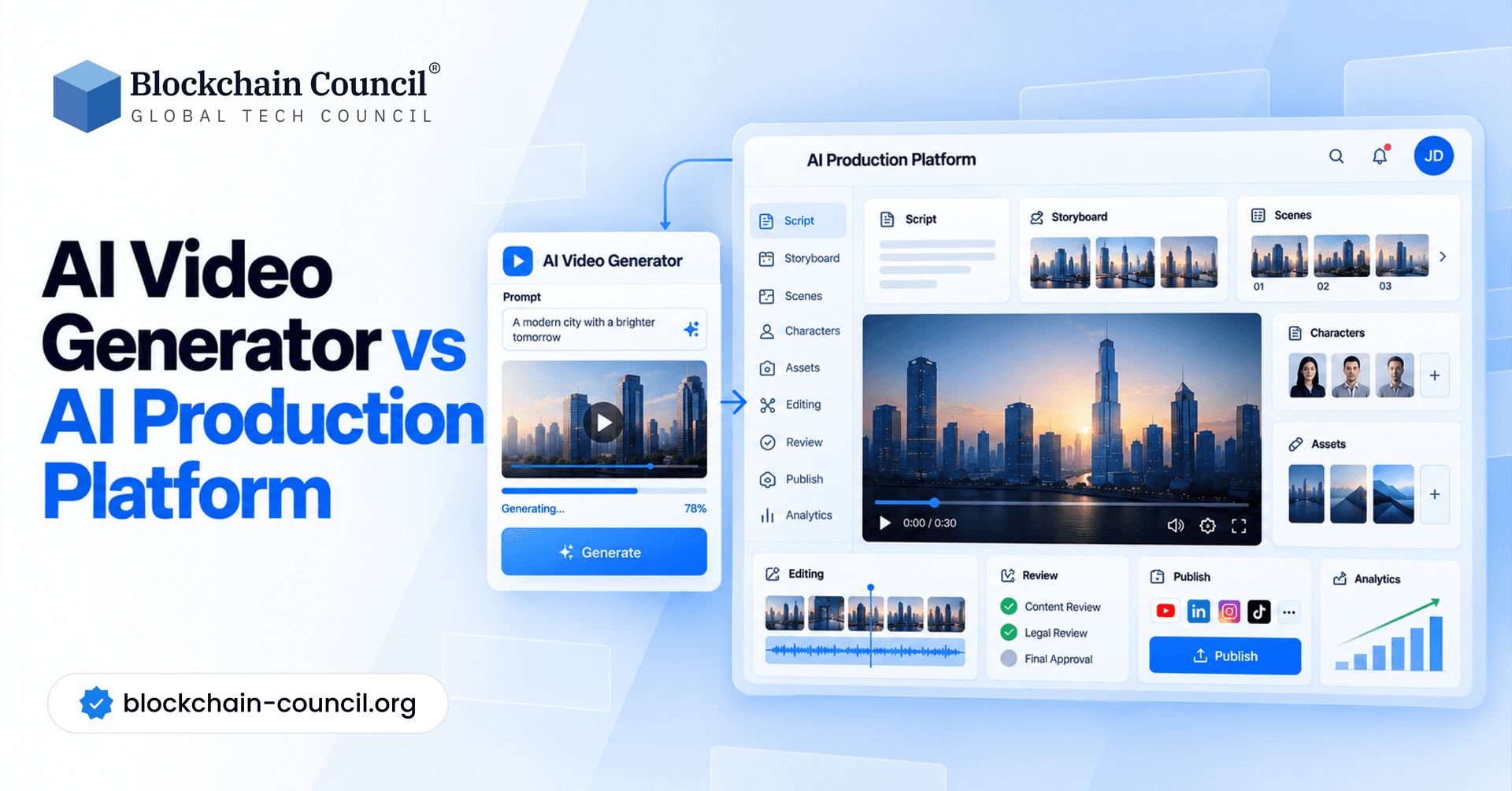
AI Video Generator vs AI Production Platform
Creating one AI video is becoming easier.

A prompt, a script or an image can now become a video without the production process that would traditionally involve cameras, locations, actors, editors and multiple rounds of post-production.
But there is a different question worth asking.
What happens when you need to create 50 videos instead of one?
Or a 10-episode series?
Or the same campaign in Hindi, Telugu and Tamil?
Or hundreds of videos that need to follow the same brand guidelines?
At that point, the challenge changes.
It is no longer only about generating video. It becomes a question of production management.
This is the key difference between an AI video generator and an AI production platform.
What Is an AI Video Generator?
An AI video generator is a tool that uses artificial intelligence to create video from inputs such as text, images, scripts or other creative instructions.
A typical process might look like:
Prompt → AI generation → Video
For a creator who needs a quick social video, visual concept or short clip, this can be extremely useful.
AI video generators can help with:
Text-to-video creation
Image-to-video generation
Short-form videos
Social media content
Creative concepts
Product visuals
Video experiments
Story ideas
The main advantage is speed.
A creator can move from an idea to a visual output without setting up a traditional production process.
But speed creates another challenge.
When the number of videos increases, managing those videos becomes harder.
What Is an AI Production Platform?
An AI production platform looks at the entire production process rather than only the generated video.
Instead of asking:
"Can AI create this video?"
It also asks:
What is the approved story?
Which characters should remain consistent?
Which brand guidelines apply?
Who needs to approve the content?
Which assets can legally be used?
Which language versions are required?
Which version is final?
Where is the content going?
How did the content perform?
This makes an AI production platform a broader system for managing AI-native content production.
A simplified workflow can look like:
Greenlight → Creative development → Production → AI generation → Human approval → Rights → Localization → Performance → Delivery
The AI video generator is part of this workflow.
It is not necessarily the whole workflow.
AI Video Generator vs AI Production Platform
The simplest way to understand the difference is this:
AI Video Generator | AI Production Platform |
Creates individual videos | Manages the broader production |
Focuses on generation | Focuses on production workflow |
Prompt or input driven | Project and workflow driven |
Useful for individual assets | Designed for campaigns and series |
Limited project context | Maintains creative context |
Generation focused | Generation + approvals + rights + delivery |
Usually asset focused | Production lifecycle focused |
Neither approach is automatically right for every project.
If you need one video occasionally, a generator may be all you need.
If you are running an ongoing content operation, the production layer becomes much more important.
When an AI Video Generator Is Enough
There are many situations where a standalone AI video generator makes sense.
For example, a creator might need:
One Instagram video
A quick concept for a presentation
A visual experiment
A short product clip
A social media post
A proof of concept
In these cases, the workflow is relatively simple.
You provide an input, generate the video, review it and publish it.
There is no reason to introduce a complex production system if the production itself is simple.
The problem appears when content volume, teams, languages and approvals increase.
When an AI Production Platform Becomes Important
Imagine a company needs 100 videos for a campaign.
The videos need to follow the same visual identity.
The product needs to look consistent.
The messaging needs to remain approved.
Several people need to review the content.
The campaign needs versions in multiple languages.
Some assets have specific rights and usage conditions.
Now the problem is much bigger than video generation.
The team needs to know which version is approved, which assets were used, who reviewed them and which language version is ready.
This is where AI production management becomes important.
The production platform becomes the layer that keeps the different pieces connected.
The Consistency Problem
Consistency is one of the biggest challenges when AI video production scales.
Consider a brand creating 100 AI-generated advertisements.
The first video uses one version of the product.
The second has slightly different packaging.
The third uses another visual style.
The fourth has a different tagline.
Individually, each video might look acceptable.
Together, they no longer feel like one campaign.
The same problem can be even more visible in entertainment.
A character appears in Episode 1 with one face and in Episode 6 with another.
The location changes unexpectedly.
A relationship established earlier in the story is suddenly different.
These are not necessarily AI generation problems.
They are production consistency problems.
Creative Canon in AI Production
This is where the concept of a creative canon becomes useful.
A creative canon provides a shared source of truth for a project.
It can contain:
Characters
Character relationships
Storylines
Locations
Visual references
Brand identity
Product details
Tone
Creative rules
Instead of treating every AI generation as a completely new request, the production can refer back to the established creative direction.
This becomes especially valuable for serialized entertainment, microdramas and recurring brand campaigns.
The goal is not to restrict creativity.
It is to make sure that new creative work still belongs to the same project.
Human Approval Still Matters
AI can produce content quickly.
That does not mean every generated output should automatically become the final version.
Businesses may need approval from:
Creative teams
Marketing teams
Brand teams
Legal teams
Regional teams
Production teams
A structured workflow can define where those approvals happen.
For example:
Brief → Creative direction → Script → Storyboard → Production → Final review → Delivery
Each decision can be connected to a specific version.
This is particularly useful when several people are working on the same campaign.
Without version control and approvals, teams can easily end up publishing an older or unapproved version.
Rights Are Part of Production
Rights management is another area where AI video production becomes more complicated at scale.
A video can contain many different assets.
These may include:
Music
Images
Product assets
Voice
Footage
Characters
Creative references
Teams may need to know where an asset came from, how it can be used and where the final content can be distributed.
When this information sits in separate spreadsheets or email threads, it becomes difficult to manage as production grows.
An AI production platform can make rights information part of the production workflow.
This changes rights from a separate administrative task into a production consideration.
Multilingual Production Changes the Workflow
Creating a video in one language is one thing.
Creating the same story for multiple languages is another.
Consider an entertainment series produced in Hindi, Telugu and Tamil.
The production needs more than translated text.
It may require:
Translated dialogue
Voice adaptation
Pronunciation review
Subtitles
Regional references
Language-specific approvals
The underlying story and visual production can remain connected while language tracks are managed separately.
This approach can make multilingual production more structured.
For India, where content can reach audiences across multiple languages, this becomes particularly relevant.
AI Video Generator for Businesses
Businesses are among the biggest potential users of AI video generation.
Marketing teams can use AI for:
Product videos
Advertising
Social media
Brand storytelling
Campaign concepts
Explainer videos
Customer communication
But businesses often need more than a generated clip.
They need repeatability.
They need brand consistency.
They need approvals.
They need rights.
They may need multiple markets and languages.
They also need to know what happened to the content after publication.
This is why an AI video production platform can become more relevant as business content operations grow.
AI Video Generator for Microdramas
Microdramas are another example of where the difference becomes clear.
A microdrama may contain 5, 10 or more connected episodes.
Each episode needs to follow the story.
Characters need to remain consistent.
The visual world needs to remain recognisable.
A standalone AI video generator can help generate individual scenes.
But the production challenge is keeping the entire series connected.
An AI production platform can provide the workflow around those individual generations.
This is one of the areas where Tosheo focuses its AI-native production approach.
Where Tosheo Fits
Tosheo is built around the idea that AI video production should extend beyond generation.
Its positioning is:
The operating system for AI-native production, from greenlight to buyer-ready delivery.
The workflow brings together:
Creative canon + human approvals + rights + multilingual production + measurable performance
This is particularly relevant when a production involves serialized entertainment, branded stories or recurring content.
For example, a microdrama can start with a story idea and move through:
Greenlight → Story → Characters → Creative Canon → Production → Approval → Localization → Performance → Delivery
Instead of managing these stages across disconnected tools, Tosheo is designed around the production workflow itself.
Tosheo begins with Indian-language serialized entertainment and branded stories and is expanding across AI-native media production.
That makes its approach different from simply asking an AI video generator to create another clip.
AI-Native Production Is the Bigger Shift
The AI video generator is changing how individual videos are created.
The next question is how AI changes the entire production system.
AI-native production means designing workflows around AI from the beginning.
It can connect:
Human creativity
AI generation
Creative governance
Production management
Multilingual content
Performance
The result is not simply more AI-generated videos.
It is a different way of operating a content production business.
How to Choose Between an AI Video Generator and an AI Production Platform
The answer depends on what you are actually producing.
Choose an AI video generator when:
You need occasional videos
You are testing an idea
You are creating individual social assets
You have a simple production workflow
You do not need extensive approvals
Consider an AI production platform when:
You are producing content continuously
You are creating campaigns
You are producing serialized stories
Multiple people need to approve content
You need consistent characters or products
You are working across languages
Rights need to be tracked
You need a repeatable production workflow
You want to connect production with performance
The important question is therefore not:
"Which AI video generator is best?"
It is:
"What am I actually trying to produce?"
A single video and a six-month content operation are two very different problems.
What the Future of AI Video Production Looks Like
AI video generation will continue to improve.
Video quality will increase.
Generation will become faster.
Creative control will expand.
But those improvements will also increase the volume of content teams can produce.
And when production volume increases, organisation becomes more important.
The competitive advantage may shift from simply being able to generate a video to being able to manage the entire production lifecycle.
That includes knowing:
What is being produced
Why it is being produced
Which creative direction is approved
Who approved it
Which rights apply
Which languages are ready
Which version is final
How it performed
This is the shift from generating a video to running a production.
Learning Paths for AI Video Production
Understanding the difference between an AI video generator and an AI production platform requires more than learning how to generate video. As AI-native production expands, professionals may also need knowledge of the technologies, emerging tools and business processes that shape modern video production.
Professionals building a foundation in technology can explore Tech Certifications from Global Tech Council. These can help develop broader technology knowledge that supports an understanding of how AI tools fit into modern production workflows.
For those interested in the technologies behind AI-native production, Deep Tech Certifications from Blockchain Council offer learning opportunities focused on advanced and emerging technology domains. This can provide useful context for professionals exploring how AI and other emerging technologies are changing content creation and production.
For professionals approaching AI video production from a business perspective, Business Certifications from Universal Business Council cover areas such as business, leadership, marketing and commercial applications of emerging technologies.
Together, these learning paths can help professionals build knowledge across the technology and business areas connected to AI video production, AI-native production and the broader shift from individual video generation to scalable production workflows.
Frequently Asked Questions
1. What is the difference between an AI video generator and an AI production platform?
An AI video generator primarily creates video from inputs such as prompts, scripts or images. An AI production platform manages the broader workflow around video creation, including creative direction, approvals, rights, localization and delivery.
2. Do I need an AI production platform to create one video?
Not necessarily. For a simple, one-off video, an AI video generator may be sufficient. Production platforms become more useful when content volume and workflow complexity increase.
3. What is an AI production platform?
An AI production platform is a system designed to manage AI-assisted content production across multiple stages rather than focusing only on video generation.
4. What is AI production management?
AI production management involves organising AI-assisted content creation, including projects, creative references, approvals, assets, rights, language versions and final delivery.
5. What is AI-native production?
AI-native production means designing the production workflow around AI capabilities from the beginning instead of simply adding an AI tool to an existing traditional workflow.
6. Can an AI production platform generate videos?
Depending on the platform, AI production platforms can include or connect generation capabilities. Their focus is broader, covering the production workflow around those generated assets.
7. Why is consistency important in AI video production?
Consistency helps ensure that characters, products, visual identity, messaging and storytelling remain aligned across multiple videos or episodes.
8. What is creative canon?
Creative canon is a structured source of truth for a production. It can include characters, story details, visual references, locations, brand elements and other creative requirements.
9. Why are human approvals important for AI-generated videos?
Human approval allows creative, brand, legal or production teams to review content before it moves to the next stage or is released.
10. Why does rights management matter in AI video production?
AI-generated productions can contain multiple assets and references. Teams need to understand how those assets can be used, where they can be distributed and what restrictions apply.
11. Can AI production platforms support multiple languages?
Yes. AI-native production workflows can support language adaptation, voice, subtitles and regional versions while keeping those versions connected to the original production.
12. What is the difference between AI video creation and AI video production?
AI video creation focuses on producing a video asset. AI video production covers the larger process around it, including planning, generation, review, approvals, localization and delivery.
13. Is Tosheo an AI video generator?
Tosheo is positioned as an AI-native production operating system, rather than only an individual video generation tool. It connects creative canon, human approvals, rights, multilingual production and measurable performance.
14. How does Tosheo help with AI video production?
Tosheo is designed to connect the production journey from greenlight through creative development, AI-assisted production, approvals, multilingual versions, performance and buyer-ready delivery.
15. Can Tosheo be used for microdramas?
Yes. Microdramas and serialized entertainment are part of Tosheo's AI-native production focus, where story continuity, recurring characters and episode-level production are important.
16. Can Tosheo support branded video production?
Tosheo's production approach extends to branded stories and AI-native media production, where brand consistency, approvals, rights and measurable performance can be part of the workflow.
17. Why is multilingual production important for AI video?
AI makes it possible to produce content at greater scale, increasing the opportunity to create versions for different languages and markets. A structured workflow helps keep those versions connected to the original creative.
18. What should businesses consider when choosing an AI video platform?
Businesses should consider generation quality as well as consistency, collaboration, approvals, rights, multilingual capabilities, production workflow and performance measurement.
19. When should a business move from an AI video generator to an AI production platform?
There is no fixed threshold. The change becomes relevant when a business starts producing recurring campaigns, multiple episodes, large content volumes, multiple languages or content that requires structured approvals and rights management.
20. Where can professionals learn about AI and emerging technologies?
Professionals can explore Tech Certifications from Global Tech Council, Deep Tech Certifications from Blockchain Council, and Business Certifications from Universal Business Council to build knowledge across technology and business applications of AI.
Conclusion
An AI video generator solves an important problem: it makes creating a video faster.
An AI production platform addresses the problem that comes next: how to manage many videos, connected stories, multiple people, different languages, rights and approvals without losing control.
For a single clip, generation may be enough.
For campaigns, serialized entertainment, microdramas and large-scale branded content, production becomes the bigger challenge.
That is the space Tosheo is designed for.
By bringing together creative canon, human approvals, rights, multilingual production and measurable performance, Tosheo approaches AI video as a production workflow rather than a collection of disconnected generations.
The future of AI video may therefore not be about choosing between humans and AI.
It may be about building a production system where human creativity and AI generation work together at scale.
Related Articles
View All
AI & ML
AI Video Generator: The Future of Video Production
### Excerpt AI video generators are transforming video production by enabling creators and businesses to generate high-quality videos from text, images, scripts, and prompts. Explore how AI video generation is shaping the future of content creation, filmmaking, marketing, and automated video production.

AI & ML
YouTube Introduces Business Agents for YouTube Ads
YouTube is introducing Business Agent for ads, allowing shoppers to ask product questions, research purchases, and receive personalized guidance directly within YouTube ads.
AI & ML
What is Jev: Typesafe New AI Model
Learn what Jev is, how TypeSafe AI’s new System One model works, and how it delivers fast, structured, probabilistic decisions for software automation.
Trending Articles
The Role of Blockchain in Ethical AI Development
How blockchain technology is being used to promote transparency and accountability in artificial intelligence systems.
AWS Career Roadmap
A step-by-step guide to building a successful career in Amazon Web Services cloud computing.
Claude AI Tools for Productivity
Discover Claude AI tools for productivity to streamline tasks, manage workflows, and improve efficiency.