

AI smart contract security
 Suyash Raizada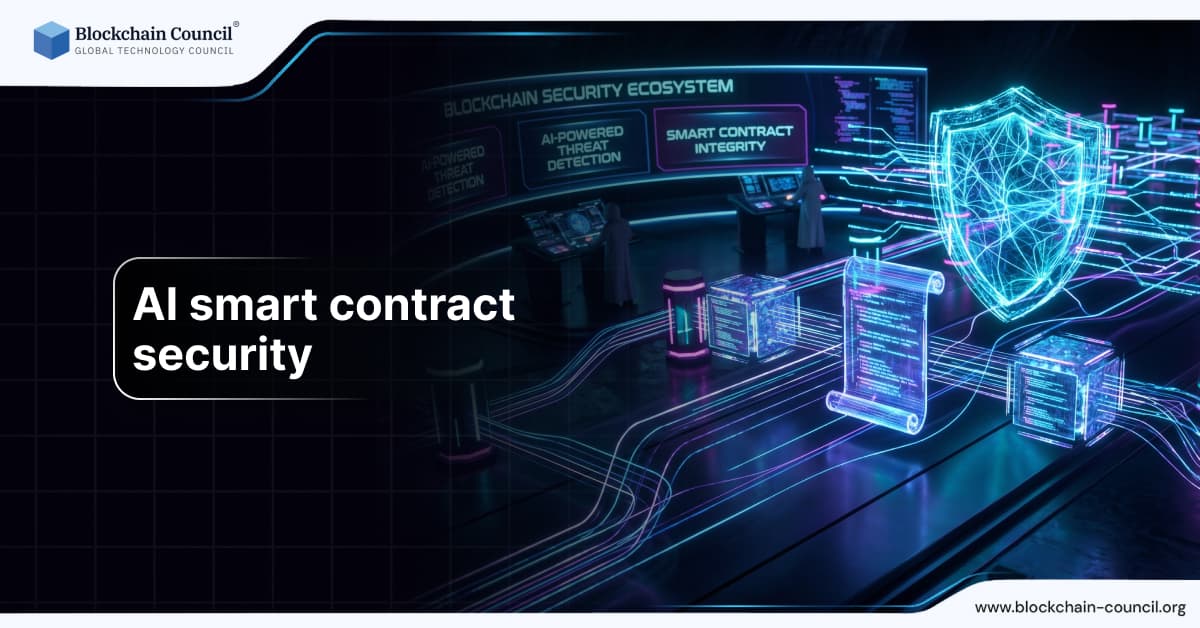
AI smart contract security is reshaping how Web3 teams identify vulnerabilities, validate business logic, and respond to attacks. As smart contracts increasingly integrate AI-driven components such as trading agents, dynamic pricing oracles, and autonomous governance, the attack surface expands beyond classic Solidity issues like reentrancy or gas-related denial-of-service. Defenders are adopting AI to automate audits, simulate adversarial behavior, and monitor production systems in real time.
This article covers what AI smart contract security includes, why it matters now, what the latest tools and practices look like, and how to build a pragmatic security program that accounts for both on-chain code and off-chain AI infrastructure.

What Is AI Smart Contract Security?
AI smart contract security refers to applying artificial intelligence and machine learning to improve the security lifecycle of smart contracts and their surrounding systems. It typically includes:
Vulnerability detection at scale by analyzing large codebases and known exploit patterns
Automated auditing support, including test generation, fuzzing, and business-logic checks
Threat monitoring for suspicious on-chain and cross-chain behavior
AI-aware risk management for models, data feeds, and inference services that influence contract execution
Leading security teams treat AI and ML systems as part of the protocol security boundary, not as a separate product feature. A consistent theme among industry practitioners is that untrusted data feeds and off-chain inference pipelines can be exploited even when the Solidity code is formally correct.
Build secure smart contract systems with AI-driven validation techniques by gaining expertise through an AI Security Certification, developing tools via a Node JS Course, and promoting solutions using an AI powered marketing course.
Why AI Changes the Smart Contract Threat Model
Smart contracts were originally designed around deterministic execution and clearly defined inputs. AI-driven systems introduce probabilistic behavior and complex dependencies. Modern protocols now include:
High-frequency trading bots and autonomous execution agents
Dynamic pricing oracles that adapt to market conditions
On-chain fraud detection and risk scoring
Autonomous governance agents that propose or execute actions
This creates new failure modes. Beyond typical smart contract vulnerabilities, teams must account for model manipulation, data poisoning, and off-chain compromise. Security researchers consistently emphasize that treating a contract as safe while ignoring its AI inputs is a category error. If model output is treated as authoritative, it becomes a high-value target.
Off-Chain Blind Spots Are First-Class Risks
A growing number of real incidents in Web3 security originate in non-contract components: API keys, CI/CD pipelines, inference servers, or privileged automation. Attackers may bypass hardened contracts entirely by targeting the inference server or data pipeline that influences on-chain decisions.
The practical implication is clear: a smart contract audit must expand into an end-to-end audit that includes the AI pipeline and all external dependencies capable of affecting state transitions.
Latest Developments: AI-Augmented Audits and Remediation
AI is accelerating security workflows in several concrete ways as the ecosystem moves from manual review toward AI-augmented processes:
Contextual reasoning about business logic: AI-assisted review can translate protocol intent into testable security properties, reducing the risk of logic bugs that pass traditional linters.
Automated fuzz testing: Security teams combine AI-guided inputs with frameworks like Foundry and Hardhat to explore edge cases faster and generate higher-value test cases.
Adversarial simulations: AI can help simulate exploit paths across composable systems, including bridges and oracles, where individually safe modules create unsafe compositions.
AI-powered remediation: Some tools now go beyond detection and propose code-level fixes, reducing cycle time and helping teams prioritize corrective action.
Tools such as SolidityScan have introduced AI-driven remediation features that identify vulnerabilities and suggest targeted fixes. This can accelerate development and reduce human error, but it should be treated as assisted engineering rather than a replacement for expert review.
Key Statistics and What They Mean for Web3 Teams
AI-driven cybersecurity solutions are frequently reported to improve threat detection rates by up to 60% compared to traditional approaches, primarily by analyzing large datasets and recognizing patterns at scale. In smart contract security, the practical benefit is broader coverage: more contracts scanned, more variants of known issues detected, and better prioritization across large protocol codebases.
Attackers are also using AI to automate reconnaissance across thousands of smart contracts, scanning for vulnerable patterns far faster than manual review allows. The result is an accelerating arms race where both offense and defense are increasingly automated.
Real-World Use Cases of AI Smart Contract Security
1. AI Remediation in Development Workflows
AI remediation can be integrated into CI pipelines to flag issues early and propose patches. The best results come when teams use AI suggestions to:
Generate candidate fixes
Run unit tests and fuzz tests against the patch
Require human approval for merges, especially for privileged or upgradeable components
This approach combines machine speed with human accountability.
2. AI-Driven Monitoring and Anomaly Detection
Protocols increasingly deploy AI-based monitoring for real-time transaction analysis and integrity checks. AI-driven frameworks for continuous blockchain transaction monitoring can detect suspicious activity and strengthen operational security.
This is especially valuable for:
Detecting unusual governance behavior
Spotting bridge or oracle manipulation attempts
Responding to exploit-like transaction sequences before damage spreads
3. zkML and Verifiable AI Outputs
zkML aims to make AI outputs verifiable via zero-knowledge proofs, allowing smart contracts to validate that a model ran correctly without revealing private data or model internals. Potential use cases include privacy-preserving DeFi risk checks and DAO governance. However, zkML introduces its own verification and implementation risks, and it requires comprehensive auditing of cryptographic assumptions, circuit constraints, and integration logic.
Top Risks Unique to AI-Integrated Smart Contracts
If your protocol relies on AI for decision-making, prioritize risks that traditional Solidity checklists may miss:
Poisoned data and corrupted labels: If training or inference data can be influenced, model outputs can be steered toward attacker goals.
Adversarial inputs: Carefully crafted inputs can trigger unexpected model behavior that cascades into on-chain actions.
Inference server compromise: Attackers may target the server that signs or submits transactions based on model output.
Hidden backdoors in autonomous governance: AI agents can propose seemingly valid actions that exploit edge cases or hidden dependencies.
Over-trusting model output: Treating AI as a truth oracle rather than an untrusted component creates single points of failure.
Best Practices for AI Smart Contract Security
Use this checklist to build a defensible program across development, deployment, and operations.
1. Audit the Full Pipeline, Not Just Solidity
Define an explicit trust boundary that includes:
Model training process and data provenance
Inference infrastructure, keys, and access controls
Oracle mechanisms and message signing
Automation agents that execute transactions
Security teams increasingly recommend treating AI/ML systems like cryptographic primitives: assumptions must be verified end-to-end, not only at the contract layer.
2. Constrain AI Authority On-Chain
Even when AI produces recommendations, contracts should enforce hard limits:
Rate limits and circuit breakers
Bounded parameter ranges
Multi-sig or time-lock requirements for high-impact actions
Quorum and delay constraints for AI-influenced governance
3. Combine AI Scanning with Property-Based Testing and Fuzzing
AI scanners improve coverage, but they do not prove correctness. Pair them with:
Property-based tests that encode invariants such as solvency constraints
Fuzz testing to explore edge cases and adversarial sequences
Simulation across composable dependencies including oracles, bridges, and external pools
4. Secure Keys, Signing, and Agent Permissions
If AI agents submit transactions, treat them like privileged infrastructure:
Use HSMs or secure enclaves where appropriate
Rotate keys and monitor signing anomalies
Minimize privileges and isolate roles
Implement fail-safe shutdown procedures
5. Build a Production Monitoring and Incident Response Loop
AI-assisted monitoring should feed into clear operational playbooks:
Define alert thresholds for unusual patterns
Automate containment actions where safe, such as pausing modules or disabling routes
Run post-incident reviews and continuously refine detection rules
Secure smart contracts using AI-based auditing and vulnerability detection by mastering frameworks through an AI Security Certification, implementing analysis via a Python certification, and scaling adoption using a Digital marketing course.
Conclusion: Operationalizing AI Smart Contract Security
AI smart contract security is a requirement, not an option, for protocols that rely on autonomous agents, dynamic oracles, or AI-driven monitoring. AI can materially improve detection and response by scaling analysis and simulation, but it also gives attackers faster reconnaissance and exploit discovery capabilities.
The most resilient approach is hybrid: use AI to expand coverage and speed, then enforce rigorous engineering controls including pipeline audits, constrained on-chain authority, robust fuzzing, and production monitoring. In Web3's hyper-connected ecosystems, security is not a one-time audit. It is a lifecycle discipline that must evolve as quickly as the threats it addresses.
FAQs
1. What is AI smart contract security?
AI smart contract security uses artificial intelligence to detect vulnerabilities in smart contracts. It analyzes code and behavior. This improves reliability.
2. How does AI improve smart contract security?
AI audits code and identifies potential vulnerabilities. It detects risks early. This prevents exploits.
3. What are common smart contract vulnerabilities?
Vulnerabilities include reentrancy attacks and logic flaws. These can lead to financial losses. Security is critical.
4. How does AI detect vulnerabilities in smart contracts?
AI analyzes code patterns and behavior. It identifies weaknesses. This improves security.
5. Can AI prevent smart contract attacks?
AI helps detect risks before deployment. It reduces vulnerabilities. This improves protection.
6. What is automated auditing in smart contract security?
AI automates the auditing process. It identifies issues quickly. This improves efficiency.
7. What are benefits of AI in smart contract security?
Benefits include faster detection and improved accuracy. It reduces human error. This enhances security.
8. What industries use AI smart contract security?
Finance, DeFi, and blockchain projects use it widely. It protects assets. Adoption is growing.
9. What are challenges in AI smart contract security?
Challenges include complexity and evolving threats. Continuous updates are required. Proper testing is needed.
10. How does AI improve blockchain security overall?
AI enhances detection and monitoring. It improves efficiency. This strengthens security.
11. What is predictive security in smart contracts?
AI forecasts potential vulnerabilities. It analyzes patterns. This helps prevent attacks.
12. How does AI improve transaction security?
AI monitors smart contract transactions. It detects anomalies. This improves protection.
13. What is the role of AI in DeFi security?
AI secures decentralized finance systems. It detects risks. This improves reliability.
14. Can small projects use AI smart contract security?
Yes, scalable solutions are available. They improve protection. This enhances security.
15. What is AI-based monitoring in smart contracts?
AI continuously monitors contract activity. It detects anomalies. This improves security.
16. How does AI improve compliance in smart contracts?
AI ensures contracts follow regulations. It detects violations. This avoids penalties.
17. What is the future of AI smart contract security?
AI will become more advanced and widely adopted. It will improve automation. Adoption will increase.
18. How does AI improve auditing processes?
AI automates and speeds up auditing. It improves accuracy. This enhances security.
19. What is the role of AI in preventing DeFi hacks?
AI detects vulnerabilities and anomalies. It prevents exploits. This improves safety.
20. Why is AI smart contract security important?
It protects blockchain applications from vulnerabilities. It improves reliability. It is essential for modern systems.
Related Articles
View All
AI & ML
Built to Catch AI Cheating: Rethinking Pre-Employment Assessments with HireValid
Explore how HireValid is rethinking pre-employment assessments with AI-resistant test design, integrity signals, candidate evidence, and human review to address AI-assisted cheating.

AI & ML
AI-Era Hiring Needs AI-Proof Tests: How HireValid Is Redefining Talent Assessment
Explore how HireValid is rethinking talent assessment for the AI era with job-relevant tests, anti-cheating design, integrity signals, and human-reviewed evidence of candidate ability.
AI & ML
Google Launches Gemini 4 Argon: Features and Capabilities
Google has launched Gemini 4 Argon, its flagship AI model for coding, finance, law, cybersecurity and science. Learn its key features, availability, pricing and safety details.
Trending Articles
The Role of Blockchain in Ethical AI Development
How blockchain technology is being used to promote transparency and accountability in artificial intelligence systems.
AWS Career Roadmap
A step-by-step guide to building a successful career in Amazon Web Services cloud computing.
How Blockchain Secures AI Data
Understand how blockchain technology is being applied to protect the integrity and security of AI training data.