
Is AI the Secret Weapon Behind Quant Trading?
 Michael Willson
AI for Quant Trading
Quant trading, or quantitative trading, is built on mathematics, statistics, and automation. Instead of relying on human intuition, it uses models and rules to find trading opportunities in financial markets. High-frequency trading is one branch of quant trading, where firms compete in microseconds to exploit tiny price discrepancies. For years, quant firms relied on infrastructure and speed to win. But the rise of artificial intelligence has added a new dimension. AI can process complex data, adapt to changing markets, and uncover patterns that traditional models cannot see.
This shift has led many to ask whether AI is the secret weapon behind quant trading. Evidence shows that AI is already transforming how signals are generated, how risks are managed, and how execution is optimized.

For investors and professionals who want to understand this transformation, the AI powered investor program is one way to learn how AI is applied in finance. It demonstrates how trading systems that once seemed untouchable are being challenged by machine intelligence.
Overview of AI
What It Is
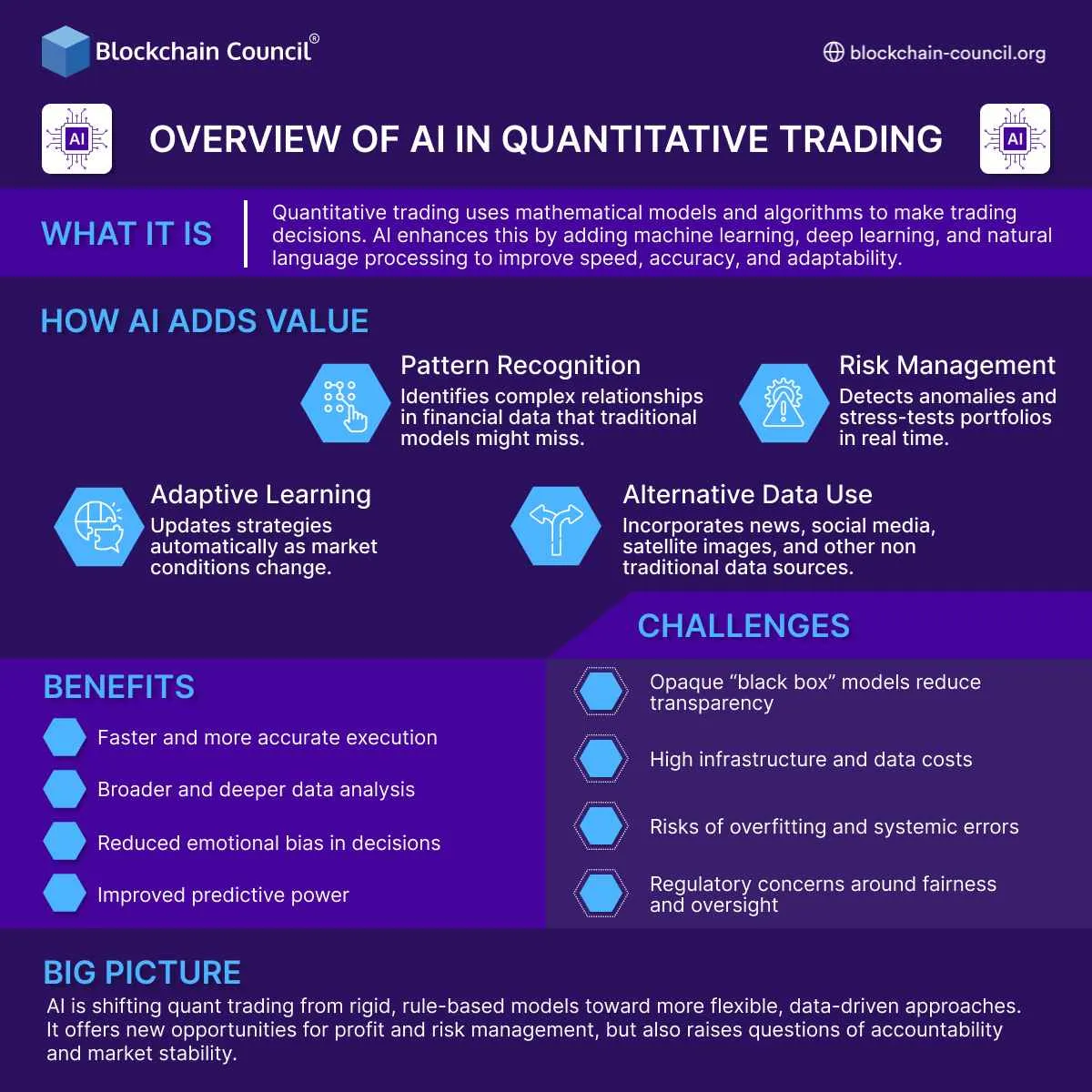
Quantitative trading uses mathematical models and algorithms to make trading decisions. AI enhances this by adding machine learning, deep learning, and natural language processing to improve speed, accuracy, and adaptability.
How AI Adds Value
- Pattern Recognition: Identifies complex relationships in financial data that traditional models might miss.
- Adaptive Learning: Updates strategies automatically as market conditions change.
- Alternative Data Use: Incorporates news, social media, satellite images, and other non-traditional data sources.
- Risk Management: Detects anomalies and stress-tests portfolios in real time.
Benefits
- Faster and more accurate execution
- Broader and deeper data analysis
- Reduced emotional bias in decisions
- Improved predictive power
Challenges
- Opaque “black box” models reduce transparency
- High infrastructure and data costs
- Risks of overfitting and systemic errors
- Regulatory concerns around fairness and oversight
Big Picture
AI is shifting quant trading from rigid, rule-based models toward more flexible, data-driven approaches. It offers new opportunities for profit and risk management, but also raises questions of accountability and market stability.
How Is AI Used?
AI is already embedded in quant workflows. In signal research, machine learning models identify nonlinear relationships across price, volume, and order book data. Deep learning networks detect hidden structures in time series that classic statistical models miss. Reinforcement learning agents learn to adapt strategies in real time, improving their performance as markets shift.
In intraday microstructure analysis, transformer models are used to detect anomalies in order book data. This allows firms to reduce losses during volatile periods. In execution, AI helps predict flows and optimize trade timing to reduce transaction costs. Even the largest asset owners, such as sovereign wealth funds, are now using AI for execution.
Beyond trading logic, AI also improves operational efficiency. It automates feature engineering, parameter optimization, and data cleaning, all of which shorten research cycles. This lets firms move faster from research to deployment. A Prompt Engineering Course is increasingly seen as essential training for professionals moving into quant-driven finance.
New AI Models for Trading
Recent research highlights experimental models that push the boundaries of quant trading. QuantAgent, for example, uses multiple AI agents. One agent looks for trends, another looks for patterns, and a third assesses risk. Together, they create a more balanced view of the market than a single model could. Early results suggest that QuantAgent outperforms both traditional and neural baselines in short-term trading.
EarnHFT is another example. It applies hierarchical reinforcement learning to cryptocurrency markets. The model learns how to act on extremely short time steps and reports a 30 percent improvement in profitability compared to older approaches. These experiments show that AI is not just theoretical. It is already proving itself in fast-moving markets.
Benefits
AI offers several advantages over traditional quant methods. First, it can uncover deeper patterns. Markets are complex, and relationships between variables are not always linear. AI can process high-dimensional data and find patterns that statistical models cannot.
Second, AI adapts. Market conditions change constantly. A fixed rule that works in one environment may fail in another. AI models can retrain and adjust strategies, making them more resilient.
Third, AI improves risk management. By detecting anomalies in real time, AI can stop strategies from failing during unexpected events. This helps firms avoid catastrophic losses.
Fourth, AI enables broader data integration. It allows quants to combine market data with alternative sources such as news, social media, and economic indicators. This provides a richer view of the market.
Finally, AI accelerates automation. From research to execution, many tasks that once required manual work can now be automated. This reduces costs and speeds up innovation.
Challenges
Despite its potential, AI is not a magic bullet. Latency is still critical. Even the smartest model must operate in microseconds if it wants to compete with high-frequency trading firms. AI models often require more time to compute, which can erase their advantage in ultra-fast markets.
Interpretability is another challenge. Deep learning models are complex and often opaque. Regulators and risk managers may be reluctant to trust systems that cannot explain their decisions.
Overfitting is also a risk. Models trained on past data may fail when the market regime changes. Without strong validation, AI strategies can collapse in live trading.
Infrastructure costs are high. Running AI in real time requires enormous computing power, networking, and specialized teams. This raises the barrier to entry, making it difficult for smaller firms to compete.
Finally, regulators are concerned about stability. Central banks have warned that autonomous AI trading could amplify market stress if many systems behave in the same way during a crisis.
Case Studies
Several case studies highlight how AI is already applied in practice. Norway’s sovereign wealth fund uses AI to predict internal flows and optimize execution. This reduces trading costs and improves performance. Major quant firms like Citadel and Virtu are known to experiment with AI in their pipelines. Exchanges and data vendors are building AI-native stacks for clients.
Other platforms are bringing AI trading tools to retail investors. Firms now market AI-driven platforms that once only hedge funds could afford. This trend shows how AI is spreading beyond elite firms into broader markets.
These case studies prove that AI is not only a research topic. It is shaping real-world trading decisions every day.
How AI Certification Strengthen Quant Trading Careers?
The growing role of AI in quant trading has made specialist training more valuable than ever. Firms are not only seeking mathematicians and traders but also professionals who understand how AI systems are designed, tested, and deployed. That is why an AI certification is becoming a popular route for individuals looking to build credibility. Certification programs provide a mix of theory and practical applications, showing how models work and how they can fail. In a market where mistakes can cost millions, this knowledge is critical.
What Role Do AI Trading Programs Play in Finance?
The idea of an AI trading program has gained momentum as technology has matured. Unlike traditional quant models that rely on fixed rules, AI trading programs adapt to new conditions. They combine real-time data with predictive analytics to make decisions without direct human oversight. In quant trading, these programs are increasingly tested not only for speed but for resilience. They can integrate data from news, social media, and economic indicators, allowing them to respond to factors outside raw price and volume. While they are not perfect, their growing use signals that AI is being positioned as a central tool in modern finance.
Why Is Data Science Important for Quant Trading?
Quant trading lives and dies on data. The ability to collect, clean, and analyze it is the foundation of profitable strategies. Professionals often pursue the Data Science Certification to build these skills. Data science is not only about algorithms. It includes the pipelines that feed models, validation techniques to prevent overfitting, and visualization methods that help traders understand results. In quant finance, these skills allow firms to generate signals that are both reliable and actionable. Without solid data science, even the smartest AI model will collapse under the weight of noise.
How Do Agentic AI Systems Change Quant Trading?
AI is evolving from passive models into active systems. Agentic AI systems can make independent choices within defined rules. This is particularly relevant in quant trading, where markets shift too fast for humans to intervene in every decision. The Agentic AI Certification prepares professionals to work with such systems. It teaches how to design agents that can trade responsibly while still being monitored for compliance and safety. In practice, this means that quants can rely on AI agents to adjust execution or respond to volatility, while still retaining human oversight at the strategic level.
Why Are Tech Certifications Valuable for Quants?
Quant trading is not just finance anymore. It demands strong technical skills. Professionals who want to stand out are pursuing broader tech certifications. These programs cover topics like cloud computing, distributed systems, and cybersecurity. Each of these areas supports AI in trading. Cloud computing powers large-scale model training. Distributed systems help process streaming data from multiple markets. Cybersecurity is essential for protecting sensitive trading models from attacks. For quants, combining financial expertise with general tech skills is becoming a baseline requirement.
How Is Technology Reshaping the Future of Quant Trading?
At its core, quant trading has always been a technology race. In the early days, speed was the differentiator. Firms invested in co-location and custom chips. Now, AI is adding another layer to this race. Advances in machine learning, natural language processing, and reinforcement learning are pushing strategies beyond traditional statistical methods. The firms that succeed are those that integrate the latest technology into their trading stacks quickly and responsibly. From microstructure prediction to portfolio optimization, technology defines who wins and who loses in this industry.
Can Blockchain Support AI in Quant Trading?
Blockchain may not be the first technology people associate with quant trading, but it has real potential. Transparency and trust are key issues in AI-driven finance. Models that are opaque and data that is hidden create regulatory concerns. Blockchain offers a way to log transactions securely and transparently. This is why professionals are increasingly exploring blockchain technology courses. By combining blockchain with AI, firms could build trading systems that are both powerful and auditable. This matters because regulators and investors alike want assurances that AI is not a black box running unchecked in financial markets.
How Does Marketing Influence AI in Quant Trading?
Quant trading might be powered by mathematics and algorithms, but success also depends on reputation and trust. Platforms and funds must convince investors that their models work and that risks are controlled. Marketing has become an important part of this process. Firms are careful to promote their AI capabilities as cutting-edge while also communicating reliability. This is why the Marketing and Business Certification is relevant in this space. It helps professionals learn how to present technical services to investors and clients without overpromising. In a market where trust can vanish overnight, responsible communication is as important as accurate models.
What Risks Could Hold AI Back in Quant Trading?
Even though AI is powerful, it is not invincible. One of the biggest risks is overfitting. Models that perform well on backtests may fail in real markets, leading to costly errors. Latency is another issue. AI models often require more computing power, which can slow execution. In high-frequency environments, microseconds matter.
Interpretability is also a concern. Regulators demand explanations, but deep learning models are complex and often opaque. This creates tension between performance and accountability. Another challenge is adversarial manipulation. Bad actors could design inputs to trick AI models, just as they exploit weaknesses in cybersecurity.
Finally, systemic risk is growing. If many firms deploy similar AI models, they could all react the same way during a crisis. This collective behavior could amplify volatility. Central banks have already warned about this possibility. The future of AI in quant trading will depend on balancing innovation with safeguards.
What Opportunities Exist for New Entrants in AI Trading?
Traditionally, quant trading has been dominated by a few elite firms with the best infrastructure. But AI is opening new doors. Startups that focus on smart strategies rather than raw speed can now compete. AI allows firms to build models that detect signals beyond what traditional systems capture. Retail platforms are also starting to integrate AI tools, offering capabilities once limited to hedge funds.
For entrepreneurs, this means new opportunities. Building AI trading platforms for retail markets or niche institutional clients could lead to billion-dollar valuations. For individuals, the demand for skills in AI, data science, and finance means that new career paths are opening. The barriers are still high, but the door is not locked.
Will AI Replace Traditional Quant Strategies?
AI is not going to erase traditional quant methods overnight. Statistical arbitrage, factor models, and risk-weighted portfolios have decades of research behind them and remain effective in many conditions. What AI does is expand the toolkit. Instead of replacing quant, it layers intelligence on top of established practices. For example, quants may still use regression-based factors to explain stock returns but now add deep learning signals to capture nonlinear effects. The combination produces strategies that are both explainable and powerful.
This blended approach is likely to define the future. Firms that hold on only to traditional rules risk falling behind, while those that rely purely on AI risk overfitting and fragility. The strongest strategies will merge old and new, with AI acting as an enhancer rather than a total replacement.
Steps to Use AI
Step 1: Define Objectives
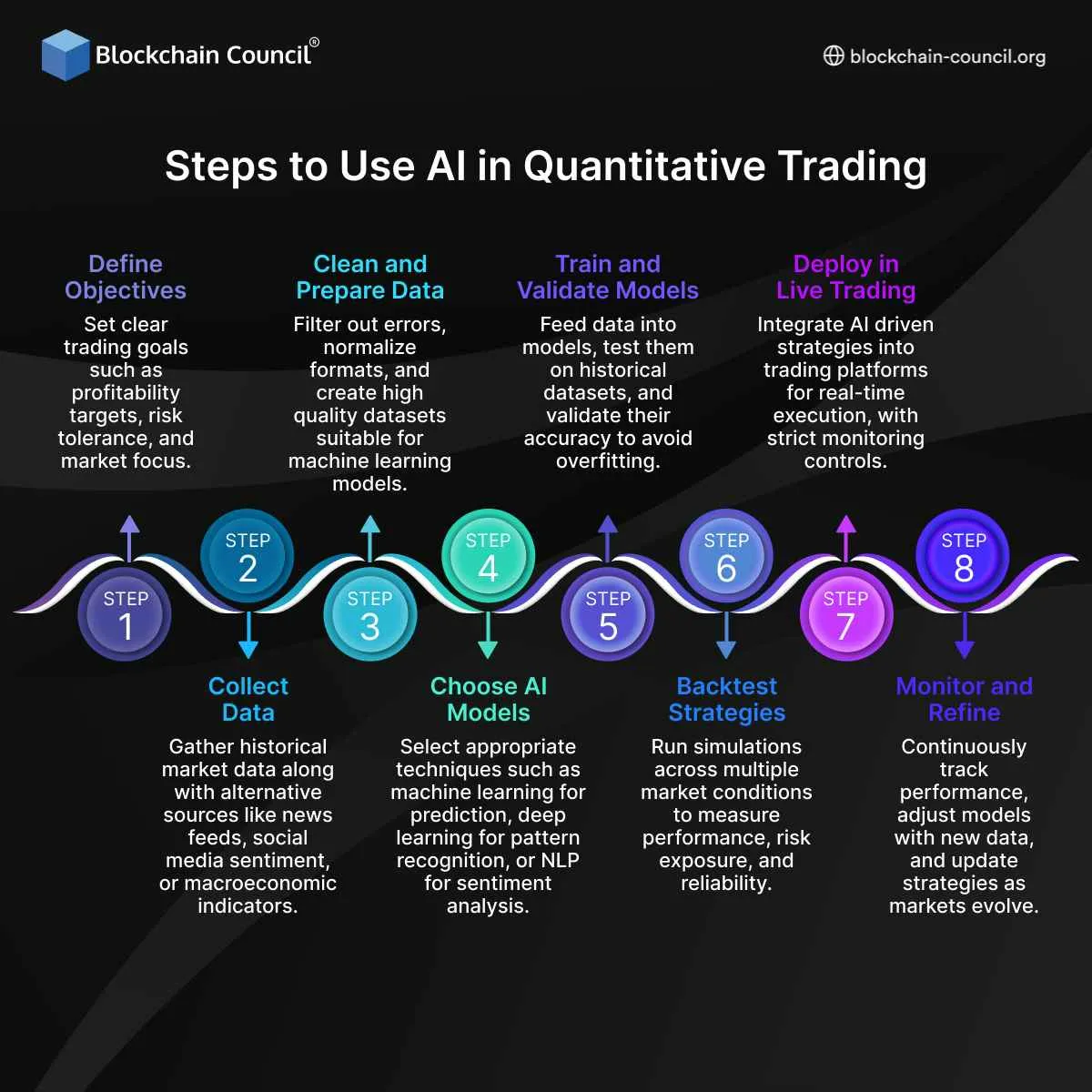
Set clear trading goals such as profitability targets, risk tolerance, and market focus.
Step 2: Collect Data
Gather historical market data along with alternative sources like news feeds, social media sentiment, or macroeconomic indicators.
Step 3: Clean and Prepare Data
Filter out errors, normalize formats, and create high-quality datasets suitable for machine learning models.
Step 4: Choose AI Models
Select appropriate techniques such as machine learning for prediction, deep learning for pattern recognition, or NLP for sentiment analysis.
Step 5: Train and Validate Models
Feed data into models, test them on historical datasets, and validate their accuracy to avoid overfitting.
Step 6: Backtest Strategies
Run simulations across multiple market conditions to measure performance, risk exposure, and reliability.
Step 7: Deploy in Live Trading
Integrate AI-driven strategies into trading platforms for real-time execution, with strict monitoring controls.
Step 8: Monitor and Refine
Continuously track performance, adjust models with new data, and update strategies as markets evolve.
How Do Regulators View AI in Quant Trading?
Regulators are watching closely as AI enters financial markets. Central banks and securities commissions have warned that autonomous trading systems could create instability. The concern is that many models trained on similar data might react the same way to shocks, amplifying volatility. This is especially relevant in fast-moving markets, where AI systems could trigger chain reactions before humans can respond.
To address this, regulators are exploring requirements for explainability. Firms may need to demonstrate how their AI systems make decisions. Kill switches and human oversight may also become mandatory. The message is clear: innovation is welcome, but not at the cost of market stability. For quant firms, this means the secret weapon of AI must be wielded responsibly.
Can AI Create Systemic Risks in Finance?
Yes, AI can create systemic risks. Overfitting is one danger. If models are trained too narrowly, they may collapse when conditions shift. Correlation is another issue. If multiple firms use similar AI models, they may all take the same trades at the same time, draining liquidity. This herd behavior can trigger flash crashes or sudden spikes.
Another risk is adversarial manipulation. Just as hackers design attacks against AI in cybersecurity, bad actors could feed misleading signals to trading models. For example, bots could flood social media with false news that AI trading programs misinterpret as real. This could distort prices and harm investors.
Quant firms must prepare for these risks. Robust validation, stress testing, and human oversight remain essential. AI may be powerful, but it is not invulnerable.
What Case Studies Show AI in Action?
Several real-world cases illustrate AI’s growing role. Norway’s sovereign wealth fund uses AI to predict internal flows and improve trade execution, saving millions in costs. Major quant firms like Citadel and Virtu are experimenting with AI-driven order book analysis. Exchanges such as the London Stock Exchange Group are partnering with technology providers to integrate AI into analytics and execution services.
New startups are also making waves. Platforms that crowdsource AI models, like Numerai, are attracting institutional money. These cases show that AI is not a distant promise. It is already reshaping how quants operate at every level, from execution to strategy.
What Opportunities Do Emerging Markets Offer?
AI in quant trading is not limited to Wall Street or London. Emerging markets provide fertile ground for innovation. In regions where data infrastructure is improving, AI can unlock opportunities in equity, currency, and commodity markets. For example, AI-driven fintech platforms in Africa and Southeast Asia are helping traders and investors access insights that were once unavailable.
Startups in these markets may not have the same speed infrastructure as global giants, but they can compete with AI intelligence. By focusing on niche data sources, such as local economic indicators or regional news, they can build profitable strategies. The next generation of AI-driven quant success stories may very well come from outside traditional financial hubs.
How Can Professionals Prepare for AI in Quant Trading?
For individuals, the rise of AI in quant trading opens new career paths. Professionals with skills in mathematics, coding, and financial markets now need to add AI expertise. Structured programs like the AI powered investor program, AI certification, and Data Science Certification provide clear learning paths.
Agentic systems are also gaining traction, making the Agentic AI Certification especially relevant. Broader tech certifications and training in blockchain technology courses give professionals additional advantages. And for those aiming at leadership, programs like the Marketing and Business Certification help combine technical innovation with communication and trust-building.
Conclusion: Is AI the Secret Weapon in Quant Trading?
AI is not just a secret weapon. It is becoming the standard toolkit of quant trading. It allows firms to process more data, adapt to market shifts, and manage risk in real time. It is already being used by leading firms, sovereign funds, and startups across the world.
But AI is not without challenges. Latency, interpretability, overfitting, and systemic risks are serious issues. The future will depend on how responsibly firms deploy these systems and how regulators shape the environment.
For now, the evidence is clear. AI is giving quants a new edge, one built not on raw speed but on intelligence. Those who learn how to use it wisely will lead the next generation of finance.
Related Articles
View All
AI & ML
AI Agents in Finance and Trading
AI agents in finance and trading are no longer experimental side projects. They are embedded across research desks, execution engines, compliance teams, and risk functions. The important distinction is not “AI vs no AI.” It is whether the system merely produces analysis or whether it can…

AI & ML
Top 10 Applications of Machine Learning
This article delves into the top 10 applications of machine learning, exploring how this technology is not just shaping industries but also redefining our daily lives. So, let’s get started!

AI & ML
AI Talent Pipeline, Here's How Schools Can Build It
Schools are under pressure to prepare students for an AI-powered world. Building an AI talent pipeline is no longer optional. It’s a necessity. From curriculum design to teacher training and real-world partnerships, schools must take clear steps to equip students with future-ready skills. This article explains how they can do that-clearly, practically, and without delay.
Trending Articles

The Role of Blockchain in Ethical AI Development
How blockchain technology is being used to promote transparency and accountability in artificial intelligence systems.

AWS Career Roadmap
A step-by-step guide to building a successful career in Amazon Web Services cloud computing.

Top 5 DeFi Platforms
Explore the leading decentralized finance platforms and what makes each one unique in the evolving DeFi landscape.