

AI Agents in Finance and Trading

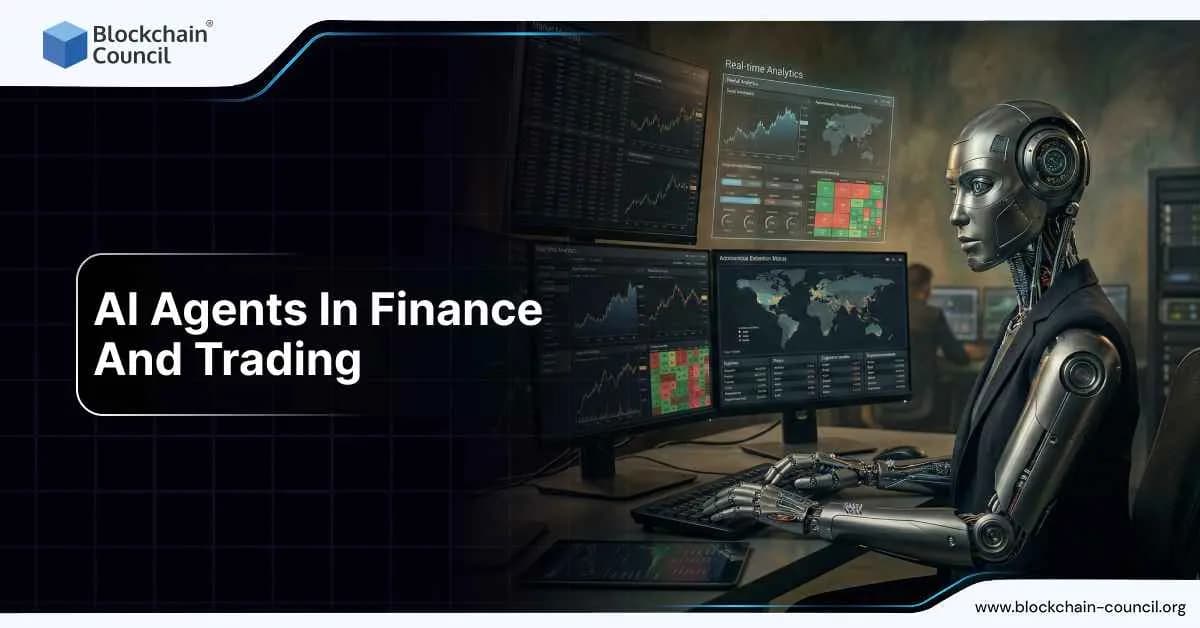
AI agents in finance and trading are no longer experimental side projects. They are embedded across research desks, execution engines, compliance teams, and risk functions. The important distinction is not “AI vs no AI.” It is whether the system merely produces analysis or whether it can autonomously coordinate tools, execute actions, and manage workflows under defined controls. If you want a structured understanding of how autonomous financial systems are designed, governed, and deployed, begin with an Agentic AI certification.
The modern financial agent is less sci-fi trader and more orchestrated decision system with supervision layers.

Core Use Cases in Trading and Markets
AI agents operate across multiple layers of financial infrastructure. The most established applications are not speculative trading bots. They are workflow accelerators with embedded decision logic.
Trading decision support
Firms deploy AI to analyze large volumes of structured and unstructured data. This includes:
- Market sentiment extraction from news and filings
- Alternative data processing
- Pattern detection in price and order flow
- Research summarization
These systems typically generate signals or ranked opportunities rather than directly placing trades.
Algorithmic execution
AI-enhanced execution systems dynamically choose venues, adjust order slicing, manage slippage, and respond to liquidity signals. These systems resemble traditional algorithmic trading engines but incorporate adaptive machine learning components.
Portfolio construction and robo-advice
AI models assist in asset allocation, client personalization, and rebalancing. In retail contexts, robo-advisors increasingly integrate ML-based personalization within regulated advisory frameworks.
Risk management and monitoring
AI agents assist with stress testing, anomaly detection, and early warning signals. They analyze liquidity exposures, counterparty risk, and operational irregularities in near real-time.
Surveillance and compliance automation
Monitoring suspicious trading patterns, AML red flags, communications review, and trade reconstruction for audit purposes are ideal agent tasks because they require persistent monitoring across systems.
Operational workflow automation
Reconciliations, margin management, corporate actions processing, and break resolution are increasingly automated through agent-driven orchestration that connects internal systems.
These use cases are practical and measurable. They reduce latency, improve monitoring coverage, and streamline back-office operations.
What Makes Systems “Agentic”
Finance has used automation for decades. Agentic systems differ in structure and capability.
They typically include:
- Multi-step tool orchestration
- Persistent monitoring loops
- Conditional decision branching
- Human approval gates for high-impact actions
- Detailed execution logging for traceability
An agent can pull data from a data lake, run a model, update exposure limits, generate a compliance note, and alert a human if a threshold is breached. That coordination layer is what distinguishes an agent from a single predictive model.
Designing these systems requires understanding orchestration engines, permission isolation, model governance, and resilience under stress conditions. That architectural layer is non-trivial, which is why structured training like a Tech certification becomes relevant in institutional deployments.
Regulatory and Supervisory Landscape
Regulators are increasingly focused on AI in financial services because automation can expand the blast radius of errors.
United States – CFTC
The CFTC has emphasized that existing regulatory obligations apply when registered entities use AI. Firms remain responsible for supervision, risk controls, and governance even if models or agents are embedded in workflows.
United States – SEC
The SEC has addressed AI-related marketing claims and conflicts of interest. It has also enforced against misleading “AI washing,” signaling that exaggerated claims around AI capabilities are a compliance risk. While certain predictive analytics rule proposals were withdrawn, enforcement and guidance remain active tools.
European Union – ESMA
ESMA has issued guidance clarifying that firms using AI in investment services must maintain governance, suitability, and MiFID compliance standards. Responsibility does not shift to the algorithm.
Global – IOSCO
IOSCO has identified AI adoption across robo-advice, trading, and surveillance while highlighting governance, accountability, and systemic risk considerations.
Banking supervisors and Basel discussions
Supervisory bodies have highlighted third-party dependency risks, especially when firms rely on external model providers or cloud platforms. Operational resilience is central.
The message across jurisdictions is consistent: automation does not dilute accountability.
Risk Themes in Agent-Based Financial Systems
AI agents amplify certain categories of risk.
Model risk
Overfitting, instability in stress regimes, and hidden dependencies can produce unexpected outcomes.
Operational risk
Integration failures, API errors, or incorrect data feeds can cascade quickly in automated workflows.
Conflict of interest risk
Systems optimized for revenue may bias client outcomes or encourage excessive trading.
Market integrity risk
If multiple firms rely on similar models, correlated behavior can increase systemic fragility.
Third-party dependency risk
Reliance on external AI providers or cloud infrastructure increases concentration risk.
These risks are not hypothetical. They are explicitly referenced in supervisory discussions.
Crypto and Digital Asset Context
In crypto markets, AI agents are widely used for:
- Multi-venue execution
- Arbitrage monitoring
- Liquidity fragmentation management
- Risk alerts across custodians and exchanges
However, crypto adds complexity: venue heterogeneity, custody risk, smart contract exposure, and fragmented regulation. The operational environment is less standardized than traditional markets.
As institutional participation in digital assets expands, systematic trading and AI-assisted surveillance will likely increase in parallel.
Implementation Standards That Survive Audit
Financial institutions deploying AI agents in trading environments typically implement:
- Pre-trade risk controls
- Backtesting and scenario simulation
- Change management governance
- Access control and separation of duties
- Human override mechanisms
- Comprehensive audit logs
- Third-party due diligence documentation
The phrase “fully autonomous trading” rarely survives regulatory review without layers of approval and constraint.
Strategic and Commercial Implications
AI agents in finance are not replacing traders overnight. They are reshaping cost structures, speed advantages, and operational scalability.
Firms that integrate agents effectively gain:
- Faster research cycles
- Improved monitoring coverage
- Reduced operational friction
- Enhanced risk visibility
However, firms that market AI irresponsibly or deploy without governance expose themselves to enforcement, reputational damage, and operational failure.
Clear positioning, accurate capability description, and transparent risk framing are increasingly competitive advantages. Communicating this effectively requires disciplined strategy, which is where a Marketing certification becomes practical rather than promotional.
Conclusion
AI agents in finance and trading represent an evolution of automation into coordinated, multi-tool execution systems operating under structured governance. The technology is not revolutionary because it predicts markets flawlessly. It is impactful because it integrates data, decision logic, and operational workflows into coherent systems that can act, monitor, and escalate in real time.
Regulators are not opposing AI adoption. They are demanding accountability, transparency, and robust controls. Institutions that treat agents as disciplined infrastructure rather than speculative shortcuts are the ones likely to sustain advantage.
The future of agentic finance will be defined less by algorithmic novelty and more by architecture quality, governance rigor, and operational resilience.
Related Articles
View All
AI & ML
AI Agents & Agentic AI: When AI Starts Thinking, Planning & Acting
Discover AI Agents & Agentic AI in simple terms. Learn how agents perceive, reason, plan, use tools, and remember, how they differ from chatbots, and where they are used today.
AI & ML
System One Models for AI Agents
Explore how System One Models can support AI agents with fast, structured decisions, calibrated confidence, routing, verification, and reliable workflow automation.
AI & ML
Jev vs AI Agents
Compare Jev with AI agents and learn how Jev’s structured decision-making differs from autonomous systems that plan, use tools, and complete multi-step tasks.
Trending Articles
The Role of Blockchain in Ethical AI Development
How blockchain technology is being used to promote transparency and accountability in artificial intelligence systems.
AWS Career Roadmap
A step-by-step guide to building a successful career in Amazon Web Services cloud computing.
How Blockchain Secures AI Data
Understand how blockchain technology is being applied to protect the integrity and security of AI training data.