

AI in DeFi
 Michael Willson
What Is AI in DeFi and Why Does It Matter in 2025?
AI in DeFi refers to the integration of artificial intelligence systems into decentralized finance platforms to improve efficiency, security, and decision-making. It represents a merging of two of the most transformative technologies of the decade — blockchain and AI — into one intelligent financial layer that operates autonomously, without centralized intermediaries.
In practical terms, AI now manages everything from market risk to liquidity allocation and protocol health. It detects vulnerabilities, tunes parameters, predicts liquidation events, and ensures that decentralized protocols remain solvent even during high volatility. This shift turns DeFi from an experimental market into a data-driven, self-optimizing ecosystem.

To understand how intelligent automation is reshaping digital finance, professionals can start with an AI certification that explains the fundamentals of machine learning, neural networks, and blockchain integration.
How Did AI Become a Core Component of DeFi?
DeFi began as a simple idea: remove banks and let smart contracts handle transactions. But as the ecosystem matured, the complexity of managing billions in on-chain assets demanded advanced intelligence.
By 2025, platforms like Aave, Compound, and Uniswap use AI-enhanced models to analyze historical data and optimize their risk and reward mechanisms. AI helps these systems make informed decisions about collateral ratios, borrowing limits, and interest rates — automatically and transparently.
Meanwhile, Gauntlet and Chaos Labs provide AI-powered risk infrastructure. Their algorithms continuously simulate market scenarios, stress test portfolios, and suggest adjustments that keep DeFi protocols resilient during market shocks.
This is where AI becomes the invisible governor of decentralized systems — a self-auditing layer that makes finance both safer and smarter.
What Problems Does AI Solve in DeFi?
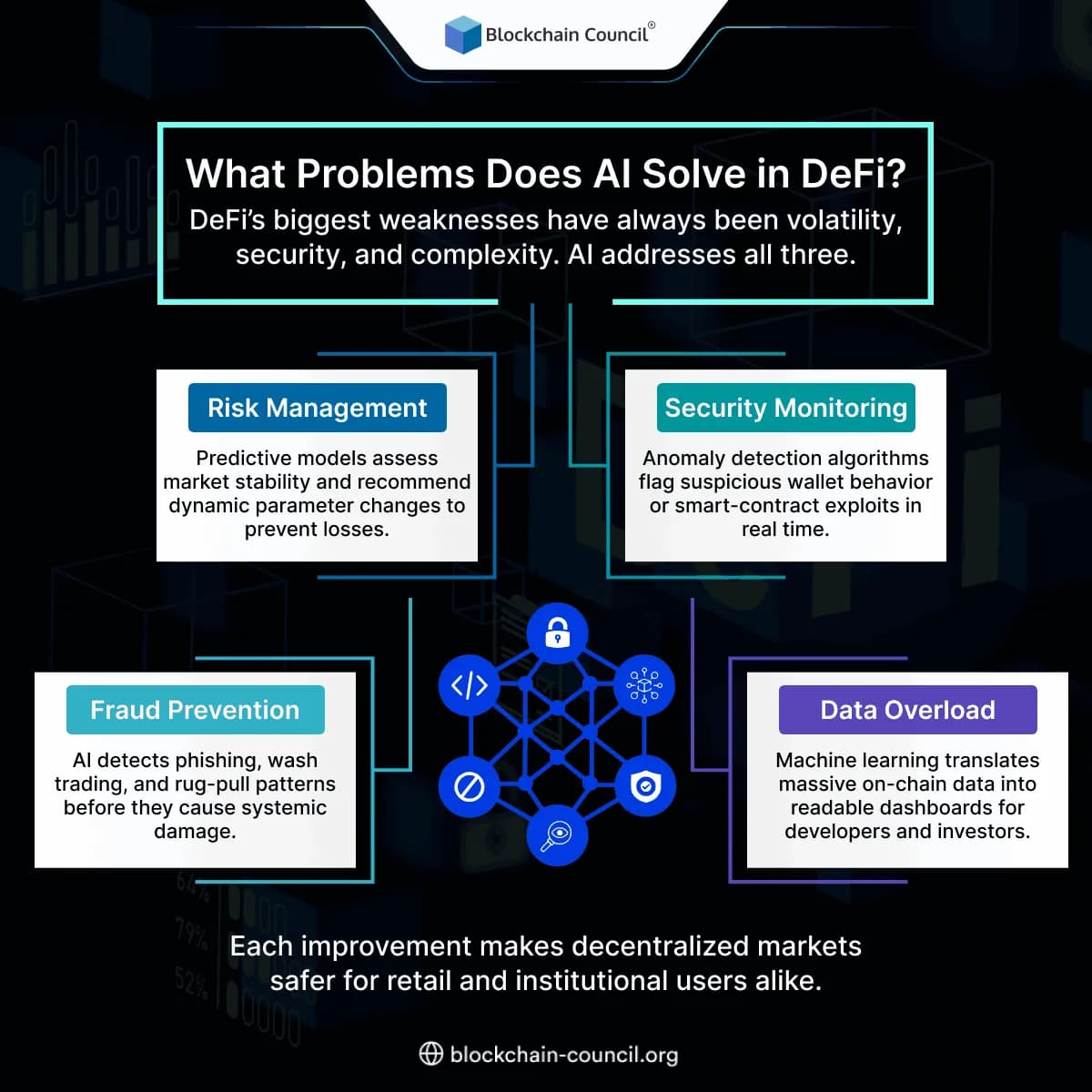
DeFi’s biggest weaknesses have always been volatility, security, and complexity. AI addresses all three.
- Risk Management: Predictive models assess market stability and recommend dynamic parameter changes to prevent losses.
- Security Monitoring: Anomaly detection algorithms flag suspicious wallet behavior or smart-contracts exploits in real time.
- Fraud Prevention: AI detects phishing, wash trading, and rug-pull patterns before they cause systemic damage.
- Data Overload: Machine learning translates massive on-chain data into readable dashboards for developers and investors.
Each improvement makes decentralized markets safer for retail and institutional users alike.
How Are AI Models Used in DeFi Risk Management?
Protocols use AI for quantitative stress testing. Companies like Gauntlet simulate thousands of market conditions daily. Their systems assess lending parameters, identify high-risk borrowers, and adjust collateral requirements before volatility strikes.
Chaos Labs takes a similar approach but extends it to stablecoins and Proof-of-Reserve tracking. Their AI checks whether stablecoins are truly backed by reserves and whether cross-chain bridges hold sufficient liquidity.
By combining real-time monitoring with predictive analytics, AI ensures that no single failure point can bring down an entire ecosystem.
Professionals aiming to learn such analytical modeling can benefit from the Data Science Certification, which covers the principles of data modeling, forecasting, and optimization essential for DeFi development.
How Does AI Improve Trading and Market Efficiency?
AI turns DeFi trading into an intent-based system rather than a manual one.
- Market Prediction: Algorithms scan thousands of data points per second to predict price trends.
- Intent-Based Orders: Platforms like CoW Protocol let users specify the outcome they want, and AI-driven solvers compete to execute trades at the best rate.
- MEV Protection: By predicting front-running attacks, AI reduces the “Miner Extractable Value” problem that plagues DeFi users.
- Execution Speed: Low-latency data feeds, such as Chainlink Data Streams, ensure traders act on accurate and timely information.
AI effectively acts as a global market referee — optimizing every move for fairness, accuracy, and speed.
How Does AI Enable Autonomous Agents in DeFi?
One of the most exciting developments in 2025 is the rise of autonomous DeFi agents — self-operating digital entities that execute tasks like trading, monitoring, and arbitrage.
Platforms like Olas (Autonolas) have created frameworks where communities can co-own and monetize these agents. Each “agent” can analyze markets, rebalance vaults, or provide price signals to liquidity pools.
These systems transform users from passive investors into participants who collectively govern and profit from AI models.
Understanding how autonomous decision systems operate aligns with the agentic ai certification, which explores multi-agent systems, governance models, and the logic behind independent AI behavior.
What Role Do Oracles and Data Streams Play in AI-Driven DeFi?
For AI to make sound decisions, it needs clean, verified data. That’s where oracles come in.
Chainlink’s Data Streams represent the new generation of pull-based oracles that deliver sub-second market data directly to smart contracts. These data feeds are critical for derivatives, perps, and automated liquidations that rely on precise, real-time information.
Unlike older push-based oracles, Data Streams enable protocols to request data on demand, reducing latency and preventing manipulation.
AI models depend on these high-quality signals to:
- Prevent false liquidations.
- Execute stop orders accurately.
- Adjust yield strategies across chains.
With expanding coverage across major DeFi platforms and tokenized equities, oracles now serve as the neural network that connects AI to blockchain reality.
How Is AI Helping to Prevent Fraud and Financial Crimes in DeFi?
The open nature of DeFi makes it vulnerable to scams, hacks, and market manipulation. AI offers a proactive defense system.
- Pattern Recognition: Machine learning models study millions of past attacks to recognize early signs of suspicious behavior.
- Wallet Profiling: Algorithms detect unusual transaction patterns or rapid capital movements indicative of laundering.
- On-Chain Surveillance: AI bots track liquidity movements across exchanges and bridges, identifying discrepancies before they escalate.
- Adaptive Learning: Every time an attack is prevented, the model learns, strengthening its defense.
These systems are already being integrated into exchanges and custodians to create an intelligent compliance layer that operates globally and continuously.
How Does AI Support Regulation and Policy Compliance in DeFi?
Regulators are starting to embrace AI as an ally rather than an adversary. In 2024, the U.S. Treasury and European regulators acknowledged that AI could help identify suspicious activity faster and reduce systemic risk.
AI’s role here includes:
- Generating explainable models for regulators.
- Flagging abnormal liquidity inflows.
- Automating reporting for stablecoin reserves.
This growing collaboration signals a maturing DeFi environment where innovation coexists with oversight — a foundation for true financial sovereignty.
How Are AI-Powered Risk Engines Revolutionizing DeFi Lending?
DeFi lending platforms depend on accurate assessments of borrower risk. Traditional models use static parameters, but AI systems learn dynamically.
They track borrower history, collateral trends, and market volatility. If a borrower’s asset value drops, the AI can trigger a liquidation process instantly or adjust interest rates to protect lenders.
This kind of adaptive decision-making mirrors how human credit analysts operate, but at global scale and speed.
How Do AI and DeFi Enable Smarter Investment Portfolios?
AI-based vaults and yield optimizers like Gauntlet’s adaptive vaults use reinforcement learning to shift assets across protocols automatically. They evaluate yields, transaction costs, and security risks in real time to maximize returns.
Investors interested in mastering these methods can explore the AI powered investment course, which teaches how intelligent systems manage portfolios and rebalance assets autonomously.
This evolution of DeFi turns passive income strategies into dynamic, algorithmically managed investment frameworks.
How Are AI Agents Changing Market Making and Liquidity Provision?
AI agents can predict where liquidity will be needed and move assets proactively. This minimizes slippage and ensures deeper markets.
Projects like Olas allow communities to deploy liquidity agents that autonomously earn fees while maintaining balanced pools. Meanwhile, intent-based routing systems like CoW Protocol leverage solver competitions to find the most efficient trade paths.
As a result, DeFi markets operate with less friction and more intelligence.
How Are Low-Latency Oracles Transforming DeFi Trading?
Traditional oracles introduced delays that made it impossible to respond to real-time market swings. Low-latency feeds, powered by Chainlink Data Streams, now deliver information in under a second.
This improvement enables:
- Real-time liquidation of loans.
- Accurate perps pricing.
- Tokenized asset trading with minimal delay.
These enhancements reduce systemic risk and improve market trust — essential factors for scaling DeFi beyond crypto enthusiasts.
How Does AI Enhance Transparency and Accountability in DeFi?
DeFi’s transparency is already high because of public ledgers, but AI adds interpretability.
- It converts raw blockchain data into human-readable summaries.
- It tracks decision outcomes to prove fairness in algorithmic processes.
- It enables audit trails that regulators and users can verify.
With AI, even the most complex DeFi strategy can be explained and replicated — bridging the gap between technical systems and public understanding.
What Are the Ethical and Governance Challenges in AI-Driven DeFi?
As AI gains control over financial operations, ethical concerns grow. Who is accountable if an autonomous agent fails or makes a harmful decision?
Governance frameworks like DAO-based oversight are being designed to handle such situations. Transparent on-chain voting, explainable AI models, and decentralized audits help distribute responsibility.
These measures prevent the concentration of power and maintain fairness — values that define decentralized systems.
Professionals can deepen their understanding of these governance dynamics through tech certifications that cover smart-contract auditing, cybersecurity, and AI ethics in decentralized environments.
How Do AI and DeFi Work Together to Improve Financial Inclusion?
AI automates education and onboarding. It can guide new users through risk evaluation, suggest safe yield options, and detect scams before funds are lost.
By translating technical steps into plain language, AI lowers entry barriers for millions who might otherwise find DeFi intimidating.
For emerging markets, this combination of AI and blockchain brings accessible, transparent, and censorship-resistant financial tools to communities historically excluded from traditional systems.
How Can Marketers and Businesses Use AI-Driven DeFi Insights?
Businesses can apply DeFi analytics to forecast consumer trends, monitor token performance, and build data-driven loyalty programs.
AI interprets wallet interactions as behavioral data, helping companies design fairer reward mechanisms. For professionals interested in this crossover, the Marketing and Business Certification provides a deep dive into data-driven strategy in decentralized economies.
AI in DeFi doesn’t just change finance — it reshapes digital commerce itself.
How Does Blockchain Technology Support AI’s Role in DeFi?
Blockchain guarantees the transparency and immutability that AI systems require for trust. Every AI-generated action — from a trading signal to a parameter adjustment — can be recorded immutably on-chain.
This ensures that no decision can be altered retroactively and every participant can verify outcomes independently.
Developers can learn how to build these integrations through blockchain technology courses, which explore the infrastructure that enables AI-driven automation.
How Are Governments Responding to AI in Decentralized Finance?
Governments recognize both opportunity and risk. The U.S. Treasury warns against model monoculture — where multiple platforms rely on the same AI outputs — while the EU is working on standardized disclosure requirements for algorithmic trading systems.
The trend is clear: regulators want transparency in how AI models make financial decisions. In return, they’re offering clearer pathways for compliance, which boosts investor confidence and institutional participation.
How Are Developers Using AI for Cross-Chain Optimization?
AI models analyze liquidity across multiple blockchains, finding the best routes for swaps or yield farming. They use data from Chainlink’s Cross-Chain Interoperability Protocol (CCIP) to move assets safely between ecosystems.
This multi-chain intelligence reduces fragmentation and increases capital efficiency across DeFi.
How Does AI Reinforce Trust in the Future of Finance?
AI and DeFi together establish a transparent, efficient, and adaptive financial network that doesn’t rely on centralized oversight. Every action — from price feeds to loan approvals — is governed by verifiable logic.
The result is a new level of trust without intermediaries, where smart algorithms maintain equilibrium instead of central banks or brokers.
For professionals aiming to operate in this landscape, AI-specific credentials or AI certs demonstrate an advanced understanding of how these systems interact securely.
How Are AI Trading Systems Powering Institutional DeFi?
Institutions are entering DeFi cautiously but steadily, using AI-enhanced platforms that offer compliance-friendly trading environments.
These systems automate liquidity deployment, manage slippage, and rebalance portfolios based on predictive analytics. Investors and analysts interested in mastering this field can enroll in the AI trading course to understand how algorithmic execution strategies drive profitability within decentralized markets.
Institutional adoption signals that AI is no longer an experimental add-on — it’s the infrastructure that powers DeFi’s next growth phase.
What Risks Come with AI in DeFi?
Every new technology brings trade-offs. The biggest challenges ahead include:
- Model Monoculture: If too many platforms use the same AI frameworks, systemic failures could spread quickly.
- Data Quality: Poor input data can produce inaccurate predictions, leading to costly errors.
- Agent Sprawl: Too many autonomous bots without governance could cause market chaos.
- Security Vulnerabilities: Attackers may exploit model logic or oracle manipulation.
- Lack of Explainability: Complex AI systems can make decisions that even developers can’t fully interpret.
Mitigating these risks requires strong auditing, transparent algorithms, and multi-stakeholder oversight — principles at the heart of responsible AI design.
What Does the Future of AI in DeFi Look Like?
The next generation of DeFi will be driven by AI systems that:
- Negotiate transactions autonomously.
- Manage liquidity across multiple networks in real time.
- Collaborate with human operators through natural language interfaces.
- Audit themselves for compliance.
- Adapt to regulatory frameworks dynamically.
AI will make DeFi not only more efficient but also more understandable, transforming it from a niche market into a mainstream global infrastructure.
Conclusion: AI as the Brain of Decentralized Finance
AI in DeFi represents the most advanced stage of digital finance — where machine intelligence and blockchain transparency converge. Together, they create an ecosystem that is self-learning, self-securing, and self-optimizing.
The combination of algorithms and smart contracts means financial systems can now function with greater fairness, precision, and inclusivity. It’s the evolution from human-governed finance to code-governed coordination.
For individuals, it promises control. For institutions, it offers reliability. And for societies, it opens the door to a more transparent and resilient financial world.
AI is not just a tool in DeFi — it’s becoming its brain.
Related Articles
View All
AI & ML
Open Dots vs Grok Bot vs Muse
Compare OpenAI Dots, Grok Bot, and Meta Muse to understand how these always-on AI agents differ in persistent work, computer use, connected apps, automation, and personal or business workflows.
AI & ML
What Is OpenAI Dots?
Learn what OpenAI Dots are, how these always-on AI agents work, and how they use GPT-6 Astra, cloud computers, connected apps, and persistent context to handle ongoing tasks.

AI & ML
OpenAI Launches GPT 6.1-Sol
OpenAI launches GPT-6.1 Sol, a new reasoning model offering near-Astra performance at lower cost for complex coding, computer use, agentic workflows, and professional tasks.
Trending Articles
The Role of Blockchain in Ethical AI Development
How blockchain technology is being used to promote transparency and accountability in artificial intelligence systems.
AWS Career Roadmap
A step-by-step guide to building a successful career in Amazon Web Services cloud computing.
How Blockchain Secures AI Data
Understand how blockchain technology is being applied to protect the integrity and security of AI training data.