
Should AI-Generated Art Be Considered “Real Art”?

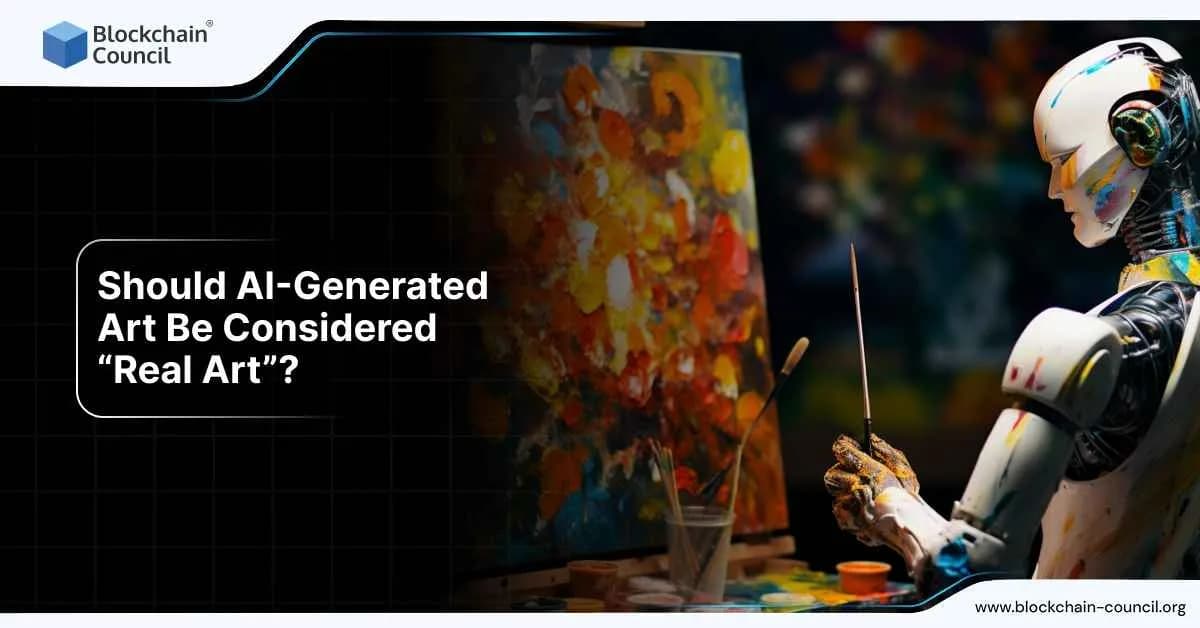
Artificial intelligence has entered galleries, competitions, and even auctions. AI-generated pieces sell for thousands, win prizes, and spark endless debate. But the big question remains: should AI art be considered “real art”? The direct answer is that it depends on what we mean by “art.” If art is defined by human emotion and intent, AI outputs may fall short. But if art is about impact and the response it creates, then AI works could indeed qualify.
Understanding these shifts is crucial. Upskilling through an AI certification can help professionals and creatives alike navigate this new frontier responsibly.

Why Some Say AI Art Isn’t Real
Critics argue that AI lacks the soul of creativity. It doesn’t feel joy, grief, or inspiration. Scholars highlight that AI art is not autonomous; it depends on prompts, datasets, and human curation. The process may deliver beauty, but it doesn’t originate from lived experience.
There’s also a legal and ethical side. U.S. courts and the Copyright Office have made it clear: purely AI-generated works cannot receive copyright protection. Without a human creator, the law sees no “author” to protect. Artists have also pushed back strongly, calling AI art based on scraped data a form of “mass theft.”
Why Others Defend AI as Art
Supporters take a different view. They argue that art is about the effect it has on people. If an image makes you pause, feel something, or rethink your perspective, does it matter whether it came from a brush or an algorithm?
Many artists treat AI not as a replacement but as a collaborator. They use it to explore ideas, generate drafts, or reimagine concepts. In this sense, AI becomes part of the creative toolkit, just like cameras or Photoshop once were.
Copyright and Ownership Challenges
The legal system is struggling to catch up. When an AI model produces a painting, who owns it—the tool’s developer, the prompter, or no one at all? A recent U.S. ruling against copyrighting AI-only works underscores the difficulty. Hybrid creations, where humans edit or reinterpret AI outputs, may still qualify, but the line is blurry.
On the ethical front, thousands of artists recently protested an AI art auction, arguing that their styles had been copied without consent. This reveals the growing tension between innovation and intellectual property rights.
Famous Cases That Sparked Debate
- Edmond de Belamy: A portrait created by a GAN sold for over $400,000 at Christie’s in 2018.
- Colorado State Fair: An AI-generated piece won a fine arts competition, angering traditional artists.
- Ai-Da Robot: A humanoid robot painted King Charles III, raising questions about legitimacy and recognition.
These moments highlight how AI art is forcing institutions to rethink categories of authorship and artistic merit.
Key Differences at a Glance
Here’s a quick comparison between AI art and human art to show where the debate lies:
Human vs AI Art
| Aspect | Human Art | AI-Generated Art |
| Emotion | Rooted in lived experience | Simulated patterns, no feelings |
| Intent | Comes from creator’s vision | Emerges from prompts and datasets |
| Legal rights | Copyright protection applies | Limited or denied without human input |
| Accessibility | Requires training and skill | Available to anyone with a prompt |
| Public perception | Widely accepted | Controversial, still evolving |
Why This Matters Beyond Art
The rise of AI art isn’t just about galleries—it’s about how society defines creativity, ownership, and authenticity in the digital era.
If you’re curious about the data and technology driving this shift, a Data Science Certification provides a foundation in how models are trained and why outputs look the way they do.
If your interest is in strategy and culture, a Marketing and Business Certification can show how AI art is shaping industries from advertising to entertainment.
Together with other AI certs, these learning paths help professionals see AI not as a threat, but as a tool that demands thoughtful use.
Conclusion
So, is AI-generated art “real art”? There’s no single answer. To some, it’s a technical trick missing the human spark. To others, it’s a valid form of creative expression that reflects our era’s tools and imagination.
What’s clear is that AI art has already secured a place in the cultural conversation. The challenge now is deciding how to value it—legally, ethically, and artistically—without losing sight of what makes human creativity unique.
Related Articles
View All
AI & ML
Gemma 4 vs Gemini: Rise of Local AI for Privacy-First, Offline Deployment
Gemma 4 vs Gemini compares local open-weight AI with cloud-only Gemini. Learn the differences in privacy, cost, performance, and how to run Gemma 4 locally in 2026.

AI & ML
Running Gemma 4 LLMs on Mobile
Learn how to run Gemma 4 LLMs on mobile with on-device inference tips, memory and latency benchmarks, quantization options, and deployment guidance for Android and edge devices.

AI & ML
Gemma 4 vs LLaMA vs Mistral
Compare Gemma 4 vs LLaMA vs Mistral for edge AI, latency, and cost. Learn which lightweight LLM fits on-device privacy, long context, or low-cost scaling.
Trending Articles

The Role of Blockchain in Ethical AI Development
How blockchain technology is being used to promote transparency and accountability in artificial intelligence systems.

AWS Career Roadmap
A step-by-step guide to building a successful career in Amazon Web Services cloud computing.

Top 5 DeFi Platforms
Explore the leading decentralized finance platforms and what makes each one unique in the evolving DeFi landscape.