

Why AI Could Be the Key to Beating Inflation-Driven Markets
 Michael Willson
Inflation-driven markets are unpredictable, relentless, and often unforgiving. Prices surge, interest rates climb, and traditional investment models lose their footing. In such turbulent times, investors and institutions alike are searching for something stronger than conventional analysis — something that can anticipate, adapt, and respond faster than human intuition. That “something” is artificial intelligence.
AI has rapidly evolved from a back-office tool into the backbone of modern financial strategy. It processes thousands of economic indicators, predicts market sentiment, and even simulates policy responses before they happen. When inflation reshapes the economy, AI doesn’t panic — it recalibrates. That’s why experts now believe AI might be the most powerful weapon for outperforming inflation-driven markets.

For those looking to understand this transformation deeply, the AI Certification provides a foundation in how intelligent systems interpret data, predict outcomes, and automate decision-making — skills that are rapidly becoming essential for traders and analysts.
What Happens in an Inflation-Driven Market?
When inflation rises, the cost of goods, services, and borrowing goes up. Central banks often respond by tightening monetary policy, which slows economic growth. In this environment, traditional forecasting models — built on static equations — tend to fail. They rely heavily on historical patterns, yet inflationary cycles are dynamic, shaped by global trade, supply shocks, and policy changes that don’t repeat predictably.
AI, however, thrives on complexity. It can recognise hidden correlations across hundreds of economic variables: oil prices, supply-chain delays, consumer sentiment, and even weather data. Using neural networks and large language models, AI creates adaptive systems that continuously learn from real-time market behaviour.
This adaptability allows investors to respond not just to what’s happening, but to what’s about to happen. For example, AI can detect shifts in wage growth trends weeks before they appear in official statistics, helping hedge funds and central banks adjust their strategies early.
Why Traditional Economic Models Fall Short
Economists have long relied on models like the Phillips Curve or the Taylor Rule to understand inflation dynamics. These models assume stable relationships between variables such as unemployment, prices, and interest rates. But the post-pandemic economy shattered those assumptions.
Supply chain disruptions, commodity volatility, and fiscal stimulus combined to produce “stagflation” — a rare mix of slow growth and high inflation. In such a nonlinear environment, human-made models simply can’t keep up. They extrapolate trends; AI learns them.
By analysing unstructured data such as financial news, policy speeches, and even social media sentiment, AI systems uncover real-world signals that standard equations ignore. They bring context, nuance, and adaptability — three qualities that make them indispensable when inflation turns chaotic.
How AI Identifies Inflation Trends Early
One of AI’s biggest advantages is its speed and precision in nowcasting — predicting the present before official data confirms it. Using vast datasets from global markets, it can detect anomalies in real time. For instance, a surge in logistics costs, subtle inventory changes, or shifts in consumer transaction patterns can signal inflation pressure long before quarterly reports reveal it.
This is where programs like the AI Powered Trading Program become useful. They train professionals to apply predictive algorithms to live markets, interpret sentiment from global data, and make decisions before the rest of the market catches up.
AI also improves inflation forecasting accuracy. Studies show that AI-driven models outperform traditional macroeconomic forecasters by a wide margin, especially in volatile conditions. These systems don’t rely on fixed rules — they continuously refine their understanding as new information arrives.
How AI Helps Beat Inflation in Practice
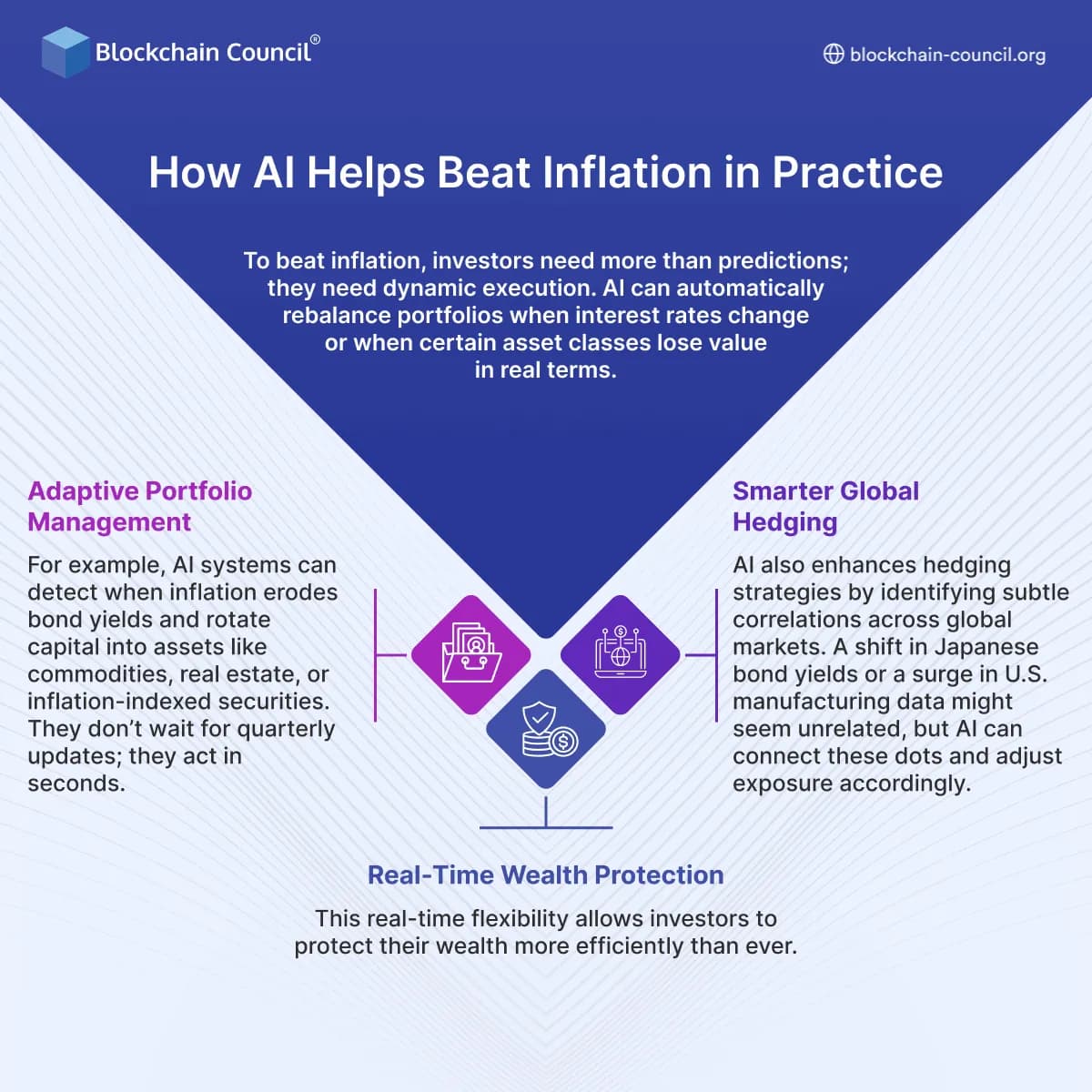
To beat inflation, investors need more than predictions; they need dynamic execution. AI can automatically rebalance portfolios when interest rates change or when certain asset classes lose value in real terms.
For example, AI systems can detect when inflation erodes bond yields and rotate capital into assets like commodities, real estate, or inflation-indexed securities. They don’t wait for quarterly updates — they act in seconds.
AI also enhances hedging strategies by identifying subtle correlations across global markets. A shift in Japanese bond yields or a surge in U.S. manufacturing data might seem unrelated, but AI can connect these dots and adjust exposure accordingly. This real-time flexibility allows investors to protect their wealth more efficiently than ever.
How Businesses Use AI to Fight Inflation
Inflation doesn’t just affect investors; it reshapes business operations. Companies use AI to cut costs, automate workflows, and optimise pricing in real time. Retailers, for example, deploy AI systems that monitor competitor prices, input costs, and customer demand, then adjust prices daily to protect margins.
Manufacturers rely on predictive analytics to forecast supply-chain bottlenecks and secure raw materials early. Logistics firms use AI to reduce fuel consumption and route inefficiencies. The cumulative effect is powerful: AI helps businesses offset inflation’s impact by improving productivity faster than costs can rise.
This is the new productivity revolution — and it’s not limited to big corporations. Small firms, too, can use AI tools embedded in cloud platforms to manage expenses intelligently.
The Role of AI Investors and Educated Professionals
AI’s impact on inflation-driven markets isn’t automatic. It depends on skilled professionals who understand how to deploy it strategically. This is where certifications like the AI Powered Investor Program come in. They teach individuals how to use AI insights for smarter asset allocation, risk management, and inflation hedging.
When trained properly, investors can use AI not just as a data source but as a co-pilot. AI highlights hidden trends, tests strategies under simulated inflationary conditions, and even generates new portfolio ideas that humans might overlook.
How AI Impacts Central Banks and Policy Makers
Central banks are also turning to AI to refine their understanding of inflation. Instead of relying on outdated indicators, they’re using machine learning to measure consumer sentiment, price stickiness, and credit conditions in real time.
By integrating AI into their forecasting models, policymakers can respond faster to inflation shocks. They can test the impact of rate hikes or stimulus programs before implementing them. AI acts as an early-warning system, signalling when inflation is likely to overshoot or subside.
Over time, this could make monetary policy more precise and less reactive. That’s crucial in economies where even small delays can turn manageable inflation into a full-blown crisis.
Why AI Offers Hope in Inflationary Times
Inflation has always been one of the toughest economic enemies — unpredictable, complex, and psychologically draining. But for the first time, we have tools powerful enough to model its every move. AI turns economic chaos into structured insight.
By understanding patterns in how inflation affects production, wages, and consumption, AI helps investors, companies, and governments adapt before damage spreads. It gives decision-makers the one thing inflation takes away: control.
How AI Compresses Costs and Improves Margins During Inflation
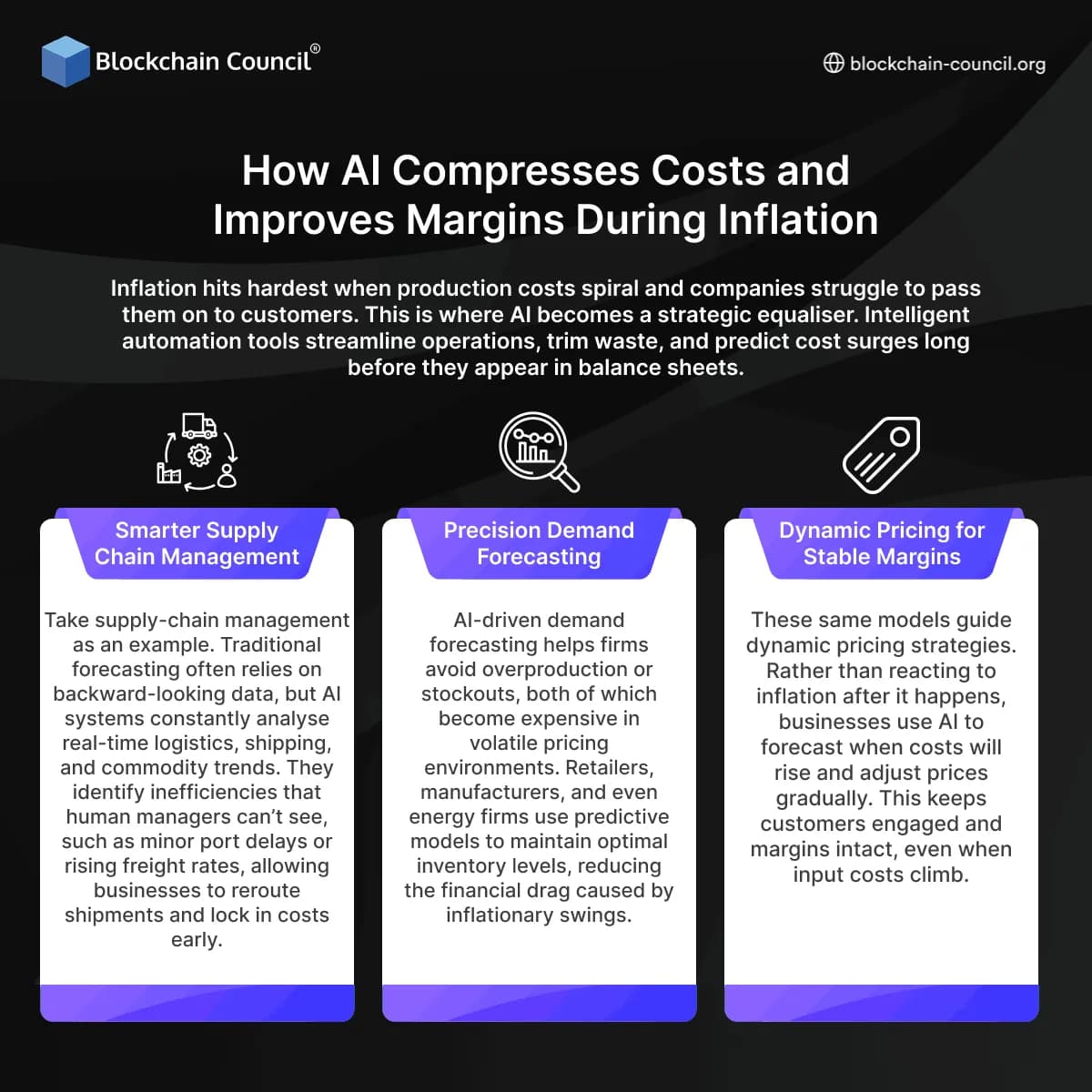
Inflation hits hardest when production costs spiral and companies struggle to pass them on to customers. This is where AI becomes a strategic equaliser. Intelligent automation tools streamline operations, trim waste, and predict cost surges long before they appear in balance sheets.
Take supply-chain management as an example. Traditional forecasting often relies on backward-looking data, but AI systems constantly analyse real-time logistics, shipping, and commodity trends. They identify inefficiencies that human managers can’t see — such as minor port delays or rising freight rates — allowing businesses to reroute shipments and lock in costs early.
AI-driven demand forecasting also helps firms avoid overproduction or stockouts, both of which become expensive in volatile pricing environments. Retailers, manufacturers, and even energy firms use predictive models to maintain optimal inventory levels, reducing the financial drag caused by inflationary swings.
These same models guide dynamic pricing strategies. Rather than reacting to inflation after it happens, businesses use AI to forecast when costs will rise and adjust prices gradually. This keeps customers engaged and margins intact, even when input costs climb.
How AI Redefines Labor Productivity in High-Inflation Economies
Labour costs are one of inflation’s biggest accelerators. When prices rise, workers demand higher wages to maintain purchasing power, which further increases costs. AI helps to moderate this feedback loop by boosting productivity.
Through intelligent automation, repetitive tasks in accounting, logistics, and marketing are handled by software instead of people, freeing workers for higher-value roles. This doesn’t eliminate jobs; it enhances output per employee. When productivity rises faster than wages, inflationary pressure eases.
AI also assists in workforce planning. Predictive analytics identify future skill gaps, ensuring companies train rather than overhire. Employees equipped with the right tools — including professional development through tech certifications — become more adaptable and efficient, giving firms resilience against sudden inflation spikes.
Even in service industries where automation is harder, AI streamlines scheduling, customer interactions, and performance analytics. Every saved minute becomes a defence against rising costs.
How AI Strengthens the Global Supply Chain Against Inflation
Inflation is often triggered by supply shocks — such as energy shortages or transport bottlenecks — that raise production costs worldwide. AI is now being used to predict and mitigate these disruptions.
Machine learning models analyse data from sensors, ports, and trade documents to forecast bottlenecks weeks in advance. This allows companies to diversify suppliers, shift production, or hedge logistics costs before shortages bite.
Some global firms are even using blockchain-integrated AI systems to improve traceability and procurement transparency. By combining the analytical power of AI with the immutability of blockchain, businesses gain a clear record of supplier costs and performance. For those seeking to understand such hybrid innovations, blockchain technology courses provide valuable insight into how distributed ledgers can reinforce cost efficiency and inflation resistance.
How AI Improves Monetary Policy and Market Stability
Inflation isn’t just a corporate problem; it’s a macroeconomic challenge. Central banks face constant pressure to stabilise prices without stifling growth. AI tools are helping them achieve a more delicate balance.
Machine learning algorithms now track indicators like credit expansion, spending habits, and wage trends in real time. This enables monetary policymakers to adjust interest rates or liquidity injections with greater precision. Instead of reacting to lagging statistics, they can anticipate inflationary triggers before they spread.
For example, AI-driven forecasting models have already demonstrated superior accuracy compared to traditional econometric tools. This accuracy can prevent overcorrections — such as raising rates too aggressively — which often deepen recessions.
By adopting these intelligent systems, policymakers can maintain both growth and stability, which benefits investors, businesses, and consumers alike.
How Investors Use AI to Protect Portfolios in Inflationary Periods
When inflation erodes the value of cash and bonds, investors must pivot quickly to assets that preserve purchasing power. AI helps manage that pivot automatically.
Through natural language processing and quantitative modelling, AI platforms scan thousands of financial reports and macro indicators to identify sectors likely to outperform under inflationary conditions. Commodities, infrastructure, and certain equities typically fare better, and AI can reallocate capital toward them in near real time.
This approach is now central to the AI Powered Investor Program, which teaches how machine learning can interpret inflation data and guide investment timing.
AI also monitors inflation-sensitive variables like yield spreads and central bank speeches. When policymakers signal potential rate hikes, algorithms automatically rebalance portfolios into inflation hedges such as TIPS (Treasury Inflation-Protected Securities) or gold-backed ETFs.
How Companies and Hedge Funds Use AI to Anticipate Inflation Waves
The most advanced hedge funds use AI to forecast inflation indirectly — by observing microscopic movements across the global economy. These models study consumer sentiment, freight patterns, wage data, and even electricity consumption to identify the early stages of an inflation surge.
When a model detects these signals, it doesn’t just alert traders; it simulates various market reactions. This enables funds to test different strategies in a virtual environment before committing capital. It’s like having a crystal ball backed by math.
Some firms combine this predictive capability with the techniques taught in the AI Powered Trading Program, creating end-to-end systems that both forecast and execute trades autonomously. The result is precision timing — entering and exiting markets ahead of inflation-driven volatility.
How Data Science Empowers Inflation Strategy Development
AI relies on clean, diverse data to deliver accurate forecasts. Data scientists play a vital role in preparing and managing these datasets, ensuring models interpret inflation signals correctly.
Professionals with a Data Science Certification learn how to structure time-series data, identify anomalies, and build regression models that detect early inflation cues. This expertise helps financial firms integrate AI tools with confidence, knowing their predictions rest on sound data foundations.
Moreover, data science teams can fine-tune AI models to reduce bias and improve interpretability — two critical factors when algorithms are used to make billion-dollar decisions.
How Agentic AI Systems Could Transform Inflation Management
The next leap in inflation control could come from agentic systems — AI agents that act autonomously, analyse data collaboratively, and learn continuously. Instead of one large model handling everything, these systems distribute tasks among specialised agents: one monitors supply chains, another tracks commodities, and a third forecasts interest rates.
Together, they form a decision-making network that’s faster and more accurate than traditional macroeconomic systems. The Agentic AI Certification explores this multi-agent structure and how it’s transforming economic modelling, policy design, and risk forecasting.
For investors and policymakers alike, this could mark a turning point — from reactive to predictive inflation management.
Why Human Insight Still Matters in an AI-Driven Inflation Battle
AI can model inflation faster than humans, but it doesn’t understand human emotion — the fear, optimism, or irrationality that drives markets. That’s why the future belongs to professionals who can merge machine intelligence with human judgment.
The best results come from collaboration. Analysts interpret AI outputs, cross-check forecasts against real-world behaviour, and bring empathy to financial decision-making. This synergy prevents overreliance on automation and ensures that economic policies remain aligned with human needs.
Understanding both the technical and behavioural dimensions of finance is where education becomes critical. Courses like the Marketing and Business Certification help professionals translate AI insights into practical business strategies that sustain performance even when prices soar.
How AI Creates New Growth Pathways in Inflationary Economies
When inflation dominates headlines, growth often slows because both businesses and consumers lose confidence. Yet AI may offer a counterbalance — a way to generate efficiency-led growth that offsets price pressures. By improving how economies produce, distribute, and consume resources, AI helps nations expand output even when money is tight.
This growth comes from three main levers. First, automation reduces the cost of labour-intensive processes, letting firms maintain production without raising prices. Second, AI-driven logistics and supply-chain optimisation cut waste and inefficiency — two of inflation’s main fuel sources. Third, AI improves capital allocation by analysing market data faster than any analyst team could, ensuring funds move to the most productive sectors.
For emerging economies especially, this combination of productivity and precision could become a stabilising force. Countries adopting AI across agriculture, energy, and manufacturing could experience growth that outpaces inflation, reducing the long-term risk of currency devaluation.
How AI Encourages Smarter Monetary Ecosystems
Beyond individual companies, AI can influence how entire monetary systems function. Central banks and financial institutions are starting to use predictive AI to simulate potential outcomes of different policy paths. These simulations test how small interest rate changes ripple through credit markets, consumer spending, and trade flows.
In practical terms, this means policies can be designed proactively rather than reactively. For instance, AI models may indicate that a mild policy tightening today could prevent a future inflation surge, saving economies from harsh rate hikes later.
Such forecasting capability not only stabilises currencies but also improves global investor confidence. AI thus becomes part of the infrastructure of modern finance, serving as a decision-support layer for monetary authorities.
How AI Enables Smarter Consumer Economies
Consumers are the backbone of every market, and inflation erodes their purchasing power quickly. AI, however, can help households make smarter spending decisions.
Recommendation engines powered by AI can analyse price patterns, track promotions, and advise consumers when to buy essentials at optimal times. On a broader level, governments can use anonymised consumer data to design targeted subsidies, ensuring that assistance reaches those who need it most.
In some nations, pilot programs already use AI-driven budget platforms to help citizens manage living costs, balance loans, and plan savings. These tools offer microeconomic stability that, at scale, strengthens entire economies against inflationary stress.
How Businesses Can Leverage AI for Long-Term Inflation Resistance
AI doesn’t only respond to inflation; it builds resilience against it. Businesses that invest in AI early create an enduring advantage by embedding intelligence into their operations.
A company using AI to optimise procurement or logistics doesn’t just save money now — it creates a feedback loop of efficiency. Each cycle of automation feeds new data into the system, improving predictions and tightening cost control. Over time, this compounds into a structural edge that protects the company from inflation shocks.
Education plays a large role in maintaining this advantage. Teams trained through programs like the AI Certification or AI Powered Trading Program can integrate these tools effectively into corporate workflows. This ensures that AI adoption doesn’t stay theoretical but delivers tangible financial outcomes.
How Cross-Sector Collaboration Multiplies AI’s Impact
Inflation is a global issue, so no single company or government can manage it alone. Collaboration between sectors — private, public, and academic — accelerates AI’s stabilising effect.
For instance, energy companies, logistics networks, and governments can share anonymised datasets to create more accurate inflation forecasts. Universities and think tanks can feed policy research into these models, helping central banks anticipate future market behaviour.
This shared-intelligence model represents a new kind of global economic cooperation — one that relies on data rather than political agreements. It’s also where professionals who hold cross-disciplinary qualifications, such as tech certifications, find their greatest value. Their understanding of both economic systems and data technologies allows them to bridge these ecosystems.
How AI Shapes Investment Strategies Beyond Inflation
AI doesn’t just protect wealth; it also helps it grow in unexpected places. Inflationary periods often lead to mispriced assets — areas where human analysts see only risk, but AI detects opportunity.
By analysing signals across commodities, equities, and currencies, AI uncovers undervalued sectors poised for rebound once inflation stabilises. These insights are particularly valuable for professionals pursuing the AI Powered Investor Program, which focuses on using data-driven intelligence to identify resilient investment vehicles in volatile markets.
AI is also expanding into environmental and social investing. Models can evaluate sustainability metrics alongside financial data, aligning returns with responsible growth — an increasingly attractive proposition for inflation-era investors seeking both profit and purpose.
How AI and Blockchain Combine to Build Inflation-Resistant Financial Systems
Blockchain’s transparency and AI’s analytical power form a natural partnership against inflation. When combined, they can track asset flows, validate data integrity, and enforce smart contracts that react to real-time market changes.
For example, AI can monitor blockchain networks to detect sudden increases in commodity or currency transactions that may signal inflationary pressure. Automated triggers can then adjust collateral ratios, lending rates, or token supplies — stabilising digital financial ecosystems instantly.
Those exploring this intersection benefit from blockchain technology courses, which explain how decentralised ledgers enhance accountability and price discovery — two essential factors in inflation control.
How AI Shapes the Future of Economic Policy and Governance
The long-term goal isn’t just to survive inflation but to build intelligent economies that adapt automatically. Imagine national budgets that self-adjust based on economic forecasts, or tax systems that tweak deductions dynamically to maintain purchasing power.
Governments are already experimenting with early versions of such systems. AI-driven fiscal dashboards can project revenue and spending under various inflation paths, allowing for proactive adjustments. This could usher in a new era of responsive governance where policies evolve as fast as markets do.
However, this shift also demands rigorous oversight. Policymakers need to understand the limits of automation — an area covered in leadership programs like the Marketing and Business Certification, which emphasises ethical decision-making and strategic accountability in tech-enabled economies.
How Agentic AI Could Redefine Inflation Control Altogether
Looking ahead, agentic systems could make real-time inflation management possible. Multiple AI agents could monitor global trade, energy prices, and central bank actions simultaneously, feeding insights into a unified decision platform.
These agents would collaborate — not compete — learning from each other’s findings. Such self-organising networks could react instantly to inflation shocks, balancing markets faster than any human-led institution ever could.
This emerging architecture is explored in the Agentic AI Certification, which delves into how distributed AI systems can coordinate complex financial environments autonomously while remaining accountable to human oversight.
The Path Ahead: Stability Through Intelligence
Inflation will always be part of the economic cycle, but how societies manage it is changing fundamentally. AI is turning economic instability into an opportunity for smarter systems, sustainable policies, and data-driven investments.
The next era of finance will belong to those who can blend technology with economic understanding. By mastering tools like AI and blockchain, professionals won’t just shield themselves from inflation — they’ll help design a more resilient financial world.
Related Articles
View All
AI & ML
How GPT-Live Could Transform Real-Time AI Conversations for ChatGPT Users Worldwide
GPT-Live could turn ChatGPT Voice into a full-duplex real-time AI conversation layer for learning, work, enterprise tools, and multimodal support.

AI & ML
GLM 5.2 Explained: Key Features, Architecture, and AI Use Cases
GLM 5.2 explained with its MoE architecture, 1M-token context, sparse attention, coding strengths, AI agents, and enterprise use cases.

AI & ML
Prompt Engineering vs Loop Engineering vs Context Engineering: Key Differences for AI Developers
Learn how prompt engineering, context engineering, and loop engineering differ, where each fits, and why production AI needs all three layers.
Trending Articles
AWS Career Roadmap
A step-by-step guide to building a successful career in Amazon Web Services cloud computing.
How Blockchain Secures AI Data
Understand how blockchain technology is being applied to protect the integrity and security of AI training data.
What is AWS? A Beginner's Guide to Cloud Computing
Everything you need to know about Amazon Web Services, cloud computing fundamentals, and career opportunities.