

AI and the Ethics of Surveillance
 Michael Willson
What Is AI Surveillance?
AI surveillance is the use of artificial intelligence systems to monitor, track, and analyze people’s actions. It often relies on facial recognition, video analytics, and predictive algorithms. Governments, companies, and even schools are adopting these systems to watch crowds, identify threats, or monitor employees. The idea is simple: machines can process far more information than humans and spot patterns in real time. But the impact on privacy, freedom, and fairness raises serious questions.
Anyone who wants to understand how these systems are designed and deployed can consider an AI certification. Such training helps explain how algorithms learn from data, and why ethical debates are so closely tied to technical design.

AI and the Ethics of Surveillance
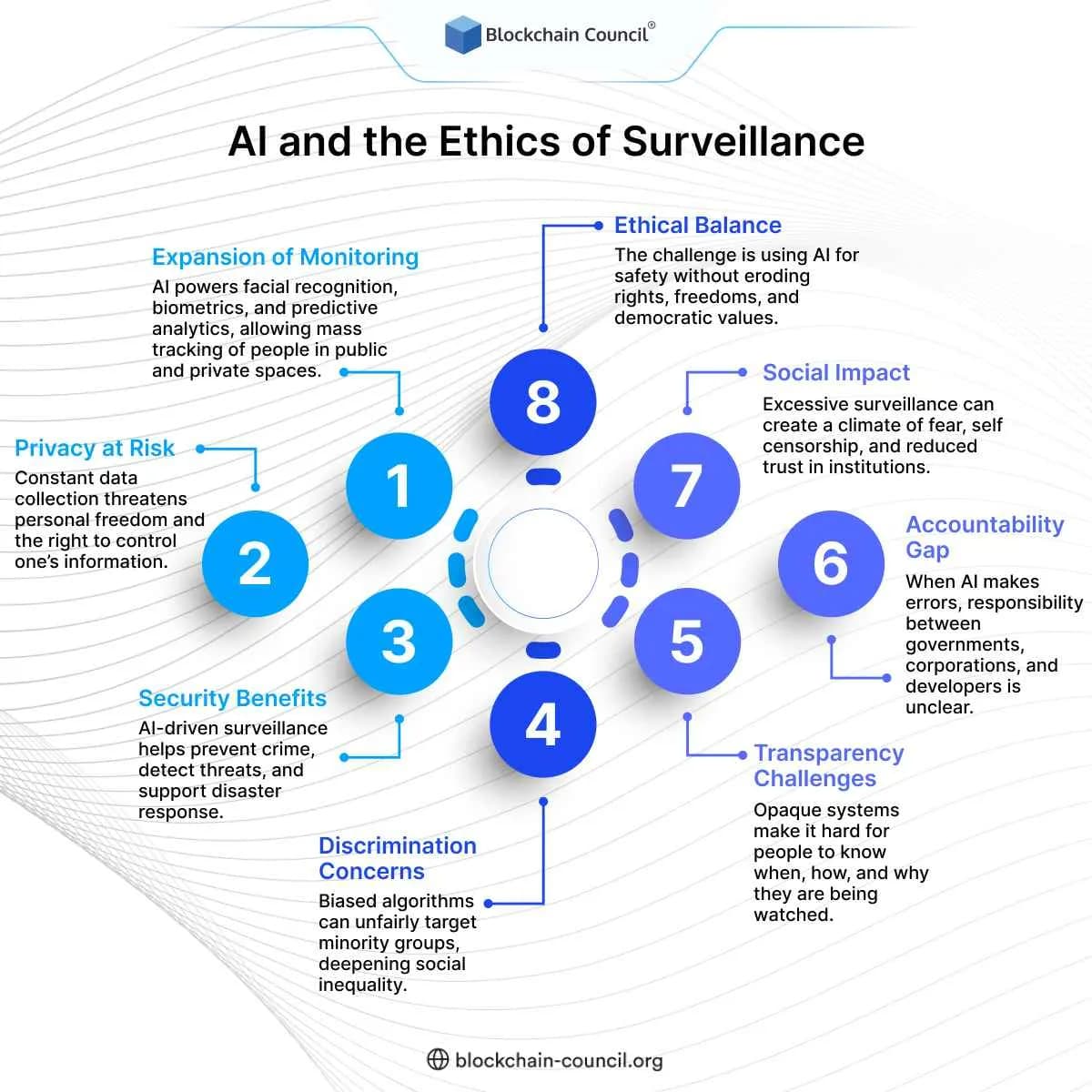
- Expansion of Monitoring
AI powers facial recognition, biometrics, and predictive analytics, allowing mass tracking of people in public and private spaces. - Privacy at Risk
Constant data collection threatens personal freedom and the right to control one’s information. - Security Benefits
AI-driven surveillance helps prevent crime, detect threats, and support disaster response. - Discrimination Concerns
Biased algorithms can unfairly target minority groups, deepening social inequality. - Transparency Challenges
Opaque systems make it hard for people to know when, how, and why they are being watched. - Accountability Gap
When AI makes errors, responsibility between governments, corporations, and developers is unclear. - Social Impact
Excessive surveillance can create a climate of fear, self-censorship, and reduced trust in institutions. - Ethical Balance
The challenge is using AI for safety without eroding rights, freedoms, and democratic values.
Why Is AI Surveillance Expanding So Quickly?
AI surveillance is spreading because the technology has become cheaper and more powerful. Cameras are everywhere. Cloud computing and stronger processors make it possible to analyze footage instantly. At the same time, security concerns, from terrorism to retail theft, have given governments and companies a reason to invest in such tools.
Research on the “surveillance pipeline” shows how academic work on computer vision often gets repurposed into commercial and military surveillance. Patent filings reveal that ideas tested in labs quickly end up in products that monitor streets, stores, and workplaces. Once deployed, these systems rarely shrink in scope. They often expand.
What Ethical Concerns Come With AI Surveillance?
The first concern is privacy. AI surveillance creates the feeling that you are always being watched. People may start to self-censor or change their behavior, a chilling effect that undermines freedom. Unlike traditional cameras, AI systems do not just record. They analyze. They draw conclusions about who you are, where you go, and even what you might do next.
Bias is another problem. Facial recognition systems are known to misidentify women and people of color at higher rates. This is not an accident. It reflects the data used to train them. When errors happen in a retail store, the result may be embarrassment. When errors happen in policing, the result may be wrongful arrests.
Consent is also missing in many cases. People often do not know that they are under AI surveillance. They cannot opt out. Their autonomy is reduced when machines make predictions or decisions about them without human oversight.
Accountability is equally unclear. If an algorithm misidentifies someone, who is responsible? The company that built it? The agency that deployed it? Or the operator who trusted its results? Because many systems work like black boxes, even understanding how a mistake happened can be hard.
Finally, there is misuse. Tools designed to protect safety can be repurposed for political control. Scope creep is common. A system installed for traffic management could later be used to track activists. The more powerful the system, the bigger the temptation to use it in ways never originally intended.
What Are Some Real Examples of AI Surveillance?
Clearview AI is one of the most widely known cases. The company scraped billions of images from social media and built a massive facial recognition database. Law enforcement agencies used it to identify suspects. But regulators in Europe fined Clearview for violating privacy laws, and activists accused the company of enabling mass surveillance.
Amazon has deployed driver monitoring systems that use AI cameras inside delivery vans. The technology tracks eye movement, head position, and even yawning. If the driver looks distracted, the system flags it. While the company argues this improves safety, drivers report stress and say they feel constantly judged by a machine.
Kuwait has rolled out AI-powered patrol cars. These vehicles are equipped with cameras and analytics to monitor city streets. Officials claim they will improve security. Critics worry they could also be used to watch citizens in ways that bypass legal safeguards.
The Paris Olympics introduced algorithmic surveillance on a massive scale. Almost five hundred cameras with AI software monitored crowds for unattended bags and other “anomalies.” The rollout raised questions because legal authorizations came after the systems were already in use. Transparency was lacking, and civil rights groups questioned whether this model would become permanent.
There are also examples of pushback. Austin, Texas canceled a project to install AI surveillance cameras after residents raised privacy concerns. In Queensland, Australia, traffic enforcement cameras powered by AI were scrutinized for failing to meet privacy standards. These cases show that public opinion and oversight still matter.
What Are the Legal and Ethical Frameworks Around AI Surveillance?
Several global bodies have stepped in. UNESCO has issued a recommendation on AI ethics that highlights human dignity, fairness, and oversight. The framework pushes for systems that are transparent and accountable.
The European Union passed the Artificial intelligence Act in 2024. It sets rules for high-risk systems, including many forms of surveillance. Some practices are outright banned, such as social scoring or emotional recognition in workplaces. The European Commission has also warned against biometric predictive policing.
In the United States, the Intelligence Community has its own AI ethics framework. It provides guidelines on how intelligence agencies should design, purchase, and use AI systems. While critics argue the rules are vague, they at least show an attempt to balance national security with civil liberties.
Companies are also beginning to react. Google updated its AI ethics guidelines, removing its earlier ban on surveillance and weapons projects. This sparked debate about whether companies should self-police or whether stronger laws are needed.
These frameworks all share common principles: transparency, fairness, accountability, and privacy by design. They recommend collecting only what is necessary, keeping humans in the loop, and ensuring explainability of decisions.
How Does Bias Affect AI Surveillance?
Bias in AI surveillance comes from the data that trains the systems. If most of the images or video used are of one demographic, the system becomes less accurate for others. Facial recognition, for example, often performs well on white male faces but struggles with women or people of color. This can lead to unfair treatment in public spaces, workplaces, or law enforcement.
Real-world consequences are serious. Several cases in the United States showed people wrongly arrested because facial recognition matched them incorrectly. Once flagged, it is difficult to prove innocence because humans often trust the machine. The result is discrimination reinforced by software.
This is not only about accuracy. Even if systems were technically perfect, their use could still be unfair if targeted at specific groups. Communities that are already heavily policed often face even more surveillance when AI tools are deployed. This deepens inequality instead of solving it. Understanding these patterns is part of what learners gain in a Data Science Certification, where they study how datasets shape algorithmic behavior.
What Are Some Recent Cases of Misuse?
Misuse often begins with good intentions. For example, surveillance tools introduced for security at events are later kept for everyday monitoring. This is called scope creep. The Paris Olympics example showed how quickly such tools can become normalized once installed.
In corporate settings, misuse also appears. Amazon’s driver monitoring system was intended to promote safety. Instead, it created a culture of constant oversight where drivers reported stress and loss of dignity. The line between safety and exploitation becomes blurry.
Internationally, the risks can be even higher. Microsoft recently restricted its cloud services after learning they were being used for mass surveillance of civilians in conflict zones. This shows that even when companies sell tools for one purpose, they cannot always control how they are used later.
These examples underline the need for strong ethical design and enforceable safeguards. Without them, AI surveillance can easily cross into misuse.
Why Is Public Trust Declining in AI Surveillance?
Public trust in AI surveillance is falling because people see the risks more clearly than the benefits. Surveys show that social media, AI, and surveillance are among the least trusted industries. Citizens worry that their data is collected without permission and stored without clear limits.
Cities like Austin have already canceled AI camera projects after public pressure. Residents said the privacy risks outweighed potential safety gains. In Australia, AI traffic cameras faced scrutiny because privacy assessments were weak or missing. These cases prove that people want more control over when and how surveillance is used.
For organizations and policymakers, regaining trust means being transparent. Systems need clear explanations, proper legal approval, and easy ways for citizens to know when they are being watched. Trust grows only when people feel they are part of the decision.
The Ethics of AI Surveillance
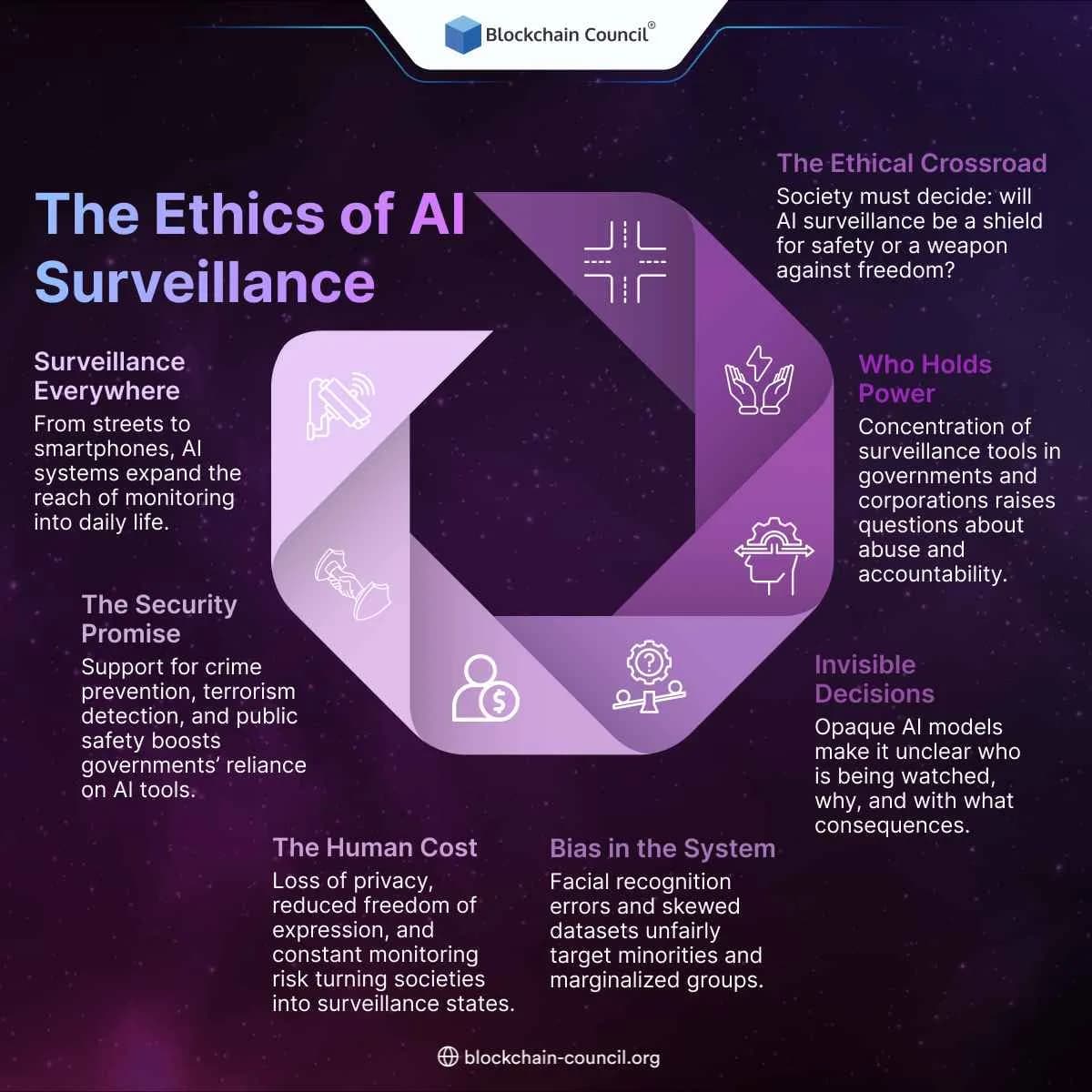
Surveillance Everywhere
From streets to smartphones, AI systems expand the reach of monitoring into daily life.
The Security Promise
Support for crime prevention, terrorism detection, and public safety boosts governments’ reliance on AI tools.
The Human Cost
Loss of privacy, reduced freedom of expression, and constant monitoring risk turning societies into surveillance states.
Bias in the System
Facial recognition errors and skewed datasets unfairly target minorities and marginalized groups.
Invisible Decisions
Opaque AI models make it unclear who is being watched, why, and with what consequences.
Who Holds Power
Concentration of surveillance tools in governments and corporations raises questions about abuse and accountability.
The Ethical Crossroad
Society must decide: will AI surveillance be a shield for safety or a weapon against freedom?
How Can Ethical AI Surveillance Be Designed?
Ethical design starts with principles. Privacy by design means collecting only what is needed and protecting it with encryption. Transparency means explaining how the system works in plain language. Accountability means identifying who is responsible when errors happen.
Independent audits and oversight bodies can check whether systems follow these principles. Data should have retention limits, so information is deleted once no longer needed. Systems should also include human review, ensuring machines do not make decisions alone.
Developers and policymakers are exploring training that teaches how to design responsible systems. Programs like Agentic AI Certification train professionals to think about AI systems not only as tools but as agents whose impact on people must be measured.
What Role Does Technology Play in Surveillance Growth?
The growth of AI surveillance is linked to broader advances in technology. Cheap sensors, better cloud computing, and stronger machine learning models make surveillance easier to deploy. Drones, patrol cars, and even body-worn cameras now use AI to process data in real time.
These advances are not inherently negative. The same technologies that power surveillance also power healthcare, education, and environmental protection. What matters is context and governance. Without rules, the most powerful tools can be used in harmful ways.
Communities are experimenting with ways to use new tech certifications to give professionals the skills to balance innovation with ethics. This is where technical training meets social responsibility.
How Can Blockchain Help in AI Surveillance Ethics?
Blockchain can provide transparency in surveillance by recording when and how data is used. This makes it harder for agencies to secretly expand surveillance without oversight. Audit trails stored on secure, decentralized systems could show whether rules were followed.
Courses in blockchain technology courses explore how distributed ledgers can increase accountability. For example, facial recognition data could be logged on a blockchain to ensure only authorized use. While blockchain will not solve every issue, it can help enforce ethical boundaries.
What Is the Role of Business and Marketing in AI Surveillance?
Companies often drive surveillance adoption. Retailers install AI cameras to track customer behavior. Employers use AI monitoring to check productivity. Marketing teams argue that these tools improve efficiency or safety.
But businesses must also consider reputation. Customers are more aware of privacy than ever. Overuse of surveillance can lead to backlash, protests, or even boycotts. Balancing business goals with ethics is now a leadership challenge.
Executives exploring career growth in this area often look at programs like Marketing and Business Certification. These programs show how to connect technical tools with business strategies while respecting legal and ethical boundaries.
What Global Regulations Govern AI Surveillance?
AI surveillance is now a global issue, and different regions are responding with their own rules. UNESCO has created a recommendation on AI ethics. This framework emphasizes fairness, transparency, and human dignity. It calls for human oversight in all high-risk systems. For countries that do not yet have their own AI laws, the UNESCO framework provides a foundation.
The European Union has taken stronger steps with the AI Act. Effective from August 2024, this law places strict limits on high-risk AI systems. It bans some practices entirely, such as social scoring and emotional recognition in workplaces. The EU also restricts predictive policing and requires clear safeguards for biometric monitoring. This makes Europe one of the most tightly regulated regions for AI surveillance.
In the United States, the Intelligence Community has published an AI ethics framework. It provides guidelines for agencies that use AI in security and intelligence work. The document promotes principles like accountability and proportionality. However, critics say it leaves much room for interpretation and does not apply to private companies.
These global regulations show a pattern. Policymakers are trying to catch up with the speed of AI deployment. While some frameworks are strong, others are still evolving. What matters is whether these rules are enforced in practice. Ethical debates increasingly point to the need for training like a Prompt Engineering Course to ensure AI is applied responsibly.
How Can Communities Participate in AI Surveillance Decisions?
One of the biggest criticisms of AI surveillance is that people rarely get a say in how it is used. Systems are often deployed without public consultation. Yet community involvement is essential to ensure ethical outcomes.
Communities can demand impact assessments before systems are installed. These reports explain how surveillance will affect privacy, fairness, and security. Independent audits can then check whether the technology is being used as promised. Public hearings and citizen committees can give residents a voice in the process.
There are examples of this happening. In some U.S. cities, councils now require approval before police departments purchase AI surveillance tools. In Europe, data protection agencies regularly investigate and fine companies that misuse surveillance data. These steps do not remove all risks, but they increase accountability.
Community involvement also ensures cultural sensitivity. Surveillance may feel different in a small Indigenous community than in a large city. By involving local voices, governments can avoid a one-size-fits-all approach.
What Safeguards Can Prevent Misuse of AI Surveillance?
Strong safeguards are needed to stop misuse. One safeguard is transparency. People must know where surveillance is happening and what it monitors. Clear signage and public disclosures help build trust.
Another safeguard is minimization. Systems should collect only the data they need and nothing more. Retention limits ensure that information is deleted once it is no longer useful.
Technical safeguards are equally important. Encryption protects data in transit. Differential privacy hides individual details while still allowing statistical analysis. Role-based access limits who can view sensitive information.
Legal safeguards create boundaries for how AI surveillance can be used. Independent courts and regulators must enforce these boundaries. Without enforcement, principles remain only on paper.
Finally, safeguards must include human oversight. No AI system should make final decisions without a human checking the result. This prevents errors and provides accountability.
What Is the Future of AI Surveillance?
The future of AI surveillance will be shaped by both technology and public demand. On the technology side, systems are becoming more advanced. Cameras can now detect emotions, identify objects, and even predict behavior. Drones and patrol vehicles equipped with AI are spreading. The capacity to monitor entire cities in real time is no longer science fiction.
On the public side, resistance is also growing. Citizens are more aware of their rights and more willing to push back. The rejection of surveillance projects in Austin and the scrutiny of systems in Queensland show that people want stronger limits. Public trust will become a deciding factor in whether AI surveillance continues to expand or faces restrictions.
International cooperation will also play a role. As data flows across borders, one country’s rules may not be enough. Global agreements on surveillance standards may become necessary, much like climate agreements or trade deals.
The balance will depend on how societies answer one key question: how much surveillance is too much?
What Is the Balance Between Safety and Freedom?
Supporters of AI surveillance often argue that it makes society safer. Detecting unattended bags at a stadium or identifying reckless drivers on the road can prevent harm. For governments, the ability to respond quickly to threats is attractive.
But safety must be balanced with freedom. If surveillance goes too far, it can create a society where people feel constantly watched. Freedom of expression and political dissent can suffer. The challenge is to find a balance where technology protects people without controlling them.
Examples show that balance is possible. Cities that include community feedback, set strict data limits, and provide independent oversight can use surveillance more responsibly. What matters is not only the tool itself but how it is governed.
Conclusion: Why Ethics Matter in AI Surveillance
AI surveillance is no longer a future concept. It is here, shaping how societies operate. From facial recognition in public spaces to algorithmic monitoring in workplaces, these systems touch everyday life. The ethical issues are clear. Privacy, bias, consent, accountability, and misuse must all be addressed.
Regulations like the EU AI Act and frameworks from UNESCO show that governments are starting to take these issues seriously. Companies are also beginning to react, though sometimes too late. Communities are finding their voices, pushing back when surveillance threatens freedom.
The path forward requires balance. AI can support safety, efficiency, and even fairness when used well. But it can also undermine rights and trust if misused. The solution lies in ethical design, strong safeguards, and meaningful participation from the people most affected.
AI will continue to grow. The question is whether it will grow responsibly. By focusing on ethics now, societies can make sure surveillance protects rather than controls.
Related Articles
View All
AI & ML
Open Dots vs Grok Bot vs Muse
Compare OpenAI Dots, Grok Bot, and Meta Muse to understand how these always-on AI agents differ in persistent work, computer use, connected apps, automation, and personal or business workflows.

AI & ML
What Is OpenAI Dots?
Learn what OpenAI Dots are, how these always-on AI agents work, and how they use GPT-6 Astra, cloud computers, connected apps, and persistent context to handle ongoing tasks.

AI & ML
OpenAI Launches GPT 6.1-Sol
OpenAI launches GPT-6.1 Sol, a new reasoning model offering near-Astra performance at lower cost for complex coding, computer use, agentic workflows, and professional tasks.
Trending Articles

Top 5 DeFi Platforms
Explore the leading decentralized finance platforms and what makes each one unique in the evolving DeFi landscape.
How Blockchain Secures AI Data
Understand how blockchain technology is being applied to protect the integrity and security of AI training data.
Claude AI Tools for Productivity
Discover Claude AI tools for productivity to streamline tasks, manage workflows, and improve efficiency.